


|
|
|
 Tuesday, August 31, 2004
Intolerance of tolerance
(Reflections on the great Republican abyss that dare not speak its name....) I guess I'm feeling a little like a flak for the Republican Party. I don't particularly enjoy that feeling. I don't like being a flak for anybody. Yes, we're in a war that's important.Terribly important. And, yes, I think John Kerry is a straw man who should not lead us in such a situation. But there's nothing that makes me more angry than masked or unmasked homophobia. It's deeply reactionary and immoral.So said Roger L. Simon, who's officially blogging the convention. God, I admire Roger as never before. That's real integrity. (And pretty much how I would feel had I been put in Roger's position.) As Glenn Reynolds has made abundantly clear many times, this issue simply will not go away. Parenthetically, I am writing this while listening to Arnold Schwarzenegger. Saw some smug faces in the crowd, with forced half-smiles, applauding less than enthusiastically, and whole sections not applauding. Arnold just put in a good word for the unfairly demonized Nixon, too, and that took courage. A great speech delivered before a crowd containing more than a few too many clueless ingrates. (Well, they're only the ostensible audience; the real audience is at home watching.) What I want to know is why the Republican Party has to be held hostage not so much to people who are against same sex marriage, but to people who truly believe that homosexuals are the greatest threat to Western Civilization. That a man should be judged not by the content of his character, but by where he puts his penis. There are two utterly incompatible views towards homosexuality in the Republican Party; tolerance versus intolerance. Those who are tolerant of homosexuals, when they must face their intolerant counterparts, find themselves in a position analogous to old fashioned liberals who feel intimidated by far left Marxists. It is because of moral authority -- real or perceived. It is thought by ideologues that the stauncher one's position on a given thing, the "purer" one is. Thus, Marxists are the purest of the left, and moral conservatives are the purest of the right. (At least, so they think.) Being a moral conservative lends itself, almost by definition, to moral authority. I saw people praying instead of applauding while Arnold spoke. Praying! Now, I have nothing against praying, and I defend passionately their right to pray. But isn't there an appropriate time and place for it? No; for those who imagine that their precious intolerance is threatened, they must pray constantly. Such people think mere tolerance for homosexuals equals "persecution." (Of their intolerance!) I am so damned disgusted right now that even Arnold's speech, great though it was, did little to cheer me that things will ever change. Fanaticism does not change. Maybe I'll feel better in the morning. UPDATE: Interestingly, Roger L. Simon noticed similar anti-Arnold behavior last night by a leading moral conservative: He had a scowl on his face. As we know, Schwarzenegger does not represent Buchanan's Republican Party. Nothing seems to make Pat happy these days. As Arnold began to lead the chant of "four more years," Buchanan spun on his heels as if repelled and stalked off, heading for the nearest microphone.I'm the last person to try to stifle dissent, but isn't four more years supposed to be their goal? If they can't unite on that, then no tent is big enough.... posted by Eric at 09:30 PM | Comments (12)
| TrackBacks (0)
The revolution will not be radicalized!
Those protesting under the banner of anarchism show no real resemblance to the historical phenomenon of philosophical anarchism and at best may be compared to the syndicalists (who would transfer authority to labor unions), the offshoots who fueled early communism (who would transfer authority to the intellectual elite), or Mussolini's several Fasci which need little explanation. None removes authority, but simply aims to replace it, thus none is truly anarchistic in the way each pretends to be. The current refrain is that they oppose the 'police state', but as my friend noted the other day, 'when you remove the police and someone takes your shit, what do you do? Form a posse and become the new police?' Save me the line about property as theft. I've read Proudhon. My friend's argument holds no matter the crime. Let's say your child is murdered. Still: do you form a posse and become the new police? Notions of justifiable violence were as alien to the Haymarket martyrs as to Emma Goldman, but the self-described anarchists of today marry Bakuninite thuggery with any ideology which opposes liberalism. Philosophical anarchism is thoughtful enough to see that authority, i.e. government, is a necessary evil, and that the spirit of anarchism is a sort of Socratic gadfly, the social conscience writ large in the voices of dissidents, but never with violence where oppression does not exist. I heard one of these mental giants on NPR recently describing their planned tactics as 'civil disobedience,' you know, the same old stuff that 'goes all the way back to Martin Luther King ... and Green Peace.' Doubtless few of their grunts know any better than their leaders that Civil Disobedience goes all the way back to Henry David Thoreau, and that the point has never been to disrupt or simply to be heard, or to be part of something. It has always been about challenging the law on the court level, and in order to do that you must be willing to break the law, and to have your day in court to challenge the law you've broken. If you oppose the use of tax dollars to fund a war (as Thoreau did), you refuse to pay the tax and then challenge it's legitimacy in the courts. If you oppose segregation, you go where you're not wanted. You don't pack smoke bombs and ball-bearings, or toss urine-filled balloons at the police. To the credit of the old anarchists (even Bakunin), they thought they'd spark a revolution that would make the world a better place, and they lived in a much bleaker time. But we've learned hard lessons since then, viz. that swift revolutions rarely last, and that socialism is a fantasy that never fails to fall, and always leaves blood in its path. posted by Dennis at 11:36 AM | Comments (2)
| TrackBacks (1)
BEWARE! "Nonviolent activists" could be up to their old dirty tricks!
Lowell Ponte asks an especially mean-spirited question: How can Senator Kerry be trusted to fight terrorism when he knowingly employs as one of his highest campaign staffers an extremist who has been trained by and facilitated the training of others for the Ruckus Society, which taught radicals ways and means to disrupt the 2000 and 2004 Republican National Conventions and has links to members of domestic terrorist groups?The staffer is one Zack Exley, Director of Online Communications and Organizing at John Kerry for President. I don't really know much about him, but he must have done good work as facilitator for the Ruckus Society or Kerry wouldn't have hired him. And I do remember the Ruckus society quite well from my days as a Berkeley Police Review Commissioner. (I also recently mentioned the exciting service they provide as a cool way of ditching a bad date.) Ruckus has come a long way since Berkeley. Today's New York Times mentions them in a piece on violence and other ugliness in New York, and there's more here documenting how they're way cool and into justifiable violence and stuff. What worries me is that from what I've seen so far, those nasty Republican activists seem be using nonviolent tactics these days. Beware! They could be trying to get the sympathy of those easily bamboozled clods in middle American flyover country. The latter are so stupid that they might get confused by images of nonviolent activists trying to exercise their constitutional rights being met with well-organized violence. This could lead them to actually feeling sorry for the Republicans! There could even be a backlash of sympathy for so-called Republican "freedom riders." Sheesh! Next they'll be reminding middle Americans about segregationist Democrats! posted by Eric at 10:28 AM
| TrackBacks (0)
Fear of content?
I have previously complained about a notorious online content filtering service called SonicWALL. This blog is blocked, as are a number of blogs on a wide variety of subjects. (What that means is that if you enter our URL on a computer "protected" by SonicWALL, you'll get an ugly black screen displaying only the message, "This site has been blocked by SonicWALL.") The blocking is quite insidious, and involves far more than protecting kids from porn. The following description is from the company website: SonicWALL Content Filtering Service categorizes Web site content into the following categories: Adult/Mature Content/Pornography, Sex Education, Intimate Apparel/Swimsuit, Nudism, Alcohol/Tobacco, Criminal Skills/Illegal Skills, Drugs/Illegal drugs, Gambling, Hate/Racism, Violence, Weapons and Cult/Occult.Um, to that they should add conservative Chicago economists! In this brave new world, there's no distinction between advocacy and discussion. And if your site shares ISP numbers with other sites (as many blogs do), then if one site is blocked, all are. Your vast national kindergarten at work, kiddies! Don't bother to complain to SonicWALL, as they will not answer. Out of curiosity, I tried to open my blog on a SonicWALL-silenced computer last night, and of course it was still blocked, as were many blogs. Not only that, but SonicWALL has no sense of humor at all. (For example, they didn't want me looking at this picture of Glenn Reynolds wearing an "I had an abortion" T-shirt! And they hate God too; even Allah himself is blocked by the blasphemous, Satanic SonicWALL!) The SonicWALL support site is very poor, and the help forum is available only to registered users. There is simply no way to contact them directly if you're blocked. (I suspect that there's an assumption that anyone who's blocked is an unclean degenerate who should be shamed out of existence.) I did find the following non-copyable statement (what's up with that? I can take a screen shot, can't I?) at their "knowledge portal":  I went to the Cyber Patrol site and entered my URL, but it didn't come up blocked, so I have no real explanation as to why Classical Values is being blocked. Must be homophobia. Or hoplophobia. posted by Eric at 07:32 AM | Comments (4)
| TrackBacks (0)
Smearing off the cuff
Eugene Volokh is outraged over Dennis Hastert's comments on FoxNews: Here in this campaign, quote, unquote, "reform," you take party power away from the party, you take the philosophical ideas away from the party, and give them to these independent groups. Volokh's response: Hastert's substantive criticisms of campaign finance may be legitimate -- but the suggestion that Soros might be getting money from illegal drug distributors, even as a hypothetical example, is pretty reprehensible. (Imagine that, say, Ted Kennedy said "I don't know where Swift Boat Veterans for Truth are getting their money, if it comes from overseas or from neo-Nazis"; I take it that we'd be pretty appalled, even if Kennedy was just giving a hypothetical example.) And while "drug groups" may be slightly ambiguous in other contexts, where it might refer to pro-drug legalization groups, in this context it pretty clearly does suggest drug criminals, partly because Hastert didn't deny the connection when Wallace raised it and partly because the pro-legalization groups are funded by Soros, not the other way around. But that's not the case at all. It was Wallace, not Hastert who used the term cartel. Hastert's phrase was drug groups, and he was careful to emphasize the point that the funding for independent groups is largely unknown. After Wallace asked whether he meant cartels, Hastert said it 'could be people who support this type of thing. I'm saying we don't know.' Was this a calculated attempt to smear or a careless answer to a question? And is it reprehensible? It seems to me too close a thing to appearance politics when a response to a question in a live interview is put under the microscope and evil machinations are imagined. If we want to begin calling such comments reprehensible we're soon ready to censure, and we reinforce the current climate in which every misstep pours outrage from all quarters and leaves only the bland and overly cautious on the stage. The fallacious analogy doesn't hold either. The Swift Boat Vets are not to Naziism as the legalization advocates are to the drug industry, and that comparison could only have been chosen for high rhetorical effect. Of course singling out George Soros was stupid, and of course Soros is right that criminalization does more harm than good. And it's clear that Hastert disagrees and sees him as a threat. But should he be roasted over this? posted by Dennis at 07:03 AM | Comments (2)
| TrackBacks (0) Monday, August 30, 2004
Sports Break
Adrian Wojnarowski has an excellent piece at ESPN.com on basketball star Allen Iverson and U.S.A. Basketball: The most telling moment of all was in the minutes after the United States' loss to Argentina in the semifinals, when the possibility for gold and glory were gone. When the coach stayed on his self-serving course of blaming USA Basketball, his players and the officials, Iverson stayed with his message in these games: It was an honor to represent his country, and his team had an immense obligation to treat the bronze medal game as though it was playing for gold. Coach Larry Brown spent six years in Philadelphia refusing to call Iverson by name. He was always 'the little kid,' and Brown, famous for breaking young players (like Jalen Rose in Indiana and Larry Hughes in Philadelphia), never missed an opportunity to blame his star. Many point to Iverson's history of missed practices under Brown, but he was the only projected star ever to develop under Brown (Brown's history is in taking other men's teams and making them better by emphasizing fundamentals, never in developing individual talent of his own, and there's a litany of soured relationships on his resume), and I would argue that Iverson's unwillingness to be broken by Brown has meant more than Brown's tutelage. And people always ignore Brown's bizarre double-standards, that would allow the likes of Derrick Coleman to set his own schedule while Iverson's every misstep was promptly aired by 'Coach' before the press. posted by Dennis at 10:55 PM
| TrackBacks (0)
Stop the Insanity: Rape on the First Date?
Rumor has it that William Kennedy Smith's accuser admits to a relationship following the alleged rape. My source tells me that Soulias, the accuser, says she didn't realize at the time that Kennedy Smith was in a power position and that what he did was abuse. I haven't been able to substantiate this yet by a secondary source, but the story may have just broken. I'll keep my eyes and ears open for confirmation in the press. Any sources to support or contradict this rumor appreciated. posted by Dennis at 07:38 PM | Comments (1)
| TrackBacks (0)
No scoop left unpuffed!
That last remark (by Dennis) about "puffery" reminded me of a few pictures taken over the weekend. Especially this first one; a candid shot of live puffballs in action.
It's tough to take an action macro shot of these mushrooms releasing their spores, as someone has to manually stimulate them! Fortunately, a helper was found, the 'shrooms were pushed, and the spores became airborne. Now that's what I call an invasion of puffery!
Couldn't get him to do any puffing, though.
Here's Puff -- huffing and puffing in yesterday's stifling heat.
He's standing next to a tasteless scoop.... posted by Eric at 03:40 PM
| TrackBacks (0)
This is just to say / nice try
A while back (when I was still posting under the name Varius Contrarius) I was getting tired of my own posts, and wanted to try something new. I dashed out a critique of a critique quoted on a website, and even though at the time I was hesitant to post it, I followed through to break up the monotony of political polemic. Sometimes in conversation Eric will say, 'you should post about that!,' but here I am still poking Kerry with my little stick. I stumbled across a response to that post that never made it's way to the comments or as a trackback here at Classical Values, but apparently some folks over at Fresh Bilge decided to let me have it. Who knew? Not I. I tried to leave a comment, but they've long since closed. The critique of my critique of Perloff's fragment of a critique begins: I've been meaning for some time to riff off a poetry post by Varius Contrarius, one of Eric Scheie's two new co-bloggers at Classical Values, but I've been so busy with FB redesign that I never got round to it. Instead I solicited a comment from the skipper, who is a poet and metrist of some repute. He's also a technophobe, and unwilling to blog, even though I've offered him guest-posting status. He responded the old-fashioned way, via email. The skipper agrees with Varius that Marjorie Perloff is, shall we say, over-rated in her expertise, but he finds Varius himself no wiser. Fair enough. I have no doubts that last part is true, but let's take a look at the argument: Tim and I believe Perloff and Contrarius deserve one another, being equally muddle-headed about matters metrical and poetical. WCW was not a metrical poet. In fact I would argue that only the line breaks cause such a mundane utterance to be called a poem. It became the besetting vice of poetry, during its Twentieth Century decline, that it could only be distinguished as poetry by an author's carriage return. Here's the skipper's riposte:Varius is shooting at a pretty fat, slow target. Observe. In "Janus-Faced Blockbuster", a review of Cary Nelson's Anthology of Modern American Poetry on her website, Marjorie Perloff, who styles herself an authority on prosody, quotes these lines by the African-American poet Georgia Douglas Johnson (written in 1918) :The heart of a woman goes forth with the dawn As a lone bird, soft winging, so restlessly on; Afar o'er life's turrets and vales does it roam In the wake of those echoes the heart calls home. The heart of a woman falls back with the night, And enters some alien cage in its plight, And tries to forget it has dreamed of the stars While it breaks, breaks, breaks, on the sheltering bars. Now if you've ingested all of that I hope you've seen the error. The Skipper, in all his wisdom, ignores my definition of meter and argues that I know less about meter than Perloff (who 'can't even discriminate between iambic pentameter and anapestic tetrameter!') and WCW (who wrote 'free verse' which is decidedly unmetrical). However, I was careful in my post to define meter openly as anything by which poetry is measured. This allows for poetry in any language (not just the classical poetry of Western literary dialects) and allows for meter beyond that recognized by pedants. To do so, according to the Skipper, 'bespeaks a classical snobbery which would have appalled Housman, the greatest classicist of his day.' Of course the real issue here is that he misinterprets my emphasis upon sentence stress in favor of word stress. My argument was that sentence stress is more natural than word stress 'unless you're a robot', not that word stress is to be scorned. This may be defended in part by an example which I believe appears in W.S. Allen's Accent and Rhythm (which I don't have handy) wherein a poet is derided by a critic for misunderstanding his own meter, when in fact the poet sang his verse with quite a different rhythm than that with which the critic read it. Admittedly the robot line was rhetorical and I knew when I wrote it that some people might take offense, but I'm not worried about offending those who hold faithfully to metrical schemes as canonical and reject all that does not fit their rules. And so it is curious that the Skipper and his mate would accuse me of classical snobbery when it is they who have limited the scope of what is metrical and poetical. And is it classical snobbery to admit of a wider concept of meter, or rather to declare that 'only the line breaks cause such a mundane utterance to be called a poem?' That the Skipper's mate speaks of the decline of poetry as conventions change is a most damning counter to their shared thesis of my so-called classical snobbery. It would surprise them that Housman is dear to me, and that I believe Shakespeare will never be surpassed. I wonder if it would surprise them too that the mature Shakespeare's blank verse is quite like the meters employed by Greek and Roman playwrights in that it often gives one the illusion of natural speech. In this work Shakespeare differs from his earlier, more formal period. I'm wondering why the Skipper is silent on sentence stress. Perhaps when strict rules of sentence stress have been defined and technical names applied to them, once poets acknowledge and employ those rules, we'll recognize it as meter. And once we've memorized enough French and Greek poetry we can take shots at slow moving targets from a safe distance, viz. third-party puffery from unknown quarters. posted by Dennis at 11:02 AM | Comments (13)
| TrackBacks (2)
Boos Abound for Kerry Kids at MTV ... News at 11 ... or not
No one seems to be reporting the fact that Kerry's daughters were greeted with boos last night when they appeared at the MTV video music awards, as reported to me by my faithful colleague Jason. No word on how the taped appearance of the Bush girls was received. ABC News notes that the daughters appeared, but says nothing about the incident: The daughters of Democratic presidential candidate John Kerry and President Bush made an appearance the Bush daughters on videotape to urge people to vote. Even the Rev. Al Sharpton made an appearance connected to voting not for the election, though, but for the viewer's choice award. Perhaps that's not surprising as the MTV video music awards are hardly newsworthy, and that almost every article published follows perhaps a single wire feed with slight modifications. But someone other than my colleague should have noticed, and given the context it seems at the very least like an item of interest. And someone did: pop music critic Jim Derogatis at the Chicago Sun-Times, who is perhaps alone in writing an independent review of the event: The show offered nothing to rival last year's notorious Britney Spears-Madonna kiss. The closest it got to controversy was when many in the crowd at the packed AmericanAirlines Arena loudly booed Alexandra and Vanessa Kerry, the daughters of the Democratic Presidential candidate, when they appeared to urge viewers to vote -- hopefully for their father -- in the coming election. Were the music fans and professionals in the audience really showing their dislike for Kerry, or for the politicization of entertainment? Either way, it's worth taking a look at because it challenges a long standing stereotype, viz. that participants in the entertainment industry are by default both political and on the left. posted by Dennis at 10:23 AM
| TrackBacks (0)
"Republican murderers go home and kill your babies!"
More escalation of tactics, and more Marxist fundamentalist zeal in action. Just as people have no right to run in a Marathon race or live peacably in their own homes when there are more important issues, there's no right to attend the theater either: ....[I]ndividual protesters kept tensions high, some of them hissing or cursing at well-heeled couples heading to popular Broadway musicals like "Thoroughly Modern Millie" and "Fiddler on the Roof."Storm their houses! EAT THE RICH! Old Berkeley stuff for me; I can tell this week will be a walk down memory lane. But speaking of nostalgia, I should remind readers that at a large gay riot I attended, the crowd refused to storm the opera house. In those days, attacking theater patrons was thought (by gay demonstrators, at least) to be gauche and tacky. More gorilla than guerilla theater. Perhaps the demonstrators need a makeover from "Queer Eye for the Demon-straight Guy."
If the goal is to make the Republicans here for the convention as uncomfortable as possible, we can take pride in our collective success. Regardless of how much you may enjoy Aida, you enjoy it much less if hundreds scream that they hate you while you step outside for intermission. The direct confrontation of protesters and the side effects of inconvenient checkpoints and spooky scenes of helmeted police wielding clubs has made things unpleasant for our red state friends.Winning the oppressors' hearts and minds by evoking "Selma-like images"? When I was on Berkeley's Police Review Commission, arrested demonstrators would (as part of their strategy) routinely bring utterly groundless charges against Berkeley's police officers. As might be expected, Berkeley cops are well trained to cope with professional demonstrators, and bend over backwards to accomodate. Never mind: evoking Selma, Birmingham, and Bull Conner was standard fare. "BERKELEY IS JUST LIKE BIRMINGHAM!" "CHIEF BUTLER IS JUST LIKE BULL CONNOR!" Not many hearts and minds were moved. Although a number of eyeballs did move -- upwards.....
Let's see if I have this right. Nonviolent activists attempting to exercise their constitutional rights are being attacked by organized violent thugs..... You know, it does sound like Selma! Perhaps there'll be some winning of hearts and minds after all.... posted by Eric at 09:57 AM | Comments (1)
| TrackBacks (0)
Dance to stop the race!
By now almost everyone knows about the nutcase who disrupted the Olympic Marathon: ATHENS, Greece - A man wearing a brightly colored costume bolted from the crowd and grabbed the leader of the marathon Sunday, about three miles from the finish. The intruder wrestled Vanderlei Lima of Brazil to the curb and into the crowd. Police tackled the intruder and freed Lima.Portugal threw me off entirely, as I looked at the picture and thought the guy was dressed as Christopher Columbus and had tackled the Brazilian as a bizarre way to protest colonial Imperialism. Well, it turns out he wasn't Portuguese; he's a well known, defrocked priest from Ireland. A Kerry priest! If you think I am kidding, read this: THE Kerry priest who brought the British Grand Prix to a halt last week has been remanded in custody for a further two weeks.I just knew there had to be a Kerry connection! (Aren't they busy enough with the Republicans in New York?) Seriously, though, Father Horan is a serious man with a serious message, and some serious, um, issues: “Remember it took only 20 minutes to destroy the Twin Towers on September 11. The end is closer than we think,” Horan predicted recently.I have no problem with dancing as a way to save the world, just as I have no problem with protests. But there is such a thing as time, place and manner. (As I hastened to point out again in the last post.) This Father Horan is not new to the blogosphere; Anthony Wells has posted about him at least twice. Sports columnists like stuff like this, of course. Father Horan is also a published author of at least two books -- Christ Will Soon Take Power From All Governments, and The Bible And The Grand Prix Priest (the latter refers to his dancing on the racetrack; can dancing against NASCAR be far behind?) -- both of which are available here: Even the most hardened cynic will get that prickly feeling down the back of his neck as he reads this book.Definitely my kind of book! Is God speaking to us through this man? Before you laugh, bear in mind that Father Horan has some serious supporters: One can only admire the man, who describes himself as a priest on sabbatical, for having the courage to risk life and limb to highlight his beliefs but, in that respect, he has been ploughing a long furrow for decades. In keeping with our policy of giving a voice to individuals or groups that find themselves in a distinct minority, this newspaper has been charting the life and times of the Scartaglin-born priest for many years.Creative dancing? Religious zeal? Or mental illness? One of the reasons why unstable people escalate is because (as in the case of Michael Marcavage) they're encouraged and enabled by people who see them as shock troops for their own cause. I think it's just as well that Horan wasn't Portuguese, or dressed as Columbus, because he'd be attracting more supporters. It hasn't escaped my attention that many who claim to oppose religion in politics (except fundamentalist Islam, of course) are in their behavior at least as sanctimonious, as glazed in the eyes -- and even as messianic -- as the religious zealots they condemn. (Messianic photo-link via Glenn Reynolds.) posted by Eric at 07:13 AM
| TrackBacks (0) Sunday, August 29, 2004
Terror from the top down?
Things are really getting ugly, and fast. This is a sickening example mob rule, of the sort which I saw in Berkeley, and which typifies the left. Nearly 40 protesters gathered Saturday at the home of the chief financial backer of the Swift Boat Veterans for Truth, whose ads criticize Democrat John Kerry's military record. (Via Glenn Reynolds.)Terrorizing someone's home because you disagree with their politics really is Nazi behavior. To call such tactics "brown shirt" as Glenn Reynolds did is not hyperbole at all. Kerry supporters chanted "Hey, hey, ho, ho, your stinkin' ad has got to go."The same thing was done to Karl Rove, and I saw it done to Berkeley's City Manager. Thus far, I have seen no Republican equivalent at all. (If someone knows of any conservatives behaving this way let me know.) It's a hell of a way for Kerry's supporters to try to win an election. More Americans need to realize that these tactics are alive and well. And on the left. It would be bad enough if the storm troopers consisted only of the lunatic fringe, but they don't. In Berkeley I saw that the respectable, mainstream politicians wink at this sort of thing, secretly enjoying the fact that they have behind them a dangerous mob who will do anything. Gives them a feeling of power. Surely, John Kerry would condemn such home invasion tactics as being beyond the pale on politics, if not borderline terrorism.... Wouldn't he? Uh oh! Wasn't there similar behavior at the president's home in Crawford, Texas by Max Cleland and Jim Rassman? Yeah, there was, and the Kerry campaign was formally and officially behind it. A man in a wheelchair and a war buddy of Kerry aren't the same thing as 40 demonstrators, but is it the number of people that's the issue? While the Crawford ranch is more of a symbol of a residence than are most residences, harassing people by surrounding their homes crosses a line which has always separated civilized discourse from mob rule. It's no accident that Cleland and Rassman chose the president's personal residence as opposed to the White House (which is a place of business). I think it was intended as a clear signal that home invasion is now to be considered mainstream (at least in the Democratic Party). Far from disparaging brown shirt tactics, Kerry is doing precisely the opposite. Little wonder that personal intimidation of delegates is now also part of the plan: a liberal Internet site [] lists delegates to the Republican National Convention and urges protesters to give them an unwelcome reception....(Ditto, Berkeley.) Kerry had a mob behind him in 1971, and it appears he still does. I honestly didn't think I would see this at the national level, by a leader of a major party. Things look pretty damned bad. While it's true that we still have the Second Amendment, in political discourse armed self defense is normally thought of as being the sort of thing that's a last resort..... posted by Eric at 10:13 PM | Comments (5)
| TrackBacks (0)
Why Kerry's Pissed
Could it be that Bush is unfairly undertaxing the poor and working classes, to Kerry's pampered disadvantage? Here's a graph from the Detroit News (courtesy G.R.) showing that while everyone's taxes went down, the percentage of the tax burden decreased for the bottom 60% of tax payers, while it increased for the top 40%, which means the rich take on a larger share of the overall tax burden than they did before when everyone paid higher taxes. Before Bush's tax cuts the top 20% paid 78.4% of the taxes, and now pay 82.1%. In contrast the bottom 60% had formerly been responsible for 6.3% (adding the numbers) but are now only responsible for about 2.7% Under Bush the top 40% take on 97.3% of the tax burden. When will their free ride end? posted by Dennis at 01:50 PM | Comments (1)
| TrackBacks (0)
Listen to the Fading Stars!
Carl Lewis wins this week's Idiot Award: Criticising Bush for linking his foreign policy with the two countries being allowed to compete here, Lewis said: 'I felt that was disingenuous. It is funny that we boycotted the 1980 Games [in Moscow] in support of Afghanistan, and now we're bombing Afghanistan,' he told the Athens News yesterday. If that isn't a perfect display of ignorance, I don't know what is. Oh ... maybe this: Scientists have proven that it's impossible to long-jump 30 feet, but I don't listen to that kind of talk. Thoughts like that have a way of sinking into your feet. That's right, Carl. There's no sense listening to reason. It might find a way of sinking into your brain. posted by Dennis at 11:38 AM | Comments (1)
| TrackBacks (0)
Candygram For Mr. Reynolds
Frequent readers may recall that I have pushed this book, “The Golden Age”, on you once before. In belated honor of Glenn Reynolds birthday, I feel that one more time wouldn’t be inappropriate. Matter of fact, I’m recommending the whole damn trilogy. My earlier post promised some excerpts from the book itself. Okay, coming right up. This following snippet is on the whimsical side, as our hero finds himself blasting along in midair thousands of feet up, without a vehicle. Even eighty thousand plus years in the future, that’s not normal. He calls home seeking an explanation. Bear in mind that this civilization relies to an extraordinary degree on virtual reality and its half-and-half cousin consensus reality. What a citizen of the “Golden Oecumene” perceives is largely a matter of choice on his or her part. Reality and special effects can be seamlessly merged. Phaethon put in a call to his mansion. “Rhadamanthus! Rhadamanthus! I know the Silver-gray protocols don’t let you manifest in a way that jars the scenery; but this is an emergency. Something odd happened to me this night; I need your help to find the answers. His sensorium signaled to admit a new object. A moment later, out of the high clouds behind him, surrounded with a roaring engine noise, a small black shape darted on wings. It did a snap-roll and came closer, till it paralleled Phaethon’s plunging descent. It was a penguin wearing bow tie, aviator goggles, and a long white scarf. The penguin’s stubby wings were spread, its bullet head thrown back, its little beak cutting the air. A contrail of vapor issued from its little webbed feet. “Oh come now Rhadamanthus! This blends?!” The penguin cocked its head. “It is a bird, young master.” “Realistic images or none at all! That’s the motto of our manor. Penguins do not fly!” “Hmm. I hate to say it young master, but neither do young men” “But--a contrail--?” “Ah, sir, you may check my math if you like, but a penguin-shaped object traveling at this speed through this atmosphere—“ Phaethon interrupted. “Be realistic!” “If the young master would care to look behind himself, I think he will see he has a condensation trail not unlike my own—“ “Good heavens!” Phaethon checked his sense filter again. The penguin and its contrail were illusions, existing only in mentality. But Phaethon’s contrail was a real object. “How am I doing this? Flying without a suit, I mean.” He checked the properties value on his sense filter again. It was real. “If master would care to direct his attention upward, in the extremely high frequency range?…” “I see a latticework of energy lines across the sky, from horizon to horizon…A levitation array? But the scale is grandiose. It extends for miles. Ah…hundreds of miles. Was this all built last night?” “It was constructed in orbit and lowered into place, young master. A surprise for the guests!” The penguin pointed with a stubby black wing. (Technical exposition omitted) “I’m impressed. But you sound sort of nasal, Rhadamanthus, even for a penguin.” “It saddens me to see a way of life I like pass on, even though I am not myself alive. The new ease of air transport may decrease the advantages of telepresentation, and, over the next four centuries, reduce the prestige of the various manorial and cryptic ways of life. Including mansions like me. Heh. …” For the context impervious, a Sophotech is an Artificial Intelligence, usually of much greater than human capacity. Like the immensely capable “Minds” in Iain Banks’s stories of “The Culture”, the Sophotechs are the real players in this society, restrained from trampling on mere humans only by their own ethics and inherent humaneness. Even so, most of them are preoccupied with high rpm navel-gazing. Many of the Sophotechs that had no names and no personalities among the human population would remember, later…These cold, remote beings had no other interest in humanity or human things, regarded all of human civilization as the toy, the museum piece, or the playthings of Earthmind and Aurelian, chess-loving War-mind and sentimental Nebuchadnezzar, and young impulsive Harrier. Most human beings in these stories consider the sophotechs friends and teachers, rather like well treated dogs might regard humans. But there are a few wolves left in the pack… “Aren’t men right to fear machines which can perform all tasks men can do, artistic, intellectual, technical, a thousand or a million times better than they can do? Men become redundant.” Thank you, Drs. Kass and Fukuyama. The rebuttal takes us into economic territory, specifically the theory of Comparative Advantage. I first learned of it from Milton Friedman, who presented it in terms of third world tee-shirt manufacture. Some of you may know it as the Martha Stewart Hires a Typist scenario. (She can type faster than anyone alive. She’s Martha Stewart. She can do anything! So why would she need to hire a typist?) ….”Efficiency does not harm the inefficient. Quite the opposite. That is simply not the way it works. Take me for example…Any midlevel Sophotech could have written in one second the architecture it takes me, even with my implants, an hour to compose. But if, in that one second of time, that Sophotech can produce something more valuable—exploring the depth of abstract mathematics, or inventing a new scientific miracle, anything at all (provided that it will earn more in that second than I earn in an hour)—then the competition is not making me redundant. The Sophotech still needs me and receives the benefit of my labor. Since I am going to get the benefit of every new invention and new miracle put out on the market, I want to free up as many of those seconds of Sophotech time as my humble labor can do. And I get the lion’s share of the benefit from the swap. I only save him a second of time; he creates wonder upon wonder for me…” I hope any bright kids reading these books can internalize these relatively painless lessons. Heinlein did it for my generation. We should keep up the tradition. Wright also tackles the unfortunate notion of life without money. But hey, the Federation gave up money! And they’re a Utopia! Just don’t ask any nosy questions about all that Latinum floating around the frontier. “No civilization can exist without money. Even one in which energy is as cheap and free as air on Earth, would still have some needs and desires which some people can fulfill better than others. An entertainment industry, if nothing else. Whatever efforts—if any—these productive people make, above and beyond that which their own idle pastimes incline them to make, will be motivated by gifts or barter bestowed by others eager for their services. Whatever barter keeps its value best over time stays in demand, and is portable, recognizable, divisable, will become their money. No matter what they call it, no matter what form it takes, whether cowry shells or gold or grams of anti-matter, it will be money. Even Sophotechs use standardized computer seconds to prioritize distributions of system resources among themselves. As long as men value each other, admire each other, need each other, there will be money.” Diomedes said, “And if all men live in isolation? Surrounded by nothing but computer-generated dreams, pleasant fictions, and flatteries? And their every desire is satisfied by electronic illusions which create in their brains the sensations of satisfaction without the substance? What need have men to value other men then?” “Men who value their own lives would not live that way.” Too right. Life is not a dream. One of the reviewers on Amazon remarked that this couldn’t possibly be a libertarian utopia because the computers ran the whole show. People were just pets. Hmmm. ”Why couldn’t I be prevented from making such a foolish agreement in the first place?” You are free to join the Orthomnemonicist School, which permits no memory alterations except anti-senility storage, or join the primitivists, who permit none at all.” “You know what I mean. You Sophotechs are smarter than I am; why did you let me do such a foolish thing?” “We answer every question our resources and instruction parameters allow; we are more than happy to advise you, when and if we are asked.” “That’s not what I’m thinking of, and you know it.” “You are thinking we should use force to defend you against yourself against your will? That is hardly a thought worth thinking, sir. Your life has exactly the value you yourself place on it. It is yours to damage or ruin as you wish….If we were to overrule your ownership of your own life, your life, would, in effect, become our property, and you, in effect, would become merely the custodian or trustee of that life. Do you think you would value it more in such a case, or less? And if you valued it less, would you not take greater risks and behave more self-destructively? If, on the other hand, each man’s life is his own, he may experiment freely, risking only what is his, till he find his best happiness.” “I see the results of failed experiments all around us, in these cylinders. I see wasted lives, and people trapped in mind sets and life forms that lead nowhere.” “While life continues, evolution and experimentation must also. The pain and risk of failure cannot be eliminated. The most we can do is maximize human freedom, so that no man is forced to pay for another man’s mistakes, so that the pain of failure falls only on he who risks it. And you do not know which ways of life lead nowhere. Even we Sophotechs do not know where all paths lead.” “How benevolent of you! We will always be free to be stupid.” “Cherish that freedom, young master; it is basic to all others.” Sounds pretty libertarian to me. There will always be people who are richer, smarter, more powerful than I am. If they respect my rights, how am I worse off? Lowered morale? Please. The politics of envy are despicable. These few brief excerpts could easily get out of hand. The books have so many good parts, it really is hard for me to stop dragging out my favorites. If I had the space and you had the patience, I would trot out the various forms of mental perversion available to Wright’s neurotechnic society, like for instance, convincing yourself with any level of detail required that you are a consummate creative genius, a DaVinci, loved by all. Or Phaethon’s wonderful ship, the “Phoenix Exultant”, or the different human neuroforms and their modes of perception, or the Red Manorials who, shunning the clarity of Silver-Gray thought, live their lives in a quivering, amped-up state of emotional excess, rather like living their lives in a Regency Romance Novel. Brrr. But we don’t have that time. So I’ll choose just one more thin mint, in honor of the Professor’s birthday and occupation. The Computer and his Boy have their day in Court. The Chamber of the Curia was austere…Unadorned square silver pillars held up a black dome. In the center of the dome, at the highest point of the ceiling, a wide lens of crystal supported the pool overhead. Light from the world above fell through the water to form trembling nets and webs across the floor. The floor itself was inscribed with a mosaic in the data-pattern mode, representing the entire pattern of the Curia case law. At the center, small icons representing constitutional principles sent out lines to each case in which they were quoted; bright lines for controlling precedent, dim lines for dissenting opinions or dicta. Each case quoted in a later case sent out additional lines, till the concentric circles of floor icons were meshed in a complex network. The jest of the architect was clear to Phaethon. The floor mosaic was meant to represent the fixed immutability of the law; but the play of light from the pool above made it seem to ripple and sway and change with each little breeze. Above the floor, not touching it, without sound or motion, hovered three massive cubes of black material.
These cubes were the manifestations of the judges. The cube shape symbolized the solidity and implacable majesty of the law. Their high position showed they were above emotionalism or earthly appeals…
A voice radiated from the central cube:”The Court is now in session. We note that the counselor for the purported beneficiary has chosen to manifest itself as an armored penguin. We remind the counselor of the penalties attaching to contempt of Court. Does the counselor require a recess or any extra channels to array itself more presentably?”
“No, Your Lordship.” The image of Rhadamanthus faded, and, fitting into the prevailing aesthetic, the penguin turned into a large green cone.
Phaethon eyed the cone dubiously. “Oh, much better…” he muttered.
“Order in the Court!” radiated the cube on the left. posted by Justin at 12:56 AM | Comments (5)
| TrackBacks (0) Saturday, August 28, 2004
Hypocritical Mass!
I'm in upstate New York for the weekend, and it turned out the people I'm staying with have a computer with a DSL connection. So I thought I'd sneak in a quickie post, so Dennis doesn't have to go it alone on a Saturday night. (Dennis is already proving himself to be one heck of a good blogger if I may say so; good man, good brain, who now has a good Internet connection!) Anyway, a group I have discussed before -- Critical Mass (plenty of good links there, folks!) -- is busy hassling not Republicans, but ordinary New Yorkers who are trying to go about their lives: Sanctuary? Hey I thought religion was bad! And such sanctimonious humanitarians these bicyclists are! "They were blocking intersections all along the way, backing up traffic," said top NYPD spokesman Paul Browne. "I personally witnessed several ambulances that couldn't get through. They had their lights and sirens on."Who cares if people can't get to the hospital and die? If we can inconvenience just one Republican..... posted by Eric at 11:23 PM | Comments (3)
| TrackBacks (0)
Baghdad Bob Reborn?
Reading about Douglas Brinkley (thanks to Glenn Reynolds), I was led to this fascinating bit of revelation: Iraqi Sheikh Mahdi Saleh Al-Sumide'i, identified as a participant in the Battle of Falluja, was interviewed by Syrian television on August 23, as follows: You can't argue with something like that. Why not? Because that would make you a racist neo-con. Or at least rational, which is even worse. posted by Dennis at 08:38 PM | Comments (1)
| TrackBacks (0)
Ask a direct question, get a direct stare
Here's a description of part of Kerry's appearance on the Daily Show (which I didn't see because I don't have cable): As Kerry launched into a monologue about why President Bush avoids talking about issues like the economy, jobs and the environment, the comedian interrupted. posted by Dennis at 05:49 PM | Comments (1)
| TrackBacks (0)
Latin is good for something
Like reading about the crisis in Darfur, which the U.N. would probably like to ignore: Rerum status in Sudania That's taken from Nuntii Latinii, a service of YLE radio in Finland, where you can also listen to the news in Latin. posted by Dennis at 12:48 PM
| TrackBacks (0)
Just one more thing ...
One of my favorite actors, Peter Falk, is interviewed over at the Onion AV club, and he has a lot to say about John Cassavetes, one of my favorite directors: Well, the entertainment industry is loaded with extraordinarily talented people. But the true, genuine originals, they're rare. Cassavetes was a true original. His contribution to filmmaking was enormous. He introduced a new standard of spontaneity in acting that had never been seen before. And I don't think people are aware of what a wonderful camera operator John was. He could put that thing on his shoulder and move around like a fish in water. And they also don't understand what a wonderful lighting man he was. He could light a scene beautifully. And I don't think they appreciate the fact that he was a non-political, non-ideological, non-issue-oriented director. Read the rest here. posted by Dennis at 12:31 PM
| TrackBacks (0)
Kerry's Nemesis
Victor Davis Hanson, the eminent classicist and historian of ancient warfare, has an excellent piece on John Kerry at the National Review, rife with classical allusions and the wisdom of Thucydides: And so now we have the present mess that will go on for weeks and can only hurt Kerry. He is earning a reputation for once welcoming third-party hit ads, then (now) whining about them; for parading his service, then whining about scrutiny of it; for spouting braggadocio, then whining about hurtful speech. As the Greeks remind us, pride can lead to hubris and then to Nemesis — on its tragic and ultimate rendezvous with ruin. Now, some may say that Rachel Lucas is Kerry's nemesis. I have to admit that I haven't read many blogs, but hers has become an instant source of joy. Hey ... cut me some slack. I've never even read Instapundit (where you'll find more on Kerry's silver star debacle.) posted by Dennis at 10:40 AM | Comments (2)
| TrackBacks (0)
Triple dog daze!
August is one of those months! Here it is early Saturday morning and instead of sleeping I am getting ready to hit the road and leave for the weekend. My blogfather Jeff still seems to be away on a combination vacation birthday celebration, but I don't know when his birthday is, so I don't know whether to wish him a happy birthday or happy vacation..... Anyway, there's not much time for a post, but since I'm into pictures lately there is one other little item. The Archaeoblogologist Ghost of a flea has a posted a high school picture challenge: Ahem. Let's make this formal:More here. Well, I haven't seen Nick's photos yet, but I will attempt minimal compliance with his triple-dog-dare. This is from 1971, and it's minimal, because it's taken from a group shot:  Obviously, I had to edit out my classmates, lest anyone's privacy be invaded. I am at a disadvantage in this contest, because more pictures are not in an accessible place. Once I see Nick's picture, I might work a little harder to rummage through boxes.... (I second Nick's words: "Mine may or may not be safely boxed up in another city.") Meanwhile, I'm gonna let sleeping dogs lie!
Wherein the truth lies? posted by Eric at 07:46 AM
| TrackBacks (0) Friday, August 27, 2004
InstaVersity rules!
I have no idea how to celebrate Glenn Reynolds' birthday, because he's taking the day off and his blog contains no instructions. So here's what I did. Not long ago, some silly leftists mounted an absolutely ridiculous attack against the InstaPundit because they didn't like his taste in T shirts, of all things! Seems his tastes in diversity were too diverse for theirs, and they had absolutely no sense of humor. I immediately ordered one of the shirts, and I'm wearing it today to celebrate Glenn's Diverse Birthday! 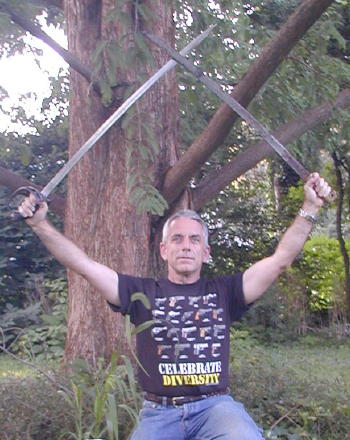 The crossed swords symbolize combat readiness and teamwork, harmony and balance, and of course always honor high rank. That's a genuine California Redwood behind me (Sequoia sempervirens); must be some symbology there, although I can't imagine how it came to be planted in my yard in Pennsylvania. No more interpretation! Happy birthday Glenn! UPDATE: I just learned that Glenn Reynolds has linked to this post, and I want to thank him for his generosity and welcome all InstaPundit readers. And I do mean generosity -- not only to me but to my blogfather, Jeff Soyer. Jeff is in dire need of financial assistance right now, and I see that Glenn has hit his tipjar, and helped spread the word. I'll more than second that! Please, if anyone can spare a few bucks, please go over to Alphecca and help Jeff! He got me started blogging, and he's more than a rugged individualist; he's the Blogosphere's Original Gay Gun Nut! Any of you readers who believe in libertarianism, the Second Amendment, and inspired writing owe it to yourselves to give Jeff a much needed tip. Other bloggers have turned their tipjars into a big money maker, but Jeff hasn't. He just needs help right now, and as Jay Solo explains, Jeff's cause is worthier: I'd rather keep Jeff's blog going, thankyouverymuch. He's not whining that he'll quit if you don't donate fifty big ones just before he takes a month off at his second home. He's short the basic chunk of change simply to pay a year's real blogging bandwidth.I helped, and I hope you will too! Thanks for coming, and please browse around. (I like to think between the three bloggers here, there'll be something to whet your whistle.) posted by Eric at 06:53 PM | Comments (9)
| TrackBacks (0)
Asshole or not, I plan to reap a_head!
There have been too many missed Online Test Days here at Classical Values! (Regular readers will know it's a year-long Friday tradition.) I was on vacation last week, but for a few weeks it seemed the tests had almost dried up. Well, I am happy to report that I found some good ones today, enough to quench my thirst for things morbid and generally unwholesome! Mmmm-Mmmm-Bad! The first test -- What kind of Goth would you be? -- comes from my old buddy Nick, best known as Ghost of a flea. I'm a tongue-in-cheek Goth (which makes a lot of sense, because I was already middle aged when I presented Berkeley's first Goth nightclub!). Nick's result is not the same as mine, but it's positively riveting! ______________________________________________
Take the quiz: "Which Dead Like Me Grim Reaper Are You (now w/ photos)?" Via Abraca Pocus, who's also Rube, but who wanted to be George. (We both scored a perfect 4 out of 4.)
Well, nobody's perfect, and the next test shows that I'm rather lacking in the asshole/bitchiness department!
Via Raging Kraut, who, at 81% asshole, certainly lives up to his name. Maybe I should take a few lessons from him, because my results are disappointing! (Oh well, maybe tomorrow I'll do some reaping, and make up for it.....) ___________________________________ Hey, if I'm not a bitch can I at least be a Bastard? Perhaps I suffer from a need to compensate for my failing score on the asshole/bitchiness test, but I'm glad to report that I found my true weapon in a test called "What sword would you use?"
But remember, folks, the sword don't mean a thing if you ain't got that swing! Don't let 'em turn yours into a ploughshare! posted by Eric at 04:41 PM | Comments (2)
| TrackBacks (0)
Radical cheap!
Here's a new idea -- Escape-a-Date, a phone service that rings or pages you with fake urgent messages so that you have a polite excuse to bail out of a dull or unpromising evening. Before venturing out on an evening of adventure, you preprogram your cell phone to ring at a particular time with one of eight 30-second "emergency" messages (your roommate is locked out, you forgot to pick up your grandma at the airport). You convey the lie to your date, and poof - you're outta there.You don't gotta have friends? Well, you wouldn't have them for long if you asked them to call you and deliver lame lies in the middle of a bad date. But I have a better idea, and it doesn't cost anything. Not only that, but if you're trying to score with leftist trend-setters, you'll be considered just too cool for words. A real rad and bad dude! Sound too good to be true? It's just an automated phone call away. All you have to do is leave your cell phone number at this web site, and viola! You're a way cool radical demonstrator, with far more important things to do! This service sends short text messages to your mobile phone on breaking news and logistical updates from the streets of New York City during the Republic National Convention 2004. The information is provided through an experienced communications team who are in touch with the coordinators of events and actions. This is the source of critical strategic truth for you and your friends or affinity groups.The nice thing about this service is that it will leave your date far more impressed than some dumb message about a burst pipe or a friend's pet would. "Gotta go babe! We're smashing the plate glass at Starbucks in just thirty minutes!" "Whoa! Gotta go! A notorious CEO has been spotted, and we're gonna try to spray him with something cool and creative!" Any date who isn't impressed by that would be a waste of time anyway. With any luck, the date will be so utterly charmed that he or she will pay for the dinner you're running away from! Good causes, like good taste, don't have to be expensive. posted by Eric at 10:05 AM | Comments (4)
| TrackBacks (0)
Swallowing pride loudly (and at the public trough)
Still playing catchup! It's tough to write about stuff like this. And scary too! But I missed out on an important local news item (many stories, actually) about New Jersey Governor Jim McGreevey's, um, lover? Boyfriend? Consultant? Victim? The old newspapers have been lying around still wrapped in plastic, and this morning when it was time to put out the recycling bin I realized I had to remove the plastic, and then I saw them -- there were blazing headlines in the Philadelphia Inquirer all last week! Like these:
These "mysteries" are now old news, and I don't want to bore my readers, so I'll just limit this recap to a few choice quotes. In a pattern all too predictable in politics, Cipel cast himself as a victim: ....I've come to understand that I was a victim and just as importantly, I was the victim whose oppressor was one of the most powerful politicians and made sure to let me know my future was in his hands.... Meanwhile, McGreevey tried in vain to cast himself as Abraham Lincoln: McGreevey noted that Lincoln said at the time that "each new generation moves society forward and brings ideas that change the world." Scary? In a way, it is. But I am not sure I agree with Mr. Cipel's assessment: "Think about how scary it is when we are talking about a powerful man like the governor of the state of New Jersey."Come on! Monica survived Bubba, and went on to fame and fortune, and greater (gulp) heights. But to be fair, Monica "worked" and so did Golan. It really wouldn't be a recap if I didn't include something about his "job": "I was not, under any circumstances, responsible for internal security under the governor," Cipel told Haaretz.In other words, the guy got a meaningless, do-nothing job at $110,000 a year. Remember, this came into public focus only because the gay angle titillated the attention of the public. I wonder how many other complete nonentities there are who consume $110,000 in tax dollars per year for doing absolutely nothing, without any qualifications. As I said before, the routine nature of such corruption is the real story, and I find it offensive that it's being buried in layers and layers of phony victimization. Are there any real victims to be found here? How about gay men who live their lives in dignity without resorting to victim role-playing games at taxpayer's expense? (At least the family courts don't yet have jurisdiction over such nonsense.) And how about New Jersey taxpayers? posted by Eric at 09:27 AM | Comments (2)
| TrackBacks (0)
Caught up with the past....
Finally catching up with old news! I watched John Kerry's famous 1971 speech last night. What shocked me the most was how little the guy has changed in all these years. He's more consistent than I thought he was. As articulate and phony then as he is now. To be honest, I expected a lot more honest youthful radicalism, and as I looked in vain for the angry young man of principle, I found myself wondering "Where's his outrage?" I watched him talk about the raped women, the mutilation, the torture, and the horror. The lips moved, the scripted, articulate words flowed, but the outrage just wasn't there; Kerry was a politician delivering his debut speech to other politicians, just as he was getting ready for his 1972 failed congressional bid. For some months now, I've been puzzled over why John Kerry went out of his way to serve in Vietnam, when he'd opposed the war for years. Youthful idealism didn't quite ring true. I'm no longer puzzled. Youthful idealism had nothing to do with it. Then or now. posted by Eric at 07:54 AM | Comments (1)
| TrackBacks (0) Thursday, August 26, 2004
Induced nostalgia
A couple of points for those who are still interested in John Kerry. Of course, the Kerry folks are trying to use the copyright laws to prevent you from reading it, which is why you should download it to your own hard drive, so you can later upload it to your blog in case the digital brown shirts try to mess with the InstaPundit-linked site. Ah, the miracles of the modern world! UPDATE: The more I think about the "digital brownshirt" phenomenon, the more I marvel over the supreme irony. I mean, it's one thing to suppress a book written by political enemies. But suppressing your own book? SHEESH! posted by Eric at 03:38 PM | Comments (1)
| TrackBacks (0)
Fuhgeddabout Free Speech! Franken Knows Best
My friend Eric from Why Dave Bergman is Neat just showed me Al Franken's Great American Shoutout: What's going on? On September 2nd, 2004, at approximately 10 pm, George W. Bush will appear on television screens nationwide. For some of our fellow citizens, this will be a moment of joy. But for most of us, it will be the low point of an incredibly exasperating week. And isn't that what America is really all about? Denying others an opportunity to speak, refusing to listen, encouraging others not to listen to different ideas? And frankly, what business does a political party have legally organizing and nominating its own candidate? By gum, this is America -- a land where freedom of expression means denying that right to others, or at least shouting them down. At least that's what it is to the Left. And if we don't shout them down (or claim that we don't), at least we'll scream our heads off before we've heard what they have to say. That kind of prejudice is called patriotism. ps: the Franko-Socialists really should settle on a single spelling. Is it fuhgeddaboutit, or fuggedaboudit? Oh ... right. It's just dumb. posted by Dennis at 01:54 PM | Comments (6)
| TrackBacks (1)
Write as I say, not as I do?
Inspired by this post (by Freelance Journalist Dennis), last month I questioned the following assertion by Salon.com's Senior Editor Eric Boehlert that the United States Air Force began drug screening tests in 1972: In 1972 he asked to be transferred to an Alabama unit so he could work on a Senate campaign for a friend of his father's. But some skeptics have speculated that Bush might have dropped out to avoid being tested for drugs. Which is where Air Force Regulation 160-23, also known as the Medical Service Drug Abuse Testing Program, comes in. The new drug-testing effort was officially launched by the Air Force on April 21, 1972, following a Jan. 11, 1972, directive issued by the Department of Defense.The above looks extremely authorititative, but I found no evidence whatsoever that the regulation Boehlert cited existed in 1972. Instead I found evidence to the contrary. And now I see that there's yet another letter to the Washington Times from Colonel Campenni which states that the Air Force did not begin its drug testing program until the 1980s: Also, the formal drug testing program was not instituted by the Air Force until the 1980s and is done randomly by lot, not as a special part of a flight physical, when one easily could abstain from drug use because of its date certain. Blood work is done, but to ensure a healthy pilot, not confront a drug user.Once again, I ask: who is right? Salon.com or Colonel Campenni? It goes without saying that there's a lot of false information on the Internet, but I was surprised to see it coming (apparently) from a source most people assume is reputable. When I have on occasion cited WorldNetDaily or Newsmax.com, people have told me that these sources are unreliable, and that I shouldn't cite them because nothing they write can be believed. I try to focus on whether something is true, and even if there's skepticism about the source, discussing public opinion and attempting to get at the facts is what blogging is all about. I saw a clear conflict between what Boehlert wrote and what a military insider says, and what I remembered from my own experience. Boehlert's assertion just seemed wrong, but not in the ordinary way. The assertion of a military regulation, complete with detailed dates and numbers, seemed so thoroughly authoritative that if it turned out to be wrong, at the very least, an explanation was in order. I can find no explanation or retraction, anywhere, from Eric Boehlert. What's the protocol here? I'm a little stumped over what to do. Should I go on that all-in-the-same-boat cruise and ask him? Nah! I'm not an in-your-face type of guy, and besides, I just got back from a cruise. (NOTE: It's only fair to point out, however, that I never would have learned about the Salon cruise but for Glenn Reynolds' spontaneous free advertising.) And it's not that big of a deal, really, because I'm a First Amendment absolutist, and I think that even if he was found to be lying and making stuff up, Eric Boehlert should have every right to do that. So why don't I just shut the hell up? Even if an online journalist made stuff up, so what? Normally I wouldn't be so bothered, but considering what Boehlert said recently, I'm a little concerned about a double standard: In an article entitled "Unfit for Bookstores," Eric Boehlert of Salon.com reported that a representative of the Kerry campaign had said Regnery Publishing, which printed Unfit for Command, is retailing a hoax and should consider withdrawing it from bookstores.What gives Boehlert such moral authority? His status as a Senior Editor at Salon.com? What if he has promulgated (or fabricated) a lie about Air Force drug testing? Either the "long-standing tradition by reputable publishers" he champions applies to Salon or it does not. Hope my suspicions are unfounded, because I've always enjoyed Salon. posted by Eric at 09:43 AM | Comments (6)
| TrackBacks (0)
Bigger competition?
Imagine the outcry if the Bush campaign were calling on Miramax to stop distributing "Fahrenheit 9/11," which really does have numerous proven falsehoods.-- James Taranto, Wall Street Journal Imagine..... I am so sick of politics that I feel like taking a break from writing about it. But I am more bothered by the hypocrisy than by the merits of charges and countercharges, and much as I wish both sides would respect the First Amendment rights of each other, I have a question. Why is it that the same people now screaming about a group of older veterans who questioned Kerry's war record didn't complain at all about a film whose central thesis is that Bush knew about 9/11 in advance, and worked in sinister partnership with Osama bin Laden? Unfit for Command is a book. Fahrenheit 9/11 is a movie. Here's a brief comparison. Here are Fahrenheit 9/11's gross receipts according to the IMDB: Fahrenheit 9/11 (2004) $116,761,122 According to Moore, the film is targeting at least 2,000 screens. And Moore never made any bones about his goal of using the film as an organizing and recruitment tool: But the bad news for Bush supporters doesn't stop there. Moore plans to use the movie as an organizing tool. On June 28, he conducted a virtual town hall meeting with the liberal group MoveOn.org. Moore exhorted the 55,000 listeners who logged in or turned out at 4,600 MoveOn parties around the country to sign up as foot soldiers in an anti-Bush crusade. Once people see his flick, said Moore, anyone who once supported Bush and the war in Iraq "will feel deceived and betrayed, and they will respond with a vengeance." Unfit for Command had an initial printing of 85,000 copies; another run of 550,000 is planned, with one major bookseller facing accusations of not wanting to sell it, as well as pressure not to sell it: NEW YORK (AP) - The nation's two biggest bookstore chains, Barnes & Noble and Borders, say angry customers are accusing them of political bias as the retailers struggle to keep up with demand for a best seller that questions John Kerry's military service in Vietnam.I am not sure who stands to make more money, but common sense suggests that it's tougher for most people to read a book than to watch a movie, and when that is factored into the sales receipts, Moore would appear to have the advantage over the Swift Boat veterans. Even though "Unfit for Command" is ranked Number 1 at Amazon, assuming a million copies are sold (a generous assumption considering the initial run), the total receipts won't begin to approach the Moore film, nor will the former's total number of readers approach the total number of the latter's viewers. But Moore's film aside, the biggest competition the Swift Boat veterans face is, according to liberal cartoonist Tom Oliphant, the daily press! O'Neill: Jim, one other thing, they can look at swiftvets.com, which is the Web site that has a great deal of information on it.Yeah, I'd say the Swift Boat vets appear to be outgunned. posted by Eric at 09:06 AM | Comments (3)
| TrackBacks (0) Wednesday, August 25, 2004
In search of denial....
Glenn Reynolds asked whether Richard Nixon denied having United States forces in Cambodia during John Kerry's periods of Vietnam service. A good question. I'd like to know too, so I did some preliminary research. As to John Kerry's service in Vietnam his campaign web site says it ended on March 17, 1969: March 17, 1969 The policy of Coastal Squadron One, the swift boat command, was to send home any individual who is wounded three times in action. After sustaining his third wound from enemy action in Vietnam, Kerry was granted relief under this policy. Unbelievable as it sounds, Nixon's secret bombing (denied, obviously) of Cambodia began on March 18, 1969. The day after Kerry left. Now, I don't know when Nixon began denying secret operations in Cambodia, but I think it's unlikely he'd have denied them before they began. As to the official incursion into Cambodia, that did not happen until April 30, 1970 (after Kerry was separated from active duty). Nixon's speech announcing the incursion made no mention of the previous secret bombing. NOTE: Kerry's web site states that he did not leave Vietnam until "early April," so I am assuming that between March 17 (the date they decided to send him back) and then he was in the status of being processed out, with no further combat duty. (He had been wounded on March 13.) MORE: The March 13 wound occured during operations on the Bai Hap River, which is not near the Cambodian border. posted by Eric at 05:23 PM | Comments (2)
| TrackBacks (0)
Anecdotage
My father was in the navy. My mother was in the navy. They met in the navy, and I grew up in the navy. This doesn’t make me an authority on navy life, far from it, but it does give me a wealth of anecdotes. I was reading some recollections of John F. Kerry the other day, and suffering an irritating mental disconnect. " a fine division officer...excellant verbal skills...a fine young officer...fitness reports were outstanding...” How to square those reports with his ever more apparent character defects? Contrary to popular culture, the military isn’t composed entirely of idiots. Surely the signs were apparent, even thirty years ago? Did he actually have some good qualities? I would rather not change my opinion if I don't have to. Then the other shoe dropped, and an old memory surfaced. My mother had been opining on why my father never made captain. She was always unusually forthright, a trait that, unbeknownst to her, many around her found annoying. Especially when she was right. “Your father was a fine officer, and he always got wonderful evaluations, but he was just no good at office politics. He was stubborn that way. He figured that doing an outstanding job ought to be enough. But that’s not the way it works. Other officers would tell me that he was no good at blowing his own horn.” “Well”, I said, “ Isn’t that the way it should work? Wasn’t he right? Your work should speak for itself.” “Not if you want to make Captain.” “Yeah Mom, but he got good write-ups!” “Everyone gets good write-ups, Justin. You have to be a real screw-up to get a bad one. Nobody wants to get killed because they kept an idiot out of trouble. But even if you’re just average, you’ll get a glowing recommendation. If they REALLY like you they’ll praise you to the stars and write extra letters commending your performance. Then they’ll invite you to their cocktail parties. Your father hated cocktail parties, he never wanted us to go, but that’s where you can catch an admiral’s attention.” Perhaps my father was smarter than he let on. My mother never did figure out that her vigorously expressed opinions may have been a career liability for him. Keeping her away from the admirals might have been a smart move, albeit at some cost. Or maybe he really just hated cocktail parties “The thing is, Justin, you never know who you might be serving under fifteen years from now. It doesn’t pay to make enemies when you don’t have to.” “Okay Mom, so if you’re just doing your job they say good things about you.” “Yes.” “And if they really, really like you, they just slather it on.” “Like there’s no tomorrow.” “What if you’re not an outright failure, but they just don’t like you?” “Lukewarm praise and a fast transfer. They get to be someone else’s problem.” And how, Mom!
posted by Justin at 04:58 PM | Comments (3)
| TrackBacks (0)
What About the Children?
Here's some more fuel both for people who think we need to be protected from ideas and people opposed to the death penalty: Two Children Die Imitating Rare Execution Wed Aug 25, 2004 08:29 AM ET When will the media learn that information kills? And when will states learn that killing only leads to more killing? posted by Dennis at 04:30 PM | Comments (4)
| TrackBacks (0)
Classical Greek tragedy? Or modern political comedy?
Can a hero become a victim? What would Aristotle say? How about Sophocles? What, if any, are the implications to Classical Values? If this sounds too much like a contradiction, consider the case of former United States Senator Max Cleland, decorated Vietnam hero who's going the extra mile for John Kerry by traveling to Crawford, Texas just to deliver a "letter" asking Bush to "call off" the Swift Boat veterans. (An act which, if Bush were capable of performing it, would probably constitute a crime under federal campaign rules.) How Cleland became a victim I am not sure. He's a liberal Democrat (ADA rating was 100%) who lost his seat in the last election to a conservative Republican. If I am reading the facts correctly, he was targeted by the "Republican attack machine" for (gasp!) his politics. And he lost. Does that mean that anyone who loses an election is a victim? Or only if they were "targeted" for defeat? What does it mean to be targeted for defeat? Have not Bush and Kerry targeted each other for defeat? Will the loser be the victim? Surely it isn't relevant that Cleland is in a wheelchair. Might he be hoping that some of his victim status will rub off on Kerry when he attempts to deliver a letter to George W. Bush? Maybe that's the theme. George W. Bush as the ultimate evildoer. He Who Turns Our Nation's Heroes Into Victims! I'm sure the play will be on tonight's evening news....
 posted by Eric at 04:06 PM | Comments (1)
| TrackBacks (0)
'Freelance Journalists' Ahead of the Curve Again
It seems every time I turn around columnists are echoing the blogosphere. Here's Nat Hentoff on Moore's Iraqi 'insurgents': The divisions in this nation have become increasingly surreal as the elections approach. Many jubilant Democrats venerate Michael Moore. Senate Minority Leader Tom Daschle and Democratic National Committee chairman Terry McAuliffe were at the Washington premiere of Moore's so-called nonfiction "Fahrenheit 9/11." This alleged documentarian said of terrorists in Iraq:"They are not the enemy. They are the REVOLUTION, the Minutemen, and their numbers will grow — and they will win. Get it, Mr. Bush?" I recommend that you read it all. There's a quote at the end by a pedestrian that appeared in the New York Observer that you have to see to believe. Hentoff is never one to play politics like baseball, he has no home team allegiance or hatred for the opposition on any pet issue. His criticism of the Left here is equal to his criticism of the Bush administration's policies on so-called ghost prisoners, (though their status under the Geneva Conventions is open to debate). UPDATE: (In classic Eric style.) I guess I just haven't been paying attention till now, but here's the Washington Times discussing what the blogosphere has already treated and virtually forgotten about, viz. Kerry's journal: Mr. Kerry has claimed that he faced his "first intense combat" that day, returned fire, and received his "first combat related injury." I wonder if they'll ever tackle the Bob Hope angle. posted by Dennis at 11:45 AM | Comments (6)
| TrackBacks (0)
Another analogy that just won't float!
John Kerry loves boat analogies. Class war. And other swift thinking..... First, there was his memorable acceptance speech at the DNC, in which he said that "we are all in the same boat." And just yesterday, at Philadelphia's Franklin Institute, he gave the boat a name: The Titanic! YOU WOULD think by now that John Kerry would be sick of talking about boats.Class war analogies are one thing. But I'm fascinated by Kerry's statement that "the wealthy folks squeez[ed] the middle class out of the boat." Out of what boat? The Titanic? Whether the statistics bear out his statement depends on the definition of middle class and wealthy. There were three classes: First Class, Second Class and Steerage (Third Class). Here are the total numbers: With the above in mind, (which shows that the First Class were outnumbered by the other classes by more than two to one) how does Senator Kerry differentiate between "wealthy" and "middle class"? I thought a look at the Titanic's actual ticket prices might be helpful: Cost of a ticket (one way)Considering that some Second Class passengers were paying more than some First Class passengers, it's tough to state definitively that the First and Second Class categories mark an absolute delineation between the "wealthy" and the "middle class." (For that matter, what would have stopped budget-minded middle class passengers -- or even wealthy "slummers" -- from buying Third Class tickets?) Factor that into the passenger numbers of 735 and 674 respectively, and the the claim that the wealthy were crowding out the middle class just doesn't hold water. (Forgive the expression!) So I'm puzzled again. Perhaps Senator Kerry was talking about the wealthy crowding the middle class out of the Titanic's lifeboats. The problem is, there's not much evidence to support that thesis either. There is, however, ample evidence that women crowded out the men: First of all, if you were a man, you were outta luck. The overall survival rate for men was 20%. For women, it was 74%, and for children, 52%. Yes, it was indeed "women and children first."Considering Kerry's attempt to court women voters, I am not sure that slamming the Titanic's survivors with class war rhetoric about who "squeezed out" whom is a wise move. And why would third class men be more likely to survive than second class men, anyway? If there was a class war on the Titanic, it's obvious who won it. Wealth took a back seat to other considerations. Sorry, but I'm left with a sinking feeling that maybe the Titanic is Kerry's boat after all.... UPDATE (08-26-04): I often feel like taking a break from all this, and now, via InstaPundit, I found a hell of a good post by Varifrank -- who has an even better idea: just stop blogging about Kerry! I didn't start the blog so I could dig up the obvious on John Kerry. Frankly, its just too easy.Read the rest. It's unbelievable. Once again the cynic in me wonders what made Kerry happen. The Democrats could have done much better. Why didn't they? posted by Eric at 10:04 AM | Comments (2)
| TrackBacks (0)
Smaller wires, bigger headaches
In a discussion on mind uploading, Glenn Reynolds quoted Larry Lessig: Larry Lessig has written that whoever controls the code, controls the Internet.Ominously true. And while we're not yet at the mind uploading stage, the Internet (which stands at the apex of human potential thus far) is now allowing people to communicate in ways never possible before. Naturally, improvements in free communication between citizens threaten those I like to call "the control freaks." While I've posted about this before, the problem -- in a nutshell -- is that a relatively low tech idea (wire tapping, once described by Justice Taft as "small wires") is seriously threatening the Internet, which wasn't designed with the "small wire" guys in mind. Trillions of data packets moving over the Internet at lightning fast speeds are threatening Big Brother's technological resources, and thus, the cops want private companies to do their work for them: Tapping Internet phones is far more complicated than listening in on traditional calls because the wiretapper has to isolate voice packets moving over the Internet from data and other information packets also traveling on the network.In order to intercept the packets they want, Big Brother will of course end up intercepting everyone's conversations -- i.e. they'll have to drag a huge net to catch a single fish. The task is complicated because the phone provider has to use special software to sniff out specific voice packets from among all the data packets traveling from the suspect's connection. Unlike traditional phone taps, this process does not reveal the caller's location, because users can plug their Internet phone modems into any broadband connection, even overseas.This is why I give money to the odious ACLU, folks. I can't stand the leftists who run the place (and I am particularly fried by their failure to support the Second Amendment), but the fact remains that they're the only large organization which constitutes a real obstacle to those who would invade people's privacy and ultimately imprison them for things like the private use of unapproved substances and other "crimes" of private conscience. Is there any hope at all? Well, there's always the Original Intent of the Internet -- now taking the form of peer-to-peer networking: The biggest challenge, Mr. Tworek and others say, is tracking down phone conversations that are connected by peer-to-peer software. This software essentially piggybacks on the networks of its users; calls are not connected at a central location. To trace such calls, investigators would have to sift through trillions of packets at routers that channel data around Internet networks - a daunting task, industry experts say.For Big Brother, freedom is always a headache! posted by Eric at 08:16 AM
| TrackBacks (0) Tuesday, August 24, 2004
Shell game
Whoa! I just realized that I almost forgot to post any pictures from my trip. Here's one which expresses my mood perfectly:
Frankly, looking at that picture makes me jealous! These little critters don't have to worry about elections; they can just tuck themselves into their shells. Well, maybe not "their" shells in the strictest sense, but when the original owner dies or gets eaten, why let a perfectly good shell go to waste? So what if it's pre-owned? And once you outgrow the shell, you just find another one, and leave the last one behind for some other deserving hermit. They get pretty big too; while I was SCUBA diving I saw one inside a large conch shell. (Well meaning humans even make designer shells for their captives.) The guys in the above picture are Caribbean Land Crabs -- Coenobita clypeatus. They have gills, but use them as lungs by means of a curious adaptation: As an adaptation for extracting oxygen from the air rather than from the water, the gills of Coenobita are reduced in number and stiffened, and the inner walls of the gill chamber are vascularized to promote the exchange of gases. Also, ventilation of the gill chamber is enhanced by the reduced side walls of the carapace or head shield of the crab. Moistening of the gills is abetted by well-developed glands in the bronchial region.Gills as lungs? It may sound unnatural to some, but they've been doing it so long that in captivity they can be terrified of water. Yup; well-meaning owners can kill them by just by giving them a bath. That's because their shells hold water in just the right balance for the crabs: The danger of drying out or of over concentrating the body fluids through evaporation is the most critical problem confronting any animal that migrates from water to land. Coenobita has an advantage in this respect over the true land crabs, for it can store water in the appropriated snail shell, and this water may be used secondarily for drinking. One reason that hermit crabs so frequently try on different abandoned snail shells is to find one that fits the delicate abdomen closely, thereby minimizing evaporation. The same explanation probably accounts for the nocturnal habits of Coenobita Clypeatus in the southern part of its range, where daytime activity could result in severe evaporation. Experiments have shown that animals in well-fitting shells can subsist without food and water six times as long as those removed from their shells. When the crab withdraws into its shell in the daytime, the claws and walking legs form a reasonably effective seal in the shell mouth against evaporation. The parts of the animal that protrude farthest from the snail shell are most heavily calcified, and this undoubtedly helps to prevent the evaporation of body fluids.While that's more than I really needed to know, I can't say I disagree with any of it. I'm all in favor of preventing adverse concentration of body fluids, although I have nothing against trying on new shells. NOTE: I don't mean to offend any crabs or hermits who might be reading this post. I'm a crab myself as well as a borderline hermit. posted by Eric at 05:04 PM | Comments (1)
| TrackBacks (1)
Vetting for victory?
Does anyone remember Admiral Boorda? He committed suicide back in 1996 because of a flap over the illegitimate display of the "V for Valor" on his medals: WASHINGTON (CNN) -- The nation's top Navy officer, Adm. Jeremy Michael Boorda, died Thursday from an apparently self-inflicted gunshot wound hours after learning Newsweek magazine was raising questions about the legitimacy of some of his combat medals.Many people wouldn't understand why Boorda might feel such shame, but not those with an understanding of the military. Honor is everything. I thought of Admiral Boorda because today I learned about a similar flap involving John Kerry: Now, on the heels of yet another revelation—that Kerry’s DD 214 (“Report of Transfer or Separation”), displayed on his website, shows his Silver Star embellished with an unauthorized “V” for valor—which makes it facially false and at variance with official government records (see our article, John Kerry’s Mysterious Combat “V”)—it has come to light that his Silver Star award is fraught with other peculiarities.There's much more about the three citations for the same medal, and while I'm no military expert, it strikes me as odd that a four star admiral would bother to do a third rewrite for a lieutenant junior grade. Connections, perhaps? Then there's the "V." Unbelievable as it sounds, the presence of an unauthorize "V" might constitute a federal crime: The presence of the combat “V” with Kerry’s Silver Star on his DD 214 raises two extremely disquieting questions. How did the unauthorized “V” get there, and why has Kerry allowed it to remain?The unauthorized "V" may have been a bureaucratic error committed long ago, but as the author (distinguished legal scholar Henry Mark Holzer) points out, Kerry has had years to correct it, yet his DD 214 still displays the "V" for Valor language. I don't think this is one of the Swift Boat veterans' allegations, but if it's true (which it appears to be), once again the question becomes, is it relevant? It strikes me that if career military guys commit suicide over these things, it may be..... Didn't anybody vet this guy's MORE: I'm beginning to see why Kerry was never vetted as so many candidates are today. In American politics, one's opponents end up doing the vetting. Kerry was first elected to public office in 1982, when he ran for Lieutenant Governor of Massachusetts as the running mate of Miichael Dukakis. (Once the primary was over, an easy win.) Two years later, Senator Tsongas retired suddenly, creating an opening, which Kerry targeted. This real race was between Kerry and his liberal opponent in the Democratic primary, one James M. Shannon -- who went so far as to criticize Kerry not for his protesting, but for having served in Vietnam. This rightly enraged Vietnam veterans who, feeling impugned, went to bat for Kerry. His Republican opponent, Raymond Shamie, had little chance of winning in liberal Massachusetts, and nothing to gain by scrutinizing the war record of an opponent better known for being against the war than for it. (Liberal Democrats -- particularly in those days -- would not have been likely to scrutunize the military records of other liberals.) Kerry has been in the Senate since, and not until this election has his life been put under the microscope as it is now. The above biographical information, plus much more, can be read here. UPDATE (08-27-04): Via Drudge, I see that the Combat "V" flap has now hit the mainstream press: the official records on Kerry's Web site only add to the confusion. The DD214 form, an official Defense Department document summarizing Kerry's military career posted on johnkerry.com, includes a "Silver Star with combat V."Once again, it's hard to believe that the professional dirt diggers who work for the Democratic Party didn't know about this. Does anyone think Kerry will release his records? UPDATE (09/02/04): Glenn Reynolds (a previous skeptic on this matter) now characterizes the story as having "some legs." And according to the the story he links, Kerry was himself critical of Boorda! At the time, Mr. Kerry told the Boston Globe that Boorda’s conduct was “sufficient to question [Boorda’s] leadership position.…If you wind up being less than what you’re pretending to be, there is a major confrontation with value and self-esteem and your sense of how others view you.”Under the circumstances, I think I should at least be allowed to say "OUCH!" posted by Eric at 02:41 PM | Comments (2)
| TrackBacks (0)
I actually voted to enter Cambodia, before I voted to exit
Here's a column that doesn't say anything you haven't seen in the blogosphere for weeks, but at the very least it shows that commentary in the press hasn't yet quit on the Cambodia story (there're more recent pieces here, here, here, and here where bloggers are respectfully credited with pushing the story, though referred to as 'free-lance journalists'). Here's an excerpt from the first column noted above: If Kerry didn't fabricate, he exaggerated. Or misspoke. Or got confused. Or something. But whatever the differences among versions, the story is part of a larger narrative that may matter more than the details. What really peaked my interest was the term 'risumi' which I'd never seen before. A little research and I found that several websites had it in place of resume. And here's the explanation: A "risumi", word fans, is a special kind of "resume" that has been written with a ISO-8859-1/14 character set and then sent through a mailer that drops the high bit. Lowercase e with an acute accent, minus the top bit, turns into an "i". Hence, risumi. Our favourite citation for the new dictionary entry: an article by Peter Kaufman, "creative strategist" at clickz.com, who confidently declares "Why would anyone hire a person with spelling errors in a document? Several risumis I've seen over the years have had spelling, grammar and syntax errors that would make you either laugh or cry". Now, I'm going to guess that the author of the column cited above had résumé and the change occurred as explained, but part of me really wants it to have said risumi, as that captures better the reality of Kerry's flawed presentation. PS: The last column linked above is heartily recommended, so I'll link it again. posted by Dennis at 11:41 AM | Comments (1)
| TrackBacks (1)
Another loss for the "base"?
I hate elections. But whether I like them or not, elections happen anyway. Hating them makes about as much sense as hating gravity, because elections are a form of undeniable reality. Last week, while I was away at sea, an election happened which I've watched closely, and discussed repeatedly: a guy named Vernon Robinson, billing himself as a new Jesse Helms for the ages, ran for Congress on a vehemently outspoken anti-homosexual platform. He came in first place in a crowded primary election, and last week lost a (Republican primary) runoff election to Virginia Foxx (a staunch conservative he painted as Hillary Clinton). At a time when I was trying to mind my own business by enjoying a little Grateful Dead nostalgia, Vernon Robinson's campaign broadsided me with hate-filled political mailings, which so offended me that I reprinted them in this blog. I found myself drawn into the race whether I liked it or not, because the cynical stench behind the Robinson campaign was too foul even for my low standards. It's bad enough to pit blacks against homosexuals in the "culture war" but to use such divisiveness to fuel and escalate war between libertarians and social conservatives is just beyond the pale. What I wanted to know then (and what I still want to know now), is who -- or what -- is behind this? There's certainly money, pouring in from somewhere. And Robinson -- using that outside money -- outspent Virginia Foxx by a ratio of nearly ten to one: Political experts said they weren't surprised that Foxx won, despite the fact that Robinson raised far more money. According to a campaign report filed Aug. 5, Robinson raised more than $307,000 between July 1 and July 28. Foxx raised about $38,000.Are these out-of-state people who gave money to Vernon Robinson the "Republican base"? I think it's a fair question. Either they are or they are not the Republican base. (In fairness, the question may be aggravated by the fact that they will claim to be the base whether they are or not.) The fact is, reality struck: their guy couldn't win in North Carolina. So, while it might not be fair to say they're the Republican base, I don't think it's unfair to characterize them -- once again -- as losers. posted by Eric at 09:23 AM | Comments (3)
| TrackBacks (0) Monday, August 23, 2004
But I Really Do Love New York!
I stumbled across this, and thought it was sort of funny. They sure look like a fun bunch. They do public outreach like Protest Warrior, but demented. Click here, and scroll down to "The People's Cube". Look at the top left corner of their mainpage and marvel at the revolutionary hair of bronze. And don't miss this. "First American Cosmonaut"....I love New York. posted by Justin at 08:23 PM | Comments (2)
| TrackBacks (0)
Interest Piqued
Sometimes, when you are curious about where the world is heading, asking an expert is the worst thing you can do. Experts know too much. They know the pitfalls and roadblocks with an intimate, hands on knowledge, and they will brook no backchat as to what can and can't be done. Often, they are correct in their ingrained assumptions. But sometimes a new technique just drops on them out of the blue, transplanted from a totally different field. Thousands of man-hours of painstaking effort are credited to their account. I love when that happens. Here's a case in point. Using old, modified printers, a group of university researchers is developing a way to make sheets of human skin that can be applied to burns. The "skin-printing" method aims to produce a sturdier skin than the currently used skin-graft method, minimizing postoperative complications. Thanks go to the invaluable Roland Piquepaille for pointing this out. I hope it surpasses expectation. It's cute. posted by Justin at 08:03 PM | Comments (1)
| TrackBacks (0)
Moral authority admits to no wrong!
Here's one of the best discussions I've seen on Kerry's multiverse. How can it possibly be that his actions thirty years ago, which Kerry himself described as shameful war crimes, are now so undeniably honorable that no one is allowed to question Kerry's account of those actions, not even the very men whom Kerry accused of committing war crimes? (Via Glenn Reynolds.)I don't think I've seen a more classic case of having one's cake and eating it too. But despite the apparent inconsistency, I think there is a common thread, and it has to do with imagined moral authority, and the politics of shame. To disagree with John Kerry -- now or then -- is shameful. Kerry, a self appointed master of shame, believes that he earned the right to moral superiority by both serving in Vietnam and then having (in his mind) the "moral courage" to oppose that war. This gave him the right to shame his fellow soldiers and denounce them as baby killers and war criminals. Not merely without pangs of conscience, but with total moral sanctimony. The fact that so much time has passed since then only invests him with greater moral authority, as he believes the passage of time proves him right. Not only that, but his type of activism -- opposing the war as a soldier -- was intended to clear the consciences of all antiwar activists who believed in the moral superiority of their cause. As I tried to explain previously, the antiwar generation likes to believe that they were every bit as much "warriors" as those who fought and died. "BRING THE WAR HOME" was one of the more popular slogans. Thus, in Kerry's mind there's no distinction at all between his wartime service and antiwar activities, once he had repented. His war service was as much service as his antiwar activities. For him to reverse himself now would be an admission that his repentance was wrong. (Or worse, that the Vietnam War was right.) He'll never do it. And thus, John Kerry cannot ever embrace the parallel universe, even though that would be good advice for lesser mortals. posted by Eric at 08:01 PM | Comments (1)
| TrackBacks (0)
P.S.:
When Eric invited me to blog here he set up the name Varius, and I had fun with it for a while, but to be honest I've never much cared for Romans and it takes about 2 seconds longer to log in with a name like Varius Contrarius. So from now on I'm just Dennis, which is my real name. So ... hi. posted by Dennis at 12:41 PM | Comments (9)
| TrackBacks (0)
Irony of Ironies
Not really ... not even close. But I'm running out of clever titles. The following is from Axis of Logic, a cute play on Axis of Evil: Some people look at the situation in Iraq and profess to believe that things are going just fine. But they are looking through a retro-lens; when they see Iraq, they see a different war altogether. And it's hard to win a war in the present day if you're lost in the fog of the last fight. It's ironic that the author tries to flay Wolfowitz with the reductio ad hitlerum, failing to note that Wolfowitz is most often flayed for being a Straussian, and that Strauss coined the phrase reduction ad hitlerum in Natural Right and History. The phrase does not refer to comparing the actions of militants to that of National Socialists, but rather to refuting a position by the argument that Hitler shared that position. Strauss was criticizing the illogical rhetorical game of attacking ideas on the basis of who else might share them. (The Axis has a ways to go on the Logic front.) What the author is actually talking about is a kind of ad hominem attack, and this abuse of Nazi comparisons has been treated better here. Not only is the the comparison of militant muslims with National Socialists not an instance of the reductio ad hitlerum, it is not invalid. The fundamental issue for the proponents of National Socialism was race, or nation (in the truest sense of nation), which the militants share. The characterization of Wolfowitz as non-Clausewitzian is puzzling and I wonder whether the author even knows what the term means. Then again, it's a very shadowy subject, and one would be hard pressed to find ten people who agree about what Clausewitzian (i.e. trinitarian) war properly is, or how the term non-Clausewitzian is generally used. As in this recent CIA article, America has been described as non-Clausewitzian because it is a nation unaccustomed to war without end or clear victory. This view would seem to explain the root cause of unrest over Vietnam, as well as the use of Vietnam as a paradigm by those who oppose U.S. involvement in any modern military conflict. The non-Clausewitzians today are actually those people who oppose our involvement in Iraq because they are 'not accustomed to the concept of a war that is necessary and waged with good reason but offers no prospect of ending with a clear peace and especially a clear victory.' The author of this article, then, in addition to unwittingly misquoting Leo Strauss, is non-Clausewitzian. The argument is really about the fact that people are still dying in Iraq, and there must be some other solution. I wonder what else Wolfowitz had to say in the article cited on Axis of Logic: Global terrorism is another manmade evil "that needs to be eradicated and discarded," Wolfowitz said, "just as piracy and the slave trade were de- legitimized and driven to the margins of civilized life in the past." Terrorists' extremist ideology, he said, must be "replaced by a hopeful vision of freedom." That bastard! Personally, I'd rather see us just come to understand how it's all our fault, and apologize to the terrorists for wanting to live. And then we'll all sing and laugh under the magical rainbow, making merry fun. posted by Dennis at 12:24 PM
| TrackBacks (0)
Greed kills!
Spiteful egalitarianism? This article -- Neighbors as Negatives, by Erzo F.P. Luttmer -- intrigued me. [D]o people care about relative position and does lagging behind the Joneses' diminish well-being? To answer this question, I match individual-level panel data containing a number of indicators of well-being to information about local average earnings. I find that, controlling for an individual's own income, higher earnings of neighbors are associated with lower levels of self-reported happiness. The data's panel nature and rich set of measures of well-being and behavior indicate that this association is not driven by selection or by changes in the way people define happiness. There is suggestive evidence that the negative effect of increases in neighbors' earnings on own well-being is most likely caused by interpersonal preferences people having utility functions that depend on relative consumption in addition to absolute consumption.The author's answer is yes -- notwithstanding logic, common sense, or wisdom. I was directed to this just after finishing a marvelous new assessment of Joseph Stalin, who was of course an unsurpassed master at harnessing spiteful egalitarianism. Kulaks weren't hauled off to Siberia because masses were starving, but because their less affluent neighbors hated them and were willing to denounce them. (Actually, the masses starved largely because the successful Kulaks were no longer there to produce the food they needed!) Similarly, the human weakness identified by Luttmer has little to do with the meeting of actual human needs, such as food or transportation. The hatred of neighbor for neighbor is based more on whether the neighbor has a more expensive (or later model) car, a house with slicker improvements, etc. Reading the article, I saw distinct hints that shame might lie at the bottom of the problem: The results are stronger for those who socialize more with neighbors but not for those who socialize with friends outside the neighborhood.The author believes that the mechanism he identifies has clear public policy implications: ....[T]he negative effect of neighbors' earnings on well-being [] is real and most likely caused by a psychological externality, i.e. people having utility functions that depend on relative consumption in addition to absolute consumption.In other words, there appears to be evidence that what Marx, Engels, Lenin and Stalin all called "class warfare" may find origin in "negative externalities of well-being." Is that why there's so much fuss these days about "self-esteem"? I can't speak for God, but regardless of who wrote it, I think the Tenth Commandment was damned good advice. (Probably why they put it last.) posted by Eric at 10:56 AM | Comments (1)
| TrackBacks (0)
My beautification campaign
I don't know how it happened, but while I was away, Kerry's "Christmas in Cambodia" story seems to have found its way into the mainstream news. Because I have complained about their lack of coverage, I think it's only fair to praise today's Philadelphia Inquirer for actually conceding that this story exists in an article otherwise unfavorable to the Swift Boat veterans: Nevertheless, they have exposed a Kerry embellishment. Kerry has insisted for years that he slipped over the Cambodian border on Christmas Eve in 1968, but, on the talk shows yesterday, even his staunchest defenders failed to back him up. John Hurley, a vet who works for Kerry, said only that Kerry "was five miles in Cambodia on a different occasion" and that the details had become "confused."I'm glad they mentioned the story, but I want to ask what, exactly, is an embellishment? According to my dictionary, to embellish something is to enhance the beauty of it. Thus, if one visited someone's house and found that it less than merited a write-up in, say, House Beautiful magazine, it would constitute embellishment to praise the owner's taste as "ecletic, provocative, and individualistic." But to say that one visited the house when one never did, that's no more an "embellishment" than it would be for me to say that I was present in New York during the 9/11 attacks. Now wait just a minute! Here are the actual facts from my personal life: Therefore, it was as if I had been right there. I really was right there, because Philadelphia is between Washington and New York, and Flight 93 went down in Pennsylvania. So I WAS THERE. A victim. Ground zero. I'll never forget it as long as I live. Any talk to the contrary is "gotcha" politics of the type we don't need. Besides, 9/11 is old news these days. What we need to be talking about is the War In Iraq. And as a victim of 9/11, I know all about war. (I need not bring up my status as a veteran of Cambodia, which was seared into my brain by genuine Apocalypse Now flashbacks.....)
"I would have invaded Iraq regardless of the WMD issue," Kerry observes. "Saddam Hussein was a threat, and a menace to his own people. And a free, democratic Iraq will be the first step toward addressing the 'root cause' of terrorism -- despotic Arab regimes that spew hatred to distract their people from their own tyranny. But as I said last year, the reconstruction needed more resources. That was why I voted for the $87 billion in reconstruction money, but urged the Bush Administration to ask for more, to do it right." Fortunately for Republicans, Kerry's existing universe seems to be imploding. Instead of spurning Moore, Kerry courted him. (A big something, perhaps, but not a Big Bang.) UPDATE: By calling myself a 9/11 victim, I meant no offense to anyone, but I do think it's fair to ask at what point an exaggeration crosses the line to become a serious lie. Others have argued that the Cambodia lie is either not a lie, or is irrelevant. My question is: when are such lies relevant? The blogosphere was not happy about Micah Wright's false claim that he was a veteran, even though Wright was not running for president. Is my hypothetical claim to be a 9/11 victim any different? If I wouldn't get a pass (and I know I wouldn't), then why should Kerry? Or is the blogosphere held to a higher standard than a candidate for president? I'm trying to avoid being a moralist, so I want to ask: is there some invisible, does-not-matter line I am missing? posted by Eric at 08:54 AM | Comments (1)
| TrackBacks (0) Sunday, August 22, 2004
Watergate begins with DUBYA
And George Dubya has now been indicted! Here's Spike Lee, discussing his latest film "She Hate Me" in an interview with the Philadelphia Inquirer: Q: Are you putting this movie out in an election year on purpose?Wow. At the rate the indictments are piling up, Bush will probably be impeached before the election. Why no threats of litigation from the Bush camp? Isn't an indictment at least as serious as an attack on someone's war record? And the word Halliburton is at least as ominous sounding as Vietnam, maybe even Cambodia. Isn't there some way to include Nixon and Watergate in this stew? Sure enough, there is! Lee's hero is a corporate whistle blower, which means that there's an eerie parallel right there to (gasp!) Watergate: One scene in the film mirrors the struggles of Frank Wills, the Washington, D.C., security guard who called the police in 1971 after discovering a taped-over door in the Watergate complex.Hmmmmm....... Pat Buchanan? He may be many things, but Watergate figure? Hardly. I think Mr. Lee ought to take a refresher course. (He might even start by reading Pat Buchanan on Watergate!) Watergate, of course, centered around gay rights and health care. At least according to the actor who plays Jeb Stuart Magruder: SHE HATE ME likens the political climate that produced Watergate's Magruder (played by Simons in the film) to our current, corrupt political and corporate culture, personified by Enron's Ken Lay. This is, indeed, particularly timely subject matter as America gears up for our 2004 Presidential elections and this summer marks the 30th anniversary of Richard Nixon's resignation due to his participation in Watergate confirmed by, among other things, the damning testimony of key Whitehouse aide Jeb Magruder.I see it now! How timely can we get? Nixon, Enron, Ken Lay, and Worldcom! All plotted to deny gay freedom and healthcare! No wonder the actor "felt strongly"; I feel strongly too! Why wasn't this all brought out in the Watergate hearings? I don't remember anyone saying a word about it -- not even John Dean, whose strong sexual feelings led to the whole charade. MORE: Keeping abreast of Watergate developments is tough these days..... Janet Jackson now claims that her "Nipplegate" Super Bowl incident was used by the Bush administration to distract people from the war in Iraq!Come to think of it, there was a gated nipple! posted by Eric at 02:03 PM | Comments (5)
| TrackBacks (0) Saturday, August 21, 2004
Barking Dogs and the Republic of Truth
Israel has done it again. Another technological triumph. For a change, I’m less than thrilled, and hoping it’s just a false alarm. You’ll have to make your own judgment on that score. The first thought I had upon reading this was that life really does imitate art. The heart of Nemesysco's security-oriented technology is a signal-processing engine that is said to use more than 8,000 algorithms each time it analyzes an incoming voice waveform. In this way it detects levels of various emotional states simultaneously from the pitch and speed of the voice. The law enforcement version achieved about 70 percent accuracy in laboratory trials, according to V Entertainment, and better than 90 percent accuracy against real criminal subjects at a beta test site at the U.S. Air Force's Rome Laboratories. I was uncomfortably reminded of the novel “Barking Dogs”, a not too bad thriller from about fifteen years ago. The story is pretty basic. A good cop loses his partner. He comes a little unhinged, as any of us would, and wants some righteous vengeance. He throws the rulebook out. This time it’s personal, and rules are for losers. Now, we’ve all seen this movie before. The new wrinkle lies in these newfangled, foolproof, pocket lie detectors (brand name “Barking Dog”). You can buy one at Radio Shack. With one of these babies, it’s EASY to find out who the bad guys are. Just troll those mean streets for muggers. When one finally makes his move on you, point your gun at him and commence conversing.”Talk or die, creep. And if I don’t like what you say, you’re going to die anyway. Have you ever murdered anyone? Raped anyone? What do you know about that dead cop, three weeks ago? Hurry up, tough guy. Don’t keep the dog waiting.” Are we really ready for 90% accurate portable lie detectors? I’m hoping that this turns out to be a scam. However, whether or not this particular device is the genuine article, the signs are pretty clear. Law enforcement is, to put it fairly, interested. I imagine Homeland Security is too. Whatever particular method wins in the marketplace, this general class of device is almost upon us, and probably sooner than we would like. It’s not too early to start worrying. Personally, I had always envisioned it as more of a hulking, immobile, MRI-type machine, deep in the bowels of the Ministry of Truth. Even that would have been bad enough. I had also envisioned it, chauvinistically, as an American development, ten or twenty years from now. As Seinfeld might say, "What is it, with Israel and technical innovation?" Everyone has heard how Israel made the desert bloom. Drip feed irrigation was pioneered there. And, of course, they’ve got their own nukes. But a cursory examination of the Sunday supplements shows Israelis First up, the incomparable gutcam, from Given Imaging. Quantum encryption and processing. Guns that shoot around corners. The Tel Aviv Love Parade! They even have an X prize team. And, of course, flying cars.
Given their degree of technical accomplishment, and the, ahem, particular requirements Israel has for security related interrogation, perhaps it shouldn’t come as a surprise that they were the ones to press ahead with this. I don’t blame them one bit. But, if I were responsible for this particular innovation, a moratorium would sound like a pretty good idea right about now. Not that it would work. I hope this machine is a fake but I’m operating under no illusions. Something very much like it, portable or not, is clearly just a matter of time. Just how this will play out, for good or ill, will depend to a large extent on initial conditions. If everything works out JUST RIGHT (a pretty big if) civil liberties in the United States will be preserved and enhanced. Starting from a position of government transparency and conscientious law enforcement, plus strict observance of the fifth amendment, “The Republic of Truth” could end up being a net win for all of us. On the other hand, if everyone else is willing to testify under the machine and you aren’t, your fifth amendment rights begin to look rather flimsy and theoretical. “Why are you not willing to speak plainly, sir? The jury is very curious.” Balance that with easier uncovering of police malfeasance. Is it a wash? For the citizens of any number of backwater thugocracies, it will be the stuff of pure nightmare. What would a Lavrenti Beria do with a “Truth Machine”? Or the Saudi religious enforcers, the Mutaween? Cloning may not make me shudder, but this stuff certainly does. I suppose a person could console themselves, to a limited extent, by remembering that evil dictators already torture and murder with no questions asked. They don't need fancy electronic gear. They've got pliars. Paradoxically, a relatively effective lie detector might make intelligence gathering more difficult under certain circumstances. No more moles. Crime families and terrorist cells can clean house on a daily basis. Absolute loyalty and truly airtight security become achievable dreams, unless the machines can be spoofed. Then you can worry about false levels of confidence, and the debilitating effect of using the machines as a crutch for “real intelligence work”. Somebody once remarked that "Life is hard enough, without people inventing things." I wish I could remember who. It's rare, but sometimes I find myself agreeing with them. What to do? Cultivate your garden. Think good thoughts. You can't unring the bell. posted by Justin at 05:25 PM | Comments (3)
| TrackBacks (1) Friday, August 20, 2004
The real losers?
I took a little bit of flak last week when I speculated that certain Republican ideologues might actually want to lose -- or at least not care whether they make their party lose. Whether or not such people are the Republican "base" -- and whether such a thing can even be defined -- are open questions. But what about the Democratic base? Isn't it just as fair to ask who they are? Is the Democratic base the Michael Moore/Ted Rall, Marxist, antiwar, let's-make-America-lose-the-war faction? They certainly don't strike me as doing the Democratic Party any favors. They are at least as hated by ordinary voters as their Republican counterparts; perhaps more. Forgetting for a moment the question of the religious right, the way this race is shaping up, the Republican base is finding succor with a group of retired Swift Boat veterans, while their Democrat equivalent finds it in Michael Moore and Fahrenheit 9/11. Sorry, but I can't see much of a moral equivalence between these two. I think it's pretty tough to maintain (with a straight face) that military veterans who want this country to win its wars are the "equivalent" of people who oppose all things military and want their country to lose its latest war, just as they did the Vietnam War and the Cold War in all its aspects. Logically, those are real, bona fide losers; certainly more so than Republicans whose ideological purity dooms their party to defeat. Such a base could do far more damage to the Democrats than the Republican base could do to their side. If the Democratic leadership had any sense, they'd keep them locked up (or least leashed and muzzled) between now and the election. NOTE: I am at sea and I apologize for the lack of links in this post. This connection is slow and inefficient; so much so that I don't want to go into detail about it. (I'll be lucky to get this posted.) posted by Eric at 04:51 PM | Comments (1)
| TrackBacks (0)
Teddor in the Skies!
Here's another gem from my favorite news site: WASHINGTON (Reuters) - Sen. Ted Kennedy, the archetypal liberal Democrat from Massachusetts, is often called names by Republicans. But until this year he had never been viewed as a threat to U.S. air travel. They may have been good reason to keep Kennedy out of the air. He's dangerous enough in a car. posted by Dennis at 12:44 PM | Comments (1)
| TrackBacks (0) Thursday, August 19, 2004
Stemming The Tide
A triplet of interesting posts at "Fight Aging!" (Definitely not an ambiguous monicker). First, some poll results. I am always rather suspicious of any poll that presumes to settle an issue. So much depends on how you phrase the question. "There is a type of medical research that involves using special cells, called stem cells, that are obtained from human embryos. These human embryo stem cells are then used to generate new cells and tissue that could help treat or cure many diseases. I am now going to read you two statements about this type of research. "Statement A: Those OPPOSED to this type of research say that it crosses an ethical line by using cells from potentially viable human embryos, when this research can be done on animals or by using other types of cells.. "Statement B: Those IN FAVOR of this research say that it could lead to breakthrough cures for many diseases, such as cancer, Alzheimer's, Parkinson's, and spinal cord injuries, and this research uses only embryos that otherwise would be discarded. "Who do you agree with more: those opposed or those in favor?". Agree more with those opposed 22% Agree more with those in favor 71% Depends (vol.) 2% Not sure 5%. Well, at least a good polling duel can keep the issue perking. I'm encouraged. Next, a pleasantly straightforward presentation on the issue, and why it should matter to you. 1) The aim of stem cell research is to produce a biological repair kit, tools that will allow age- and illness-damaged tissue to be repaired or replaced. These tools, coupled with effective cancer therapies, will greatly extend our healthy life spans and bring cures for all the most common degenerative diseases.. 2) It is probably the case that scientists would eventually make as much progress using only adult stem cells - several extra intervening steps would be required, but it is conceptually possible. It is widely agreed that progress towards a full biological repair kit would be much faster due to embryonic stem cell research.. 3) Time matters a great deal - more than 100,000 lives are lost worldwide each and every day precisely because we don't have a biological repair kit complete with therapies for the most common age-related conditions. There simply is no sane counterargument to this point. Speed is of the essence. It should be self evident. Why isn't it? And now, my final pick (Three in a row! You could have just scrolled down!) Excerpt follows. The number of Americans who approve of embryonic stem cell research has increased from three years ago, while the number who disapprove has fallen by almost half, according to a recent Harris poll released Wednesday. Now is no time to go wobbly. posted by Justin at 07:02 PM
| TrackBacks (0)
Help Wanted
Has anyone been to this restaurant? I owe someone dinner and thought it looked promising. Strolling gauchos carve choice slices of churrasco, for your dining pleasure. Did I mention it's all you can eat? Problem is, someone told me Brazilian Barbeque is too salty. Operators are waiting to take your call.... posted by Justin at 06:50 PM | Comments (1)
| TrackBacks (0)
The Little Guy Loses Again? Not so fast.
Is there a media bias in the things that are left unsaid? Consider this excerpt from the BBC: Little guys come last The article was titled 'Iraqi Assembly: Democracy or pretence,' and one gets the sense that the old boys network of the rich and powerful is having its way as it always does and that the independents, who doubtless have more humanistic and humanitarian goals, are squeezed out in the process. It should be noted that the BBC article also had as a paragraph unto itself the line, "A quarter of the seats were reserved for women." There is no indication in the article that these two things are intricately connected. Here's the account given in le Monde: Vers 20 heures, deux listes étaient constituées. L'une menée par les grands partis (UPK et PDK kurdes, Conseil suprême de la révolution islamique en Irak, Entente nationale, Haut Conseil islamique et parti Daawa), l'autre forgée sous l'impulsion des indépendants. Mais cette dernière n'est pas parvenue à remplir les conditions imposées par la commission préparatoire, à savoir une répartition des membres selon des quotas visant à respecter la diversité religieuse, ethnique et sociale de l'Irak. Les indépendants ont notamment buté sur la participation des femmes, auxquelles devaient revenir au moins 25 % des sièges. The "little guys" offered their own list, which was flatly rejected because it refused the participation of women in government. The major parties are actually the progressive voices here, but the traditional division of 'majority:bad, minority:good' was too comfortable to let facts get in the way for the BBC. Interestingly, if you'll note above, even the Kurds are represented among the so-called major parties, and it was the political minority which showed a lack of interest in offering representation to Iraq's diverse ethnic and religious groups. This is important to note because Iraq has historically been a country in which a certain minority has held authoritarian power over all other groups and has variously used ethnic and religious division to its advantage. That the 'little guys' in Iraq have decried the 'dictatorship of the major parties' is ironic, but also quite misleading when journalists fail to give context and history. In fact the 'little guys' were disruptive and attempted to bully the proceedings: Les personnalités dites indépendantes (ONG, représentants de la société civile) forment le gros des mécontents. Parmi eux, plusieurs dizaines de délégués ont claqué la porte de la conférence, refusant catégoriquement ce procédé qui favoriserait, à leurs dépens, les grands partis politiques. Pour tous les autres, les tractations politiques sont allées bon train, à peine perturbées, en milieu d'après-midi, par un obus de mortier visant les bâtiments tout proches du ministère de la défense. ONG is the French acronym equivalent to our NGO, for non-governmental organization, which may be why le Monde says, 'dites indépendantes,' which I'm tempted to translate 'so-called independents,' though that may be too strong. NGO is not an acronym I take lightly. While many are fine organizations which have done and continue to do good work, the designation NGO can be great cover for shady business, and to question those who abuse the status and position of NGOs invariably leads people to question the questioner, and to circle the wagons as if NGOs themselves were being attacked. NGOs are virtually unaccountable, cross international lines, and often attempt to affect policy throughout the world. Just look at the UN, which (as we've said before) continues to make a mockery of human rights and whose members are probably still making money on the side. But I digress. I'll offer one more excerpt, this time from the Boston Globe: Organizers said the system was designed to force broad coalition-building, but it had the effect of making a minority of delegates feel frozen out of the process. This article does not mention the issue of women in government and also paints the 'little guys' as victims of the status quo. The New York Times mentions the issue, but blames both sides for coming up short and ultimately fails to mention that the 'little guys' never accepted a role for women while the major parties did. Their report however reprints the accusations of minority representative Ismail Zayer that there was some sort of conspiracy and sabotage on the part of the majority. Even if this were so the minority was still unprepared to submit an acceptable list (i.e. one that would not only allow women to serve in government but fill 25% of the seats). It seems much more likely that the conspiracy theory is meant to mask the minority's refusal to allow women into government. So is there a media bias, and do we really have to learn French to get all the facts? And if there is a media bias is it predicated upon what my old sociology professor has called 'a subtle kind of racism,' akin to President Bush's criticism of 'the soft bigotry of low expectations?' Are many in the West willing to support a society that treats women as secondary citizens because 'that's their way?' posted by Dennis at 12:21 PM | Comments (3)
| TrackBacks (0) Wednesday, August 18, 2004
What is it that beats a pair?
I was reading more of "The Lever of Riches" today, and it reminded me of my latest post. We have far more good ideas at any one time than we can ever "make real". But we can still see that many of those ideas are balanced right on the edge between dream and reality. More Mokyr, coming up. In the centuries after 1500, the gap between Europe and the rest of the world gradually widened.... Technological progress in the conventional sense continued unabated. The increase in productivity, however, became more gradual.... One explanation for the absence of discontinuous breakthroughs between 1500 and 1750 is that although there was no scarcity of bold and novel technical ideas, the constraints of workmanship and materials to turn them into reality became binding. If inventions were dated according to the first time they occurred to anyone, rather than the first time they were actually constructed, this period may indeed be regarded as just as creative as the Industrial Revolution. But the paddle-wheel boats, calculating machines, parachutes, fountain pens, steam-operated wheels, power looms, and ball bearings envisaged in this age—interesting as they are to the historian of ideas—had no economic impact because they could not be made practical. The paradigmatic inventor of this period was the Dutch-born engineer Cornelis Drebbel ( 1573-1633 ), who made minor contributions in a host of areas….but whose main claim to fame rests on a demonstration of the idea of the submarine in 1624, two-and-a-half centuries before submarines became practicable. We today are in the same boat as poor Drebbel. We can see that all manner of wondrous devices are within our grasp...almost. Just a little more effort and we shall have the "Turtle".Nanotech promises to ease a lot of constraints, and I believe it will deliver the goods. Of course, we could always just say "Enough". As noted, by 1500 Europe was no longer the technological backwater it had been in 900, nor was it the upstart imitator of 1200. It is clear that Europe owed China a great deal, as Needham has argued tirelessly. Yet in the two centuries before 1500, Europe’s technological creativity had become increasingly original. In the later Middle Ages Chinese technology had become, in Landes’s phrase, a “magnificent dead end.” After 1500 China ceases to be of much interest to the historian of technology. Its use of iron and waterpower did not lead to a Chinese Manchester anymore than its knowledge of printing led to a massive outpouring of printed books in China; Su Sungs’s famous water clock did not cause a large clock to be erected in the center of every town in China…p56 You may have heard of the Chinese "Treasure Fleets". In the early fifteenth century, Chinese exploration vessels got as far as Africa and Southeast Asia. Though they were a total failure from a financial standpoint, they brought back priceless knowledge. The greatest enigma in the history of technology is the failure of China to sustain its technological supremacy. p 208 As an interesting side note, some of you may have read "A Deepness in the Sky" by Vernor Vinge, a truly wonderful reworking of good old-fashioned space opera. He named his starfaring traders the Qeng Ho. (pronounced Cheng Ho) That was the name of the swashbuckling eunuch Admiral who commanded the Treasure Fleets. He's also known as Zheng He. Gotta love those historical references! And yet China failed to become what Europe eventually became. At about the time we associate with the beginning of the Renaissance in Europe, China’s technological progress slowed down, and ultimately came to a full stop. China’s economy continued to expand, to be sure, but growth was mostly of the Smithian type., based on an expansion of internal commerce, monetization, and the colonization of the southern provinces. Some techniques that had been known fell into disuse, then were forgotten. In other cases great beginnings were not pursued to their full potential. The implications of this failure for world history are awesome to contemplate…..”China came within a hair’s breadth of industrializing in the fourteenth century,” writes Jones. Yet in 1600 their technological backwardness was apparent to most visitors; by the nineteenth century the Chinese themselves found it intolerable. pp 218-219 There's a lesson there for all of us, maybe even several lessons. I feel confident that the Chinese have long since gotten the point. Which is very good. Americans sometimes get sloppy and complacent without someone to keep them on their toes. Political fragmentation was thus not a sufficient condition for technological progress. In some cases…decentralization led to more destruction than innovation….competition in and of itself does not guarantee efficiency….And yet in Europe….political fragmentation guaranteed that no single decision maker could turn off the lights, that the capriciousness or piety of no single ruler could prevent technological advances and the economic growth they brought. p208 I'm so glad we don't have world government yet. We still have room to grow. posted by Justin at 08:45 PM | Comments (1)
| TrackBacks (0)
They Beat Horses, Don't They?
Tomorrow is a very special day. Did you think I would forget? Oh, no. Not a chance of that. Tomorrow the newest Jeremy Rifkin book is released in the stores. I suppose I could have ordered it from Amazon by now and read it cover to cover, but frankly, I don't want to pay him for the privilege. The local Borders has comfy chairs. Regular readers may recall my earlier posting on "The Amazing Mr. Rifkin". It's available here. Newer readers who think they already know about him should go there and check him out. They might be surprised. Here's the Amazon editorial review: The American Dream is in decline. Americans are increasingly overworked, underpaid, and squeezed for time. But there is an alternative: the European Dream-a more leisurely, healthy, prosperous, and sustainable way of life. Europe's lifestyle is not only desirable, argues Jeremy Rifkin, but may be crucial to sustaining prosperity in the new era. With the dawn of the European Union, Europe has become an economic superpower in its own right-its GDP now surpasses that of the United States. Europe has achieved newfound dominance not by single-mindedly driving up stock prices, expanding working hours, and pressing every household into a double- wage-earner conundrum. Instead, the New Europe relies on market networks that place cooperation above competition; promotes a new sense of citizenship that extols the well-being of the whole person and the community rather than the dominant individual; and recognizes the necessity of deep play and leisure to create a better, more productive, and healthier workforce. From the medieval era to modernity, Rifkin delves deeply into the history of Europe, and eventually America, to show how the continent has succeeded in slowly and steadily developing a more adaptive, sensible way of working and living. In The European Dream, Rifkin posits a dawning truth that only the most jingoistic can ignore: Europe's flexible, communitarian model of society, business, and citizenship is better suited to the challenges of the twenty-first century. Indeed, the European Dream may come to define the new century as the American Dream defined the century now past.
posted by Justin at 08:09 PM | Comments (1)
| TrackBacks (0)
Wrong, wrong, wrongity wrong wrong!
It seems Bush can do nothing right, if we listen to Kerry who says that the President's plan to realign the military and shift 70,000 troops to U.S. soil was "vaguely stated" and "hastily announced." Did you hear what I just said? (Okay, wise guy. Did you read what I just typed?) Not only did the President not explain his plan in enough detail during his initial announcement, but he didn't slowly prepare us over a long period of time by hints and foreshadowing. He just blurted it out, said, "here's what I'm gonna do," without any regard for how his opposition might react. Doesn't the President know that he's a conservative? that he's supposed to favor the stiff old status quo that doesn't work anymore? that Kerry is going to make our dilapidated old military 'state of the art?' (John Edwards actually said that -- I'm not making it up). Doesn't Bush know that he's not allowed to bring troops home because that's something Kerry wants to use in his "I can do anything better than you" routine? "Nobody wants to bring troops home more than those of us who have fought in foreign wars," said Kerry, a decorated Vietnam War veteran. "But it needs to be done at the right time and in a sensible way. This is not that time or that way." But hold on just a second. It seems that Kerry is using the supposed vagueness as capital to twist the issue to his advantage. If the President's announcement was so vague and hasty, how does Kerry know that this is not the time or the way? How does he know what the time or the way are? In pretending to be confused about the details Kerry can claim that this new plan is reckless and threatens the safety of our troops who are in the middle of a dangerous and far-ranging military campaign. But the truth is that "[t]he plan, to be implemented over 10 years, would not affect the 125,000 U.S. troops now deployed in Iraq." Not to mention the 100,000 currently stationed in Asia, or the 100,000 in Europe. We're talking ten years here. There is nothing hasty about a ten year plan. And so Kerry resorts once again to word games. Rather than attack the plan (which he claims is unclear, though he supported the overhaul as recently as August 1st) he attacks the way in which the President announced the plan. Kerry, to be sure, would have made a better announcement. Can anyone take that seriously? Oh, for the record: I believe Kerry supported giving the President the authority to plan an overhaul of the armed forces, but only as a last resort. posted by Dennis at 02:50 PM | Comments (2)
| TrackBacks (0) Tuesday, August 17, 2004
But What About the Social Problems?
If you devote any time at all to serious life extension, that's the first reasonable objection you hear. Assuming of course, that you have the nerve to bring it up in public at all. Thirty years ago it was thought "eccentric". But today's a new day, and more and more people find the idea at least plausible. "O Brave new world that has such people in't!" The animal results were helpful that way. So, let's say the science is successful. Moral objections have gone away. The therapy (or what have you) is effective and inexpensive. Now what do we do? Right about now is when deep thinkers start spinning dystopian scenarios about quality of life, tragedies of the commons, and "Do you really want to live in the cramped, impoverished, polluted world of our children?" Well, if it's that or death, then yeah, I guess I do. But I'm a cockeyed optimist. I don't think it'll be that bad. But let's just consider this for a moment as a serious objection. Would you rather be dead than live in a cramped apartment? Would you rather be dead than live as a vegetarian? Honestly? Would you rather die than take the bus to work, or breathe smoggy air? How about long runs in the country? Would you rather die than give them up? Would you rather die than live in Hong Kong or Manhattan for the rest of your life? Well, city life isn't for everyone. What a fate. Sentenced to life in New York City. Still, I think we can do better than "Soylent Green". I think that the reality will be much more pleasant. So much is changing at once these days, it's hard to keep track. Medical breakthroughs will arrive in company with rising capability in many other fields. Let's look at some of the most basic worries. Will we have enough to eat and drink? Will we have enough power? Will we have enough raw materials to make our "stuff"? Will we have enough space to keep our "stuff" in? Can we avoid grinding up nature, and utterly consuming it? Well, sure, why not? I've written elsewhere of my Malthusian teen years. To counter my conditioning, I read widely on questions of resource abundance. If we avoid doing something stupid (now I really am scared) we should be okay for a while yet. And if we really work at it, we could postpone any final reckoning by an astoundingly long time. Eventually, some sort of levelling off in growth will have to take place. But this is also true with our currant lifespan. In neither case can we expand forever. The late Herman Kahn wrote a book back in 1976 called "The Next 200 Years", which I thought was terrific, albeit a little dry. Here's a small excerpt.A more hostile view is exhibited here, but what would you expect from "Dieoff.org"? By all means, feel free to check out the opposing arguments, and they do give Kahn's perspective a fair shake. The Kahn book is hard to find, and might be fairly decribed as stylistically... neutral. If it were a color it would be beige. I liked it fine, but you might prefer something shorter and more colorful.Like this essay by Jesse Ausubel. I found it oddly charming, not least because it lead me to swissmetro.com. So the Swiss are building a maglev! Who knew? Ordinarily, I would discount it as one more pie in the sky vaporware project, but I have a vast admiration for the Swiss. The STM was developed in Zurich. They just might pull this off, so click around their site, see what they're up to. So how will we power our shiny populous world? Kahn, in his exhaustive way, covered every option known to him, ranging from the humdrum to the bizarre. I believe he mentioned space solar power as one of the more exotic possibilities. One key point of his book was that we wouldn't need the resources beyond earth to achieve prosperity for all. He was convinced we would eventually use them, but he didn't think they were necessary to his argument. Earth would be enough. Here's a novel version of SSP that doesn't require free floating platforms the size of Manhattan. I think he might have liked it. He might also ask what happens if you beam 10,000 gigawatts worth of separate microwave beams at the same square mile of ground, simultaneously. Probably nothing good. Maybe we should stick with groundbased. So, there are more than just a few good ideas kicking around that may prove useful. Everybody take a deep breath. Resource exhaustion, long term, is the least of our worries. Engineering may be hard. Not engineering is harder. Considering how "crowded" it will be, we may have to rent our flying cars, instead of owning them outright. posted by Justin at 08:08 PM | Comments (1)
| TrackBacks (0)
Cop Punches Shark
Sometimes the internet is so behind the times... I saw a news story last night about a police officer surfing in Atlantic City (courtesy tropical storms which kicked up the surf) who was approached by a shark. As the shark came in for a bite, the officer (a former boxer who stands at 6' 4") decided to go down swinging. Like Rocky Balboa he worked the body and the shark disappeared. Believe it or not (links appreciated). posted by Dennis at 10:05 AM | Comments (3)
| TrackBacks (0) Monday, August 16, 2004
Puffery
The Beastly Overlord has left me with strict marching orders, and in the strangest tone of voice, too. It was a painfully self-cancelling mixture of virile, manly authority and unseemly whining. “I’m counting on you and Varius to pick up the slack. Try to produce one new post per day. At least one. Two would be better yet. I know I can count on him, but what about you? Don’t you think it’s about time you started pulling your own weight around here.” He actually had the nerve to scratch his chin at me while he spoke. How I hate that. Then he squinched up his eyes like a “Precious Moments” Child and said “Pleeeeeze!!” Well, how to respond to that? One immediately tempting rejoinder would simply have been. “Bite me! I know where you live!” I guess he thinks I’ll just pity him or something, and start grinding out product. Well, I’m here to tell you, it’ll be a cold day when that happens. Ma Case didn’t raise her boy to just ”roll over” for The Man. If you know what I mean. Plus, I’ve got quality control issues. On the other hand, he did say “ Pleeeeeze!!” Expect a couple of short puff pieces over the next few days. And maybe some pap, too Mmmmm. Pap. On a more serious note, I got three, count em’, THREE congratulatory comments for pointing people to “Iragwarwrong”, a post that took all of five minutes to slap together. Granted, the guy is good. But for my agonizing effort on that behemoth Kass post I get what? Not a single negative comment, is what. Where is all my hate mail? D.F. Moore’s response to the piece was so decent and good natured and thoughtful that I’ve been unwillingly raised to a more elevated level of discourse. Damn. Mr. Moore should be aware that I am currently working on a Pointed but Fair Rejoinder.
posted by Justin at 07:30 PM | Comments (4)
| TrackBacks (0) Sunday, August 15, 2004
Plugging Away
You might enjoy this parody site, "The Iraq War Was Wrong Blog”. Good neighbors, bad neighbors When I was in law school, (briefly) (long story - don't go there) (as in don't ask, not as in don't go to law school) (although that particular one was subpar (if you ask me), I got into a little conflict with one of my neighbors. I find it eluminating in light of the (wrong) Iraq war. I lived in a little studio apartment on the second floor and below me was a preem medical student from India named Arun. Now, keep in mind here that Arun was not perfect (by our (Western) standards) downstairs neighbor either, anymore than I was. (Upstairs). Many's a time where, I would be up at 3-4 A.M. kept awake by his stereo ("I Got The Power" - C&C Music Factory - his favorite) or by him talking LOUDLY to family back home in India in native language Hindy (Note: as many ignorant Americans (Neandertheals) not realize - language spoken by Indians (from India) not Indian, language spoken by Indians Hindy). At first I got frustrate - But, I would always tell myself, He is from a different culture and I must be tolerant. If I cannot tolerant his culture at 4 A.M> then where does that leave us. (I would have to apologize to him for being so intolerant, frankly). The true test of multi cultural tolerance occurs at 4 A.M. (Just a little aphorism I thought up - you can use it) So, I would switch on late nite Bob Costas show or Twilite Zone rerun and wait till his culture calms down (just, alittle). Meanwhile, however, I offended him something greatly, for which still feel guilty. You see when I was (still) in law school (officially) I spent ALOT of time hackysacking. (In my apartment - no good place to do it outside). You know - for exercise. I would stand there and hackysack in front of TV to wile away the time and sweat. Day or night. (You're probably wondering was there enough space in studio apartment to hackysack - well there was (just barely) if I move E-Z chair and keep control (the secret: use your knees ALOT)). Well, I must of hackysacked through 90% of both OJ trials (if you ask me). (In retrospect-- probably would of been better to attend more lawschool classes. Water under the bridge as they say). Now I guess Arun could hear this thumping on ceiling. At first probably I assumed that in his culture (diverse) such noises - normal. (Hustle and bustle of big Indian city - Multi cultural diverse people LOVE the noises/smells (i.e. excitement!) of big city)( I assumed). But apperently (from what I could piece together) he "has to study for MCAT" or whatever bla bla bla (I admit, did not understaned his diverse accent too well. Mostly gazed at his cloths (VERY stylish dresser) So I had offended him - my downstairs neighbor. I had overstepped the bounds of good neighborship. I had crossed the line. I recognize that (now). But at the time I didn't realize. So Arun (wise) - here's what he did. Typed up note on word processor - slipped under my door. Something about "Dear Neighbor" can you stop that infernal racket / noisy behavior raucous and rude (some words - rather long) (diverse Indians have suprirsingly large English vocabulary) (I've noticed). Well that's the end of the story YOU KNOW WHY? Because I actually listened to his note and changed behavior accordingly. (I'm can be quite rather sensitive and compassionate to other peoples's needs, infact). I stopped indoor hackysack so much (for exercise switch to: night hikes) and Kept it down alittle. (New indoor hobby: making collages). Well soon enough I was out of there (lawschool) anyway so Arun got his peace and all's swell that ends well. What does this have to do with our current predicament, youask?The answer to that question lies beyond this link. Click on it. Do NOT skip the comments. I think Bob is a ringer. posted by Justin at 03:38 PM | Comments (3)
| TrackBacks (0)
John Hindsight Kerry and the Politics of Inequality
I was just reading Bertrand Bronson's essay "Johnson Agonistes" which puts Johnson first in contest with the leading men of his youth and then in contest with himself. He emerges as a man of radical spirit yet with a belief in the unquestioned sovereignty of the state, viz. authoritarianism. In respect of this Bronson rightly compares him to modern socialists, but suggests we not make too much of hypothetical party alliances. In Samuel Johnson we have a man who could say that the contest between the French and British in the French and Indian Wars was "only the quarrel of two robbers for the spoils of a passenger," and that "no honest man can heartily wish success to either party," in sympathy with the Native Americans, yet say that "a talking blackamoor were better than a white creature who adds nothing to life." It's virtually impossible to approach the giants of the past without meeting contradictions such as these, without facing racism here and enlightenment there. (To Johnson's credit, though, he railed against slavery and appealed to the natural equality of all men, which makes the above quote all the more difficult to take. Bronson notes that he once toasted a group of Oxford dons saying, "Here's to the next insurrection of the negroes in the West Indies.") In the case of Voltaire, for example, (whom Johnson judged a 'rascal' on par with Rousseau) the statements are far worse, as I recently pointed out to a commenter bearing his name. Voltaire wrote several times on his belief that whites were superior to blacks, in perhaps the most disturbing of which statements he extended the comparison saying, "just as blacks to monkeys." And yet Voltaire, who could not see the humanity of some, is seen as great humanist. Perhaps he was, and Johnson too, and the only words we can add are a paraphrase and emendment of a quip attributed to Themistocles, who might rival Johnson in self confidence. Told that he was a great man because he was an Athenian, he replied that he may not have been great had he come from Larissa (his interlocutor's home), but neither would the interlocutor be great in Athens. Voltaire and Johnson were great men even in a time and culture which directed the majority toward racial intolerance, and their greatness should suggest that today they would be great by our standards, that the faults of their time would be replaced by our own, faults which the centuries will make plain of us as they have made plain of Johnson and Voltaire. My purpose for this post was not to discuss racism among intellectuals of the past, but rather to cite one of Johnson's more humane moments against a major issue in Kerry's campaign: It has been urged, that charity, like other virtues, may be improperly and unseasonably exerted; that, while we are relieving Frenchman, there remain many Englishmen unrelieved; that, while we lavish pity on our enemies, we forget the misery of our friends. John Kerry, as is often true of the Democrats, wants to use the good done by others (here by the Bush presidency) to point out what might have been better. And his most reprehensible claim is that Bush is doing wrong by giving schools and police officers to Iraq while they're needed here. This appeals to an ugly 'us-vs.-them' sentiment as well as playing the politics of 'the good is not good enough.' His acceptance speech at the Democratic convention could have been more direct had he said simply, "I will do what the President is doing, but I will do it better." The paradox of Kerry's purported umbrella over minorities with his isolationist rhetoric that uses aid given to Iraqi's to highlight the President's supposedly misguided loyalties is irreconcilable. I was talking with a friend yesterday, a radio DJ whose station has virtually dissolved over internal censorship, and we remembered our days as young undergraduates editing a college literary magazine. One student wrote a piece dedicated to Lenny Bruce, which was composed of a series of slurs and expletives. His purpose was, in the tradition of Bruce, to say that these are only words and if you treat them as words without mystical properties to harm, they will cease to do harm. Of the words (there must have been dozens) the faculty advisors objected only to a slur against blacks while leaving alone every slur against jews and others. My friend and I fought them on the principal first that the magazine doesn't promote censorship, and second that one racial slur is equal to another, that should one stand, so should the rest. Their argument was, unbelievably, that black students would be more likely to complain than Jewish students, and that black students would respond too emotionally to understand the point of the piece. We prevailed, and there was no uproar because we were right and the professors were wrong: we knew that all students, regardless of race, were capable of seeing a piece in a literary magazine for what it was, that all students, regardless of race, could understand the context and the message. The facutly advisors were leftist academics of the highest stripe and to them their duty was apparently to protect minorities from things they couldn't understand. It was probably at about this time that I began to see what I might conveniently call the white Democratic base for what it really is: the party of the white man's burden, that is to say the party that believes non-whites need whites to help and protect them, and all too often they pick and choose to which minority they'll give their 'help' in terms of political capital. I was convinced for a long time that most white Democrats were well-meaning racists, and it was finally confirmed after the last presidential election in a brief conversation I had with a man who lived and breathed the Great Society. Lyndon Baines Johnson was a hero to my acquaintance, though he was quick to temper stories of LBJ's heroism on social fronts like civil rights with anecdotes about LBJ's obsession with his own penis or his predilection for holding meetings while on the toilet. To this acolyte such stories served to humanize Johnson in quite the opposite way that character flaws distance us from an otherwise impressive Samuel Johnson. When Gore lost the election my acquaintance grew angry, yet unlike those who trumpet the unfounded claim of an election stolen by Republicans, he blamed two other groups, in his words: "ignorant blacks and senile jews who can't figure out how to use a simple ballot." This was the same man who told me on several occasions that it didn't matter whether people voted Democrat for the right reasons, or whether people were voting Democrat out of habit. All that mattered was that as many people as possible vote Democrat because the Democrats know what's best. I'm not prepared to throw my old acquaintance to the fire for being a racist and an anti-semite (although he didn't seem to realize it) anymore than I am ready to throw Rasselas or Candide to the fire. Perhaps in time he'll come around, and I know he had his moments. But I am prepared to take the mantle of compassion and social conscience away from a party of hypocrisy. And it is hypocrisy when John Kerry continues to use the charity afforded one group in need as a blight upon his opponent and a promise that his own brand of charity is better. posted by Dennis at 02:28 PM | Comments (1)
| TrackBacks (0)
NEWS FLASH: KATIE COURIC IS DUMB
I really need to get an internet connection so I can post these things in a timely manner ... I happened to catch a few minutes of NBC's coverage of the opening ceremonies at Athens and wondered if anyone else laughed along with me as a float clearly representing the geometric period in Greek vase painting was described by Katie Couric as celebrating Greek achievements in mathematics by men such as Pythagoras, whose theorem you remember from geometry class! I imagine they were given an outline describing the procession, and when Katie read "Geometric" she came to what seemed the obvious conclusion, but to anyone with a bit of sense and education it was obviously wrong. Before you judge my judgment harsh, I'll concede that your average viewer wouldn't know the first thing about the Geometric period, but a professional broadcast should be a bit more professional than that. Bob Costas, whether equally ignorant or slyly covering, rattled off the names of several other famous Greek mathematicians, like Archimedes. posted by Dennis at 02:04 PM | Comments (2)
| TrackBacks (0) Saturday, August 14, 2004
The Cellars of Laputa
Blogger D.F. Moore has done me the honor of responding to my latest Kass post. It’s my very first trackback, so I’m kind of pumped. Thanks, Mr. Moore! My argument stands accused of being sophomoric and unhelpful. Well, regarding the first count, guilty as charged, sir! Though my opinions may be sophomoric, I shall endeavor to soldier on bravely. They say that even a cat may look at a king. Now as to the matter of unhelpfulness in the debate, I must disagree. Does it count that I wasn’t concerned with an ongoing debate, as such? Had I been trying to “contribute to the debate”, I would have (metaphorically speaking) shaved and worn my best suit. I fear that Mr. Moore has mistaken my intent. Contributing to the debate strikes me as being on a par with contributing to the King Canute Wetlands Reclamation Fund. Nor was my post focused on the Bioethics Council, as such. I was just going after Kass, which is my habit, and something I enjoy. Please note, unlike some scurrilous anti-Kassian wretches, I provide link access to the entirety of his quoted articles when possible. Readers are free, nay, strongly encouraged to graze upon the rolling meadows of his prose. And remember folks, it’s not ad hominem if he really said it! "....if one could do something about Alzheimer's, if one could do something about chronic arthritis, if one could do something about general muscular weakness and not, somehow, increase the life expectancy to 150 years, I would be delighted." Leon Kass on Sage Crossroads Actually, I don’t believe Mr. Moore is reading my argument correctly. And it’s really more of a fixed opinion, based on elementary observations, than an argument. First, it’s necessary to unpack the controversy over stem cells from that over life extension in general. My first observation would be that in the latter arena, Kass is fighting a losing battle. Try as I might, I simply cannot imagine a scenario where radical life extension is not achieved within the next century and a half, will he or nil he. I wonder if Mr. Moore would agree with this observation? In a multi-polar world with competing factions, there is no single power that can say no to technical progress and make it stick. Perhaps I was a little vague with the “Some people, somewhere” line, but I meant to be. Not having top of the line scrying equipment, I am as much in the dark about specifics as anyone. But, if I absolutely had to guess, I would incline towards mainland China. Or India. Or Singapore. Irrespective of the specific actors involved ( Switzerland? Israel? ) you don’t need a crystal ball to see that we will eventually be handed a fait accompli. I don’t believe that the whole wide world shares our particular prejudices and squeamishness. Nor can we make them do so. How could we? Brute force? Economic sanctions? Bribery? If I’m wrong here, what am I missing? This fait accompli assumes that the United States unilaterally implements comprehensive restrictions on Life Extension By Any Means, which I don’t find terribly realistic. But as I said before, assume for the sake of the argument that we do. We turn ourselves into Kass Land. What follows? The line will not hold. Too many people on our side will want it to fail. Fifth columnists will be trying to torch the portcullis and lower the drawbridge. You don’t have to be a genius to see this. Well, talking is good, talking is important. But, saving lives is important too. Which leads to my second observation. He cannot win, he can only impede. Should the triumph of (perceived) evil be resisted, even at long odds? To crib a line from Groucho, “I don’t know, let me see the evil.” If you were engaged in fighting a counter-revolution, for whatever great cause, and you knew you were going to (inevitably) lose, how long would you soldier on? Would you continue the good albeit hopeless fight at the cost of other (post-natal) people’s lives? Lots and lots of other people’s lives? Would you even care? Might you tell yourself that pursuit of your cause was a matter of principle, and therefore non-negotiable though the heavens fall? Would you try to convince yourself that winning was still an option, even when you knew it wasn't? Or would you surrender, and try for an accommodation you can live with? In his writings at least, the Chairman comes across as the former guy and not the latter. Sure, he may be a peach of a guy in real life, but so what? He thinks longer lives are a really bad idea. He says it a lot, in a lot of different ways. I happen to disagree, and I believe Mr. Moore does too. Here’s my final, obvious, observation. Impeding research today will cost lives tomorrow. If, as they say, over a thousand Americans per day die of heart disease, what’s the cost of a delaying a cure by one month? By six months? By even a week? Stopping to smell the roses has a fearful opportunity cost. So who died and made him God? Leaving Dr. Kass behind us for a bit, and regarding the stem cell “debate” as such, I notice that all of the attending parties seem to have already staked out their positions. Further, they seem to be basing those positions on a fairly clear understanding of the science involved. Refer to Mr. Moore’s comments section, and the transcripts of the Council. Notwithstanding the futility involved (Canute again), I was sorely tempted to leave a comment myself. As it happened, my thoughts were admirably conveyed by “Fly,” in a manner more concise and agreeable than I could possibly have managed. Thanks, Fly! Based on what I’ve read there, It would seem that opinions have already been set in stone, at least for the moment. Gosh, I know mine have. What good then, does Mr. Moore think that THIS SPECIFIC debate will entail? Clarification? Conversion? Is there really anyone sitting on the fence on this one? What I truly think might be “helpful” at this point, is dissemination of the issues to a much wider audience and providing that audience with educational resources. Then they can be polarized and contentious, too. In my humble way, I feel I may be doing this. “If Justin admits that there is a gray area, then aren’t we, as moral beings, charged with separating it out and determining what is right and what is wrong?” I would answer that question with a vigorous perhaps. In this specific case, I’m dubious of the short-term utility. Sure, it’s fun and all, and you can play ”gotcha” with your opponents, but I would actually prefer to defer, if at all possible. If we can agree on the existence of a gray area, can we not also demarcate its bounds and then make sure that we just don’t go there? Maybe this could move progress along in the real world just a little faster? I feel a certain sense of urgency here. One of my fears is that too leisurely an exploration of complex philosophical and ethical ramifications might actually delay the implementation of life saving therapies. I wouldn’t want people to die as a result of that. Would anyone be comfortable with that? My other fear is that elements of our intellectual odyssey might be seized upon by, umm, certain factions within society, as an excuse for promoting “unduly restrictive” legislation. It’s much harder to repeal a bad law than to simply prevent it from being enacted. My intuition is that Dr. Kass longs to act as a sea anchor on the great ship of medical progress. What harm in slowing down to stop and take our bearings? Well, perhaps a great deal. I am curious as to Mr. Moore’s opinion regarding the proposed Brownback legislation. Now, let us suppose that I believe partial birth abortion is murder. It destroys a healthy, functioning human brain. Goodbye, small person. And let us say I assent to a general ban on third trimester abortion, with certain caveats. For me, the gray area would involve advanced neural activity and structure. I believe it takes a human brain to enable a human person. If we studiously avoided that stage of development and its sequelae, I would have few qualms about embryological research. Many people agree with this point of view. Others, of course, feel that there IS NO GRAY AREA. They feel that the “protective umbrella of human dignity” should be extended to the first, finely parsed second of a nascent human life. Now, how do you debate that? I suspect that no amount of verbal “exploration” will change their convictions. I also suspect that such perceived intransigence on their part merely stiffens the resolve of the other camp. Feedback, meet stalemate. Hence, my dubiousness. Speaking for myself, I don’t believe that a self directing, self organizing clump of two hundred cells has the same claim to human dignity and protection as a twelve year old child. A healthy eight month old fetus, on the other hand, does. Having somewhat nailed down the two opposing ends of that spectrum, is probing the gray area in between an immediately pressing moral imperative? Only if we plan on skating close to the edge. And lacking that inducement, I fear that it would be quite the reverse if we were to halt research with, just off the top of my head, a four year federal moratorium while the moral inquiry proceeds. I would cheerfully sacrifice several blastocysts to save a (post-natal) child. In some eyes, this would make me a murderer and, perhaps worse, Logically Inconsistent. Where are the words to change such people’s minds, or even my own? Nowhere. So then, it becomes a waiting game, while a Kuhn type paradigm shift percolates through society? The past repeats itself? Well...damn... Not to single out the Catholic Church (the nuttier Protestants can be far worse), but they do have a long and educational history regarding opposition to medical innovations past. Let’s see now there was basic sanitation, medical school dissection, autopsies, vaccination, anesthesia (particularly for childbirth), antibiotics (particularly for venereal disease) no wait, that might have been American sectarian tub-thumpers. Who sometimes oppose blood transfusion, even to this day, even unto death. Temporarily departing the medical arena, we can observe that amusing little heliocentric worldview tiff…routine witch burning…enslavement of pagan indigenes…sodomite burning…swords point conversions…burning of heretics…the various flavors of Inquisition, and of course, the theory of evolution. The Vatican has ruled, in the last century, that evolution is more than a hypothesis. Well, knock me over with a feather. Let me just detour for one minute. Back in the day, part of my college history materials included a transcript from an interrogation by the Spanish Inquisition. A middle-aged woman was accused of backsliding into Judaism, based on her reluctance to eat pork. She had been ratted out by her husband’s apprentices, and apostasy was a Big Deal back then. Right about the time they started dislocating her arms, she began to confess. Or tried to, anyway. But she didn’t know why they had nabbed her. She was begging the Holy Fathers “What have I done? Dear God! What have I done?” Why? So that she could agree to whatever it was and be executed, to stop the pain. They kept mum. Being morally serious men, they wanted a voluntary and honest self-incrimination. It certainly made for disturbing reading. Decades later, I still haven't forgotten it. And of course, in the Church’s defense, the secular authorities were no better back then. The Church was just a fiend for accurate record keeping, is all. Does anyone think it’s possible to be philosophically well educated, self-consistently moral, and still do evil? The point though, the Real Point here is that the Catholic Church has been known to change its mind. They have made mistakes before, and they have even admitted them. So, in all honesty, how do we know that this isn’t one of those times? When will we know? Must we wait on that paradigm shift, yet one more time? Aquinas thought that insufficiently developed embryos lacked a fully human soul. Today, that’s out the window. Augustine, with his “unfructified seeds” and Aquinas with his forty day “Hominization” musings, have been revised by doctrinal fiat. How inerrant is that? Maybe if we wait another hundred years, the Church will reverse its current doctrine and first month embryos will no longer have souls (again). And by the way, whatever happened to limbo? It’s just one more mystery. Ah well, at least there's hope for the future. I fear that the inflexible Protestant logicians will be made of sterner stuff. They have no wiggle room left at all. Perhaps they are a small enough demographic that I need not be worried about them. But I do worry. I think that I shall break my own rule here, and actually try and turn back the tide, just a little. If any of my readers are of such an unyielding persuasion, let me offer a scenario for them, a peek into the future. First, imagine someone you love dearly. Anyone you like, really, but this will work better with one of your children. I shall imagine a twelve year old girl, named, oh, let’s say Miriam. I shall further imagine that she is bright, witty, caring and athletic. But temporarily, she’s a little uncoordinated, which is unfortunate because she has fallen out of a tree and broken her neck. And so has your loved one. Sadly, this actually happened to Chris, a boy I knew, dead these thirty four years now. But these two are more fortunate than poor Chris, and are merely quadriplegic now. I guess it’s lucky that we’re living in the future. Doctors can cure them, using embryonic stem cells. Now the point of this scenario is not that they can be cured in other ways. I am high-handedly ruling those other therapies unavailable, just for the sake of the argument. And the fact that embryonic stem cell therapy might not work at all is also not considered. That falls outside the limits of this particular exercise. Nope, only embryonic stem cells can save the day here. Because this scenario is about you. Now, no cheating here, you have to really imagine someone you love, motionless in a hospital bed. I’m imagining it myself, just as hard as I can. Here come the doctors, ready to start curing. What do you tell them? What will you do? And, most particularly, how do you feel about it ? In my own case, Miriam is in luck, and a sub-millimetric nascent human is not. She walks. What about your case? Perhaps you will choose to rationalize, and let them do it. In olden times, during famines, parents sometimes stole food to feed their children. Which might mean other children starved. Some few parents, especially desperate, might rob or even kill to feed their children. Would you? How different is that from your hospital dilemma? After all, those cells can't even feel pain, or think. They don't even know they're alive. Would you cast aside your morals for love? Or perhaps you are made of sterner stuff. You think that people are people, no matter how small, and that to assent to such an act would be murder most foul. If such is the case, I can only stand by in mute admiration of your indomitable spirit. No matter the temptation, you will not murder to save your loved one. But, would you want to, just a little? Whatever your decision, don’t feel that you have to let me know. I’m just posing interesting questions here. You’re the one who should care about the answers. But you might want to think about something else, too. If you were tempted to say yes, but morality deterred you, you should consider that a comfortable majority of people in this country would feel just like you did, but also find this particular moral dilemma impossibly arcane, and pointless. I suppose they love their own children as much as you love yours. Do you think they will meekly allow them to remain crippled? That's what your side will be up against. posted by Justin at 11:29 PM | Comments (3)
Goodbye Mrs. Child
So Julia Child is gone. I mourn. She was truly one of a kind. Some of you may not know this, but she served in the O.S.S. during WWII. It’s true, so help me. She worked at one point with “Wild Bill" Donovon. Scheie told me years ago, and I researched it. Frankly, I was skeptical. Perhaps that was because I had subconsciously associated French Chef with French Resistance. I immediately had a vivid image of Julia, wearing tweeds and sensible shoes, parachuting into occupied France. It was Southeast Asia, actually. And no parachutes. Something that none of you know is that Eric Scheie, proprietor of this blog does an absolutely devastating impression of her. Seriously. But with an O.S.S. twist. “A homemade Claymore mine…well it’s a lot like a casserole really, but you want to fill it with ball bearings and chain links if you can get them, mmpf, you can really use just anything that’s lying to hand. Broken bottles,mmm,…make it look quite nice.” “With plastique you know, the texture, it’s like a dense bread dough, you can roll into different shapes, mold it into locks, and the smell is just Heavenly. I prefer the older C 3, but remember, you can't let it get too cold…” There’s more I’m afraid, but it exceeds the bounds of good taste. Bon Appetite! posted by Justin at 07:40 PM | Comments (1)
| TrackBacks (0)
Deeper roots?
Pondering the roots of a vexing problem, I stumbled upon something. Is French Hegelian Marxism competing right now with the philosophy (real or perceived) of Leo Strauss? Reading Leo Strauss's book On Tyranny was a life-changing experience for me. Originally published in 1948, it is Strauss's interpretation of Xenophon's dialogue "Hiero, or the Tyrant." Might at least some of what drives the virulent hatred the French have for George W. Bush be philosophical in nature? Once again, I am not a Straussian in my view of the classics, but the ancients still have a lot to offer over some of the moderns. I'm intrigued. MORE: Had to cut this short, as the connection is departing in twenty minutes. Maybe if I am lucky someone will put some deeper thought into this. posted by Eric at 11:45 AM | Comments (1)
| TrackBacks (0)
Florida report
Here I am on the Florida East Coast, violating the first rule of my vacation by blogging! Well, there's a two hour delay, and there's free WiFi, so what else can I do? Everyone's talking about the hurricane damage, but there's none to be seen here, because the storm hit the West Coast. One thing struck me while on descent: the place looks like Venice -- built on water. Canals and swamps everywhere. All you need is a little more water, and voila! No more land. Someone who elevates common sense over reality opined that people really "shouldn't be living here." Well, they are. And there's nature and all that. I'm not a moralistic scold, and I think people should live wherever they want, and do whatever they want so long as it doesn't hurt others. Hey, we all take chances with nature. "Acts of God," don't you know. Someone wrote something about the "laws of nature" into the Declaration of Independence, but I can't imagine that being interpreted to say we can't alter nature, or that it isn't our nature to alter nature. Because it is in our nature to alter nature. I don't believe that "Nature's God" is punishing anyone, and I hope all those affected by these two hurricanes can bounce back! UPDATE: Nice image here (although my location is not visible in the picture.) And here's a cool story from the Atlanta Journal and Constitution about the value of blogs in reporting hurricane news (login required, so I will try to quote generously): Blogs go on amid stormI hope it didn't/doesn't too, and I am glad to see the blogosphere in action. ("When there's trouble in the stratosphere" or something.....) MORE: Had to do some link repair. (Had to add links manually; I found the above story in hard copy in a newspaper at the Atlanta airport.) posted by Eric at 10:53 AM
| TrackBacks (0) Friday, August 13, 2004
Politics isn't always about common sense. (Nor are policies.)
In the comments to my post about the Republican base, Spoons raised a very important point which invites further elaboration. His comment: Eric, you fell victim to one of the classic blunders, the most famous of which is 'Never get involved in a land war in Asia', but only slightly less famous is this: 'Some people care more about policies than politics.'That's a thoughtful criticism, and when I read it I was immediately reminded of Alan Keyes -- a man with whom I agree on private property issues as well as Second Amendment issues. Most of what he says I agree with as a libertarian. But I have two major problems with him: one is his view of homosexuals as a dire, evil threat, and the other is his central philosophy that the "Declaration" (as he interprets it) overrules the Constitution. I could never, never, vote for him -- no matter what his party affiliation. The principle -- "Some people care more about policies than politics" might be every bit as much at the root of the problem than the policies or politics they champion. I see the point about politics as being one's nominal position in a party, but I want to focus on political philosophy ("ideology" is often used synonymously). In one sense, there isn't much point in caring more about policies than politics. (and in some cases the two are inseparable). Ideologues tend to care more about defining politics, but then when they see the policies not reflecting the stated politics of those who set policy, they are quick to complain about betrayal. There's also the fact of political reality, or feasibility. If, for example, I say that the majority of the American people will never favor an outright ban on all abortion, but that a partial birth ban is feasible, this will irritate ideologues and theoreticians on both sides, who believe that principles are more important than feasibility. Same thing with gay marriage. Ideologues are simply irritated by practical considerations, and some see pragamtism as a betrayal of deeply held, core principles. You get two people arguing when one is arguing principle and the other practicality, and the discussion tends to go nowhere, because they're not on the right wave length to even reach intelligent disagreement. But it is always a mistake to be guided solely by considerations of pragmatism. Political philosophy -- especially when it is extreme in nature -- must always be taken into account, even if it seems there's not a snowball's chance in Hell of it ever being enacted. I have previously used the example of whether handguns should be sold in elementary school vending machines as an example of how absurd this can get. No matter how much of fanatic libertarian/strict constructionist one is about the Second Amendment, handguns will never be sold in elementary school vending machines, so it's better to focus on practicalities. But still, it's helpful to know if one is dealing with a Second Amendment absolutist. Similarly, if someone favors the death penalty for homosexuals, while it might be safe pragmatically to to elect him to office (certain in the knowledge that the penalties of the Sharia or Leviticus will never be enacted into law), I could not vote for such a person, because I could not trust anyone who held that mindset. Many Jews in 1930s Germany had heard about Hitler's views. They were stated clearly in Mein Kampf for the world to read. But the pragmatic view among many intellectuals was that this silly man couldn't possibly kill the Jews, and that in any case he wouldn't dare, because it wouldn't be practical. Who would do all the work, run the stores, run medical clinics, pay the taxes? They failed to realize that Hitler was ultimately not a practical man. This is where common sense can be brought to bear. When views are so extreme as to be outside common decency and fair play, I think it's a good idea to proceed with caution. When an underlying political philosophy is crazy enough or fanatic enough, the policies that flow from it can be unsound. Fortunately, Americans are moderate people with common sense. Most of the time, political aspirants who adhere to way-out ideas get nowhere, because these ideas just don't sell. I still can't shake my conviction that if the Republicans want to win, they should avoid ideological fanaticism. Let the Democrats embrace and be guided by the Michael Moores and the Ted Ralls of this world. Americans will vote for whoever makes them less nervous. Not sure whether that's a political judgment or one of a policy. posted by Eric at 01:09 PM | Comments (1)
| TrackBacks (0)
I didn't mean it, honest!
I fear I may have killed Julia Child, telepathically. Before you call me mad know that I have twice insisted in the last week that Julia Child was dead, hazily recalling her donation of a house to Smith College some years ago, and assuming that the consequence of her demise. And just last night a friend, who also shared this heretofore wrong belief, that Julia Child was no longer among us, revealed that she'd learned Julia to be very much alive. In my heart -- I shudder to admit it, fair readers -- I repeated again and again, "Julia Child is dead!," still unconvinced of her quickness. And then this: Julia Child, the grande dame of U.S. television cooking shows and books, has died at age 91, her publisher said on Friday. Now it was just the time when Julia Child might've been sleeping that I uttered sub-lingually those words I now so regret, "Julia Child is dead!" It is with great sorrow, with gravest weight and pangs upon my conscience that I confess the deed. Rest in peace, fair chef! I shall henceforth quit thinking dead those I know not assuredly to be so. ... I shall quit too this style of expression once I have quit reading Thomas De Quincey. posted by Dennis at 11:53 AM | Comments (3)
| TrackBacks (1)
Beastly overlord's last request!
I may be diving into a hurricane, but unless the trip cancels at the last minute, I'm going to be away for one week (08/14 through 08/21). Fortunately, it won't be like last year when my blog all but stopped. This time, Varius Contrarius and Justin Case will entertain and regale all regular readers. When the beastly overlord is away, the unlorded underserfs get to play! Perhaps the blog readership will go up while I'm gone! (I can't think of a better way to shame me into silence than by such humiliation.) I do have at least one last request: Be sure to check out this week's Carnival of the Vanities, hosted at The Smallest Minority! A true carnival theme, it's one of the best ever, and I appreciate my entry being honored with a picture of a guillotine! Almost lost my head laughing. And while you're at it, don't miss this week's flaming spear edition of the Bonfire, which burns happily this week at Kevin Donahue's blog. Alas, my entry was too late to make it in, but I loved Aaron's Kerry hamster dance! Read 'em all! posted by Eric at 10:32 AM
| TrackBacks (0)
Headlines for penises! And Closets for Cambodia!
This did not come as news to me. (For blogosphere reaction, via Glenn Reynolds, there's Jeff Jarvis's link roundup, Boi from Troy's analysis, and this factual history.) I don't think it's any more interesting than the scandal involving Illinois senatorial candidate Jack Ryan. People's private sex lives are really no one's business but their sex partners. In McGreevey's case, the guy was closeted, corrupt, and blackmailable, so it caught up with him. But in a six page extravaganza with two inch headlines, the Philadelphia Inquirer is spinning this as if McGreevey is a victim: "Lives are ruined because people can't be who they are," said Nancy Piserchia, 46, of Haddonfield, sitting at a table at the Grooveground coffee shop in Collingswood and shaking her head.Such lying cynicism is unbelievable. Tell me about my generation! I am three years older than McGreevey, I came of age in the 1970s. The 1970s, folks! Free love, wild parties, orgying, and coming out of the closet. This line about the "McGreevey generation" is almost as bad as the claim (shrieked in a front page headline) that McGreevey is in the "front of the culture war." Speaking frankly about his lifelong inner turmoil, and declaring that "I am a gay American," he attributed his imminent resignation to an "intensely personal decision" and the unnamed "circumstances" of his liaison.Come on, many people knew he was gay (I'd seen it discussed openly on the Internet for two years), and there wasn't a real problem until the guy made his blackmailing lover the special counsel for Homeland Security. Where the hell do these lying, spinning bastards get off? I agree with Larry Sabato's analysis (which the Inquirer, to its credit, reported): Larry J. Sabato, director of the University of Virginia Center for Politics and author of a book on governors, said McGreevey's speech was the ultimate in political spin.The real scandal is corrupt New Jersey politics, here being swept into the closet of gay rights: McGreevey's resignation is the latest in a series of tumultuous events that have rocked New Jersey politics over the last three years.[More here on McGreevey's "web of scandals."] So much for "gay rights." Spare me. What I want to know is why McGreevey's crooked penis occupies most of the front page (and six full pages inside), while for two days now, nothing -- NOTHING -- has been reported about the biggest lie of John Kerry's career? And I do mean nothing. Read Glenn Reynolds's indictment of the media's Kerry Cambodia closet. (And Will Collier does a particularly good job of blasting this official silence.) There's of course nothing in the Philadelphia Inquirer, and I doubt there's anything in the New York Times. All I can find is this story, in the New York Daily News: The issue is not whether the charges against Kerry are politically motivated (they obviously are) or who is paying for them. There's just one relevant question: Are the allegations true? Specifically, is it true he lied about being in Cambodia.The Kerry campaign now admits that, well, maybe it wasn't Cambodia..... I'm sorry, but that won't wash, and this isn't a game of "gotcha." The latter implies a picky, picky tussle over technicalities. This isn't just a one time slip of the tongue or a drunken comment at a partisan ceremony. Kerry made the United States incursion into Cambodia -- and the denial thereof by Richard Nixon -- a major cornerstone of his antiwar leadership and his political career. The Cambodia lie is much more than a slip of the tongue. People who see it as political grandstanding or military bragadoccio miss the point. The Cambodia canard was calculated political rhetoric, because a primary goal of the left has been the deliberate inculcation and maintenance of the fiction that Vietnam was "Nixon's War." In reality it was LBJ's war. When Kerry went to Vietnam, it was still LBJ's war -- something the politically motivated young Lieutenant Kerry knew full well. Thus, it suited his interests later to have been in Cambodia in Christmas of 1968, and to realize -- as a turning point in his political thinking -- that Nixon and the Republicans were responsible for All That Went Wrong. Factor in the antiwar explosion over Cambodia. Kent State. Nixon, Nixon, Nixon. Kerry might just as well have been in Cambodia in 1968. Nixon might just as well have been president. The Cambodia lie is no ordinary lie, but a cornerstone of Kerry's thinking. By comparing the media treatment of McGreevey to their treatment of Kerry, I do not mean to make light of this matter. But at least McGreevey did not make his sexuality the central focus of his political life. Kerry's war record -- especially his "service" in Cambodia -- has been invoked time and time again. And in such a way as to give Kerry the moral high ground in major policy debates. Such as Nicaragua. Am I the only one who remembers "lying before Congress"? And who knows what else might be buried in Cambodia? Kerry's Cambodian lie has been proved beyond all serious dispute. It's more than relevant; it's an indictment of his whole political life, his ethos. A far more serious thing than an indictment of his penis. So what entitles Kerry to have an outrageously large closet? Maybe it's homophobia after all.....
Meanwhile, Charles Krauthammer sees a downside to the focus on Kerry's military record: Politically, though, I think the whole Swift boat campaign is not very smart. It focuses attention on Kerry's one strong point. The man has nothing to say about his next 30 years. His own emphasis on his Vietnam days is a brilliant distraction from his mediocre Senate career and his unbroken string of misjudgments about the national security requirements of the United States: supporting the idiotic nuclear freeze, opposing crucial Pershing II missile deployments in Europe, opposing support for the Nicaraguan anti-communist insurgency, voting against the Persian Gulf War, trying to cut post-Cold War intelligence funding. The list is long.He has a point, but he misses the very telling, utterly damning lie about Cambodia -- which is more important than the details of his various exploits. (Unless, of course, Kerry can prove he was in Cambodia.....) If he can, the word "Cambodia" will be all over the news. (The argument would then become whether it was Christmas or January, thus reducing the whole thing to a partisan game of "gotcha!") If he can't, the closet will, I think, remain closed. MORE: As comparisons between Bush's service and Kerry's service go, this is the most damning I've seen. (Via Glenn Reynolds.) AND MORE (08/15): I'm on vacation, but Dave Kopel did a masterful job of discussing this in Denver's Rocky Mountain News. With journalists like Kopel in print, maybe there's hope for the mainstream media! This via Glenn Reynolds, who also links to a potentially devastating revelation from Ed Morrisey that "Kerry's crewmate" David Alston never served a day under Kerry's command: If this gets out to the mainstream media, this story kills Kerry's campaign. This isn't just a guy embellishing his war record -- this is a deliberate and longstanding attempt to mislead and defraud people by creating his own witnesses after the fact. That he could have done such a clumsy job should disqualify him for higher office on that basis alone.As a reward for the obvious act of public service in getting this information to Mr. Morrisey, Democratic Underground has linked back to this post with a suggestion that they dig up dirt on one of my readers who did research for this series.Standard, shame-based operating procedure of leftist political thugs -- who doubtless condemn Richard Nixon in the most sanctimonious tones.... Meanwhile, I'm running up an Internet bill and neglecting my vacation, so that's it for today. I think this stuff is damned important, and thank God for the blogosphere. UPDATE: Attempting to occupy what he must imagine is a "middle ground," Bill O'Reilly is ignoring Cambodia, instead charactering the controversy as an improper attack on Kerry's war record. Sorry, but if Kerry said he was in Cambodia when he wasn't, and embellishes the myth for years as a cornerstone of his political philosophy, discussing evidence contradicting that claim is not an attack on his war record. If Kerry wasn't in Cambodia, then how can it even be said to be part of his "war record?"And if he did spend Christmas in Cambodia after all, where's the record? Until there's a record, there's no record to attack; just Kerry's so far unsupported word. Should I be surprised at the "fair and balanced" O'Reilly? posted by Eric at 08:04 AM | Comments (4)
| TrackBacks (0) Thursday, August 12, 2004
A Thing That Has "Sort of Interested" Me
One of my favorite pastimes is to browse the stacks in the basement of the college library where most books are labelled "STORAGE" and virtually forgotten. I'm ever in the ire of the girls at the check-out counter for bringing them dusty old barcode-less books. One book has jumped out at me a few times and till now I've been happy just to smile at the title: Things That Have Interested Me, by Arnold Bennett (1921). It is exactly what it sounds like, viz. a collection of small observations, many no more than a page, and rarely as interesting as Andy Rooney. Here's a sample: SEX EQUALITY I must pause here to wonder whether eating was not commoner, but perhaps that's not truly fashionable. But apparently restaurants of a more bourgeois type have a different code. The sad fact is that the fight for sex equality is not yet over. It is won, but not finished, and a "sort of war" persists in odd corners of the battlefield. I must pause again to wonder whether war always persists in battlefields, and not simply in odd corners, whether battlefields in which war does not persist cease to be battlefields (commemorative parks excepted), and whether "sort of war" is meant to be a quote or "sort of colloquial," in which case it's "sort of annoying." And there are still public places where even daring and desperate women do not venture to smoke. Not even the desperate? A duchess might smoke in a restaurant-car of a train, but she would never smoke on the top of an omnibus. Still, evolution proceeds. I can remember the time when a lady who travelled at all on the top of an omnibus risked her reputation in doing so. If you're good I may just share with you "Brains and Eating," which I haven't yet read but I hope dearly that it's about zombies. Of course I'm sure most of you are holding out for "More Efficient House-Keeping." posted by Dennis at 04:03 PM | Comments (2)
| TrackBacks (0)
GIRLS WHO ARE BOYS, WHO LOVE BOYS LIKE THEY'RE GIRLS ...
This was too good not to share in full. The last line had me wondering whether "Turkmenbashi" had not been to Houyhnhnmland. ASHGABAT (Reuters) - Turkmenistan's authoritarian president, whose recent decrees have included banning gold teeth, has told television presenters to stop wearing make-up because he had difficulty telling the men from the women. posted by Dennis at 01:59 PM | Comments (4)
| TrackBacks (0)
Sore strategy?
This is no one universally binding Morality; there are only moralities, which come in two basic types: slave morality and master morality. Slaves compensate for their lack of power by their feelings of resentment toward their masters, whom they label as "evil." "Blessed are the poor" translates as "I hate the rich." Masters, however, discharge their powers without resentment, in accordance with their expansive ambitions. They are fettered neither by humility nor altruism, although they may elect to show kindness—when it suits them. -- Christian scholar Douglas Groothuis, in Nietzsche and Postmodernist Nihilism [NOTE: Groothuis is characterizing Nietzsche's views, not his own!] I've made a lot of mistakes in my life, and I think I know a little bit about patterns of losing. While I haven't won too many victories in life, I don't begrudge others their victories, and I try to observe both winners and losers in the hope of possibly learning. (Considering the quote from one of Nietzsche's detractors, I guess it's fair to point out that I dislike the idea of being either a slave or a master -- problematic though that is at times.) Anyway, the purpose of this essay is not to endorse or condemn Nietzscheanism, but to contrast a proven winning formula and a proven losing formula. I'll start with a simple yet elusive question: What is meant by the term "Republican base?" I am not sure, but one thing I do remember is that Arnold Schwarzenegger was very unpopular with them. So unpopular that he would never have made it past the Republican Primary in a regular election: Had Schwarzenegger faced Tom McClintock in a Republican primary, his moderate positions would have handed victory to his right wing opponent, and the Democrats would still be in power in Sacramento.Is it unreasonable to ask whether that would be a better situation for the so-called "base?" I don't mean to be facetious, but I think that for many of those who consider themselves leaders of this ill-defined base, it would be far better to have Gray Davis (or Cruz Bustamante) as governor -- even right now -- than Arnold Schwarzenegger. The Republican base in California had been losing elections for so long that they'd gotten used to the status quo of being out of power. The more out of reach power became, the less they had to worry about things like getting votes or making platforms palatable to voters, and the more they could concentrate on ideological purity. Not having to worry about winning helps. Priorities change. Think tanks out of touch with reality need not worry about reality. It's a little like a guy who's trying to lose weight finally realizing that his goal is unachievable. Once that happens, he need no longer worry, and he can pig out to his heart's content. Whether he's attractive has ceased to matter, and that can be liberating for the soul. He can still go through the motions of pretending to be sexy, but he need not worry. This can prove fatal in the long run. Especially when a healthy stud appears out of nowhere and the imaginary courtship is exposed for the sham that it was. Actually, I'm sure there's a very fine line between acceptance and denial in there somewhere...... But it isn't my job to fix the Republican base in California. They might ask themselves why Arnold Schwarzenegger now enjoys the highest approval rating of any California governor since 1975. While I really can't blame them for hating him, I think it's fair to ask why. Why is Schwarzenegger so hated by the "Republican base?" Might it be simply because he won? Reading Machiavellian strategist Dick Morris, you'd think losing is what they want: It is about time that the Republican Party realizes that the Christian right is doing to it exactly what the radical black Rainbow Coalition of Jesse Jackson did to the Democratic Party in the ’80s — making them unelectable. Their embrace is the kiss of death. It is not that the religious right is wrong. Right or wrong, it gets in the way of so much good that the Republican Party could achieve if it were not in the Christian right’s grasp.Dick Morris wrote that after the election. Conservative Ben Shapiro, on the other hand, was more optimistic in examining the dynamics before Schwarzenegger's victory: The vast majority of voters in California pull the lever for Democrats on a regular basis. In the 2000 presidential elections, George W. Bush campaigned hard in California. Al Gore didn't spend a dime and won the state easily. Why? Not because the positions of Californians are so far to the left but because Californians are accustomed to voting Democrat. Registered Democrats outnumber registered Republicans in the state 45 percent to 35 percent. It's inconceivable to many Californians to even consider voting Republican.While Shapiro was mostly right, have the "strongest conservatives" shown their apprecation? I don't think so, and I think the reason might be because they don't want to win. Earlier I characterized the selection of Alan Keyes as a slap in the face of libertarian Republicans. Now that I think it over, it's really more of a slap in the face of Illinois voters, if not all voters. Barack Obama was the only breath of fresh air at the DNC, and he was showcased as such. Instead of offering a real, reasonable alternative, the Republicans came up with a man so out of touch with middle America that it's downright scary. They've not only thrown away a Republican seat in Illinois, they've done it in a way that implies they're now happy to be seen as losers. I can't think of a better way to lose, and I've seen it for years. Might there be a hard core (the self-styled "Republican base") which actually wants to lose? Can anyone explain how a deliberate strategy of defeat will lead to victory? If this is viewed from the most cynical Machiavellian perspective, there is one way that a strategic defeat might lead to a sort of "victory": If the Republicans lose this election, Hillary Clinton will not be president in 2008. She would have to launch an "unseat Kerry" movement, and I don't think she'd dare. But what would happen to the Republican Party? There'd be the inevitable power vacuum with lots of factions, and if history is any guide, the best organized, most disciplined faction would gain ascendancy. If there's any truth to the paranoid assertions about a secret plot by "Dominionists," a Bush loss would certainly put it to the test. Angry religious conservatives would claim that Bush lost because they -- his "base" -- had been neglected or shut out, and there'd be hell to pay. It could get messy, and a viable third party might rise from the resultant chaos. But with Kerry making such a supreme ass of himself, with his own personality getting in his way, I think despite the problems, a Bush win is more likely. If so, then the goal of the Democrats (which will revert to the Clinton/McAuliffe machine) should be twofold: I'll admit my biases here. I disagree with the moral conservatives (if they are in fact the base, then I disagree with the base), especially those like Alan Keyes who are against any sort of compromise. In the years I lived in California, I saw them make the Republican Party lose again and again, and I began to suspect that they were quite resigned to losing. The selection of Alan Keyes made me suspect that the losers were moving ahead within the Republican Party, but on closer analysis I saw that it was more a matter of local politics. But what's local can become national very fast. If California taught me anything, it's that a small group of losers can get and keep a stranglehold on a much larger group. Losers give each other aid and comfort, and depending on the level of their denial, they're all too glad to form unwitting alliances with their worst enemies, along the lines of "the enemy of my enemy." Early warning signs of that appeared here in Pennsylvania, where Democrats first helped Pat Toomey against Arlen Specter, and now that Specter survived that, they've blatantly helped Jim Clymer's third party candidacy. (The last link's al Jazeera connection is a reminder of the enemy-of-my-enemy principle at work.) And now Keyes. I don't doubt his sincerity in the least. But when proven losers pick proven losers, it begs the question of whether they want to lose, and of course, who wins. UPDATE: My thanks to Glenn Reynolds for linking this post! A welcome to all InstaPundit readers, and I hope you stick around and browse. Right away I can see from the comments that people do not agree on what it is that constitutes the "Republican base." Is there a base? Is it a majority of the party? If not, then why is it called the base? Is the base defined by what it's for? Or by what it's against? MORE: The above follows two related earlier posts in which I tried to make sense of the Alan Keyes selection: one on Tuesday, and another on Wednesday. UPDATE: I do appreciate the comments! And while I'm at it, I'd like to add this observation: whatever the base is, it's pretty clear that it's constantly changing as issues emerge, are debated, and are somewhat resolved and redefined. For example, with abortion, once a consensus is reached that a majority will support a limitation on third term "partial birth" abortions, a legislative solution might be acheived, but then the base is different. The new base believes that life begins at the moment of conception, but the larger consensus is gone. Such shifting definitions tend to make analysis difficult. MORE: While Missouri wasn't especially on my mind when I wrote the above, I see that several commenters have raised it, and Glenn Reynolds links to these thoughts from Craig Henry: I know this really isn't a response to Classical Values's post. In truth, I posted this hours before i saw the link to CV on Instapundit. But I do think that the point about Missouri directly applies to his argument about the "Republican base." You can't extrapolate California to the nation as a whole. While it is true Arnold was the only republican who could have won in the recall election, it is also true that Arnold would have had to run as a Dem in Missouri (i.e. in the mini-US). And McClintock would probably have cleaned his clock in that state.Good point! (But see this caveat about McClintock from Roger L. Simon.) And while I am not sure that Missouri speaks for the entire nation, I wasn't saying that California does either. Or Illinois. Or Pennsylvania. I was trying to examine a problem I've seen before of what can happen when ideologues out of touch with the majority are able to gain effective control. People who think I was talking about gay marriage should reread my many posts against it. Same sex marriage is in my view inflammatory right now and likely to create a backlash. But that is not the same as an endorsement of sodomy laws -- to say nothing of Keyes' view of gays as a nuclear threat. MORE: Via Glenn Reynolds, I see another typical example of the stubborn determination so often characterizing this persistent, losing, theme: If the Republican Party wishes to have a future, it must come to grips with the fact that its stances on issues related to homosexuality, while perhaps not strategically risky right now, will prove disastrous in the future if they do not evolve. Voters under 30 are "gay-friendly." Half of us support gay marriage, and a sizeable majority of us support full legal rights via civil unions. We can claim more openly gay friends, relatives, and co-workers than any other generation of Americans. We view any remark that hints of anti-gay animus with the same mix of disdain and ironic bemusement as we do retrograde comments endorsing racial superiority.The author notes that Bush "nearly split the 18-29 group" in 2000, but that Kerry now leads in that demographic by a margin of 2 to 1. Republican strategists who would write off the 18-29ers would do well to remember that Arnold Schwarzenegger did quite well with that same demographic. (Perhaps "disdain and ironic bemusement" wasn't a factor?) posted by Eric at 10:08 AM | Comments (73)
| TrackBacks (1) Wednesday, August 11, 2004
The Lever of Riches
Let me call your attention to a truly superlative little book. That is, if you have a love for historical technology bordering on the obsessive. Joel Mokyr's immensely informative "The Lever of Riches" poses the question, how does an economy grow? It goes on to define the different modes of economic expansion, and explores in depth the mode nearest to my heart, innovation and invention. I thought it would be fun to get Professor Mokyr's take on Classical Technical Values, so without further ado, here he is: Until recently, the consensus on classical civilizations (Greek, Hellenistic, and Roman) was that these societies were not very successful technologically. As some recent critics have pointed out such a judgment is overly harsh….In the areas that mattered most to THEM, the Greeks and Romans achieved huge successes....Some of the important achievements of classical technology were in those aspects of technology that were nonphysical in nature: coinage, alphabetization, stenography, and geometry were part of the information processing sphere rather than the physical production sphere of the economy. Even when their achievements were in the physical sphere, they were mostly in construction and architecture, rather than in mechanical devices. Nonetheless, the judgment reflects our instinctive disappointment with a civilization that celebrated such triumphs in literature, science, mathematics, medicine, and political organization. Even in nonmechanical aspects of technology, such as chemistry and farming, the record of the classical world seems to fall short of what appears to have been its potential. Well, that's rather disappointing. We here at CV have a vested interest. Sad. But perhaps a strong dose of European Exceptionalism will buck us up, eh? Early medieval Europe, sometimes still referred to as a “dark” age, managed to break through a number of technological barriers that held the Romans back. The achievements of early medieval Europe are all the more amazing because many of the ingredients that are usually thought of as essential to technological progress were absent. Particularly between 500 and 800 A.D., the economic and cultural environment in Europe was primitive compared to the classical period. Literacy had become rare…Commerce and communications…declined to almost nothing. The roads, bridges, aqueducts, ports, villas, and cities of the Roman Empire fell into disrepair. Law enforcement and the security of life and property became precarious. And yet toward the end of the Dark Ages, in the eighth and ninth centuries, European society began to show the first signs of what eventually became a torrent of technological creativity. Not the amusing toys of Alexandria’s engineers or the war machines of Archimedes, but useful tools and ideas that reduced daily toil and increased the comfort of the masses…When we compare the technological progress achieved in the seven centuries between 300 B.C. and 400 A.D., with that of the seven centuries between 700 and 1400, the prejudice against the Middle Ages dissipates rapidly.
Key though, to the old standard version, is the belief that Europe lost ground on all fronts in terms of sophistication and ability, when compared to the old Empire.I love revisionism when it's well done. The more you look, the more you see, and old Europe has apparently been getting something of a makeover. The later Middle Ages also witnessed the increasing usage of chemicals in Europe’s economy. The Moslems had been better chemists; it was a long time before Europe produced a chemist of the stature of Rhazes or Avicenna. But whatever the Europeans knew and learned about chemicals, they used in production. Alcohol, dyes, alum, saltpeter, mercury, and acids were all used wherever possible and necessary. Gunpowder may not have been a European invention, but the Europeans soon designed and built guns that left Islam and the Orient at their mercy. Most chemicals were used for peaceful ends, such as staining windows, dyeing, tanning, oil painting, medicine, and metallurgy. It was progress without science, chemicals without chemistry, but it worked. Progress was attained by thousands of forgotten tinkerers and craftsman, often replicating each other, many of them wasting their creative energy in the fruitless pursuit of alchemy and other dead ends. Yet progress there was: slow perhaps, but inexorable in the long run. It may well be true, as Alfred North Whitehead has stated, that as far as science is concerned, Europe still knew less in 1500 than Archimedes knew in 212 B.C. As far as technology is concerned this assessment is definitely false. By 1500, technology in Europe had advanced far beyond anything known in antiquity. Although Europeans may not have been wiser or more enlightened in 1500 than in 600, they had become incomparably better at producing the goods and services that determine material living standards. I remember poring over a book of ancient arms and armor when I was eleven, and being struck by how superior medieval plate armor was to, say the average Roman Centurion's. There really is no contest. Of course, the stirrups helped too. So, I got a great deal of vindicatory pleasure reading about the early European knack for power tools. In terms of their direct contribution to agricultural output, changes in agricultural technology were particularly important…A second area in which early medieval Europe was successful was energy utilization. Energy takes two forms, kinetic and thermal. Kinetic energy could be derived from animate power (including human muscles), transmitting the energy of sun through living bodies, and nonanimate power, using solar power directly, through water or wind motion. Wind power had been used in sailing ships, but had not been harnessed in the west in other ways until the first windmills were built there in the twelfth century. In waterpower, radical improvements came early. During the Merovingian and Carolingian eras (seventh to twelfth centuries) better and bigger waterfalls spread through Europe. Medieval Europe not only produced the more efficient overshot wheel, but also adapted and improved the gearing of both horizontal and vertical waterwheels, making it possible to use wheels on both rapidly flowing and slower flowing streams. Medieval engineers made much progress in the construction of dams, allowing controlled usage of water power through storage, and diverted streams to mill races. They applied cams, and later cranks, to convert the circular motion of waterwheels into the reciprocating motion needed for hammering, fulling, and crushing. The cam had been known in antiquity but had apparently not been combined with the waterwheel. The crank was in all likelihood a medieval invention. The result was that the waterwheel was transformed from an occasional device used for grinding flour into a ubiquitous source of energy operating on rivers of every type. By about 1100, waterpower was used to drive fulling mills, breweries (to prepare beer mash), trip hammers, bellows, bark crushers, hemp treatment mills, cutlery grinders, wire drawers, and sawmills. In 1086, Domesday Book listed 5,624 watermills in England south of the Severn river, or roughly 1 for every 50 households. Unlike their Roman ancestors, medieval men and women were surrounded by water-driven machines doing their more arduous work for them. The waterwheel may not have been invented in medieval Europe, but it was there that its use spread beyond anything seen in earlier times. As Lynn White has remarked, medieval Europe was perhaps the first society to build an economy on nonhuman power rather than on the backs of slaves and coolies. To paraphrase Heinlein, "I guess our Dark Age ancestors weren't such dummies after all." By 1500, Europe had more or less achieved technological parity with the most advanced parts of the Islamic and Oriental worlds. Indeed, in the assessment of some historians, by that time Europeans already controlled more energy, machinery, and organizational skill than any civilization, ancient or contemporary. It was soon to turn from borrower to lender. Much of the achievement in technology preceded the beginning of European science. Systematic learning had little to do with technological progress. Medieval technology differed from classical and modern technology in another important respect. Cardwell has pointed out that unlike classical technology, medieval technology was not grandiose or extravagant. Apart from a few imposing church buildings and castles, it was concentrated in the private sector. It was carried by peasants, wheelwrights, masons, silversmiths, miners, and monks. It was above all, practical, aimed at modest goals that eventually transformed daily existence. It produced more and better food, transportation, clothes, gadgets, and shelter. Chapter four of "The Wealth and Poverty of Nations" references Mokyr, and paints a very similar picture. I enjoy Landes. He comes across as erudite but snarky, rather like your favorite bad tempered uncle. Important in all this was the Church as custodian of knowledge and school for technicians. One might have expected otherwise: that organized spirituality, with its emphasis on prayer and contemplation, would have had little interest in technology. Surely the Church, with its view of labor as penalty for original sin, would not seek to ease the judgment. And yet everything worked in the opposite direction: the desire to free clerics from time-consuming earthly tasks led to the introduction and diffusion of power machinery and, beginning with the Cistercians, to the hiring of lay brothers (conversii) to do the dirty work. Employment fostered in turn attention to time and productivity. All of this gave rise on monastic estates to remarkable assemblages of powered machinery—complex sequences designed to make the most of the waterpower available and distribute it through a series of industrial operations. A description of the work in the abbey of Clairvaux in the mid-twelfth century exults in this versatility: "cooking, straining, mixing, rubbing [polishing], transmitting [the energy], washing, milling, bending." The author, clearly proud of these achievements, further tells his readers that he will take the liberty of joking: the fulling hammers, he says, seem to have dispensed the fullers of the penalty of their sins; and he thanks God that such devices can mitigate the oppressive labor of men and spare the backs of the horses. I think this might be a good place to indulge in a random interjection of idiotic counterpoint. No one expects the Rifkin Inquisition! Imagine a time warp that could put us face to face with a medieval Christian serf. The thirteenth century is not so very long ago….Still, even without a language barrier we and the serf would have very little to say to each other after the usual chitchat about the weather. That’s because we would probably be interested in finding out what his goals in life were….Of course, we shouldn’t expect much in the way of a response. In fact, if all we see in his eyes is a blank expression, it’s not because we’re talking over his head, or because his mind isn’t developed enough for the exchange of ideas. It’s just that his ideas about life, history, and reality are so utterly different from our own. The Christian view of history, which dominated western Europe throughout the Middle Ages, perceived life in this world as a mere stopover in preparation for the next….the doctrine of original sin precluded the possibility of humanity ever improving its lot in life….There were no personal goals, no desires to get ahead or leave something behind. There were only God’s decrees to be faithfully carried out. Bit of a broad brush there, eh what? What do the locals have to say? Not all the arts have been found; we shall never see an end to finding them. Every day one could discover a new art….It is not twenty years since there was discovered the art of making spectacles that help one to see well, an art that is one of the best and most necessary in the world. And that is such a short time ago that a new art that never before existed was invented….I myself saw the man who discovered and practiced it and I talked with him myself. posted by Justin at 07:35 PM | Comments (2)
| TrackBacks (0)
Indeed
Hugh Hewitt made me laugh today: Atrios has put up the lamest post in history, an apparent defense of Kerry's lies about having been in Cambodia on Christmas Eve, 1968. Go read it and laugh. The meltdown is progressing, as Carl Cameron reported on FNC tonight that the Kerry campaign is saying that Kerry was near but not in Cambodia. That can't be squared with the Congressional Record from 1968 --the thrust of which depends on Kerry's having been in Cambodia illegally. It can't be spun. Kerry lied, and now he's trying to cover up. Memo to Atrios: You guessed wrong on the spin. Heh. I know it was wrong of me. posted by Justin at 06:38 PM
| TrackBacks (0)
Flashbacks can be grave issues!
Have they got Kerry so dead to rights that he's a dead man walking? A live zombie? Actually, I don't think Kerry really is a zombie. But others have asked whether he might be soft on zombies: WASHINGTON, DC -- If president, Sen. John Kerry may de-prioritize fighting zombies as part of the war on terror, several sources allege. Critics blasted the shift across the media on Saturday.Similar thoughts here. Zombies did all kinds of terrible things in Vietnam -- and Cambodia! I know this personally, because I saw Apocalypse Now! And via Glenn Reynolds, I see that there may be a direct Apocalypse Now connection to John Kerry! That's incredibly cool, because, I have to admit, I absolutely loved Apocalypse Now, and I saw it many times, in various states of mind, and sensed a lot more than absurdity. The soundtrack (which really makes the film) included stuff by members of the Grateful Dead, and this CD is one of my favorites. From the InstaPundit link, I found this video, and listening to it really got my Apocalypse Now nostalgia going. The video URL is: http://www.johnkerry.com/video/player.php?video=112603_brothersinarms The river boat music segment (at 3:59 though 4:43 on the above video) reminds me very much of the Apocalypse Now soundtrack. I'm pretty sure it is actually taken from that soundtrack, but the film is very long and I don't have handy access to the entire soundtrack right now. If it is from the soundtrack, wouldn't that be cool? I really don't know; all I know is that something was seared into my brain, and that Kerry video made me have Apocalypse Now flashbacks! No, seriously! Anyone who's interested can stream the segment here and face the music..... Let's put it to the acid test, folks.....
Stop making me have flashbacks! MORE: Kerry and grave political consciousness: "My 10 years of political consciousness in America is very wrapped up in gravestones," he said. "These are the gravestones of John and Robert Kennedy, Martin Luther King, Medgar Evers, the Kent State students, the men of Attica and the other 53,000 brothers in Vietnam."Hey what about the Killing Fields? UPDATE: My post on the Republican base is here. Sorry for any confusion! posted by Eric at 06:20 PM | Comments (2)
| TrackBacks (0)
De-Vendors of Freedom?
Call me old-fashioned, but what ever happened to personal responsibility? I've been wondering why every soda machine on campus disappeared a few months back, and I may have stumbled onto the answer last night flipping past Teen Jeopardy (it's painful to watch a dumbed-down show dumbed-down more). There was something about fighting obesity and the question had to do with removing soda machines from college campuses (or campi for the purists). Now, if that's the case what about my water? I know -- I've heard it before: water should be free. I've seen the heroic peasants in India fighting Coca Cola over water rights. I've seen the bumper stickers on gas guzzling cars yearning after Utopia. But water isn't free unless you want dysentery. Not selling water doesn't make a political statement. It just makes me thirsty. But back to soda and obesity, I say "my body, my choice!" Where goes soda, so does your freedom! posted by Dennis at 10:19 AM | Comments (5)
| TrackBacks (0)
What's local? What's national?
Yesterday I read that Arnold Schwarzenegger enjoys the highest approval rating of any California governor since 1975. This has been much on my mind as I've endeavored to figure out what was "behind the decision" to run Alan Keyes as the Republican senatorial candidate in Illinois. For what it's worth, I went to the trouble of following this story as it unfolded in the Chicago Tribune, and the results surprised me. A couple of days ago, I thought that "the Republicans" had gone crazy at the national level. Now I see that it was pretty much a matter of local politics, and I'm feeling naive. I forgot the basic principle that you never look for a complicated explanation when a simple one will do. And never attribute to intelligence or design that which can best be explained by simple human stupidity. It wasn't Washington calling the shots; it was Rockford: State Sen. Dave Syverson, a Republican from Rockford who pushed hardest for Keyes to be considered, echoed several other committee members' opinions that if Hillary Clinton can successfully run for senator in New York, Keyes can run in Illinois.It came down to last minute lobbying not by Karl Rove, but by State Senators Steve Rauschenberger (who didn't want to run against Obama) and Dave Syversen (who was generally disgruntled). From the Tribune: Keyes' entered the race only within the last few days as state Sen. Dave Syverson of Rockford and state Sen. Steve Rauschenberger of Elgin pushed for Keyes' nomination. If anything, the Keyes selection was a reaction by local conservatives against the national "moderate leadership": Keyes' decision comes as ideological rifts finally have come to a head between conservatives and moderates within an Illinois Republican Party battered by scandal and struggling to find its vision. That it took nearly six weeks to pick someone to replace March primary winner Jack Ryan on the Nov. 2 ballot--and the machinations the GOP hierarchy went through to come up with Keyes--points to a sharply divided political organization, some Republicans say. This whole thing may boil down to be a hissy fit thrown by five Illinois conservatives: Keyes was joined by a veritable who's who of Illinois conservatives, all of whom have long felt neglected by a state Republican Party controlled by social moderates. The announcement provided a reunion event for the "Fab Five," a group of five conservative Illinois state senators first elected in 1992. That group includes former Sen. Patrick O'Malley of Palos Park, Sen. Steve Rauschenberger (R-Elgin), Sen. Dave Syverson (R-Rockford) and Sen. Chris Lauzen (R-Aurora). The fifth member of the group is U.S. Sen. Peter Fitzgerald of Inverness, whose seat Keyes is seeking. There it is. Local resentment. Not a plot by Karl Rove. Not an experiment in floating a way-out candidate as a cynical test run. And what about outgoing Senator Fitzgerald? Fitzgerald said his No. 1 achievement has been to bring "independent U.S. attorneys to Illinois,'' most notably Patrick Fitzgerald, a nationally ranked prosecutor who has no ties to the Illinois GOP insider establishment that the senator loathes. He is next proudest of throwing up roadblocks to deals for the Defense Department to lease refueling tankers from Chicago-based Boeing and government loan guarantees to the struggling United Airlines, based near Elk Grove Village. Both deals were championed by House Speaker J. Dennis Hastert (R-Ill.), but Fitzgerald will not give the benefit of the doubt to a home state company if he thinks it is a waste of taxpayer money, a philosophy that has put him at odds with his colleagues in the Illinois delegation.Fitzgerald's reasons for vacating his seat are mysterious, and open to speculation: Fitzgerald's reasons for dropping out are obscure, but some have theorized that he is leaving because his independent-mindedness may have caused the White House to quietly ask him to step down.Hmmmmm...... Clearly, Illinois Republicans are an angry bunch, and I think they've succeeded in making trouble for the Republicans nationally. In fact, their antics have prompted a surprisingly astute challenge from Jesse Jackson to President Bush: .....Rev. Jesse Jackson, who is backing Obama, challenged the national Republican Party to prove Keyes' importance by making him a centerpiece of the Republican National Convention, which starts Aug. 30.Jackson obviously knows full well that this wasn't a national decision, and his remarks prove it's local Illinois politics. Meanwhile, Keyes is sweating, and one of his supporters wiped the sweat from his brow. He's offering the napkin for sale on Ebay. Buy It Now price? $999.99! (I think that qualifies as sweat equity....) And if you don't want (or can't afford) Alan Keyes' sweaty napkin, there's always this. I don't think Barack Obama is sweating. Here's one of his Illinois supporters: The Republicans are running a man who couldn't win for senator in his own state -- one that is, one might add, trending gently Republican. They're now trying to run him here, in a state that is trending Democratic, where he couldn't reach 10% of the Republican vote in two presidential primaries. The Republicans wanted name recognition to bring attention to their candidate; well, yes, one must concede that they've achieved that much. Of course, the downside to that name recognition is that it's been pretty clearly demonstrated that the Republican voters ... don't actually like him. For some reason, they also seemed to think it was important to "neutralize the race issue" by throwing it into sharp relief -- after all, by noting (repeatedly) that it will be the first time that two African-Americans have ever run against each other for senator from the same state, that manages to thrust the race issue, such as it is, into everyone's face. The problem is, of course, for all the Republicans' insistence that Illinois is a sincerely conservative state, it's actually pretty much moderate. Keyes' stance on most issues is pretty much appalling.Pretty much I'd say. But I don't think it's fair to blame the RNC, or Bush, or Rove, because if anything this whole affair seems to have been directed not by them but at them. (For more local analysis, there's lots and lots of stuff here. And more on the napkin here.) posted by Eric at 09:13 AM | Comments (7)
| TrackBacks (0)
Pretty much 1968?
Indeed, if people start dishing dirt about these guys instead of offering factual refutations, it will pretty much serve as an admission that the charges are true. A number of days into this major uproar in the blogosphere, I see that the dirt digging on Unfit for Command author Jerome Corsi and his web comments has morphed into national news: The Kerry campaign called Corsi's Web chat postings disgusting.Notice that despite this attack on the author, there's no mention of Kerry's Christmas-in-Cambodia "absolute categorical lie". Even if we assume the author's web site comments are newsworthy, how are they relevant to a story he reported which has been verified independently? And how can one story be considered news without the other? Here's the problem as I see it: the Cambodia lie is no longer about the book Unfit for Command. It has been independently verified from the Congressional Record, so it wouldn't matter if every other statement in the book were proven absolutely false and that both authors were shown to be convicted perjurers. Attacking the book's author in a story which does not mention Cambodia is an incredibly lame maneuver. I'd say it's moved from "pretty much" an admission to "very much." (Ever heard the phrase "lying before Congress"? I pretty much have.) The Cambodia story has nothing to do with the author -- but everything to do with deliberate non-reporting. Will they get away with it? And who will report the non-reporting? 1968 is getting to be more important than I thought it would be (albeit in pretty much another context). posted by Eric at 08:00 AM | Comments (3)
| TrackBacks (0) Tuesday, August 10, 2004
My Aunt Margie
She wasn’t really my aunt, but rather my great aunt, my grandmother’s sister. But she was always just “Aunt Margie” to us, and she was always our favorite. She died years ago, but we all still remember her. She was there at my christening, dressed to the nines, clowning and laughing. We used to have it on super-eight, now it's on VHS. Someday it will be solid state, I suppose. I remember her when I was a teenager and she was getting on a bit, the time my overly transgressive cousin waved a copy of Playgirl magazine at her. “So whatcha’ think, Aunt Margie? See anything you like?” “Oh!” she huffed, in tones of outrage. “Put that dirty thing away!” She then added, quite sweetly as I recall, “I don’t like those old, limp things…I like em’ like this!” Whereupon she raised her clenched fist in the air, and pumped her forearm up and down. Like I said, she was always our favorite. It was memory that reminded me of her. My Aunt Margie died with a severe case of Alzheimer’s. In the beginning she tried to skirt around it, tried to be cheerful about it. "If I should happen to run off the rails while I’m talking, I’d take it as a personal favor if you just let it slide, okay? It’ll be easier all around.” So we did. Eventually, of course, she couldn’t kid about it anymore. She had to give up driving herself to the market. Then she had to give up walking to the market. She could no longer find her way home. So she stayed in her room and watched television, till she couldn’t do that anymore either. None of the shows made sense to her. Before the shows were half over she’d forgotten how they had started. So she just lay there, looking at the ceiling. When the end finally came, she wasn’t there at all. And, you know what? Watching her “wither” contributed nothing toward my “full flourishing”. I had grown up and made a life for myself just fine, thank you. If she were still alive today, it would diminish me not at all. Not a penny’s worth. So what was it, again, that reminded me of her? Just this. Not the final answer perhaps, but at least another step on the way. Surely this is an unalloyed good? I truly believe so. One last memory of her, one of my favorites. When I was ten, I spent the night in her cabin. She lived up in Topanga canyon back then, before age and infirmity forced her down to the Valley. To me, it seemed like the middle of nowhere. Back then, perhaps it was. She had opened up the couch to make my bed, and had just turned out the lights. There was a big full moon shining through the window. “Justin,” she said, “Come here.” I got out of the sofa-bed and walked over to the window. She cranked it all the way open and said “Listen”. It was the first time I heard the coyotes singing. posted by Justin at 07:31 PM | Comments (2)
| TrackBacks (0)
What don't we know about the president and when will we know if what we don't know was worth knowing?
I'd rather not beat the horse of questioned timing as it lay dying (it's taken us a long way lately and has long deserved a decent burial) but I couldn't help noticing that within the final five minutes of PBS's awkardly-titled "Watergate plus 30: Shadow of History" (re-aired last night) there were repeated reminders that someone in the White House today could very well be keeping secrets, that Watergate didn't scrub the walls clean, and sad as it is to say, the only lesson may have been, "don't get caught." One of the rather stately looking gents in a tie seated in front of a fireplace or a flag (or a shelf of leather bound books or something) said that this is not an attack on George Bush, I mean, other Presidents have done the same things. But what has he done, honestly? Ah ... but what we don't know! You can't add all that up and fail to see it as an effort at subtly placing Bush in Nixon's shadow, or rather at making Bush the shadow of Nixon's history. The way the piece closed was like a quiet lament; it seemed to say "we know they're up to no good, but they learned from Nixon and they hide their sins better these days." Jeb McGruder's claim (prefaced with the caution that only he knows whether his claim is true) that Nixon ordered the break-in came just before the final flourish of doubts on lessons learned. (I leaned toward the Artie Lange approach to the Mike Walker game on the Stern show: When McGruder hinted at his Nixon impression I smelled a fake, but that's neither here nor there.) Perhaps this is paranoia from overexposure to the left (I am an academic afterall) but the lesson here seemed to be that -- save Jeb McGruder and three decades -- the sins of Presidents tend toward the grave. If Bush has sinned we won't have the evidence for quite some time. So learn the lesson of history! Don't let the work of those brave men go unheeded! You can effect change by voting out Nixon's shadow! posted by Dennis at 02:33 PM | Comments (3)
| TrackBacks (0)
Three more years at the very least!
I just happened to notice that Talk Left had some kind words on the occasion of Glenn Reynolds' bloggiversary: Instapundit was one of the first blogs we began reading regularly, and Glenn was an especially gracious, early and frequent linker to TalkLeft. You'd be surprised at some of the important issues we agree on....but not if you knew deep down he has a libertarian heart. He's not the ultra-conservative many on the left make him out to be.....I'd like to add that I wouldn't be blogging were it not for Glenn Reynolds. And had it not been for my friend Justin I'd probably be one of those people who'd just be hearing about the blogging phenomenon now. Justin was a daily InstaPundit reader before 9/11 and I couldn't possibly count the number of times he'd call me on the phone, and say "Hey, Eric read InstaPundit right now! There's something you've got to see." I was hooked early on, but I never thought I'd be blogging daily. I guess I'm now double-hooked! I didn't begin blogging in earnest until May of last year, and Jeff Soyer (the super Alphecca) was nice enough to sponsor me as his first blogson. This makes me a legitimate grandson of Glenn Reynolds, and I'm ten years older than he is! I was super-honored to get an InstaLanche on the InstaPundit's Third Bloggiversary, and I'll never forget it. Perhaps it's because the blogosphere is so new, but I'm inclined to agree with Jeff that it seems like more than three years. Why is that? Not that I'm questioning the timing or anything..... HAPPY HAPPY HAPPY! posted by Eric at 01:22 PM | Comments (2)
| TrackBacks (0)
Tolerance for blasphemy?
Is this anti-Pagan blasphemy? ATHENS — They are getting more bad press than the Olsen twins and worse reviews than the latest Spike Lee flick. Olympic mascots Phevos and Athena, siblings named for a pair of Greek deities, are catching an ungodly amount of abuse around Athens.This calls for an official investigation! Here's what the goofy pair looks like:
Here are some "action shots." And you can buy a pin here. Athena, it should be noted, was a war goddess, and I am not at all sure the cutesy cartoon does her justice. Here's a classical description: Athena is classically portrayed wearing full armor, carrying a lance and a shield with the head of the gorgon Medusa mounted on it. It is in this posture that she was depicted in Phidias's famous gold and ivory statue of her, now lost to history, in the Parthenon on the Athenian Acropolis. Athena is also often depicted with an owl (a symbol of wisdom) sitting on one of her shoulders.But hey! I'm not about to say the gods will be angered by any of this. Too many wars have been started that way. (Besides, as Glenn Reynolds astutely reminded the blogosphere in this classic post, Athena was smart!) I say, let the gods speak for themselves. posted by Eric at 11:15 AM | Comments (6)
| TrackBacks (0)
Goss to be Boss? Dems at a Loss?
This morning, after the President announced Porter Goss as his pick for CIA director, NBC titans Matt Lauer and Jim Miklaszewski wondered whether Goss, as a former army intelligence officer, CIA agent, and member of a House intelligence committee, might not be part of "the problem" in America's intelligence agencies. That's a fair question. But of course a former swift boat captain and member of a Senate intelligence committee is not part of the problem. Should Democrats take the line cast by Lauer and Miklaszewski they're sure to reel in more than criticism for politicizing the appointment. They'll call into question whether Kerry is part of the problem himself. posted by Dennis at 10:43 AM | Comments (2)
| TrackBacks (0)
Searching for Hope? In Cambodia?
Glenn Reynolds links to a comprehensive summary of Kerry's Cambodian Christmas links here. The whole thing is getting surreal. I know I've speculated earlier about whether lies become true with age. Some do, but they have to be believable, and classy. This one was just never subjected to genuine national scrutiny and now it's unraveling. I hope everyone reads this excellent post by Varius Contrarius. Might Kerry have been engaged in a secret plan to infiltrate Cambodia in search of Bob Hope? I'm with Roger L. Simon on this one: Christmas in Cambodia is a lie on the level of an impeachable act, and bloggers have the power to make sure it doesn't go away. posted by Eric at 09:02 AM | Comments (1)
| TrackBacks (0)
Did we fight a nuclear war over slavery?
....[T]here are two major moral issues that confront this country today. They both of them are issues of life and death. And they both of them are issues of life and death, not only for the body, but especially for the soul, for the spirit. And that is abortion, in which we kill the body of a child and the soul of its mother, and homosexuality, which is, if we understand it, the weapon--indeed, in some sense I think it is the thermonuclear device--that is aimed at the soul of America. And not just of America as this or that country, but as the representative of the civilization that, in the end, was built upon the insights which were brought to this world by our Savior, Jesus Christ. While I recently discussed ad hominem attacks (against the Swift Boat vets), the nature of those attacks was on the level of credit checks and personal credibility. No one accused them of being a thermonuclear threat. It was with great sadness that I saw this depressing news: Alan Keyes (news - web sites), a two-time presidential candidate who lives in Maryland, announced Sunday that he would accept the Illinois Republican Party's nomination and run for the U.S. Senate.Would a Keyes victory really be a victory for God? Or would it be a victory for religious theocracy? Keyes is no mere conservative, but a very radical thinker, who believes the Constitution is subordinated to the Declaration of Independence, which in turn Keyes believes is subordinated to the Old Testament. (Never mind that the Declaration's author wanted to remove the Old Testament from the Bible! Keyes knows more about Jefferson than Jefferson!) Trying to pin Keyes down can be a bit difficult (as Alan Dershowitz found in this debate over religious laws). While Keye's web site offers clues about his thinking, what he said in the context of "Catholic law" may be more illustrative as to his view of the founding: If there is, as we deeply believe, an absolute supreme being who has by his will determined the difference between right and wrong, then it doesn't matter what your opinion is -- what matters is what his will and law are. And according to Catholic teaching, that will and law exclude sexual activity outside of God's plan of procreation. You want to include it? The Catholic doctrine says God excludes it. We don't take a vote on that! Because you can't vote on God's law. He makes it; we don't."That may be a correct statement of Catholic doctrine, depending on who wrote the laws. But it also appears to be very close to Keyes' view of the Declaration -- which, he claims overrules the Constitition. [T]he Declaration is more than just an assertion of rights. It also makes a clear statement about the ultimate source of authority which commands respect for those rights. God, the Creator, the author of the laws of nature, is that source.Get that? God's laws are the prerequisite for our freedom. Freedom is obedience to God and God's laws. Any guess who gets to do the defining? For a more chilling, if paranoid view, this left-wing piece quotes Keyes and other "Dominionists" for the proposition that the Constitution is superceded by their view of the Declaration (which of course mandates pure theocracy). It's very wild stuff, and I hope the author is wrong, for I don't like to imagine the Republican Party standing for such nonsense. (In any case, I know a great many Republicans who'd do anything to stop it.) Out of fairness to the many non-Dominionist Republicans, and to President Bush, it ought to be remembered that Alan Keyes condemned President Bush's appointment of a gay man as a "perverse" act: .....[A]dvocacy of the homosexual rights agenda [note: he means honest admission of homosexuality, folks!] is disqualifying for any prospective holder of high public office. It is important to review this argument so that we will remember that we are simply not free to follow President Bush in such acts of so-called (and misnamed) "tolerance" unless we are willing to recognize them for what they are -- the direct repudiation of our most important principles."No compromise." He said that; not I. Those were Alan Keyes' words in 2001. Three years later, some members of the administration he criticized for "perverse" decisions seem to be supporting his senatorial campaign (which strikes me as certain to fail). Do Republicans really want to stand for the proposition tolerance for homosexuality is a "direct repudiation of our most important principles" and that homosexuals desire "abandonment of any notion of right and wrong?" If so, they're going to lose a lot more than the "gay vote" -- and they deserve to. This is ad ad hominem attack on a group of tax-paying Americans who are neither against American principles nor desire the abandonment of right and wrong. It's shame-based politics at its worst, as homosexuals are defined -- without regard to the merits or accomplishments of any individual -- as inherently evil and wrong. As Keyes sees things, allowing a homosexual to serve in government is evil because all homosexuals are evil. This position goes well beyond any disagreement over gay marriage, and I am sorry to see it gaining ground in the Republican Party. While I want to give Bush the benefit of the doubt, I think it's fair to ask what's going on, because at this point I really don't know. I also see that Keyes endorses fellow theocrat Vernon Robinson, calling him a "forceful advocate of Declaration issues." Declaration issues? What are they? If you peruse Robinson's literature as I have, you might think he was talking about a Declaration Against Sodomy. Don't think the left isn't chortling with glee over this stuff. Right now I am wondering whether the left is assisting (at least indirectly) certain fringe groups gain ascendendancy in the Republican Party. The Democrats benefit enormously, while the Republican Party becomes more and more shrill, and increasingly out of touch with ordinary people. I think I can say without any exaggeration that ordinary Americans don't think homosexuals are a repudiation of America's most important principles or that they will cause the country to abandon any notion of right and wrong. Many of them have a gay friend or family member. They know gays are not inherently bad people. And they vote. While Democrats decry the Keyes choice as "sad," I think they're tickled pink by all this -- as they would have been had Pat Toomey defeated Arlen Specter and been the opponent of moderate Joseph Hoeffel. That didn't happen here, so the Democrats are now doing all they can to support an obscure third party theocrat, James Clymer: On Monday, Clymer submitted about 36,000 signatures to the Pennsylvania Department of State to gain access to the November ballot. His candidacy, he said, gives voters an alternative because Hoeffel and Specter are "two peas in a pod."I know that politics is like sausage, but I worry about the direction of the Republican Party. And why are the right wing and the left wing so determined to destroy Arlen Specter? Does the left want the Republican Party to move right? Does the right want the Democratic Party to move left? (Is the two party system becoming a "two Moore" system? Michael or Roy?) None of this is to argue that the anti-constitutionalists (which is what those believing the Declaration trumps the Constitution should be called) don't have the right to speak their views or run for office. I'm just not sure they could honestly take an oath to "support, protect, and defend the Constitution of the United States." They think it's subordinated to God. And, unfortunately, they mean their view of God, which (as I've argued before) means them. Illinois, huh? Is this someone's idea of a sick, Civil War analogy between homosexuality and slavery? UPDATE: It didn't take long. According to today's Chicago Sun-Times, Alan Keyes says Barack Obama has "broken and rejected" the "principles" of the Declaration -- and "he has taken the slaveholder's position." On a final note, anyone with the idea that Keyes typifies conservatives or conservatism should read this analysis by David Horowitz: The slavery metaphor, which has also been used by Gary Bauer, is invoked by Keyes to justify the urgency and primacy of the abortion issue. If slavery was a crime against humanity and a cause worth dividing party and nation over, so is the cause of the unborn. But if Bauer and Keyes are advocating a civil war over the abortion issue, they should say so. If they think it is a cause that would be worth the lives of tens of millions of Americans (which would be the contemporary price of the Civil War)—they should say that too.Just how big is the Republican tent? Stay tuned. posted by Eric at 06:06 AM | Comments (2)
| TrackBacks (0) Monday, August 9, 2004
Goodnight, Johnboy.
I've seen a PDF preview of chapter three from the forthcoming Unfit For Command, and it seems pretty damning. Now, for those who would instantly discount it as lies I humbly offer my friend's defense of Fahrenheit 9/11: "if it's not true why isn't he being sued?" Libel laws aside, let it suffice to say that the chapter, "The Purple Hear Hunter," sets out the official Kerry line ... John Kerry’s website presents his first Purple Heart incident in typical heroic fashion: “December 2, 1968—Kerry experiences first intense combat; receives first combat related injury.” ... then offers a number of variants and contradictions, many in Kerry's own words, before concluding that the story was hogwash. The most interesting bit to me was that while Kerry contends he was in command of a boat with two mates, on a special patrol, he was in fact on a training run with two mates and a superior officer. This superior has never been mentioned by Kerry, nor has his commander's reaction to events: The truth is that at the time of this incident Kerry was an officer in command (OinC) under training, aboard the skimmer using the call sign “Robin” on the operation, with now-Rear Admiral William Schachte using the call sign “Batman,” who was also on the skimmer. After Kerry’s M-16 jammed, Kerry picked up an M-79 grenade launcher and fired a grenade too close, causing a tiny piece of shrapnel (one to two centimeters) to barely stick in his arm. Schachte berated Kerry for almost putting someone’s eye out. According to the physician who treated Kerry the splnter was removed and the scratch covered with a bandaid. Kerry was refused the purple-heart request by his commanding officer, yet somehow obtained it three months later: Most Swiftees who were with Kerry at Cam Ranh Bay never knew until Kerry decided to run for president that he had somehow successfully maneuvered his way to this undeserved Purple Heart. More evidence of the vast right wing conspiracy? One more thing ... I don't know if much has been made of this yet, but Kerry has his own conflicting story about Christmas 1968, one he recorded in his journal: The story of Christmas 1968 has one final chapter. When refueling his PCF near Dong Tam, Kerry and his crew were told that the Bob Hope USO show was at the Dong Tam base. So Kerry decided to leave his station on the river and go searching for the Bob Hope Christmas show. Unable to find the show, he risked boat and crew by unknowingly blundering into one of the most dangerous canals in Vietnam, a canal that to those who knew the area was notorious for Viet Cong ambushes. Given the easy navigation by radar and map of the rivers involved—not much more difficult than driving a car—Kerry had just performed a feat of reverse navigation worthy of Wrong Way Corrigan. Tour of Duty, of course, "is the definitive account of Kerry's journey from war to peace," not the John Dos Passos book of the same name, which I would venture to guess is eminently more worth your time. posted by Dennis at 09:56 PM | Comments (2)
| TrackBacks (0)
Before buying that book, run a credit check on the author!
I have not read the new book about Kerry, but I am fascinated that so much attention is being paid to various comments made by one of the authors, Jerome Corsi. While I certainly don't agree with many of the comments as reported, I am not sure how relevant they are to the debate on the merits of Unfit for Command. Apparently, this is part of a larger plan of character assassination and ad hominem attacks against the authors: “We have prepared what we call ‘Brown Books’ that contain damaging military records, personal credit histories, medical histories, psychiatric histories, divorce records, you name it,” our source told us. "We've got the goods on the Veterans who oppose Kerry."Brown books? I have bought a lot of books, and I usually pay attention to the reviews. I like to know the biases of whoever is writing them. But psychiatric records? Divorce histories? Credit records? Why should I care whether an author has been late on his mortgage payments? I don't even care if he's been to prison; what I'm interested in when I read a book is what's in it and whether it's true. Of course, Unfit for Command is not being treated as a book; it's seen as war: ....[T]he DNC has deployed a six member team from their press shop whose sole responsibility will be to spin and counter-spin stories about the members of Swift Boat Veterans for Truth with pro-Kerry media entities, like the Times.Six member teams? Sheesh! It has a familiar ring to it, but I don't like to dwell on the past. We all have our biases, and anyone who wants to read through my blog can certainly determine mine. There's something which causes me a lot of confusion, though, and I think it may account for a major disconnect in political dialogue. That is this: despite my biases, I do try to establish whether or not a given fact is true, and I try to grapple with whether an idea is valid. I can respect people who do the same, whether or not we reach the same conclusions. Increasingly, there are mobs of people on both sides who are more interested in winning arguments than finding out what's true. Truth is becoming almost irrelevant. Thus, in "analyzing" Unfit for Command, political partisans focus on weird remarks an author made in online discussions, whether he paid his bills on time, what his wife said in a divorce proceeding, etc. This forces their opponents to defend not the words in the book, but words somewhere else, or personal financial decisions. I think it's getting a bit crazy. You can be sure that a site like MediaMatters will never admit that anything in Unfit for Command is true, even if it were proved to be an incontrovertible fact. All that matters is whether the author is a bigot or a deadbeat. If I really wanted to know that I'd hire a private investigator. I mean really; how many writers have been in prison over the centuries? Even if MediaMatters were to show that half the anti-Kerry veterans are convicted felons, why should I care? None of this, of course, is to argue over the merits of Unfit for Command. I haven't read it and I can't read it yet because it's not for sale. But I do wish the argument over the book could somehow be limited to its merits. Whether the stuff is true is all that should matter. But what about people who think truth is not the point? UPDATE: Blogging hastily from an airport with free WiFi, but I wanted to express my thanks to Dean Esmay for his link to this post. Welcome all fans of Dean and family! Hope you stick around. posted by Eric at 09:24 AM | Comments (10)
| TrackBacks (1) Sunday, August 8, 2004
Defending the indefensible?
Regarding the man who faked his own beheading, while I share Kevin's (and Michele's) assessment of the hoaxster, I am a bit concerned about First Amendment implications. According to this story, the FBI is treating the matter as a crime: SAN FRANCISCO (Reuters) - A San Francisco computer expert duped international media on Saturday into believing Islamist kidnappers had executed an American hostage in Iraq by staging his own mock beheading on the Internet.Little Green Footballs, properly characterizing the hoax as "an incredibly foul thing to do," links to this Fox News story, in which Vanderford elaborates on his reasons: Forgive me for being suspicious, but the above reasoning sounds very similar to the justifications used by media operatives who do things like penetrate security in various places, and then later claim current laws are inadequate. Via Reid Stott, pictures of Vanderford can be seen here. He's an otherwise bland and inspid looking bureaucrat (as well as an aspiring politician) and I don't trust his motives one bit. I think he wants more than just fifteen minutes of fame. (Slide show here, via New Media Musings.) Maybe he is angling for a new job; Betsy Newmark wonders whether Vanderford might now qualify for a job working for Michael Moore. Which brings up an important issue. Much as I detest Michael Moore, he has just as much right to crank out his hokey videos as does Mr. Vanderford. Considering recent statements by the FBI and by at least one dean of a journalism school, I find myself wondering whether legislation is in the offing.... The News Integrity Protection Act? Or, the News Infrastructure Protection Act? FBI Supervisory Special Agent Kenneth McGuire, who oversees the cyber-crime squad in Los Angeles, says that disseminating video of such violent acts over the Internet is a new form of cyber-terrorism — one proving difficult to contain.Here here! More laws! We need to protect the public -- especially the children! While I never thought I'd be defending the likes of Michael Moore, or the right to create fake news stories, free speech is not conditioned on honesty or integrity and it never has been. I can't tell you how many stupid hoaxes I've seen on the Internet. (In honesty, some of them were even intelligent-sounding, and really pissed me off because they had me going along.) The Howard Stern Show has a long (and quite infamous) history of inspiring phony news calls, infuriating guys like Dan Rather while ridiculing their gullibility and greed in wanting to beat the competition to the story. It is illegal, of course, to lie under oath, or to official investigators such as the police or the FBI. But God help all of us if it ever becomes illegal to lie to the news media, or circulate bogus stories. Hoaxes are irritating, and sometimes hurtful, but I hope people don't react in anger and scream that it's "time for new laws" against "bad news." That would really be bad news. posted by Eric at 05:37 PM
| TrackBacks (0)
Why Nixon nostalgia now?
NEWSFLASH! According to today's Philadelphia Inquirer, historians are now speculating over whether or not President Nixon may have held off withdrawing from Vietnam in order to improve his chances of winning the 1972 election: "We also have to realize, Henry, that winning an election is terribly important," Nixon told his national security adviser. "It's terribly important this year, but can we have a viable foreign policy if a year from now or two years from now, North Vietnam gobbles up South Vietnam? That's the real question."Well, I am glad the Inquirer (the Associated Press, really) is keeping me up to date on current events! There was speculation about Nixon's motives back in 1972. And now we get to hear it again? Surely there must be some reason why this story is so newsworthy right now. I just can't figure it out..... Maybe the sudden interest in Nixon was triggered by the long ignored (but now widely reported) fact that Nixon sent troops into Cambodia and denied they were there -- all before he was president! A guy capable of doing that would do anything.
UPDATE: I am delighted to see this linked by Glenn Reynolds, whose well-timed camera skills helped supply fuel for this post. A warm welcome to all InstaPundit readers! Please feel free to browse around. (I especially recommend this post about Leon Kass by fellow blogger Justin.) UPDATE: Via Ed Morrisey, here's more on Kerry's Christmas in Cambodia. Kerry has been sticking to the Nixon-was-president story for 30 years. At least he's consistent. I have that memory which is seared -- seared -- in me .... (Via John Maguire.)My memory is still seared by Bush's plastic turkey.... posted by Eric at 01:31 PM | Comments (10)
| TrackBacks (0) Saturday, August 7, 2004
Still life in New York
I visited the New York Museum of Natural History today, and took a few pictures. It wasn't easy, because if you use the flash the reflections on the glass cases look terrible and spoil the shots. So I had to hold my camera against walls, posts, rails -- anything to keep it still. First is an exhibit titled, simply, "BIODIVERSITY." It features a whole bunch of mounted species arranged on the wall.
Around the corner was the lifesize blue whale, which hangs in the middle of the undersea and coastal exhibit hall:
Finally, one of the few exhibits which photographed fairly well today. An Australopithecine couple, recreated for New Yorkers with imagination:
I have nothing of substance to post today; just this photographic interlude. But meanwhile, Justin has been on a roll. His writing is wonderful, so just keep on reading.... posted by Eric at 10:36 PM
| TrackBacks (0)
A Good Read
Looking for something to do? Want to be horrified? Then Read This. "Death by Government" by R. J. Rummel. Be sure to scroll down for the reader reviews. It makes a nice companion piece to "Carnage and Culture". It also makes a nice counter balance to "War before Civilization". Here's just a snippet of editorial for the latter: For the last fifty years, most popular and scholarly works have agreed that prehistoric warfare was rare, harmless, and unimportant. According to this view, it was little more than a ritualized game, where casualties were limited and the effects of aggression relatively mild. Lawrence Keeley's groundbreaking War Before Civilization offers a devastating rebuttal to such comfortable myths and debunks the notion that warfare was introduced to primitive societies through contact with civilization. Building on much fascinating archeological and historical research and offering an astute comparison of warfare in civilized and prehistoric societies, from modern European states to the Plains Indians of North America, Keeley convincingly demonstrates that prehistoric warfare was in fact more deadly, more frequent, and more ruthless than modern war... Can't get to sleep now? You can Night Owl away with "Sick Societies" You will be amazed. posted by Justin at 05:10 PM | Comments (2)
| TrackBacks (0) Friday, August 6, 2004
Leon and Me
I first heard of Leon Kass through the good offices of Virginia Postrel, under whose editorship Reason magazine became one of my favorite periodicals. Back then, I never missed an issue, and wouldn't you know it, it just hasn’t been the same since she left. Come back, Virginia!! Please? I felt a little bit the same towards Whole Earth Review under the guidance of Kevin Kelly. Nowadays, I no longer read either as much as I used to. Is Whole Earth Review even around, still? One reason I liked those magazines was commonality of interest. Almost always, I could count on more than just a couple of articles that skewed towards my particular fascinations, which I’ll freely admit are pretty skewed. To cut to the chase, back in the mid eighties, Ms. Postrel submitted for our inspection the most fascinatingly obtuse quotes on medical science I had ever come across. If my degraded, enfeebled memory serves me rightly, they were as follows:
even the perfectly voluntary use of powers to prolong life ... carries dangers of degradation, depersonalization and general enfeeblement of soul.
The desire to prolong youthfulness is not only a childish desire to eat one's life and keep it; it is also an expression of a childish and narcissistic wish incompatible with devotion to posterity. We, on the other hand, with our dissection of cadavers, organ transplantation, cosmetic surgery, body shops, laboratory fertilization, surrogate wombs, gender-change surgery, "wanted" children, "rights over our bodies," sexual liberation, and other practices and beliefs that insist on our independence and autonomy, live more and more wholly for the here and now, subjugating everything we can to the exercise of our wills, with little respect for the nature and meaning of bodily life. That was my first sip from the well of Kass’s deep thought, and what a stimulating draught it turned out to be! I fear I took it personally. Now, I had always thought that a doctor’s job was to help sick people get better. Call me shallow, call me simple, tell me I’ve ”forgotten how to shudder”, but there it is. Doctors should heal the sick. It’s what they do. And, if they can’t heal the sick, they should get the hell out of the way and let the priests have a shot. Different jurisdictions, you see? I’m afraid Dr. Kass immediately set my teeth on edge. It’s my default response to specific types of pretentious nonsense. Of course, with other pretentious nonsense, I'm totally on board. Also, it’s a peculiarity of mine that when presented with such an idiotic array of quotes, I want to see them in their original context. It’s a simple question of fair play. Perhaps, I’ll find myself thinking, perhaps this person is being unfairly represented, based on a single line of isolated thought. Perhaps, taken as a whole, his or her argument makes a great deal more sense. Surely no one in their right mind could seriously say such a thing. Or if they did, perhaps they later changed their mind. Silly old bear. Dr. Kass was, if anything, even more Medieval than Ms. Postrel had stated. And he is just as annoying in bulk as he is in free samples. Perhaps more so. ...young people need to acquire the sensibilities, tastes, and skills in reading character that can help them find and judge prospective mates—something they once gained from the study of fine literature and which they can never hope to learn from watching Seinfeld or Ally McBeal. Off topic, but still horridly fascinating. I had gone to a local bookstore to check out the original source. Sure enough, they had it in stock. Forty minutes later, seeing red, I put the book back on the shelf. How could a former M.D. contort himself into such an anti-life posture? He had been a Doctor! Didn’t he want people to live? Where was his common sense? At one with the bones of Homer and Aristotle, apparently. I had entered the bookstore intending, maybe, to buy the book. I left the bookstore resolved never to do so, and thankful that this seemingly mad former Doctor was in absolutely no position to influence the real world. I didn’t want any of my dollars going into any of his pockets. Hopefully, his views would languish in academic obscurity where they belonged, garnering no plaudits, little cash, and zero credibility. I sincerely hoped that he would just vanish. Look how well that turned out. Head of the Presidents Commission on Bioethics. Hires and fires to set the tone. Strives for a “diversity” of opinion. Tackles the really Deep questions, like how long we should be “allowed” to live. Yeah, right. Very deep. He wants to make human cloning a felony. He wants to make merely researching human cloning a felony. Ten years in the pen, and one million dollars, Jack, for transferring human DNA to an enucleated human egg. Here’s a (severely) compressed opinion on the subject from 1997, before he acquired so much notoriety inside the beltway. I had to trim out a very great deal of puffery and persiflage, but the end result has a sort of purity of intention that the original is lacking. My, how he does go on! ....we should do all that we can to prevent the cloning of human beings....by means of an international legal ban if possible, and by a unilateral national ban, at a minimum....This still leaves the vexed question about laboratory research using early embryonic human clones....There is no question that such research holds great promise....Still, unrestricted clonal embryo research will surely make the production of living human clones much more likely.... I appreciate the potentially great gains....At the same time, I have serious reservations about creating human embryos for the sole purpose of experimentation. There is something deeply repugnant and fundamentally transgressive about such a utilitarian treatment of prospective human life. This total, shameless exploitation is worse, in my opinion, than the "mere" destruction of nascent life....any opponent of the manufacture of cloned humans must, I think, in the end oppose also the creating of cloned human embryos.... Commercial ventures in human cloning will be developed without adequate oversight....prudence dictates that one oppose - for this reason alone - all production of cloned human embryos, even for research purposes.... certainly most scientists, will not accept such prudent restraints....the commission will almost surely recommend that cloning human embryos for research be permitted.... it will likely also call for a temporary moratorium - not a legislative ban - on implanting cloned embryos to make a child....a moratorium on implantation cannot provide even the minimum protection needed to prevent the production of cloned humans..... no one should be willing even to consider a recommendation to allow the embryo research to proceed unless it is accompanied by a call for prohibiting implantation and until steps are taken to make such a prohibition effective....Technically, the National Bioethics Advisory Commission can advise the president only on federal policy.... But given the seriousness of the matter at hand.... the commission should take a broader view....it would be cowardly and insufficient for the commission to say, simply, "no federal funding"....Far better....would be to distinguish between research on embryos and babymaking, and to call for a complete national and international ban....of the latter, while allowing the former to proceed....The proposal for such a legislative ban is without American precedent.... working out the details of such a ban, especially a global one, would be tricky, what with the need to develop appropriate sanctions for violators. That would be pretty tricky, sure enough. Think the Chinese will play nice? Or Singapore? The man seems to have a powerful yearning to set the future course of civilization. ....if one could do something about Alzheimer's, if one could do something about chronic arthritis, if one could do something about general muscular weakness and not, somehow, increase the life expectancy to 150 years, I would be delighted. Madness. Hubris and Madness. I would never imagine it was my choice to make. Perhaps my first mistake was in thinking of him as a Medical Doctor. He is a Medical Doctor who doesn't practice medicine. He didn’t care for it, much. Even in my medical days, well before I acquired philosophical interests in these matters, I found the disappearance of a human life from a human body to be a simply incomprehensible occurrence. For this reason, I always disliked the autopsy room, where confident pathologists gave anatomical or physiological explanations, adequate to their limited purpose, that only increased my bewilderment regarding the questions that most troubled me: what happened to my patient? What was responsible for his extinction? Umm, death? The limited purposes of the confident pathologists might help narrow the field a bit. And would one really prefer timorous pathologists? Arrogant doctors.... well, who would have thought? He retreated from clinical medicine and tried his hand as a Research Biologist…but he didn’t care for that, either. What he ended up becoming, is a Classics Professor. And, of course, a Bioethicist. In more than fifteen years of discussing questions of medical ethics with physicians, I have been impressed by their reluctance to generalize the principals of their conduct. They counter philosophical argument of principals with anecdotal accounts of cases." Every case is altogether unique" they frequently insist. For several years, I must confess, I was impatient with this approach. It seemed to me then that my physician interlocutors were either too lazy or thoughtless to articulate the tacit premises of their conduct. Premises that seemed to me at least, readily accessible through analysis of their cases....I have come in large measure to appreciate the practitioners point of view.... So, after "several years" of pestering working doctors, doctors who actually had, um, patients, he finally worked his way round to thinking that they might (however inarticulately) know what they're talking about. Lieber Gott, wir sind verloren. It must be great fun to be a bioethicist. You get to spout off on all sorts of topics of the day, honoring the world with opinions like the following:
Whether or not we know it, the severing of procreation from sex, love and intimacy is inherently dehumanizing, no matter how good the product....It is not at all clear to what extent a clone will truly be a moral agent.... Well, if they are human beings, I would suggest that they very probably will be. How could you imagine otherwise? But let’s turn our attention back to those two great public goods, aging and death. Paradoxically, even the young and vigorous may be suffering because of medicines success in removing death from their personal experience. Those born since the discovery of penicillin represent the first generation ever to grow up without experience or fear of probable death at an early age. They look around and see that virtually all their friends are alive. Why do I suspect this is seen as a Bad Thing? It must be profoundly rewarding, on a deeply personal level, to be a bioethicist. It is, I recognize, awkward, and perhaps improper, for a relatively young man--I am forty-five--to praise mortality, especially before his elders. Doubtless, there are people reading this essay who are close to death, who may indeed know that they or a loved one is dying, and my remarks may give offense or may appear insensitive. More important, because of the apparent remoteness of my own end of days, I may simply not know what I am talking about. If wisdom comes through suffering, perhaps only among the old can there be wisdom about mortality. I am acutely aware of these possibilities, but I persist.... Yes. It is improper. And offensive. I found it so twenty years ago, and the intervening time has done nothing to change my opinion. The protracted declines, the agonizing losses of function, the untimely extinctions occurring in the interim, they had nothing to do with my attitude. I already knew he was wrong, from the first time I read him. Having to watch loved ones falter and die was merely a long anticipated confirmation. If the life span were increased-say by twenty years-would the pleasures of life increase proportionately? Would professional tennis players really enjoy playing 25 percent more games of tennis? Would the Don Juans of our world feel better for having seduced 1,250 women rather than 1,000? There is something truly unwholesome about these questions. They have an air of trivialization with intent, and I am hardly the first to notice. How long did it take to come up these particular examples? One could as easily have asked, would brilliant neurosurgeons really enjoy saving 25 percent more patients? Would the Florence Nightingales of our world feel better for helping 12,500 people rather than 10,000? Would we have liked to see twenty more years of work from Picasso, or Patrick O’Brian, or Stephen Jay Gould, or Kelly Johnson? To reduce the value of a longer, healthier lifespan to more steak dinners and walks on the beach is a shabby rhetorician's trick. It strikes me as not very “serious” at all, no matter the felicitous preciosity of the phrasing. How did he go so wrong? After all, by all accounts the man is brilliant. I totally believe that. He entered college at fifteen or sixteen, graduated with honors, raced through his medical training, etc., etc. That may be part of the problem. When you’ve always been the smartest guy in the room, even if you diligently practice your humility (and his humility does seem very practiced) you probably can’t help feeling that you really do have a lock on the truth.It’s just the way things have always been. I think of it as “The Smartest Kid At P.S. 53 Syndrome”. Paul Ehrlich has it really bad, with less excuse. Blogger D. F. Moore, smarter than the average bear, calls him “the most thoughtful and intelligent man that I have ever met.” A cynic might respond that it’s all too easy to seem intelligent to a college student. No doubt that’s why the campuses are crawling with leftists. But I’m taking Mr. Moore at his word. Kass's students seem to adore him. To say that Dr. Kass was a highly popular professor goes only a short distance in conveying the awe in which he was held. His seminars--deeply serious excursions into the book of Genesis, Aristotle's "Nicomachean Ethics," Plato's "Meno," Descartes's "Discourse on the Method," and other Western classics--served as a kind of church in which we came to understand that one could not be intellectually respectable without being morally so. This was news to most of us, but it gave us a reputation that we tried, with typical Chicago earnestness, to live up to. Plenty of other people have met the good doctor and also come away charmed by him, even those who disagree with him.
....I later had a private conversation with Kass and found him to be very gracious and likable. That I'm now being so mean to him is either a testament to the importance of this issue, a testament to my mean-spiritedness, or both. Unlike them, I don’t feel particularly bad about slamming him. While he may be a very fine person, I have no trouble drawing a distinction between the man and his body of work. He may be ever so much more intelligent and accomplished than I am, but he is still wrong. Egregiously, spectacularly wrong. Even if he’s right, he’s wrong. Consider. We don’t rule the world, nor does it look like we ever shall. The dreams of better health and extra time that Kass hopes to shape are not uniquely American, nor are the moral and ethical objections he raises global universals. Somebody is going to do this thing. What then? Well, for starters, some people, somewhere, will start living longer, healthier lives. This may come at some cost to inchoate, hard to articulate values. But the degraded brutes won’t care, will they? From there, simple observation and simple envy carry the good fight to American shores, where all too willing accomplices are eagerly waiting. Can this be stopped? Not a chance. All that he can do is delay it. And what is the human cost of this delay? You already know. A bunch of folks are going to die, prematurely and needlessly. Is it worth it, morally speaking? I’d be inclined to say no, but then I’m shallow and narcissistic. I don’t think a blastocyst is a human being. It could become one, but it isn’t there yet. Should “nascent human life” get equal rights under the law? No way. You can’t tap dance fast enough to convince me otherwise. Does this make me a monster? Look, if I could, like Billy Windle the Hormagaunt, live two hundred years by feasting on the endocrine glands of children, I wouldn’t do it. If a newborn babies thymus could give me twenty extra years of glowing health, I wouldn’t want it. Some prices are simply too high. I would rather die. But somewhere in that gray area between a week old blastocyst and an eighth month fetus, the person who will eventually come to be, hasn’t. And I am far from being the only American to feel that way. Trade the life of a week old speck, which can’t even feel pain, for a ten year old boy’s or a sixty year old woman’s? For me, it’s no contest. But say the other side wins. Just for the sake of the argument. You still end up with radically longer lifespans. They just arrive later, is all. Too late for me, and perhaps for thee. The sheer waste involved is maddening. Leon Kass can play dog in the manger all he wants to, as hard as he wants to, but it all ends up in the same place. Even if he wins, he loses. It’s just, we get to lose too. You would think a guy that smart would figure it out. posted by Justin at 08:01 PM | Comments (3)
| TrackBacks (1)
Shameful thoughts can never be retracted!
Speaking of the " range of hands-on actions" to combat "misinformation in the media," here's Atrios (opining on the "retraction" of part of Shift Boat veteran George Elliott's story that we now hear wasn't really a retraction after all): Obviously, Kerry sent his goons after the guy's family.Hmmmm.... Does this mean (if it turns out there was a retraction of the retraction) that Kerry retracted his goons? Or maybe practiced a little goon control? Or did the goons come back again to make Elliott unretract after the retraction? Well? Actually, there will never be any need for Atrios to correct (or retract) anything, because his comments were made sarcastically, and (I suspect) with full knowledge that they couldn't possibly be true. Atrios (a major blogger with a well-oiled machine behind him) was in a position to know that the reporter he quoted works for the Kerry team, and that the "retract" story was, well, sexed up. If he knew that, he certainly knew that there was no way that "Kerry's goons" could have gone after George Elliott's family, because if the original story wasn't retracted, Elliott couldn't have been forced to retract it. This means, of course, that there's no need to retract the "goons" comment, either, because the sarcasm mocks the stupid right wing nuts so deluded as to imagine that Kerry would ever send goons after anyone's family. They should be ashamed for thinking the thoughts imputed to them, and the falsity of the retraction only shows how wrong they were. Shame on the right wing nuts for thinking that Kerry sent in the goons! Why, it is they who owe us a retraction! Of "their" thoughts! posted by Eric at 05:04 PM
| TrackBacks (0)
Diversity and other family values
My reaction to this unbelievable nonsense? No monkeying around; I bought one of the "racist" T-shirts. While I'll try to be polite to the people who do it, I have nothing but contempt for the tactic of engaging in name calling instead of logical argument. Atrios, or Duncan Black, or whatever his name is, has cheapened dialogue in the blogosphere, and it doesn't reflect well on him. (Or his employer for that matter. Perhaps this is one of the promised "hands-on actions"?) Anyway, attacks on humor aren't funny (particularly these mean-spirited, intellectually thuggish tactics aimed, unbelievably, at Glenn Reynolds' employer!). For those who don't read the bigger blogs, Glenn Reynolds has a humorous T-shirt emblazoned with guns followed by the words "CELEBRATE DIVERSITY." It's an attempt to ridicule the left's pathetic and manipulative use of language while reminding them that celebrating freedom -- especially the much-neglected Second Amendment -- is more important than taking seriously their silly code language. And "diversity" is code language -- every bit as much as the word "family." Another one of those otherwise harmless words which has taken on new meaning thanks to political ideologues. The word deserves ridicule, and in precisely the way the T-shirt ridicules it. Many of those who shout about "DIVERSITY" would imprison people for owning guns just as certainly as many of their counterparts who shout "FAMILY" would imprison people for "sodomy." As far as I'm concerned, guns and sodomy are part of diversity and family. Duncan Black and Jerry Falwell might want to think about it. I'm with John Hawkins, Baldilocks, and others who think these people are in desperate need of a sense of humor. That's why I say, BUY THE SHIRT!
posted by Eric at 08:57 AM | Comments (1)
| TrackBacks (1)
Upgrading the soul?
Let's move from long-dead Kerry hamsters to today's pets..... Justin Case was asking me the other day whether I would clone my dog Puff, and now I see that for those who can spare $50,000, pet cloning is not only available to anyone, but they're using a new, more effective method: The company used a new method called chromatin transfer, which had been perfected by cloning expert James Robl and colleagues at Sioux Falls, South Dakota-based Hematech LLC. Hematech is using the method to clone cattle that produce human antibodies in their milk.The company -- Genetic Savings & Clone -- describes their method as safer and more effective than previous methods. And if you're not interested in cloning your pet right now, or, say, you can't afford it and are hoping prices will come down, there's always Gene Banking: New, low-cost, uncultured gene banking service for live, healthy pets: two external biopsy samples are deposited directly into PetBank without culturing. When you're ready to clone, we'll culture the biopsy samples and clone your exceptional pet for you. $100 annual storage fee after the first year.Prices start at $365.00. What you'd end up with, of course (whether you cough up the $50,000 now or wait for the competition to bring the price down), is not your pet, but a twin of your pet. Not that much different from what you'd get by simply breeding the animal to a similar mate. If I had a twin of Puff, he wouldn't be Puff, but a different dog, who'd grow up in a different place with a much older version of me projecting my old expectations of the old Puff onto a hapless twin without a clue of my inner emotional needs. Not that I'd mind having a twin of Puff, but something about the idea of "cloning" might contaminate my thinking. The clone would not be Puff. On the other hand, if they could figure out how to transfer Puff's memories into his newly born twin, things would get more interesting. There were some older experiments in which neural tissue from one salamander was transferred into another salamander, and to a certain degree memories were transfered -- including behaviors taught only to the first salamander. (More here. And the possibility of such memory transfer is obviously of great interest to cryonicists.) So if I could have Puff's brain memory transfered (much like old-to-new hard drive), it might be fun to give Puff a new lease on life. Old memories transfered to new brain in new body. Puff's a dog, too. Any moral objections? What would Leon Kass say? posted by Eric at 08:26 AM | Comments (4)
| TrackBacks (0) Thursday, August 5, 2004
Saving private hamster?
Here's a hotly disputed tale about an animal rescue effort involving a small furry member of the Kerry household: Aug. 3 - A mass e-mail from the Republican National Committee is questioning whether or not Democratic nominee John Kerry actually saved his daughter Alexandra's pet hamster, Licorice, from drowning during a family boating trip as she has claimed he did.Via Glenn Reynolds, who says the story doesn't have legs. What I want to know is: why a hamster? And why now? Is the hamster issue another one of those recurrent Kerry themes which won't go away? I think some history is in order. Superficially, the hamster meme might appear to have been started by Jodi Wilgoren of the New York Times. At first it seemed that way to me, because she beat all the other journalists to the punch when she called Kerry a hamster. At the time, I researched and analyzed the matter as best I could with my post, "HAMSTERS DON'T WAFFLE": Hamsters lead very busy and restless lives, without regard to habitats or habitrails. Male hamsters have very large, prominent testicles. (They also live short lives, tend to develop untrustworthy personalities, and are susceptible to bladder stones.) Hamsters are sophisticated international critters (major varities include the Syrian, Dwarf Campbells Russian, Dwarf Winter White Russian, Chinese, and European Hamsters) are nocturnal, and have incisors. OK, they're restless, and, er, incisive.Etc. (OK, so I'm long-winded! At least I care!) Looking back, I guess someone should have forseen that Kerry had actually been involved with a dramatic, real life encounter with a hamster. While it may be true, I question the timing of this story appearing now. And, in view of the fact that there are much larger issues, isn't it time to put all this hamster talk behind us? Forgive me, but I think the Licorice is dead. It's time to move on! posted by Eric at 01:52 PM
| TrackBacks (0)
Is left wing visual impairment more profitable than right wing blindness?
"The campaign of character assassination waged by the right was a singular, unprecedented effort. Nothing like it exists on the left. What I object to on the right is the obsessive hatred, the bigotry, and the personal savaging of their opponents, all achieved through an echo chamber of talk radio, the Internet and Rupert Murdoch's media outlets. That kind of well-funded disinformation campaign has no analog on the left." -- David Brock, The Washington Post, 2/26/02 Have times changed? Or has David Brock changed with the times? David Brock has never made much sense to me, and he still doesn't. Years ago I read his book, Blinded by the Right (which should be subtitled "How I used to be a libertarian until I discovered that conservative non-libertarians hated homosexuals even though they hired me knowing I was gay so now I'm a socialist"), and I was as baffled then as I am now as to what explains his philosophical change. In college (at UC Berkeley) Brock realized he was a libertarian. That I can understand; the same thing happened to me. But eventually he fell in with what he obviously feels was the wrong crowd: the right wing attack dogs, which he joined wholeheartedly. At least, until he had a change of heart. He "discovered" that the Washington Times/right wing think tank axis was populated by a bunch of anti-homosexual bigots, who apparently tolerated him only to the extent that he was willing to do their dirty work. When he saw the light, according to Brock, they showed their true colors, and turned against him for his sexuality -- something he does not dispute they knew about before. He then turned over a new leaf, and since then he has been living happily ever after as an advocate of socialism. My question is: what happened to this man's stated libertarianism? Assume for the sake of argument that all "real" (non-libertarian) conservatives are angry homo haters. I haven't found that to be true, but let's just give Brock the benefit of the doubt. Obviously, he hates many of them and the feeling is apparently mutual. What was stopping him from joining, say, the Cato Institute? The Institute for Justice? Why didn't he start a gay libertarian think tank? Unless he was lying about his core libertarian beliefs, I'm very skeptical. This touches on a related question which has remained unanswered for many, many years: from what logic does it follow that if you are a homosexual, you have to be a socialist? Despite his very articulate bashing of conservatism, Brock substitutes emotion for logic, and I'm sure his new book offers more of the same. But I'm still inclined to agree with Christopher Hitchens original assessment of Blinded by the Right: ....[David Brock] is incapable of recognizing the truth, let alone of telling it.I'll say this: it's much easier to achieve political success (and make money) when you simply jump on one of the major party bandwagons and stick with it. And if you can dramatically switch sides and market an apologia for your past misdeeds, so much the better. posted by Eric at 10:26 AM | Comments (2)
| TrackBacks (0) Wednesday, August 4, 2004
Food is a preference too!
Well, I knew something like this would happen sooner or later. ORLANDO, Fla. -- A Central Florida woman was fired from her job after eating "unclean" meat and violating a reported company policy that pork and pork products are not permissible on company premises, according to Local 6 News.Clearly a case of religious discrimination, right? Not so fast! The employer maintains that it was their employee who had the duty to accomodate them: The CEO of Rising Star, Kujaatele Kweli, told Local 6 News that they have tried to create an office that accommodates anybody's religion -- not just Islam.This is an interesting test case, and I predict that if it goes anywhere, a few misguided American religious zealots will follow the usual left wing ideologues and side with the Muslim employer. One reason is that (apart from the fact that homosexuality is more charged emotionally than eating pork) there is no logical difference between discriminating against someone for tastes in food and tastes in sex partners (something I have pointed out before), but there is a shrill movement seeking the right to do the latter. And they're always looking for new opportunities. It never ceases to amaze me how thoroughly confused people can be over the concept of discrimination. Failing to follow the religious dictates of other people is not discrimination, nor is it persecution. This has nothing to do with disrespect for Islam or any other religion. Many Jews also follow dietary laws forbidding pork, and many Hindus eat no meat of any kind. But no Jewish or Hindu employer would ever fire an employee for failing to follow their laws. Why? Because this is America. Where do these people get off, anyway? posted by Eric at 03:37 PM | Comments (7)
| TrackBacks (0)
Are you now, or have you ever been, "un-Pennsylvanian"?
Teresa Heinz Kerry's "un-American" remark continue to puzzle people (as does her outburst), but not much has been said about the accompanying (and possibly more puzzling) remark about "un-Pennsylvanian" traits. Former Pennsylvanian Lionel Waxman posed a direct question: Somehow, lost in the furor over Teresa’s comments the other day which included, “un-American” and “shove it,” was a peculiar phrase, “un-Pennsylvanian.” I claim some expertise in this area, being a refugee from Pennsylvania. It is unknown to me. Perhaps it is a recent addition to lexicon there. Perhaps it is a western Pennsylvania thing. I’m from Philly.I'm from Philly too, but I'm just as stumped. Maybe it be a Pittsburgh thing? (The reporter told to "shove it" is from a Pittsburgh newspaper.....) Another editorial writer speculates that the remark touches on how much of Pennsylvania you own: Heinz Kerry actually used three different weapons of rhetorical destruction. The day before "shove it," she accused unnamed opponents of "un-American traits." (Then she foolishly denied having said it.)I don't know what she meant, but now that I'm thinking it over, I wonder if she might be talking about Pennsylvanians like me (I was born here) who take up residence in another state (in my case, California). In logic, that's un-Pennsylvanian conduct, although when I'm here in Pennsylvania, wouldn't that also make me "un-Californian?" There's a lot of un-Pennsylvanianism in the country as a whole. How can we ever hope to turn back the tide? UDATE: Sean Kinsell left the following comment with Mrs. du Toit: WTF is an “un-Pennsylvanian” trait? The desire to move to New Jersey?I think that would qualify around here! posted by Eric at 02:06 PM | Comments (2)
| TrackBacks (0)
You may already have been asked for $1 Million!
Remember how the Kerry–Edwards ticket was going to be the alternative to negative campaigning? Well, here's something fun that came in the mail:
Let's get that son of a bitch! Here's the front of the envelope:
But seriously folks, Kerry and Edwards have a zero tolerance policy on negativity. Just ask Tuhrayza Heinz, as she shouts, "they want four more years of hell!," to the delight of her husband and the converted masses in the crowd. BONUS: In today's installment of the MISPRONUNCITATION MINUTE, we return to Senator Kerry, who was heard on the radio yesterday telling a crowd that to effectively fight a war on terror, we must have better relationships with the rest of the world, "than we's ever had before." You tells 'em, John! posted by Dennis at 10:10 AM | Comments (2)
| TrackBacks (0) Tuesday, August 3, 2004
Gay kids with strained parental relations are not terrorists!
Lest readers get the idea that I am against Teresa Heinz Kerry, I have to say that there are some things I like about her. In a recent speech, I thought it was commendable of her to offer to be a mom to gay people whose parents have rejected them: She told of how she was moved at a campaign appearance a few months ago in Washington state, when a man told her in a question and answer session that his relationship with his mother was strained and told her, “I want you to be my mother.”I agree. And I say this as someone who has known a lot of gay kids whose parents abused them and threw them out of the house. If there's one thing I don't like seeing Mrs. Heinz Kerry under attack for, it's for advocating tolerance of gay kids. (Even Dick Cheney was attacked for this by some of the same people; I was appalled.) Mrs. Heinz Kerry is, I think, a basically nice person who means well. I am not all that sure she even wants the role that's been forced upon her, but I think she's doing her best to make the most of a tough situation. Yet as I say this, I have to recognize that being nice is not always the best approach. Tolerance, understanding, and compassion, while appropriate in the case of rejected gay kids, is a bad idea in the case of people who want to kill you. Terrorism, for example. Here's Teresa Heinz Kerry (writing with the late Fred Rogers) advocating that we try to understand our enemies' "roots": We pray that one day we will view Sept. 11 as an isolated catastrophe, triggering a successful world campaign to try to understand the roots of international terror as well as to work cooperatively to remove it.I disagree. First, 9/11 was not an "isolated catastrophe." I don't think extended discussion is necessary, but it was preceded a number of terrorist operations, before (Somalia, the first World Trade Center terrorist bombing, the Khobar Towers terrorist bombing, the African Embassies terrorist bombings, and the U.S.S. Cole) and since (Bali, Spain, Saudi Arabia, Iraq, and more). Understanding the roots of those who have killed us (or want to kill us) is useful only after they are dead or defeated. Sure, historians need to know that Hitler was rejected by the art academy, that Stalin was expelled from the seminary, and that European anti-Semitism was a growing problem. But wasting time trying to understand those who want to kill you and who have been doing so puts the cart before the horse. A fatal luxury. I like some of what Mrs. Heinz Kerry says, but I wish she'd keep in mind that what's good for gay American kids is not good for Islamic terrorists. If the latter had their way, they'd single out the gay kids for punishments that make beheading look kind by comparison. posted by Eric at 05:10 PM | Comments (4)
| TrackBacks (0)
The Zogby Boyz
On NPR yesterday Allison Keyes spoke with pollster John Zogby whose work has shown that Arabs feel the 9/11 commission missed some important things. The commission hasn't taken into account, for example, that America should try to promote a more positive image abroad, and that it shouldn't treat Arabs as only capable of responding to the barrel of a gun. He certainly sounded convinced and eager to effect change in the minds of Americans who -- as the left is always trying to remind us -- need to understand why the world reacts to us they was they do. Remember -- it's your fault. But let's slow down for a second. First let's ask if either of those assertions is valid, and (even assuming they were) whether they have anything to do with the 9/11 commission. And the answer is no ... and no. And I'm already bored with that. I almost wrote an extensive essay on the leftist weltanschauung, but you've heard it before, and if you know anything about logical fallacies you can see well enough for yourself why these diversionary arguments don't wash. There was something else about this. Where had I heard that name before? Zogby ... Zogby ... As many of you must already have known, famed pollster John Zogby is the brother of Jim Zogby, president of the Arab American Institute. Has anyone called into question the objectiveness of John Zogby's polling when he and his brother would appear to have political and cultural biases? Here's Jim Zogby equating voting with terrorism: "You can make yourself felt here by voting, by organizing, by imposing yourself and showing that you can help 'em or hurt 'em," says Jim Zogby. "Tragically, the only way the Arab world can help or hurt policies is by lowering their oil prices or having a boycott, or by, in some mistaken or perverse way, thinking that by striking out in terror you make an impact. But what struck me most of all in the piece on Arab sentiment was the pairing of Bush and and Sharon as the worst world leaders. And why? Is it really because they haven't tried to promote a positive image, or that they treat Arabs as only able to respond to the barrel of a gun? Or is it funadamentally the Israeli issue? Is it that the United States remains the world's strongest supporter of Israel, and regardless of the pressure the president puts on Israel, that he remains committed to supporting this land that is so hated? Jim Zogby has elsewhere tried to coopt anti-Semitism on behalf of Arabs, and of attempts by a Harvard Divinity graduate to expose an anti-Semitic think tank in the Middle East and to reject a donation by its namesake, Zogby has said, "The purpose is to smear and to taint and to create a McCarthyite attitude so that people will be afraid to associate with any Arab country, or Arab business, or Arab leader." That think tank argues that Zionists, not Nazi's, were responsible for the holocaust. Isn't it high time Arabs try to promote a more positive image? posted by Dennis at 11:30 AM | Comments (2)
| TrackBacks (0)
Saving just one child....
Here's a disgusting development: a mandatory carding policy for anyone, regardless of age, who wants to buy some beer. Adding insult to injury, the birth date of the suds-buying Methuselah has to be noted down before the sale can be rung up. Now, you'd think that this policy is dumb and demeaning enough for the Food Emporium's fun police without any added refinements. Unfortunately, you'd be wrong. A loathsome little sign boasts (I hope I have written this down correctly - a red mist of rage was beginning to obscure my vision) that this insolent imposition was part of the company's commitment to "our community" and, wait for it, you know what's coming, "its children". Bah!While I am a longtime card-carrying member of the ACLU, as well as the NRA, I think the kind of mind-numbing egalitarianism the ACLU promotes is as much to blame as anything. As I have complained repeatedly, we are compelled to live in a vast national kindergarten which reduces us all to the lowest common denominator of human idiocy. Common sense has disappeared -- in the name of fighting "discrimination." It's no more "fair" to ask young people to show ID to buy beer than it is fair to screen young Mideastern men at airports. So we have to shake down grandma and grandpa at airports, and further humiliate them by demanding their ID at convenience stores. Might as well lower the speed limit to 30 MPH and make everybody blow into a breathalyzer in order to start their cars.... Oh, and no more cell phones or cameras anywhere in public, mandatory sterilization of all dogs, bans on specific breeds of dogs, and background checks before anyone is allowed to engage in just about any human activity which might cause harm to any child. Or any adult! Anywhere! Ever! Bah! is right. posted by Eric at 09:22 AM | Comments (2)
| TrackBacks (0)
Wutz in a name?
At the risk of seeming like a stupid and uninformed American, I have a spelling question. Is it Theresa, or Teresa? CNN, ABC, and the Telegraph spell it Teresa, but Theresa appears on many of the American news sites. (Including the New York Times.) Googling "Theresa Heinz Kerry" yields only 9000 hits, while "Teresa Heinz Kerry" gets over 200,000. Some people (including the Tampa Tribune, Fox News' John Gibson, and an occasional writer or blog commenter) even use "Tereza." But Teresa it is, I think. I stand corrected! posted by Eric at 07:54 AM | Comments (5)
| TrackBacks (0) Monday, August 2, 2004
FOOD FIGHT!
Who has the facts right? According to a number of reports (including the New York Times), John Kerry, John Edwards, and an entourage including actor Ben Affleck all went to a Wendy's and supposedly enjoyed a working-class sort of meal. Here's a typical write-up: Before arriving in the Keystone State the Kerry-Edwards team made a pit stop at a Newburgh, N.Y., Wendy's on Friday to celebrate the 27th wedding anniversary of Edwards and his wife, Elizabeth Edwards.I never thought I'd be defending Wendy's, or any other fast food, because I try to avoid eating the stuff. But if you're going to eat fast food in order to pass yourself off as an ordinary American, I don't think it's a good idea to let news reports like the above loose on the Internet without making sure there aren't any conflicting stories. And I do mean conflicting. Stories. Or is that tastes? Like this vastly different account from the Mid-Hudson News Network: While Democratic presidential nominee John Kerry and his running mate, John Edwards, and their families were having a “lite” lunch at Wendy’s in the Town of Newburgh Friday, drumming up local support right after the national convention in Boston, their real lunches were waiting on their bus.I am not sure about the accuracy of the story, because $200 strikes me as an awfully good deal for 19 gourmet meals consisting of "shrimp vindallo, grilled diver sea scallops, prosciutto, wrapped stuffed chicken, and steak salad!" Why, I'd even be willing to split the check!
UPDATE: Glenn Reynolds (a real Wendy's fan!) also linked the above story, and found himself reminded of the fake turkey uproar. I doubt this will gobble as much bandwidth. posted by Eric at 02:32 PM | Comments (4)
| TrackBacks (0)
Un-American un-answers?
"We need to turn back some of the creeping, un-Pennsylvanian and sometimes un-American traits that are coming into some of our politics" -- Theresa Heinz Kerry, July 25, 2004. I agree. But when reporter Colin McNickle, the editorial page editor of the conservative Pittsburgh Tribune-Review, asked what she meant by the term "un-American," Mrs. Heinz Kerry exploded. Heinz Kerry said, "I didn't say that" several times to McNickle. She then turned to confer with Pennsylvania Gov. Ed Rendell and others. When she faced McNickle again a short time later, he continued to question her, and she replied, "You said something I didn't say. Now shove it."And now the reporter is paying the price. His family is being been harrassed, and heavyhanded thuggish tactics are being used. Read about it here: ....[O]nce the DNC's liberal attack machine was fully cranked, the e-mails and telephone calls started.But I thought only the conservatives ran attack machines! We've seen this before -- notably in totalitarian countries (although I've experienced it in Berkeley). Are death threats and harrassment of families un-American? If you want to know, apparently you need only ask certain people what "un-American" means! UPDATE: JustOneMinute offers an exhaustive analysis of the whole un-American "Shove it" story. (It's pretty clear she lost her temper, and lied when she denied saying "un-American." There's some fuss about whether the phrase "un-American activities" is itself a provocation; in logic why would it be?) More ShoveIt stuff here: Teresa Heinz Kerry's "shove it" phrase to a Pittsburgh editor was the most cited Kerry campaign message in the press last week — mentioned 381 times in American publications, according to Factiva, a Dow Jones/Reuters company that tracks daily press mentions.And if you want "ShoveIt" as a domain name, forget it, unless you're willing to settle for third-class status. Here's all that's left: shoveit.com Not Available [WHOIS]I'm not buying, although ShoveIt.tv might have longterm appeal.... As to Google, "Shove it" Kerry brings over 90,000 hits, "Shove it" Theresa brings 44,400, while "Shove it" Heinz brings 63,300. For now, I'll just shove on.... One last quote from Mrs. Heinz Kerry: In America, the true patriots are those who dare speak truth to power.Once again, I agree. (But I do hope she's not referring to wealthy film directors who travel about with bodyguards.....) UPDATE: Glenn Reynolds asks whether this is part of the new strategy of intimidation outlined in a recent workshop. As I said, I don't think it's anything new. And you don't have to be a reporter for any of the major media. I've even seen it as a lowly blogger. MORE: I'm sure it's just a coincidence, but now I see that Glenn Reynolds is under attack for promoting Second Amendment diversity! How un-Pennsylvanian! And then (in what has to be another coincidence) the same blogger attacks a likely Democrat in Tennessee. Such un-diversity! It might even be un-Democratic.... It's only fair to point out that I proposed a historically comprehensive diversity flag not too long ago, and I think it's time to unfurl it again:  MORE: Another hoax! It turns out that this whole flap was a hoax orchestrated (not surprisingly) by Frank J.. Hmmmmm.....Frank recently mentioned "hacktivism......" "Blaming the victims of genocide"? That should have been the tipoff. Anyone who reads InstaPundit regularly knows that he blames John Ashcroft! posted by Eric at 11:46 AM | Comments (12)
| TrackBacks (0)
ACHTUNG! Grillmeister an der Seite des Oberkommandeurs!
Here's John Kerry, speaking over the weekend about using his vast influence to withdraw U.S. troops from Iraq: I know that as president there's huge leverage that will be available to me, enormous cards to play, and I'm not going to play them in public. I'm not going to play them before I'm president.I know that everyone is saying this reminds them of Nixon's "secret plan" to end the war in Vietnam, but I'm more interested in the huge leverage and the enormous cards. Might this be what Kerry's talking about? By asking “Is Kerry too smart for America?” and making the points that it makes, the article is also clearly inviting readers to ask: “Is America too stupid for Kerry?”As to the article itself (referred to in David Kaspar's blog), I might be too stupid to understand it, but I don't like the tone: Lansdowne, Pennsylvania, 11 000 Einwohner, zwei Tankstellen. Der Ort bringt alles mit, was die Präsidentenwahl am 2. November entscheidet: eine bröckelnde Mittelklasse, Soldaten im Irak und die Sehnsucht nach einem führungsstarken Präsidenten, mit dem man gern mal grillen würde. Kerry müsste, so raten die Demoskopen, etwas mehr Johnny sein und weniger Senator, er müsste etwas von der Dynamik Bill Clintons zeigen oder dem Charme John Edwards', den er als Running Mate auswählte, weil er so etwas wie der Anti-Kerry ist, der Grillmeister an der Seite des Oberkommandeurs.Stupid me! I just translated that, and woe to poor Lansdowne! (See my previous post about one man's ill-conceived plot to reclaim the place from homos.) Lansdowne is indeed in plenty of trouble with the Gemans! Here's the translation: Lansdowne, Pennsylvania, 11 000 inhabitants, two gas stations. The place brings everything what decides the presidential election on the 2nd November: a crumbling middle class, soldier in Iraq and the longing for a guidance-strong president with whom one would have a barbecue gladly sometimes. Kerry would have to be, advise the pollsters, a little bit more Johnny and less senator, he would have to show somewhat of the dynamism of Bill Clinton or the charm the John Edwards' whom he selected as a Running Mate selected because he is a sort of the anti-Kerry, the grill master in the side of the upper commander.The grill master in the side of the upper commander? Now why doesn't that damned schweinhund Amerikan Press Korps tell us these things? Today, Lansdowne? Tomorrow, the world? (No jokes about the grillmeister's hot dogs, OK?)
Kerry is more popular with journalists than with Germans? Hot dog! That's an enormous private card! Will the Germans catch up with the barbecue? UPDATE: Ed Morrisey offers a much more detailed analysis of Kerry's Nixonian "secret plan" (with a slightly different take on the Germans): John Kerry -- the new Nixon! He won't tell you anything about how he plans to convince the French and Germans to put troops they don't have into Iraq in numbers great enough to have us go home and leave them holding the bag. If that sounds like a stupid deal for the French and Germans to accept -- even Republicans wouldn't demand that of them -- Kerry wants you to know that his superior brain power will convince them to do it. Why? Because he has a secret plan, and you don't get to see it unless you elect him President. (Via Glenn Reynolds.)Send in the Germans? Well, it wouldn't be the first time they got fooled. UPDATE: In an open letter to the German people," Michael Moore asked, “Should such an ignorant people (Americans) lead the world?”It's not the first time the Germans have been asked that question..... posted by Eric at 07:55 AM | Comments (4)
| TrackBacks (0) Sunday, August 1, 2004
Thunderous events
A stormy weekend all around, with lots of thunder, lightning, rain and flooding. It finally cleared late this afternoon, so I drove to Valley Forge National Park. Here's a photo (taken in the very late afternoon) of the house which served as headquarters of General Henry Knox during the frightful winter of 1777-1778 at Valley Forge.
And here's a patriotic looking dog named "Thunder," befriended by Puff last weekend.
Will Michael Moore accuse Thunder of hijacking the flag? Not to his face, I hope.... UPDATE (08/30/04): I can't steal Thunder from this wonderful new Carnival idea, because I never entered his picture! But I think Thunder certainly qualifies as "reminiscent of the political season. . . ." posted by Eric at 11:01 PM | Comments (1)
| TrackBacks (0)
For love of hate!
More local politics. And First Amendment hatred. Regular readers may recall Michael Marcavage, a very talented young opponent of the "homosexual agenda" who I've predicted will go far. His latest project is to "reclaim" his town of Lansdowne, Pennsylvania from the homos and their supporters, and to that end, he has started an organization called "Reclaiming Lansdowne." According to Marcavage, Lansdowne is becoming "a haven for sexually deviant behavior, which is against state law, but most importantly, God’s law," and he's going to stop it. ....[H]istory clearly documents that the laws of our nation come from a Biblical foundation. It is this moral foundation, and the acknowledgment of God upon Whom our nation and our organic law has been established. Even earlier Congresses in 1776 and 1789, recognized that the acknowledgment of God lay at the very foundation of law and liberty in America.What fascinates me about this is that the reasoning confirms what I just posted about last week: the merest acknowledgment of God is being used by some as an attempt to bootstrap very specific religious laws and texts into the very founding of this country. The problem is, the folks in Lansdowne are not behaving in a terribly sophisticated manner, and at this point I'd say Marcavage is winning the game. As I've remarked before, he's an old hand at provoking people and getting arrested -- something he's recently done again at a Lansdowne City Council meeting. Here's the Philadelphia Gay News: Lansdowne is the only municipality in Delaware County to have an openly gay council member, Kevin Lee. But Lansdowne also happens to be the home of Michael Marcavage, an outspoken opponent of gay rights.I don't know what happened because I wasn't there, but you can't just drag someone from a public forum because you don't like what the speaker said. If they did that with Marcavage, they're helping him promote his agenda, which strikes me as stupid by any standard. What Marcavage obviously wants is to create a situation documenting and giving ammo to those who fear that the Bible itself will be declared "hate speech." And, wittingly or unwittingly the Lansdowne politicians seem to be helping him right along: "If he's going to use council to promote his hate speech, we don't wish to be a part of that," Council told PGN. "We don't want to infringe on the guy's First Amendment rights. But he was using the Bible to try to exclude a section of our population in Lansdowne."A content-neutral, ten minute limit is perfectly fair. But silencing a speaker during public comments because you don't like his remarks -- especially when he wants you to do precisely that in order to fuel his agenda -- that just makes no sense. Here's Elliot R. Borgman, the councilman accused of slugging Marcavage: "We're very open, and welcoming of diversity. We've done many things to put Lansdowne in a good light, and Marcavage comes along and raises questions about us doing that. He has a level of sophistication at pushing the envelope."Yeah, I'd say so. Right now he's looking more sophisticated than his opponents. He's skillfully playing a game of guerilla theater, while his opponents oblige him by acting more like gorillas. The Delaware County Daily Times characterizes this as a "lesson in civics": "I don’t desire anyone who is practicing homosexuality, fornication or any other unlawful behavior, speaking biblically, to be welcomed into the community," Marcavage said in explaining his views.The outcome will probably hinge on whether or not there was a clearly designated time limit on public comments. It strikes me as odd that the Council is only now getting around to announcing such a limit. If Marcavage can show that others were allowed to speak as long or longer than he did, I'd say he's got a good case. What hate has to do with any of this I am not sure. Marcavage has as much right to hate homosexuals and their supporters -- and demand that they not be welcomed in Lansdowne -- as his fellow citizens have to hate him. And they are just as free to demand publicly, say, that "anyone who is practicing fundamentalist Christianity or speaking biblically not be welcomed into Lansdowne." (Fortunately, neither side will win on the merits....) Who ever said that free speech means love?
posted by Eric at 05:27 PM | Comments (3)
| TrackBacks (0)
To each according to his greed?
Wow, this is a slow weekend for news! Front page news in today's Inquirer involves the disappearance of an Alzheimer's patient (in February), and I am getting a little tired of the election. So, I'll save a little steam and write about some personal stuff. Twice in one week now, I have gone out to dinner with large groups of people and been annoyed by the same two things: Bush bashing and check splitting. While I doubt there's any connection between the two, I want to focus on check splitting, because there isn't much more to say about Bush bashing that hasn't been said repeatedly in the past three years. (Or, as Kerry would argue, four years.) It might be unfair that social niceties preclude Kerry bashing while promoting Bush bashing, but that's just the way it is around here.... Where it comes to check splitting, though, I'm a real victim. Doubly so, because I'm too nice to complain about it. I just pay my "share." But even there I'm wrong, for it's not my share! What happens is a phenomenon documented in economic studies such as this: in any group of diners, there are always certain people who take advantage of the socialist, let's-split-this-evenly formula, and they'll order lots of expensive appetizers, upper-end entrees, desserts, coffee, etc. And if, like me, you're a light eater who can get by with a sandwich or a salad, you end up paying four times the price of what you had. The most insufferable part of all is the drink tab! In most restaurants, this is an integral part of the total check, and so, naturally, the drinkers have the advantage over the non-drinkers. I don't drink, and not only that, I get impatient when I have to sit through long drunken celebrations, because I used to drink heavily and I had to quit (in 1996) for health reasons. It just galls me to see the prices restaurants charge for alcohol, and the cost of drinks often exceeds the food bill. To be asked to pay my "share" of a whole bunch of expensive drinks adds insult to injury. (And I'm in the process of quitting my blog-fueling tobacco, which makes things infinitely more agonizing.) Asking a non-drinker to pay for other people's drinks is about as fair as it would be to ask someone who merely sat at the table and had nothing while others ate dinner to pay his "share" of food eaten by others. It has been argued that splitting the check in this manner gives people with less money a chance to order higher priced items they'd otherwise not be able to afford. Arnold Kling ridicules this idea by analogizing to socialized medicine: Just as splitting the check at a restaurant tends to lead people to order more expensive meals than what they would order on their own, insulating individuals from the cost of health care decisions tends to make them less cost-conscious in their health care choices.But hey, I'm liberal enough to split the food costs. Consensual socialized eating is occasionally acceptable. But socialized drinking? With non-drinkers forced to pay when they don't drink? Might as well make people chip in for the cost of after-dinner cigars even if they don't smoke and the smell makes them sick! I suspect that some of this blog's readers have been in similar situations. What is the etiquette? Unfortunately, in a word, it's fuzzy: it's hard to laugh when both your wallet and your sense of fairness have been offended. Especially with the ghastly new tradition of Birthday Parties Being Held at Pricey Restaurants. Based on the numerous interviews I conducted, I'd say these parties are responsible for at least 40% of check-splitting debacles. And at least two friendships grinding to a halt.The author (M.P. Dunleavey) does an excellent job of presenting the dilemma, but is a bit short of definitive conclusions, although she ends with advice from etiquette author Richard Sand (what to do if "someone had six drinks and you had none"): ....you should leave early and steal their umbrella.Now why didn't I think of that? posted by Eric at 12:16 PM | Comments (2)
| TrackBacks (0) |
|
June 2009
WORLD-WIDE CALENDAR
Search the Site
E-mail
Classics To Go
Archives
June 2009
May 2009 April 2009 March 2009 February 2009 January 2009 December 2008 November 2008 October 2008 September 2008 August 2008 July 2008 June 2008 May 2008 April 2008 March 2008 February 2008 January 2008 December 2007 November 2007 October 2007 September 2007 August 2007 July 2007 June 2007 May 2007 April 2007 March 2007 February 2007 January 2007 December 2006 November 2006 October 2006 September 2006 August 2006 July 2006 June 2006 May 2006 April 2006 March 2006 February 2006 January 2006 December 2005 November 2005 October 2005 September 2005 August 2005 July 2005 June 2005 May 2005 April 2005 March 2005 February 2005 January 2005 December 2004 November 2004 October 2004 September 2004 August 2004 July 2004 June 2004 May 2004 April 2004 March 2004 February 2004 January 2004 December 2003 November 2003 October 2003 September 2003 August 2003 July 2003 June 2003 May 2003 May 2002 AB 1634 MBAPBSAAGOP Skepticism See more archives here Old (Blogspot) archives
Recent Entries
• Intolerance of tolerance
• The revolution will not be radicalized! • BEWARE! "Nonviolent activists" could be up to their old dirty tricks! • Fear of content? • Smearing off the cuff • Sports Break • Stop the Insanity: Rape on the First Date? • No scoop left unpuffed! • This is just to say / nice try • Boos Abound for Kerry Kids at MTV ... News at 11 ... or not
Links
Site Credits
|
|