


|
|
|
 Saturday, December 31, 2005
Happy New Year!
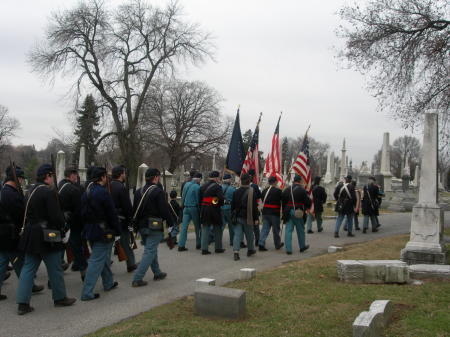
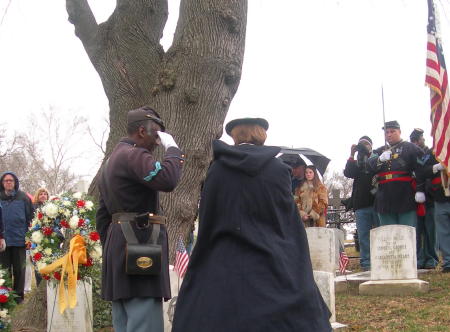
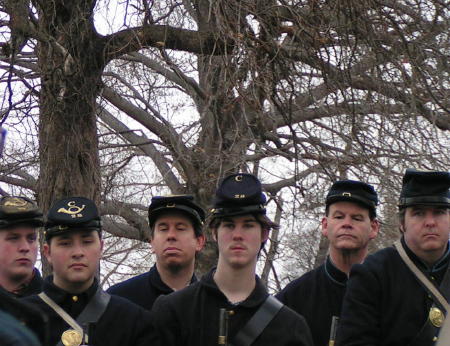
Today is not only New Year's Eve, it's also the birthday of Civil War General George Gordon Meade, which was celebrated with full Civil War military regalia by reenactors at Philadelphia's Laurel Hill Cemetery. Representatives from today's Army, Navy and Marines were all present, and the ceremony included speeches, wreath-laying, and a twenty one gun salute with Springfield and Enfield rifles. It was cold and rainy but I managed to take some pictures. Hope you like them. Um, I took all of them except this first one, as there was no way to photograph General Meade (who'd be 190 years old today): 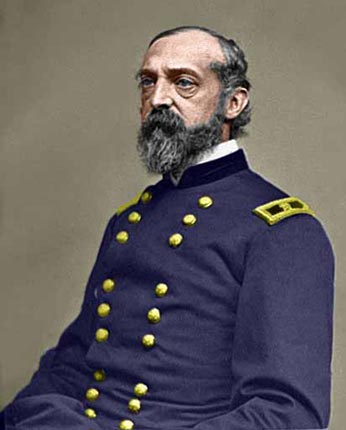 To go with the above, here's Robert E. Lee's assessment of him: "Meade, in my judgment, had the greatest ability. I feared him more than any man I ever met upon the field of battle."



Duty, however, requires me to be here, to do the little I can to defend our old flag, and whatever duty requires us to do, we should all, old and young, do cheerfully, however disagreeable it may be.Yes, we should. And with that, Happy New Year everyone! posted by Eric at 08:51 PM | Comments (3)
| TrackBacks (0)
Detecting the direction of undirected readings
Dennis's last post reminded me of certain extremely stubborn pieces of primary source historical evidence which won't go away, because they're made of metal. C-O-I-N-S. I've discussed ancient Roman coins in several posts, particularly the ones which were struck to commemorate victories over the Jews in a place called "Judea" -- which of course was named on the coin. A bound, captive Jew is proudly displayed on the reverse of one of the better known of these coins:  The coin celebrates the military exploits of emperor Vespasian who, as a Roman general, was sent in to destroy and occupy Judea in 66 A.D. (Vespasian became emperor in 69 A.D., and the coin dates from his reign.) Likewise, the Romans also built triumphal arches showing the destruction and plundering of the great Jewish Temple of Jerusalem. Like this:
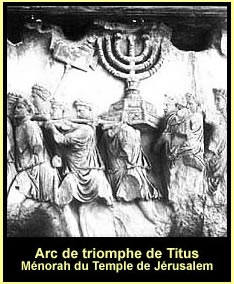
But now, thanks to Dennis, I see that the Roman presence in Judea, their military victory, the destruction of the Temple, is only my "reading" of history. What would my reading be called? Pro Roman? Or pro Zionist? According to the professor Dennis quotes, "each of us had a different but equally valid view of history." (As I wisecracked earlier, "Denial of reality is, of course, a 'view.'") That must mean that it is equally valid to declare coins and monuments "modern Jewish forgeries" as it is to see them for what they are. It might just be my "reading," but I think the lunatics are trying to run the asylum. (Well, they already are running certain asylums -- a fact which reflects poorly on people dumb enough to imagine that they're being "educated" in them.) I'm left wondering whether they actually believe their nonsense, or whether it's a tactic. Because, if they really can't recognize the plain meaning of primary source material like what's on the face of a coin, how can they be expected to do things like drive a car? Or vote? (The former requires "reading" street signs, while the latter requires "reading" ballots.) And how would you read a compass? If I say it points North, is that just my "reading?" Is it all as absurdly directionless as it seems? Or is there a hidden direction of which I'm unaware? (I try to use logic, but I'm told that too is a reading -- and a "masculinist" one.....) BTW, "masculist" is gaining in usage, but the former still wins the Google memefest. Isn't it time to look at the bigger picture? Shouldn't we ask what it is that we call "reading," and whether it has any value at all? Or why, say, should what we judgmentally call "mathematics" be considered culturally superior to drinking blood? It's going to be a long day, and I might not have time for any more posts. I think I'll take a "reading" from my watch, then go outside and try to "read" the weather. It's supposed to rain, but whether it rains or not depends on our "views." HAPPY NEW YEAR EVERYONE! (But can I really say that? I mean, isn't that just my "reading" of a Western, Judeo-Christian-centric calendar?) posted by Eric at 08:26 AM | Comments (2)
| TrackBacks (0) Friday, December 30, 2005
Reading as a weapon in the culture war
I was just thinking the other day about the politicization of scholarship and how people who inject their work with an agenda create enemies in the process. For example, I know of a 'feminist reading' of a poem by Catullus, published in a major classics journal, the stated goal of which (right there in the introduction) is to help modern man to become more sensitive and more fully human. This sort of thing willfully ignores the author's intent and the work's peculiar cultural context while serving the critic's political goals. That article was partly responsible for deepening a rift between a feminist bloc that kept silent but seethed, and a number of independent voices (myself included) who openly attacked the article in a seminar discussion. The feminists took it personally, and we were thus enemies of feminism, and were in turn misogynists. If we did not accept the feminist reading, we must have had an anti-feminist reading. You see, in this crazy, mixed-up, po-mo world, texts don't matter -- just readings. We 'read' everything from history to film, and expose the ideology of our enemies through their 'readings' as defined in contrast to our own. It's not what happened, but how you 'read' it. It says something about YOU. And YOUR KIND. Creepy, isn't it? If you reject a given reading, then you've made yourself an enemy of that reading's interest group. The group doesn't need to adhere to it, by the way. It's enough to make something a 'women's reading' that a 'feminist' critic has made it. To deny the critique is to attack women, to be a misogynist. To deny a 'queer reading' is to be a homophobe. If you're gay, you're a self-hating homosexual. If you're a woman, we might as well call you Suzy Homemaker (and that's supposed to sting). I stopped by a used book store this morning and found amid the stacks of new arrivals Mary Lefkowitz's Not Out of Africa: How Afrocentrism Became an Excuse to Teach Myth as History. The book is a rational response to a politically motivated reconstruction of ancient history called Afrocentrism, whose proponents necessarily charge their detractors with 'Eurocentrism.' (I think Afrocentrist's fail to recognize that what they see as their enemies' vice is the mirror of their own virtue.) This is the same thing that was discussed above: by creating your own subjective reading, you can charge those who challenge you with having their own subjective reading, which is often characterized as the perpetuation of a long-standing cultural hegemony or a reactionary attack. The familiar themes crop up: Lefkowitz was called a white racist, and the member of a 'Jewish onslaught.' It's funny how Jews are so often linked to white racism on the fringes of the political left. (I suspect sometimes that the ultimate target is really the Judeo-Christian heritage of the West.) In 1993 Professor Lefkowitz attended a talk by Afrocentrist author Dr. Yosef A.A. ben-Jochannan, who had been invited to deliver the Martin Luther King, Jr., memorial lecture, and who has claimed in print that Aristotle robbed the library of Alexandria: After Dr. ben-Jochannan made these same assertions once again in his lecture, I asked him during the question and answer period why he said that Aristotle had come to Egypt with Alexander and had stolen his philosophy from the library at Alexandria, when that library had only been built after his death. Dr. ben-Jochannan was unable to answer the question, and said that he resented the tone of the inquiry. Several students came up to me after the lecture and accused me of racism, suggesting that I had been brainwashed by white historians. ... Professor Lefkowitz describes the silence of her colleagues, one of whom later called the lecture 'hopeless,' thus requiring no discussion. Charges of racism, she suspects, kept them quiet. Her dean tried to pacify her by claiming that 'each of us had a different but equally valid view of history.' This last claim, common enough, negates the value of history. If any of us actually believed it we'd have no reason to make one or another reading of history. Except of course were it politically advantageous. This brings me to the point of this post, namely that there really are things knowable with a degree of certainty, that history, like science (though judged on very different evidential grounds), should not lie within the provenance of rhetoric and politics. Afrocentrism and various other agenda-driven 'readings' of history and culture that manufacture enemies are no different in this respect from Intelligent Design, that bastard child of Creationism which pits evolutionary theory against god and makes those who deny politically advantageous 'readings' of nature the enemies of Christianity. But this line of thought matters little. It will doubtless be 'read' as a racist, Zionist, anti-Christian, misogynistic, homophobic attack in support of the Western capitalist hegemony. posted by Dennis at 03:42 PM | Comments (2)
| TrackBacks (1)
Stereotypes are for sheep?
WARNING! This post has been called a "spoiler." People who don't want to read about certain details in "Brokeback Mountain" might not want to read any further.
You'd never know Childress was a terrible place merely by Googling the name. What you get are interesting facts like these: The community was named after George Campbell Childress, who wrote the Texas Declaration of IndependenceHey wait a second! Number of murders and homicides was 0? What about the awful Sawyer family who murdered motorists by the carful and then ate them? As attentive fans of "The Texas Chainsaw Massacre know, Childress was the nearest town to the murder scene. And now, from "Brokeback Mountain," we know that homosexuals get beaten to death in Childress. Which means the above statistics can't be right, can they? Should it matter that "The Texas Chainsaw Massacre" and "Brokeback Mountain" are actually fictional? That no such murders actually took place near Childress? Is it fair to ask whether Childress is a victim of unfair stereotyping? Might it have been better to pick another town? Another state, perhaps? The reason for my concern about Childress is that I saw "Brokeback Mountain" last night, and the night before that I rented and watched the umpteenth version of "The Texas Chainsaw Massacre." (A must for all fans of Full Metal Jacket's R. Lee Ermey, BTW....) What I'm troubled by is the logic of stereotyping a small town I've never visited and probably never will. Am I supposed to be more afraid of cannibals with chainsaws? Or homophobes with tire irons? Somehow, the latter seems intended as the more truthful stereotype of the two. Perhaps evocative of the death of Matthew Shepard? No, that can't be right, because his name aside, Matthew Shepard never herded sheep, and he wasn't what you'd call a man's man. He was tiny and effeminate, and it is doubtful he could have put up much of a fight -- either on the night the thugs beat him to death or any time. But the "Brokeback Mountain" guy who was murdered in Childress, well, he was tough enough to ride bulls in rodeos, physically threaten his bullying father-in-law into submission, and duke it out with his violent boyfriend. He was also smart enough to carry on a gay relationship behind his wife's back, as well as score with guys in Mexico (where such things can be more dangerous than here). He just didn't strike me as the type who'd get himself beaten to death by fag bashers. I don't mean to engage in stereotypical thinking, but the few cases of fag bashing I've personally known about took place not at the hands of cowboys, but in urban areas, at the hands of minority youths offended by gay men who ventured too close to "their" neighborhoods (and who were too open for their liking). This is not to say that small town Texans wouldn't do the same thing, but seeing stuff like that on a big screen always makes me wonder whether there's a message being sent. ("GAY MEN BEWARE! Texas towns are dangerous places.") In reality, I think most gay men would be more likely to be attacked in New York, Los Angeles, Philadelphia, or even tolerant San Francisco than in Childress, Texas. But again, is Childress really the issue? Or is there a bigger stereotype meant to include Texas, Wyoming, and other flyover states? The red-state/blue-state cultural stereotypes, perhaps? Anyway, there was just something about portraying a Texas small town that way that struck me as a bit unfair. I can see past the stereotypes (assuming that is what they are), but are there clueless people out there who won't? And am I supposed to care about clueless people? As it is, the clueless hordes drive me to utter distraction, because while I don't know where they are or what they think, they are always invoked by communitarian proponents of the National Kindergarten mindset which so infuriates me. From what the ideologues on both sides say, they -- the little people -- are victims of bad leadership and propaganda aimed at manipulating them and leading them astray. The evil Red State Neocons make them think Saddam Hussein personally directed the 9/11 attacks, fill their minds with homophobia, and trick them into voting for antigay marriage ordinances. Clearly, they don't know what they should think. This justifies the people on the other (blue state) side in telling them how bigoted, insensitive, and murderous they are, and of course what they should think. It's almost as if American ideologues on both sides believe that non-ideological Americans are sheep to be led. But it's insulting to tell people they're sheep. It can backfire. So, instead of telling them that directly, they're told that they're acting like sheep if they follow the evil ideologues on the other side. I tire of this, mainly because I dislike the idea that Americans are sheep. In fact, I hate the very idea of human sheep. I do my best to deny the existence of a class of people who want to be led, and I defend individuality to the best of my ability, because I don't think it is natural for human beings to be led, much less Americans, who are a proud, independent, individualistic people. On some deep subconscious level, I hated the endless images of sheep in "Brokeback Mountain." I'm not sure why, but I'm now finding myself wondering whether I saw them as a symbol of the imaginary mindless Americans who think what they're told to think, and whose existence I deny, but who fill me with fear and loathing. For, if we are a nation of sheep, then libertarianism is wrong, and the communitarians, the fascists, and the Communists are right. So, I refuse to believe in sheep. The catch is that it makes me sheepophobic. (Would that be oviphobic?) I hate and fear the sheep I deny, because they threaten my view of a proud, free, independent America. Is it an accident that the cowboys in "Brokeback Mountain" were portrayed as neglecting the sheep while they were screwing, or am I just being paranoid? Author (and non-Texan, non-Wyomingite) Annie Proulx doesn't say much about the sheep, but the way she talks about her characters might be seen as a tad condescending: I had to imagine my way into the minds of two uneducated, rough-spoken, uninformed young men, and that takes some doing if you happen to be an elderly female person. I spent a great deal of time thinking about each character and the balance of the story, working it out, trying to do it in a fair kind of way.It didn't seem fair to me. But then, neither did "The Texas Chainsaw Massacre," and I never complained about that. So what the hell is my problem with unfair stereotypes and sheep? (I think I should conclude by reassuring myself that these movies are all fiction and we are not a nation of sheep.....) UPDATE: A reader who wishes to remain nameless has sent an email titled "Stereotypes are sometimes real" in which he argues that in his experience, small towns are more dangerous for gays: My partner and I have lived in rural northern California together for 27 years. Our experience in many ways mirrors that of what is portrayed in "Brokeback Mountain" (We haven't seen the movie yet, but have read the reviews - so I'm kind of flying loose here.)Obviously, these things can happen anywhere, but I can only speak from personal experience, and the incidents I've known of took place in large cities. It's certainly true that Christian Identity types (as well as certain fringe fanatics) often prefer rural locations, but I'd want to see a statistical breakdown before generalizing. I do remember reading about the Matson-Mowder murders described in the email. Yet California as a state was never implicated in the same way that Wyoming was for the Matthew Shepard murder. (If I lived in Wyoming, I might consider that a double standard.) UPDATE (1/02/06): The Philadelphia Inquirer's Faye Flam rounds out the discussion of "Brokeback Mountain" with a quasi-scientific piece on gay sheep: ....in his book Biological Exuberance, author Bruce Bagemihl details gay behavior in a huge variety of wild animals. Here's an excerpt from his section on bighorn mountain rams: "Typically the larger male rears up on his hind legs and mounts the smaller male... the mountee assumes a characteristic posture known as lordosis, in which he arches his back to facilitiate copulation."I say Bah! posted by Eric at 07:57 AM | Comments (11)
| TrackBacks (0) Thursday, December 29, 2005
A strange sign
Via Samizdata, I found the perfect sign for my house:  Haven't run it past Coco yet, and it might take a little explaining. But how many dogs devote themselves to fighting coverups, promoting products, and writing in the snow? Or hiding in a trunk? 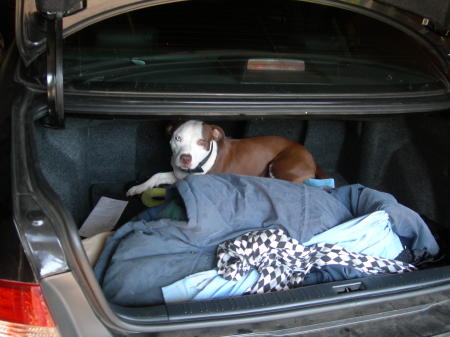 How about hiding behind designer jeans?  I'll let Coco think this over... posted by Eric at 12:47 PM
| TrackBacks (0)
Spears won't kill Piggy's traffic!
La Shawn Barber's observations about blogger responsibility are well worth reading: ....[U]nrestrained power coupled with little to no accountability is a dangerous thing. As a blogger who’s been the subject of nasty and false statements made by bloggers and in comment sections by anonymous cowards, I know what people are capable of saying when they get caught up in online anonymity. When you’re not man or woman enough to stand behind your words using your own name, high ideals like accountability and responsibility are mere afterthoughts.(Via Glenn Reynolds.) While this came up during La Shawn's response to Kathleen Parker's attack on bloggers (we're like the uncontrolled children in Lord of the Flies, claims Parker), I do think that there are probably a lot of bloggers who do behave precisely like undisciplined brats, and who are unaccountable. I'd rather avoid reading them if possible, but I think it's fair to criticize unaccountability and condemn "Lord of the Flies" antics whenever they are found. Which is not to say that bloggers in general behave that way, because they don't. These days, there are so many bloggers that there isn't any generalization which could apply to all of them -- save the fact that they all write web logs. (Well, a spammer or a bot is not a blogger. Nor do I consider certain vast conglomerates to be the same as individual blogs, but that's another issue.) Because I realize bloggers will disagree on issues like accountability (as they do on nearly everything), I can only speak for myself, and by way of definition of accountability, I can only offer the standard I apply to myself, and it's pretty close to La Shawn's. As I have said before, I have to be ready to defend anything and everything I have written in this blog, at any time. That's a pretty tall order for anyone writing opinions every day, as it is impossible to do this and be right all the time. Accountability means knowing the difference between fact and opinion, being willing to admit and correct errors and (at least for me), always being open to the possibility that I might be wrong about nearly everything. Even my most deeply held beliefs. For example, it is always possible that there really does exist the God so many people want to see as the angry bearded legend who sends people to hell for things like using their genitalia for purposes he's said to dislike. It is therefore possible that I might face eternal damnation. Although I have to be just as willing to acknowledge and answer for everything I have done in my life as I am to defend the thoughts in this blog, I live with that possibility, and the only bright side is that I'd probably be going where most of my friends have gone. I might not believe in such a God, but I know it's just my opinion and belief, and other people have other opinions and beliefs. Similarly, I don't believe in Communism, socialism, or other forms of communitarianism, but I must acknowledge that my beliefs may be wrong. I hesitate to attack people simply because their opinions differ from mine, and I try to limit my disagreements to the ideas rather than the people who hold them. But I'm human, and I'm always tempted to return fire when differences of opinion are coupled with ad hominem attacks. If only the world of opinion consisted of verifiable facts! But it doesn't. Even the distinction between fact and opinion can be tricky. Many people believe what they want to believe despite evidence to the contrary. This leads to assertions of being wrong, of lying, and of being stupid or evil. In general, people who are willing to acknowledge that they have said what they said and are willing to defend it in a sincere manner are less likely to resort to insulting ad hominem attacks, they are more accountable, and less like the kids in Lord of the Flies. I think the flaw in the Lords of the Flies analogy is that in the novel, a bunch of ordinary kids found themselves on an island where they reverted to natural savagery which resulted in mob tyranny by bigger and stronger boys. While some bloggers might voluntarily submit to systems which could be characterized as mob rule, there is no way for them to rule over other bloggers. If, in the blogosphere, a blogger doesn't want to join an online mob, there's no way to make him do anything, and there is no way to destroy his blog. Unlike "Ralph" (or poor "Piggy"), he can't have his glasses broken or be speared to death by other bloggers for speaking up. There might be people who'd want to do that, but they're ultimately powerless because the Internet more resembles a universe than a small island. The only spears to be thrown are verbal. And here's the problem and paradox for would-be tyrants (whether of the MSM or blogger variety): the stronger and sharper their verbal spear thrusts, the stronger their "victims" become.
posted by Eric at 09:53 AM | Comments (4)
| TrackBacks (1)
Drugs and terror. A nexus of evil?
That last story (about an innocent girl whose imprisonment on phony drug charges resulted from an airport search) highlights a longtime concern I've had about the war on terror, and that is that the "War on Drugs" may be its Achilles heel. The problem with giving authorities extraordinary powers to search citizens for bombs is that there's no clear line limiting their jurisdiction. That's because once an officer has the right to search you for things including, say, a "white powder," (which might be TATP), any other white powder he finds becomes admissible as evidence. It doesn't take much imagination to see how this can pave the way for a hellish future in which all citizens are subject to search at all times. Arguably, we may be there right now. To fight terrorism, many citizens are willing to be searched, whether on planes, trains, or buses. It wouldn't take more than one or two suicide car bombers to cause people to willingly allow searches of their cars, too. And with geiger counters pointed at homes, how much more difficult would it be to add computerized drug sniffing devices? Would Americans tolerate what would be totalitarian police tactics in the fight against terrorism? It depends. I think many of them would. But throw in the damned "War on Drugs," and limited, quasi-totalitarian tactics can lead to a nexus in which our constitutional freedoms are lost -- a scenario which I think may be a bit too intolerable for most people. While there may be practical ways to exclude drug law enforcement from the war on terror, I don't see much discussion of it. In fact, I see precisely the opposite. From a recent piece in the Christian Science Monitor titled "Terror War Aiding Drug War": As Congress and President Bush wrangle over the USA Patriot Act, the Border Security bill, and other tools of the war on terror, they may want to keep another law-enforcement group in mind – the nation's drug-fighters.If this trend continues, I think we can expect more Drug War abuses committed against citizens in the name of the War on Terror. For the record, I strongly support the War on Terror, and I strongly oppose the "Drug War." I wish that certain totalitarian-minded bureaucrats wouldn't keep trying to blur the distinction, as I'd hate to have to change my mind. UPDATE: This policy briefing makes a good case that the Drug War is actually impeding the war against terrorism in Afghanistan. As I've argued before, the Drug War is also a great way to turn former allies into enemies. posted by Eric at 08:16 AM
| TrackBacks (0)
As laughable as a hoax
(Except I'm not laughing....) The main reason I thought the Little Red Book hoax was so laughable was that I couldn't believe that federal officers would seriously waste their time on innocuous, universally-available, tacky Communist kitsch. A story in this morning's Inquirer, however, would be even more laughable if it wasn't true, which it appears to be. Amazing as it sounds, a Bryn Mawr college student was arrested not for a silly book, but for flour in condoms: She was a freshman on an academic scholarship at Bryn Mawr College, preparing to fly home to California for Christmas, sleep-deprived, with questions from a calculus exam still racing through her head.It wasn't as if she was trying to pass the stuff off as drugs, either. The girls at Bryn Mawr are known for making goofy arts and crafts things during Finals Week, and young Ms. Lee stuffed the condoms to make improvised stress squeeze balls (a bit like these omnipresent things). Obviously it was not a busy day for terrorism, as the authorities we normally trust to keep us safe from Osama bin Laden devoted themselves assiduously to putting this girl in jail on trumped up charges: ....[S]creeners at Philadelphia International Airport inspecting her checked luggage found three condoms filled with white powder. Lee laughed and told city police they were filled with flour. It was just part of a phallic gag at a women's college, she told them, a stress-reliever, something to squeeze while studying for exams.How in the world could a "field test" determine that flour was opium and cocaine? The police won't say -- and apparently many of the records remain "confidential": Capt. Benjamin Naish, a spokesman for the Police Department, declined to comment, noting that the department rarely comments on litigation. Cathie Abookire, a spokeswoman for the District Attorney's Office, also declined to comment.(Only after she got a lawyer was the flour retested again and determined to be flour.) I don't blame this woman for suing! I note that her lawyer (former White House appointee Jeremy Ibrahim) is no slouch, and I honestly hope she ends up owning the Philadelphia Police Department and the Philadelphia Airport so she can fire everyone responsible and tell the rest to devote themselves to fighting terrorism. While I find the story hard to believe, the Inquirer is not some college newspaper, and I don't think they'd have run this story without checking the facts. I have a brief observation and a question. First of all, airport authorities have no business abusing the extraordinary powers granted them during war on terrorism to shake down people for drug offenses -- real or (as in this case) imaginary. Second of all, what the hell kind of "drug field tests" are being used in this country? If they can't determine the difference between flour and cocaine and opium, why, it makes me afraid to get on a plane. (Especially if I'm carrying well-known methamphetamine precursors like sudafed and lithium.) AFTERTHOUGHT: My gut reaction to this is that the police probably never did a field test. It's just a guess on my part, but my common sense tells me that they just made up the test results to "teach her a lesson." If so, I hope she teaches them a lesson. I wish it didn't have to be at the taxpayers' expense, but maybe if things like this happen more often, people will start asking tough questions about the growing totalitarianism inherent in that damnable human rights atrocity so euphemistically called the "Drug War." MORE: Via Glenn Reynolds, Michael Totten looks at airport security in Libya (a "total-surveillance police state" in which "one person in six works for the secret police"): A bored official glanced at my visa, rubbed his face, stamped my passport and pointed me toward my first Libyan checkpoint. A man in an untucked button-up shirt, with a cigarette jutting out the side of his mouth, waved me toward a metal detector. He hadn’t shaved in two days. I walked through. The alarm screamed and I braced for a pat-down. He just stood there, took a long drag on his cigarette and stared bleary-eyed into space over my shoulder. I guessed that meant I could go. So I did.I hate to say it, but right now I'd rather be searched by lethargic Libyans. posted by Eric at 07:25 AM | Comments (5)
| TrackBacks (0) Wednesday, December 28, 2005
Breaking the back of violence and other U.S. "exports"
In what appears to have been a gang-related dispute in Toronto yesterday, a girl was killed and six people were injured in a shootout in a crowded shopping center. Rather than blaming the individuals who did the shooting (or even gang violence), Toronto's mayor blames guns. And above all, he blames the United States: Mayor David Miller said almost every other type of crime is down in Toronto, but the supply of guns has increased and half come from the United States.I'm not much of an expert on imports and exports. However, Mayor Miller is right there on the scene, so obviously he knows more than I do about United States exports. If in fact we are exporting what he says we are, why not simply impose a huge tariff? Whenever guns or violence appear at the border, just tax them! No, that wouldn't work for guns, because they're already subject to considerable regulation. As the U.S. State Department points out, importing most firearms into Canada is severely restricted: Prohibited FirearmsAll handguns which are not prohibited are restricted, and according to the State Department are subject to lengthy bureaucratic delays: To be able to bring a restricted firearm to Canada in person, you will need to obtain an Authorization to Transport (ATT) from the CFO of the province where you will be entering Canada. If you are bringing firearms with you and declaring them with a Non-Resident Firearm Declaration, you will need to wait until your declaration has been confirmed, before you call the CFO to request an ATT.I'm wondering whether any of the guns used in yesterday's Toronto shooting were either prohibited or restricted. If they were brought in from the United States illegally, can it really be said that the U.S. "exported" them? What I'd like to know is how we manage to "export violence" to a country with which we're not even at war. Well, more prominent minds than mine have argued that the United States exported homosexuality into a country we invaded. Perhaps it's no coincidence that "Brokeback Mountain" was unveiled to wide critical acclaim at the Toronto Film Festival last September. Wow. I also see it was set for "wide release in Canada in December." (The same month as the shooting!) posted by Eric at 11:05 AM | Comments (4)
| TrackBacks (0)
The only real Christian is a loud and angry Christian?
History is written by the victors. And so is morality. In another reminder of the principle I touched on in the last post (that moral debates are won by those who yell the loudest), Jeff Jarvis links to a very tedious "Culture War" skirmish between the American Family Association and NBC. The AFA has decided that a television program ("The Book of Daniel") -- featuring a minister with a substance abuse problem -- is an attack on Christianity and Christians. Why would that necessarily be the case? Didn't Jesus go out of his way and endure great criticism to befriend and hang out with disreputable people like drunks, tax collectors, and sinners of various stripes? Wasn't Jesus the guy who Christianity was named for? I haven't seen the series (it hasn't aired yet), but in theory, why can't a guy with a substance abuse problem be one of his ministers as long as he beliefs are sincere (which according to the website they apparently are)? Can't they at least watch the show before jumping to the conclusion that it's against Christianity? A major reason the AFA gives for opposing the show is that it's written by a "practicing homosexual." I'm assuming their argument is that this is bad on it's face, because no Christian could possibly be a homosexual, because homosexuality is condemned as a sin in the Bible. But isn't there someplace else where it says all Christians are sinners? Aren't there also adulterous Christians, lying Christians, covetous Christians, and Christians who don't always strictly obey the Sabbath? Is the AFA arguing that Jesus would want a background check run on all writers to see whether they're free from sin? Furthermore, where do they get the idea that homosexuality was one of Jesus Christ's primary concerns? Is the AFA free from sin? If not, then who put them in charge? One thing is sure: they'll try to yell louder than anyone else. That's because they hope that their yelling will be seen as the only "Christian" voice. Loud, cacophonous, and unreasonable. Isn't that how the godless secular atheist heathens want to portray all Christians? Back to Jeff Jarvis, who raises an interesting point about fairness. Change the channel. Go watch the 700 Club, which offends me, though I’m not trying to keep you from watching it.Jeff's point about changing the channel, of course, is lost on people who are not content with merely not watching something they don't like; as he says, their goal is to stop other people from watching what they don't like. Again, assuming there is some right to not be offended, isn't it possible that some Christians might find the 700 Club just as offensive as other Christians might find "The Book of Daniel"? Don't they have just as much right to complain that the 700 Club presents Christianity in an unfavorable light, and does great damage to the cause of Jesus Christ? Legally speaking, they do, but they're just not as loud in presenting their moral argument. Whether it be a left wing or right wing variety, it's because morality is often confused with volume that the loudest voices win. posted by Eric at 09:10 AM | Comments (7)
| TrackBacks (1)
Toys 'Я' worse than Communism and murder?
What is art? What is speech? What is offensive speech? Such questions leaped from the front page of today's Philadelphia Inquirer in an article about Sony's "Playstation kid" graffiti advertising campaign. Local activists who favor political murals but hate corporate ones are in a dither: Sony has conceded that the graffiti ads are not spontaneous art, but contrived marketing for the handheld games.I know it's a simplistic question, but I'd like to know why a permit would be required for a Playstation kid, but not for Che Guevara, Rachel Corrie, or Tookie Williams? (In many cities, even building owners are prohibited from painting over what's called "mural art.") Is the current uproar over the fact that someone wants to make money, and that's bad? Unlike the case of regular graffiti art, Sony is paying the owners of buildings to allow the art, and some of them like it. (A fact which appears not to matter at all.) It strikes me that there is a serious philosophical question somewhere in all of this. Dare I ask whether this question involves morality? Commercial graffiti is more immoral than graffiti glorifying murderers? New York blogger (and "street-art aficionado") Jake Dobkin does not like Sony's Playstation graffiti (to say the least): I've written about this so many times on Gothamist that I'm worried about sounding like a broken record-- but apparently the big corporations have not gotten the message. This week, Sony Playstation graffiti pieces have been popping up like cancer all over Manhattan. The pieces are sometimes drawn by hand-- others are wheat pasted to walls all over SoHo and NoLIta. It's clearly a large campaign, and deserves a thoughtful, measured response. Here's mine: corporate graffiti sucks. Sucks! Sucks! Sucks! It sucks for a variety of specific reasons....He lists the reasons why it sucks (exploitive, fake, deceptive, illegal, hated by neighbors, bad PR, etc.), and I think he has some good points. He also provides a photo of Sony's sucky-ass art:  I have to admit, I don't especially like Sony's graffiti art, but I think there's a huge double standard which isn't being acknowledged. Forgetting for a moment First Amendment concerns, I'd like to ask why there should be more of a moral right to deface buildings with pictures of a communist murderer than with pictures of the Playstation kids. For example, Mr. Dobkin links to some of his own art, which features a picture of Che Guevara surrounded by BB King, Ernest Hemingway, and others. Many people wouldn't mind seeing Che Guevara, but many would. (I know it's just my own personal opinion, but may I be so bold as to venture that Communism sucks?) While I'm not especially offended by Dobkin's work (because he's at least kind enough to also feature images of people I do like), here's an example (by another artist) which typifies the type of mural I don't like:  Again, why does the fact that this is not commercial make the above morally superior? Is it less offensive because it doesn't advertise a product? Isn't it advertising Communism and murder? Aren't Communism and murder at least as offensive as high tech toys? Well, no! That's because making money is immoral. Committing murder in the name of "social justice" is not. Whether anyone likes it or not, moral questions are won by those who scream the loudest. (What, you're expecting I should scream more loudly? On behalf of the DRM-virus-spreading Sony?) UPDATE (12/29/05): Yahoo has picked up the story, and links to a photo of Sony's actual Philadelphia, um, art.  The owner likes it, but the City says he has to get a license because he violates "zoning" or something. (And of course, commies get to advertise free.) Go figure. posted by Eric at 07:55 AM | Comments (3)
| TrackBacks (0) Tuesday, December 27, 2005
Fatally bad manners?
Via Pajamas Media, here's a tale of road mob psychosis: MILWAUKEE, Dec. 27, 2005 (AP Online delivered by Newstex) -- At least 15 young people dragged a motorist out of his car and kicked and punched him, causing severe head trauma, after he honked his horn to get them to move out of a street, police said.According to the article, there have been other similar incidents. I'd say there's a failure of law enforcement in Milwaukee, and if I had to live there, I'd want be be armed. Had the driver been armed, he'd have been fully justified in defending himself against a crowd of fifteen murderous people. As it was, he was defenseless. But that is no excuse for what may well have been rudeness on the part of the driver. Being in a car does not entitle a driver to behave any differently than he would were he walking down the street. I'm reminded of an incident in New Jersey in which a driver who'd been cut off in traffic followed another driver all the way home, ran him down with his car, whereupon the injured driver struck back with his fists and killed the other driver. He'd have been equally justified in shooting back, and that is true notwithstanding his initial rudeness. Cases like this make me wonder whether armed drivers might not be a bit slower to anger in situations that provoke confrontations. There's truth to that old saying -- "An armed society is a polite society." Most of the people I've known who carry guns also understand the consequences of escalation, and consequently, they're slower to do things like flip people the bird. MORE: According to this organization working to change the laws, Wisconsin is "one of only four states that prohibits anyone other than police officers from carrying concealed weapons." I'd say it's a good place to be a criminal. UPDATE (12/30/05): Five uveniles may soon be charged with the mob beating: Two are 17 years old, two are 16 and one is 14, according to a police statement that did not give the genders of the suspects in the attack on Samuel McClain, a 50-year-old father of 12. Police continue to seek more suspects, the release said.Pictures of the victim before and after the incident can be seen here. AND MORE: According to this report, three teens have already been arrested. CNN has another report of the arrests, as well as pictures. posted by Eric at 04:35 PM | Comments (1)
| TrackBacks (0)
The mother of all precursors
In my haste to complain about the crackdown on sudafed sales to Americans with colds, I forgot about something that a lot of people seem to have forgotten about: a substance called phenyl 2 propanone (also known by the abbreviation P2P). Back in the 70s and 80s (a period I remember well) there was at least as much methampetamine abuse as there is now, but instead of using sudafed as a precursor, the meth labs used P2P. This triggered a crackdown on P2P, which led to the shift to sudafed. It's been so long that I'd forgotten. But the lab operators don't forget. In the 1960s and ’70s, biker gangs made meth using phenyl-2-propanone, a dark brown syrupy chemical that eventually was regulated by the government. Methamphetamine made in “mom-and-pop labs” is chemically different than its 1960s counterpart, making it extremely addictive, police say.It's the business of these people to make methedrine whatever way they can, and if they can't get sudafed, they can always go back to P2P. Whether, as police say, the old fashioned stuff is "chemically different" (and therefore less addictive) is debatable, because methamphetamine is methamphetamine. The only difference might be in the way it's cut. P2P is not an especially profound substance. It's not mind altering, and cannot get anyone high. Yet it's regulated as a Schedule III narcotic -- something which caused the lab operators to switch to the less regulated pseudoephedrine. Here's one underground chemist shooting off his mouth: The major problem with methedrine synthesis is procuring the precursors. Phenyl-2-propanone is the most direct precursor to my knowledge and is (unfortunately?) at Schedule III controlled substance. It has no pharmacological activity and yet the DEA saw fit to regulate it around 1975. The first synthesis I will give uses this in as a starting material. Actually it is still possible to find this substance tucked away in store rooms in many universities that presumably purchased the compound before it was controlled. A friend of mine came across 500 mls made by Eastman Kodak in the stock room at Princeton. I purchased 100 mls when I lived in England many years ago and did my first run using it. The reaction can be completed in about 6 hours giving about 60% yield; I am a biologist, not a chemist so someone who knew what they were doing could probably improve on that.The recipe he goes on to supply appears no more complicated than many kitchen recipes; all you need is old fashioned P2P. Are history and chemistry being forgotten in the latest bout of hysteria? An MSN piece by Jack Shafer debunked current hysteria with much-needed historical perspective, and it's worth reading if you marvel over the cyclical nature of hysteria (or enjoy reading about drug addiction in the White House): One well-known and avid consumer of legal amphetamines was President John Kennedy. When users (and dealers) couldn't obtain a doctor's prescription, they would divert the drugs from legal channels—stealing them, forging prescriptions, setting up fraudulent companies and ordering them from the source, or smuggling them across the border. Use was so prevalent that a 1964 study in Oklahoma City (population 300,000) identified 5,000 individuals who got amphetamines and barbiturates (downers) through illegal sources.Of course, the switch from legal to illegal led to the switch from P2P to sudafed: In 1988, the federal government attempted to curtail the production of illicit methamphetamine by severely restricting access to the P2P precursor compound. Some chemists switched to ephedrine, which could be found in cold remedies, and when the government suppressed ephedrine, some moved on to pseudoephedrine, the active ingredient in Sudafed and other decongestants. Now, the government strictly limits even the sale of over-the-counter preparations containing pseudoephedrine. According to Newsweek (which I should be reluctant to present as a reliable source), the precursor clampdown helped drive half of all U.S. methamphetamine production to Mexico, where there are few controls.And if you really enjoy being titillated by the vagaries of the "Drug War," this piece on "Nazi Meth" is a real treat. Excerpt: Large amounts of the drugs were diverted into the black market, which swelled in the 1960s as speed use escalated, prompting Congress to enact laws to stem illicit sales in 1965. It was then that clandestine labs really started to proliferate, many of them large-scale. The region between Dallas and Oklahoma City, with its ready access to interstate highways and its miles of unpatrolled farm and ranch lands, became home to more than its share of "P2P" labs, named after one of the precursor chemicals, phenyl-2-propanone. Back then the manufacturing process required some chemical savvy, it smelled much worse than the Nazi method, and it took a few days; speed cooks would go out into the country and come back with a pound or two. In North Texas it was, in part, a kind of oilfield supply business: Roughnecks commonly took speed to get through their shifts of 12 hours and longer.The current crackdown is intended to slow the production of "Nazi Meth" (a label which sounds emotionally contrived, as if to inflame pro-Drug War passions), but if pseudoephedrine becomes as scarce as P2P, the chemists will simply synthesize whichever precursor is easier. Regarding "Nazi Meth," it's not my purpose to get into underground chemistry, but the recipes are readily available online. This anti-meth website's summary of the ingredients highlights the drug cookers' ingenuity (and in my view, the futility of criminalizing the human appetite): Once the ephedrine has been extracted, the cook will manufacture “Nazi” or “Red P” meth. Both “recipes” utilize heat and chemical reactions to manufacture the finished product, Methamphetamine Hydrochloride. The process is essentially the same with the exception of the agents used in the reaction. In Nazi meth, the cook will add lithium strips, usually extracted from batteries, and anhydrous ammonia to the reduced ephedrine to start the chemical reaction. In the Red P recipe, red phosphorous, usually extracted from match tips, and iodine are used in lieu of lithium and anhydrous. Most of the ingredients used in ephedrine reduction can be purchased legally, thus contributing to its popularity. Common household items used in the production of meth include denatured alcohol, ether, salt, drain cleaner, camping fuel, paint thinner and lye. Obviously, most of us would be reluctant to ingest ingredients. However, most of these precursor ingredients are destroyed or consumed in the manufacturing process and the finished product does not contain the poisons used in the process. The availability of these items and the simplicity of the process contribute to meth’s growing popularity.Isn't it about time we banned lithium batteries? I mean, does anyone really need a digital camera or MP3 player? Why, I'm almost ashamed to admit that my very own Nikon Coolpix 7900 has a lithium battery! I already knew I had the deadly sudafed in the house, but had no idea how guilty I truly was. So I might as well confess, folks. For the past week, I suffered from an awful cold, but I've had many social commitments. This situation has required me to take sudafed regularly, while running around with my camera, and until now I hadn't realized that I've been a walking speed lab. (And a Nazi one at that! Have I no shame?) Making me get rid of my camera would be a small price to pay if it would save just one life.... Satire aside, there's a serious irony in all of this. When I was a kid, amphetamines could be easily obtained from any doctor, and the "speed problem" was a medical problem. And a much less dangerous one. There's a lot of talk about medicalizing a host of social problems, including such things as bias, and even guns. But here, an actual medical problem has been de-medicalized, and instead of people going to the doctor for a prescription, they're polluting veins and sinuses with foul stuff like the (new and improved) "Nazi meth." Can anyone tell me how this is an improvement? posted by Eric at 09:03 AM | Comments (1)
| TrackBacks (0) Monday, December 26, 2005
Almost back, but not on track!
Not quite through the Christmas social ramble, so I'm not back to regular posting. But here are couple of pictures I took today. This was near the railroad tracks:  And here's something more festive:  (At least, I guess that's festive.....) posted by Eric at 04:34 PM | Comments (2)
| TrackBacks (0)
Shrinking common sense
In an earlier post I objected to the medicalization of bias, because I see this as leading towards classfying dissent as disease. However, some of the top minds in the psychiatric community not only continue to insist that bias is a mental illness, but they do so in language revealing such contempt for the distinction between the sanity and insanity that I wonder whether they believe everyone is insane (or want them to be). Fortunately, there are still mental health practitioners with enough common sense to object: Advocates have circulated draft guidelines and have begun to conduct systematic studies. While the proposal is gaining traction, it is still in the early stages of being considered by the professionals who decide on new diagnoses.The problem with pathologizing all of life is that if everyone is sick, then no one is sick. There are people who are really suffering and unable to perceive reality amidst hallucinations. When the great egalitarian state lumps them in with people who are shy at cocktail parties and children who don't pay attention in school, or simple bigots, then how are they to get the help they so desperately need? Might as well just diagnose them as "homeless" and tell them they're victims of capitalism while they run around yelling at people who aren't there. But never mind that. It all comes down to social, um "context": Psychiatrists who advocate a new diagnosis, such as Gary Belkin, deputy chief of psychiatry at New York's Bellevue Hospital, said social norms play a central role in how all psychiatric disorders are defined. Pedophilia is considered a disorder by psychiatrists, Belkin noted, but that does not keep child molesters from being prosecuted.Pathological bias is no more or less scientific than major depression? I don't even know how to begin to analyze a statement like that. I'd almost swear the man believes science stands in opposition to common sense. (Perhaps common sense itself will soon be declared a delusion, and therefore worthy of DSM inclusion as a disease.) posted by Eric at 09:07 AM | Comments (9)
| TrackBacks (0) Sunday, December 25, 2005
Something still smells fishy, and I don't know what. . .
I'm sorry, but the story about the Little Red Book hoax (and the now disappearing "student") continues to not make sense: Mr. Hoey, the university spokesman, said the university had been unable to substantiate any of the facts of the story since it first was reported in The Standard-Times on Dec. 17.Why is this student being protected and his identity being withheld? Has anyone even seen or talked to him other than the same people who've quoted him from the start? How do we know he even exists? We have only the word of the same reporter who broke the story (Aaron Nicodemus), plus the professors who were supposedly conned, and "university spokesman John Hoey," who seems overly eager to provide official cover for both the student and his professors. The tale was so laughably unbelievable that at this point I can't believe anyone in this group ever believed it. I'm wondering whether they ever did. Naturally, this makes me wonder about the "source." (Considering his statement that he received "75 messages and like something like 87 missed calls," his identity shouldn't be too tough to track down.) MORE: The Boston Globe claims that someone from the Globe spoke to the student, but won't say who, nor will they identify him: The student was not identified in any reports. The Globe interviewed him Thursday but decided not to write a story about his assertion, because of doubts about its veracity. The student could not be reached yesterday.Why not interview him again? This story was important enough to be cited by Senator Kennedy, and it's been reported all around the world. Now that it's been identified as a hoax, why protect the identity of the hoaxster? Regarding the hoaxster's professor, his website shows that he's a sophisticated international traveler, and not someone who'd be expected to be taken in so lightly. The story just doesn't make sense. What's going on now more resembles political damage control than reporting. MORE: Because he asks such a good question, Glenn Reynolds' comment is well worth repeating: I'm disturbed tremendously that such a suspicious story was accepted so uncritically by alleged critical thinkers -- and I'm a bit surprised that the student's identity is still being protected. Why shouldn't we know who's behind this?Why? If I may be permitted to speculate, I'll offer an answer. Because, if it were discovered that the identity of the person claiming to be protected was fictitious, that might shed too much light on who's behind this! If, on the other hand, there really is an unnamed student whose identity is being protected, it would behoove the professor(s) to speak up. Otherwise speculation like this is fair game. MORE: Regarding motivation, I want to return to the apparent claim by original reporter Aaron Nicodemus that the student wanted attention ("Wow, I was popular. I usually get one or probably two a week and that's about it, and I usually pick them up.") I think it's very odd that a student who enjoys a circus atmosphere would not want more. (And I agree with commenter Swen Swenson that it's even odder that "one of those [87] callers wouldn't like call the press just to like claim their 15 minutes.") Unless, of course there is no student. And no 87 calls. AND MORE: There's a reason I'm dwelling on this at such length, and that's because if the student did not exist, the hoax becomes much larger (and infinitely more perfidious) than if he did. I think the people who pushed this story now have a duty of full disclosure. MORE: I'm also intrigued by Professor Pontbriand's statement that the alleged student is in need of care and attention: "It was a disastrous thing for him to do. He needs attention, he needs care. I feel for the kid. We have great concern for this student's health and welfare."If we are to believe the accounts, this story involves a 22 year old man who fabricated a tale and then admitted he lied when the details didn't check out. If Professor Pontbriand knows that this student has health problems, when and how did he discover that? Is additional information being withheld? Or is the professor assuming that lying is a form of illness? (If it is, the world is a much sicker place than I thought . . .) MORE: It is possible that the student could be half-fake. That is, there might have been no student with the initial story, but as the pressure built, the professor found someone willing to impersonate the alleged lying student, safe in thne assurance that he would simply disappear and his identity would never be known. That way, people could honestly claim that they'd seen and talked to him. But this is all pure speculation, based on the mysterious failure to identify a "confidential liar." AND MORE: Michelle Malkin discusses campus hoaxes. (The "Little Red hoax" isn't the first one...) posted by Eric at 07:34 PM | Comments (2)
| TrackBacks (0)
Merry Christmas Everyone!
Lots of running around today, so blogging will probably be light. But Coco and I wish everyone a Merry Christmas!
posted by Eric at 09:58 AM
| TrackBacks (0) Saturday, December 24, 2005
NEWSFLASH! Santa has been debunked!
(Oh really? The Devil, you say . . .) Whether I agree with them or not, within certain limits I try to respect everyone's beliefs. This respect might even extend to beliefs I consider childish or ridiculous, depending on the context. Such as the age of the, um, believer, perhaps? Anyway, it's Christmas Eve and I found myself intrigued and irritated by this story about a teacher apparently unable resist debunking Santa Claus for six year old children: Theresa Farrisi stood in for Schaeffer’s regular music teacher one day last week. One of her assignments was to read Clement C. Moore’s famous poem, “A Visit from Saint Nicholas” to a first-grade class at Lickdale Elementary School.(I hope she debunked Kwanzaa while she was at it....) Farrisi doesn’t believe in Santa Claus, and she doesn’t think anyone else should, either. She made her feelings clear to the classroom full of 6- and 7-year-olds, some of whom went home crying.Well! We can't have children thinking things that aren't true, can we? Next thing you know, they'll start believing in the Easter Bunny! Or the tooth fairy! Or storks bringing babies! "Mommy, why did you lie to me?" Good question, damn it! It's high time six year olds when home and confronted their parents about these and other very harmful lies. My immediate reaction was to assume that this teacher was probably one of those "godless secular atheists" we've been hearing about. But I should never assume, because after a minimum of digging, I found an additional report, which reveals possible religious bias by Ms. Farrisi: ....erecting a sign along the eastbound side of I-78, between the Bethel and Grimes exits, Leonard H. Martin has taken it upon himself to shatter the myth of Santa Claus for any youngster able to read the message from the back seat of a car as their parents drive by.Gee. Now I'm confused. Next she'll be telling the kids that Halloween is evil and Satanic. What I want to know is, can Ms. Farrisi prove there's no Santa Claus? As I proved two years ago today, science, religion, and logic are all very close to agreement that Santa Claus does in fact exist, which means Ms. Farrisi is promoting junk science, bogus religion, and bad logic. She has 24 hours to repent or else she's getting coal in her you-know-whats!
posted by Eric at 08:59 AM | Comments (4)
| TrackBacks (0) Friday, December 23, 2005
Suffocating Mary
Let me begin with a disclaimer: I consider myself a non-practicing atheist. (i.e., I don't believe in gods, but I'm not evangelical about.) What follows is only logical. A british artist has pulled one over on the Jesuits at America (a Catholic weekly magazine), buying an ad for a sculpture of the Virgin Mary in a condom (described as a 'latex veil'). Many will consider the artist's motive just, as he clearly does: The artist, British-based Steve Rosenthal, said in a media e-mail on Thursday, "The primary aim of the work is to highlight the Vatican's continuance of non-advocation regarding the use of condoms and I conceived America magazine to be the most suitable place to contextualize the work outside of the gallery space and produce a dialogue." Let me parse part of what Rosenthal said. 'Continuance of non-advocation regarding the use of condoms' is, stated another way, 'failure to advocate condom use.' The complaint appears to be that the Catholic Church doesn't actively take an advocacy position on the promotion of condom use. But is that really what the Catholic Church should be doing? Isn't that asking the Church to cease being the Church? Marriage ('Holy Matrimony') is one of the seven sacraments which Catholics believe were instituted by Christ as the basis of the New Law. They believe that Jesus writes the the New Law 'on the hearts' of the faithful, as he said in the Sermon on the Mount. It, and its sacraments, are thus part and parcel of Catholic faith. Why do I bring this up? Because Catholics also believe that sex has no place outside of 'Holy Matrimony,' the greater purpose of which is the salvation of others (i.e., one's family). The purpose of sex within the context of Catholic marriage, then, is to make more Catholics. Incidentally, the sacrament of marriage is believed to restore the natural union of man of woman as found before 'the fall.' Catholics believe that sin introduced lust. You might as well lobby the Church to promote masturbating to internet porn: while most of us see the difference, Catholocism doesn't. And so it is completely out of the realm of possibility for the Catholic Church to advocate any kind of sexual activity beyond that outlined in one of its core sacraments. To do so would be to deny the importance of its own beliefs. It would tell the fold 'aim high, but don't sweat it if you miss.' That's why we in the West don't allow religious law to write the state's laws (i.e., there is no equivalent to the Muslim application of Sharia). The rest of us don't accept the Catholic sacraments, and we don't need the help of those who do in order to address issues outside their highly restrictive moral code. Our answer is condoms; their answer is not to have sex, and they can't have any other. Which explains the title of this post: the imagery of the condom on the Virgin Mary was meant to convey something quite different, but I think it's best interpreted as symbolizing an attempt by non-Catholics (or even Catholics who defy or misunderstand the sacraments) to suffocate the Church by removing its most sacred beliefs. What goes for 'offensive' TV goes also for churches: 'If you don't like it, change the channel.' If you don't accept a church's beliefs, don't join it. None of this, however, addresses what might be a legitimate issue, and that's whether the Church contributes to the spread of disease by actively opposing those who advocate condom use, particularly in the developing world. Is that the case, and if so what do you do about it? posted by Dennis at 01:54 PM | Comments (10)
| TrackBacks (0)
Politicizing self hatred?
Reflecting on the "all-gays-must-see-this" hype surrounding the release of "Brokeback Mountain," Sean Kinsell demonstrates why he's one of the most honest voices in the blogosphere: ...those of us who don't see our story in it have to be allowed to appreciate it on our own terms and to our own degree, and that's where I find the implication that it's our homosexual duty to rally around Brokeback Mountain, the pop culture phenomenon, annoying. Gays deserve as much liberty to decide whom to identify with as anyone else does. Sometimes we'll sympathize with people without necessarily seeing them as reflections of ourselves, even if gay advocates deem it politically expedient to do so. We have to be as free to choose for ourselves as we are to speak for ourselves.If only a time would come when it wouldn't require the courage that Sean displays to say what really amounts to common sense. A lot of gay men would agree with Sean, but they don't feel free to say so. This is a movie, for God's sake. If you can't identify with two cowboys falling in love (of if that just doesn't fulfill your romantic ideal) that should not mean you hate yourself or that there's something wrong with your view of the world. To analogize to a heterosexual setting, how many love stories have been put on film with which all heterosexuals can identify? I've seen a lot of shlocky love films, and some that are considered timeless classics, but that doesn't mean I've been able to identify with them. A good example is "Gone With The Wind" -- a great film, but I just couldn't relate to either Rhett Butler or Scarlet O'Hara as especially worthy of love, so I had little empathy with either side of this dysfunctional relationship. Had the same relationship been homosexual in nature, I'd have thought it equally irritating. These things are personal, and I can think of few things more distasteful than the idea of culturally dictated tastes. Popular culture is often held hostage by lowest common denominator thinking, and I don't see why I should apply a separate standard to a film because Hollywood has bent over backwards to smash some all-American stereotype about cowboys. I mean, wasn't it Hollywood which gave us the cowboy stereotype in the first place? Might this film reflect some need to demonstrate that Hollywood has the right create and destroy these stereotypes at will? Is it reasonable to ask whether "Brokeback Mountain" might be seen as an exercise in raw power? Sometimes I find the whole stereotype smashing thing as tedious as the underlying stereotypes being smashed. Is that allowed? I haven't seen the film, but Sean's hoping that it might be like Romeo and Juliet: Personally, my highest hope for Brokeback Mountain is that it's kind of like Romeo and Juliet, making a generalizable point about the raw resilience of love in the face of social pressure by taking the circumstances to an unusual extreme. Given the frantic "It's not a gay movie!" PR fusillade, that appears to be the way its makers are also hoping it will be regarded. But that may not make it a metaphor for gay life in any kind of direct and overarching way.While forbidden or impossible love is kind of cool, I could relate more to a gay "Palestinian guerilla falls in love with Israeli soldier" meme (or perhaps "1960s IRA Provo falls in love with Ulster Orange Order Man") than cowboys. This may or may not be a good film, but I'm not especially captivated by the cowboys as an inherently forbidden class. If we really want to milk the gay Romeo and Juliet theme, why not a cowboy falling in love with a ferocious Indian brave whose tribe has sworn to exterminate him (and vice versa)? Or how about a gay man and a lesbian paired off as a faux hetero couple by unthinking fundamentalist activists at Exodus, but who actually fell in love with each other just as they became disenchanted with Exodus, which left them with no place to hide, no one to accept them (for two open and unrepentant homosexuals cannot be said to be "saved" merely by falling into heterosexual carnal knowledge), and anathema to gay activists who'd denounced them as "ex gays." Crazy as that might sound, a relationship hated and spurned by both lovers' peers (with no available "support group") would seem truer to Romeo and Juliet than a pair of gay cowboys. Sean concludes by complaining that the stereotype doesn't fit him: ....self-loathing and the necessity of keeping things hidden don't govern adult reality for many of us, and it's not clear to me why we should push the line that Brokeback Mountain says more than it actually does about the gay experience just to get more exposure for gay love stories.Ah, but the magic of the "self loathing" stereotype is that these days it's applied to those who disagree with the stereotype! There's only one way out of the old "self-loathing" stereotype, and that's the new identity politics. There is a group for you, it defines "your" culture because it has been assigned a role and a script in "our" culture, and you have been assigned to it based on what you do with your genitalia. Therefore, you will accept, follow, and embrace it! That's because the only alternative is the old self loathing, comrade! Why, we'll even let you be a gay cowboy! What, you don't like your new identity? Obviously you hate yourself. (Be careful, or else we'll hate you too!) UPDATE (12/25/05): A front page article in the Philadelphia Inquirer massages box office statistics in a manner almost calculated to persuade non-critical readers that "Brokeback Mountain" is already a huge success: In its opening weekend, in five theaters in New York, Los Angeles and San Francisco, the movie pulled in more per theater than almost any film in the last two decades. Last weekend, in 69 theaters, it took in $36,354 per theater, according to Box Office Mojo, more than twice the average of King Kong (though Kong's total, $66 million, dwarfed Brokeback's $3.5 million)."Five theaters in New York, Los Angeles and San Francisco" constitutes niche marketing. What remains to be seen (as the Inquirer admits) is how well the film will do in the national metroplex market: Early next month, the film is to open in 300 to 800, where it will have to perform on a much broader stage.From what I've read, the film targets the mainstream heterosexual market, but that doesn't guarantee that they'll be lining up to see it in large numbers. Hype won't persuade people to see a film with which they can't identify, nor will a good scolding. (It's a real stretch to blame "heterosexual bigotry" for the failure of people to see a film.) If only there'd been a major coordinated attack on the film by social conservatives with massive boycotts and picket lines in front of every theater! That might have triggered a Brokeback Mountain backlash, but the social conservatives seem to be learning what not to do. (I guess I should keep my trap shut about such things....) MORE: I think, however, that it would be a mistake to misread this strategic silence as an indication of tolerance or an embrace of a live-and-let-live philosophy. That's because the hard core opposition to the film arises from a moral collectivist belief that people are not responsible for their own actions: "If [Brokeback Mountain] encourages even one confused boy to engage in sex with another male, that makes it an instrument of corruption, not one of enlightenment."I may be in a minority, but I can't think of a single time -- at any point in my life -- where sex resulted from confusion. posted by Eric at 09:11 AM | Comments (13)
| TrackBacks (0) Thursday, December 22, 2005
Onward Christmas soldiers!
I've been too busy to write, but not too busy to commit a random act of PhotoShop kindness. I was just thinking, well, if there's really a war on Christmas, we need some warriors!
I think our hero looks postively Mongolian in that stunning hat. Almost like Genghis (in a manner reminiscent of "Jenjis"?) Khan! UPDATE: Even though I don't have the skills for Santa Che animation, in the spirit of the season I'll speculate about the rest of his costume...
posted by Eric at 05:17 PM | Comments (3)
| TrackBacks (0)
Summoning my unconscious . . .
Dreadfully depressing dream in which my house was under construction. A nasty fight with racial overtones broke out between two completely unreasonable contractors -- each of whom blamed me for the presence of "the other." Naturally each one blamed the other for starting the fight, and of course I had not seen any of it. All I knew is that it was my house, and I was going to be sued by both of these total assholes. The white guy, main contractor and supreme loudmouthed know-it-all who pronounced long and loudly on all subjects, fancied himself in charge of my house (which he called "the job site"), while the black guy (there only to remove and replace a broken dishwasher), had an equally serious attitude problem, had barged in blasting the place with loud rap music, and loudly referred to the white guy as a "cracker!" It became clear that they'd been on a collision course from the moment they met -- at my expense and in my house. Despite my best efforts, there was no reasoning with either one of them, no way to find out what had really happened, and nothing fair about it. Each man seemed capable only of uttering his respective culture's stereotypical sound bytes (man-in-the-street populist slogans almost shouted from scripts) -- and the only probable truth I could discern was that the other guy just didn't get it. It was all my fault, of course. In real life, that's why we have insurance. In a dream, a house represents your mind. Hopefully mine does not consist of two unreasonable and irreconcilable sides, but I guess I'll never know, because I'm not witness to what goes on in my unconscious. The dream might as well be a summons. (I'm incredibly guilty, of course.) In my dream, the fact that I could see that each one of these guys had a good side only seemed to add to my guilt. posted by Eric at 08:49 AM | Comments (3)
| TrackBacks (0) Wednesday, December 21, 2005
Cycle completed
Blogging has been light because of major Christmas-related responsibilities. It's not yet Christmas, so today I'll just say Happy Solstice! A couple of solstice scenes:  posted by Eric at 10:22 PM
| TrackBacks (0)
Therapeutic howl
Dr. Helen's speculation about bloggers being people who don't feel well has cheered me immeasurably: Winston Churchill once said, "85% of the world's work is done by people who don't feel very well." Perhaps this saying applies to bloggers. Is it my imagination or do a lot of bloggers seem to be people who don't feel very well?What's interesting to me is the quote from Churchill, whose primary problem was depression. His "black dog," as he called it: "Black Dog" was Churchill's name for his depression, and as is true with all metaphors, it speaks volumes. The nickname implies both familiarity and an attempt at mastery, because while that dog may sink his fangs into one's person every now and then, he's still, after all, only a dog, and he can be cajoled sometimes and locked up other times.There's even a Black Dog Institute in Australia, featuring this logo: Notwithstanding Mohammad's fear of these mischievous animals, I rather like the emotionally detached idea of bloggers utilizing black dogs in packs.
UPDATE (12/23/05): My thanks to Dr. Helen for linking this post! posted by Eric at 09:36 AM | Comments (6)
| TrackBacks (0)
Why I sometimes hate blogging (and need to clear the air)
This kind of thing (via Drudge) makes me so sick of blogging that I could scream. Here's Clinton, February 9, 1995: "The Attorney General is authorized to approve physical searches, without a court order"And, of course, Carter (May 23, 1979): "Attorney General is authorized to approve electronic surveillance to acquire foreign intelligence information without a court order."Why does it make me sick of blogging? Because I remember the hue and cry by the right wing when Clinton invoked the same powers everyone's screaming about now. It's a bunch of hyperpoliticized nonsense by sanctimonious poseurs, and what I'm mad about is that there seems to be some duty incumbent upon me as a blogger to address it. (Yeah, I touched on it earlier. And a big "so what" to that!) Whether it's the latest NSA "scandal," or the previous Wilson Plame out-my-wife tempest in a teapot, there's nothing new about spooks using their skills and power to subvert presidents they don't like. They are perfectly positioned to do it, and ever since Watergate (where things converged), there's been an alliance between spooks in the bureaucracy and conniving journalists (who do each other's bidding in a very unholy, totally denied alliance). This machine (for lack of a better word) has been in a position of great strength ever since the overthrow of Nixon. It's able to manipulate public opinion quite easily, for memories are short, and American people are very trusting, and easily shocked. I'm not shocked by any of this stuff. What I don't like is this feeling that the spooks and their MSM allies are setting the agenda. Hence my distaste for the idea that I'm even supposed to pay attention to it. I started this blog because I wanted to discuss ideas and write about things I wanted to write about, and it gives me the creeps when "huge national scandals" are created out of whole cloth, and if you don't address them as a blogger, why, it's as if you're not living up to someone's idea of "responsibilities." It's precisely what I hated litigation. It's a reactive process, driven by your mandatory response someone to else's bullshit. (Or, if you get aggressive, their response to yours.) Now, my rational side knows that I don't "have to" address this latest spookfest scandal. But it's the sense of obligation (blogligation), a creeping sense of nagging responsibility to respond to an agenda dictated by people whose great unearned power I distrust and detest, that makes me very angry. Can I "prove" that there's a conspiracy of spooks and journalists? Of course not. I don't have a security clearance, nor access to information, and so all I can offer is speculation based on what I've seen over the years. But it's nothing new. For me, it's old and tired, and exhausting in the extreme. What's new is a feeling I can't shake that the blogosphere has been drafted into service -- along the lines of "Here's the latest scandal, so you better hop to it right now or else you're not doing your job as a blogger!" I know this is just an irrational feeling, but it's as if I'm being given marching orders by an old enemy I've long detested. I resent the fact that these people have so much power, and I wish they could be summarily ignored. I'd like to say "I told you so!" but that's just another big so-what. (I might as well have tried to warn people about the existence of evil in the world.) Still, there's something degrading about having to pretend to be shocked and outraged. (Sorry I haven't jumped through all the necessary hoops.) MORE: As luck would have it, just I'm about to publish this depressing post, I find yet another scandal deflator: ....the Internet is full of armchair constitutional scholars right now who're fighting tooth and nail over these questions, generating much heat but very little light. Instead, I'd like to point your attention to some later developments in this case that clearly indicate that there's much more going on here than we initially assumed. When the truth comes out (if it ever does), this NSA wiretapping story will almost certainly be a story not just about the Constitutional concept of the separation of powers, but about high technology.(Via Glenn Reynolds, whose admirable stamina makes me ashamed of my depressive yawning.) Hmmmm.... Despite my gloomy outlook, I'll end on a note of optimism. The blogosphere is clearly shortcircuiting the hoop jumping process. More bloggers mean fewer hoops! That's good. posted by Eric at 07:52 AM | Comments (4)
| TrackBacks (0) Tuesday, December 20, 2005
The war to end all drug wars?
While I wouldn't normally get too worked up about an election in Bolivia, when an anti-American leftist wins based on his opposition to the failed U.S. "War on Drugs," I think it's worth paying attention. I agree with Glenn Reynolds. I'm for relegalization. But until the other day, I had not known how desperate or how crazy the United States' efforts had become. In response to massive spraying of glyphosphate (aka Roundup) on coca fields, growers appear to have resorted to bioengineering to create a new, glyphospate proof strain of coca (Boliviana negra) which has now been replanted everywhere. In response, the United States has been trying to introduce a potent, coca-eating fungus (Fusarium) into the soil: Last summer, documents show, anti-narcotics officials at the US embassy in Bogotá quietly approached Colombia's president, Álvaro Uribe, and asked him if he'd consider switching from Roundup to Fusarium oxysporum, a plant-killing fungus classified as a mycoherbicide. Some species are known to attack coca; in the early '90s, a natural Fusarium outbreak decimated the Peruvian coca crop.Great. Now we threaten Bolivia with the "A-bomb" of potent mutant herbicides? Because we have a drug problem? Excuse me, but I didn't think we owned Bolivia. I think the Drug War stinks, and I can't think of a better way to empower anti-American commies. And now Evo Morales has risen to power from his base (pun unintended) as a leader in the opposition to the United States' coca eradication efforts. What the hell are we trying to do, anyway? Transform a phony war into a real one? As I pointed out in a comment the other day, I don't think this nonsense will end until some libertarian idealist with nothing to gain resorts to a different sort of bioengineering. UPDATE: More on Morales here: DUBAI (Reuters) - Evo Morales, the winner of Bolivia's presidential election, branded U.S. President George W. Bush a "terrorist", in an interview with Arabic satellite television on Tuesday.But for the damned drug war, I seriously doubt that this crackpot would have ever managed to get a majority. Blaming other countries for America's drug appetite is like blaming bartenders or distilleries for alcoholism. Morales (a pissed off cocalero) is no more worthy of Bolivia's presidency than a pissed off bartender would be worthy of our presidency. (Dysfunctional behavior is so damned enabling!) posted by Eric at 07:28 PM | Comments (5)
| TrackBacks (0)
Little red lie?
The other night when Sean Kinsell was visiting, I read this story about Homeland Security agents showing up at the home of a student and intimidating him for checking out Chairman Mao's ridiculous (and omnipresent) "Little Red Book," and my immediate reaction was "I don't believe this!" It's just too hokey. I don't think the government would hire agents that stupid. I started a post and forgot all about it. I've had a bad cold and haven't blogged much the last few days, and it seemed so idiotic that I didn't think it would be taken seriously. But alas! The Internet lefties are eating it up as proof of President Bush's Gestapo tactics. Anyway, I'm delighted to see that Sean Hackbarth has been all over this, and he's determined that it's almost certainly a fraud: Looking at DHS's website I'm not sure what agency would have visited him. Maybe it was the Secret Service. But this sounds like something the FBI would do, not someone from DHS. The student wishes to remain anonymous so we have no details from him. No word also from DHS. Only two professors conveyed the story, one, of which, Dr. Brian Glyn Williams stands by the story he was told. In fact, he only mentioned the story to the reporter as a comment on the NSA spying story. In an e-mail he wrote, "I cited this incident as an example of the WhiteYeah, something certainly is. But that hasn't stopped the big leftie blogs (and countless other sites) from jumping all over an unverified story which is probably a hoax. My common sense suggested this was utter nonsense, because there were hundreds of millions of Little Red Books distributed and sold all over the world, even as novelties. It's sold at Amazon and Barnes and Noble and it's of historical interest (and possibly of interest as a novelty or nostalgic item) but it doesn't pose one iota of a threat to Homeland Security. If DHS agents actually did spend their time tracking down copies of the Little Red Book, we'd lose the war. I knew this was baloney. Good work Sean! ADDITIONAL NOTE: In my attempt to leave no stone unturned, I did find one version of the Little Red Book which might be considered dangerous, and which might even be confiscated at airports!
posted by Eric at 06:17 PM | Comments (4)
| TrackBacks (0)
Revolutionary genetics
Gee, it must be Stalin day at Classical Values.... Here's a news item for the bioethicists to ponder: THE Soviet dictator Josef Stalin ordered the creation of Planet of the Apes-style warriors by crossing humans with apes, according to recently uncovered secret documents.Stalin's plan failed before it got very far: Mr Ivanov's ideas were music to the ears of Soviet planners and in 1926 he was dispatched to West Africa with $200,000 to conduct his first experiment in impregnating chimpanzees.Scientific techniques have improved since then, and a number of experts have asserted that such a transspecies cross is certainly possible. The problem is that most of the fertilized eggs tend to get rejected, which means that multiple attempts are required. They didn't work at it hard enough or long enough. From a genetic viewpoint, we're pretty damned close to chimpanzees: Chimpanzees are believed by many scientists to be the closest relatives of humans. The genetic difference between the two species is estimated to be about 1.7 percent at the DNA level (less than that between horses and zebras). Recent progress in studies of DNA sequences, the fossil record, and brain functions support the idea that there is a sizeable gap separating chimpanzees and monkeys, but not chimpanzees and humans.The writer goes on to speculate that it may have happened in Italy, but was, um, "interrupted" because of ethical concerns: A very interesting article, headlined “New breed of half-ape ‘slave’ thought possible,” was published in the May 14, 1987, issue of the Houston Chronicle. Brunetto Chiarelli, dean of anthropology at Florence University, claimed that he had knowledge of a secret experiment in which a chimpanzee egg was exposed to human sperm with the result that an apparently viable embryo was created. The experiment was interrupted at the embryo stage because of ethical considerations. “Scientific information is numerous but reserved. Maybe at the end of the year we will have an idea of what has been achieved,” Chiarelli said. Apparently, the cell proceeded to divide; it was the beginning of a routine developmental process that could potentially have resulted in a human-chimpanzee hybrid.Assuming such a thing happened, I'm wondering whether it would have been considered destruction of human life. As I see it, there are two different ethical issues; creation and destruction. If it is unethical to create such a life, would that make it ethical to destroy it? In all probability, the creation would be more intelligent than its ape parent, and depending on how the genes lined up, it might even be capable of speech. It would not be human in the true sense, though, but I think its existence might tend to blur the distinction between humans and animals, possibly to the detriment of humans, and to the benefit of animal rights advocates. I'm sure a lot of people would be extremely upset, but I think the one I'd be most concerned about would be the poor creature itself, which would have had no say in its existence, but which would face a life of innumerable frustrations (including quite possibly being regularly targeted for killing). Whether that's an acceptable argument in favor of aborting the thing, I don't know. Would it matter whether the mother was human or ape? What if the mother was human, and had consented? (For whatever reason -- perhaps in order to advance the animal rights agenda....) One could argue that it had fewer legal rights than a human, but I think it would have more rights than an ape. The legal system is predicated on a distinction which would be challenged. I'm glad I don't have to decide these things. MORE: Last year, Harvard's Michael Sandel addressed the President's Commission on Bioethics on this very issue: Imagine, said Robert Streiffer, a professor of philosophy and bioethics at the University of Wisconsin, a human-chimpanzee chimera endowed with speech and an enhanced potential to learn — what some have called a "humanzee." AND MORE: Rumors of the 1987 Italian ape-man experiment inspired a British film called "Monkey Boy" in 1991. (Released in the United States as "Chimera.") posted by Eric at 02:58 PM | Comments (4)
| TrackBacks (0)
Here's why they hate us!
Via Kathy Kinsley at On The Third Hand, I found a fantastic, thought-provoking essay on radical losers. It's much too long to discuss in its entirety, but the writer identifies certain traits shared in common by the loser: He can explode at any moment. This is the only solution to his problem that he can imagine: a worsening of the evil conditions under which he suffers. The newspapers run stories on him every week: the father of two who killed his wife, his small children and finally himself. Unthinkable! A headline in the local section: A Family Tragedy. Or the man who suddenly barricades himself in his apartment, taking the landlord, who wanted money from him, as his hostage. When the police finally gets to the scene, he starts shooting. He is then said to have "run amok", a word borrowed from the Malayan. He kills an officer before collapsing in the shower of bullets. What triggered this explosion remains unclear. His wife's nagging perhaps, noisy neighbours, an argument at the pub, or the bank cancelling his loan. A disparaging remark from a superior is enough to make the man climb a tower and start firing at anything that moves outside the supermarket, not in spite of but precisely because of the fact that this massacre will accelerate his own end. Where on earth did he get that machine pistol from?As I read through the piece, I immediately started thinking about the danger posed by such people finding each other, and of course, the German author, Hans Magnus Enzensberger, has much to say about Hitler and the Nazis as classic radical losers: The radical loser has no notion of resolving conflicts, of compromise that might involve him in a normal network of interests and defuse his destructive energy. The more hopeless his project, the more fanatically he clings to it. There are grounds to suspect that Hitler and his followers were interested not in victory, but in radicalizing and eternalizing their own status as losers.If you think this sounds like the Islamofascist mentality, well, you're right, and you owe it to yourself to read the rest. The essay one of the most thoughtful explanations I've seen to the vexing but unanswerable question of "Why Do They Hate Us?" (A question I've always thought should be asked psychiatrically, preferably post mortem!) I found myself wondering whether the term "loser" isn't a modern construct for what Nietzsche called the "untermensch," -- the people who are down, but who lurk, have to be watched and kept down by the ubermensch lest they band together in a sense of triumphant inferiority, rise up, and ruin everything for everyone. The Romans knew that such people ("barbarians") were all around them, and they worked tirelessly to keep them down, while allowing civilization to spread where it could. (Not politically correct stuff in an era which glorifies losers.) And at the risk of compounding politically incorrectness, I think one way to take the stigma and the sting out of losing would be the relegalization of drugs. Obviously, this wouldn't work for everyone. And hell hath no fury like a reformed sinner (especially if he's an angry loser who now demands to win -- or die trying). I think the reason this sort of thing isn't discussed much is because it's elitist to call anyone a loser. More than elitist, it might be dangerous. Prisons are said to be full of losers. The term "three time loser" has been part of the criminologist's lexicon for many decades. The thing is, I've known and loved some losers who were very nice people, and who really weren't a threat to anyone. In order to become dangerous, a loser has to be filled with a thing called resentment. Resentment is the ultimate source of fuel, and it can really cause something to arise where there was nothing. In certain instances (as at least arguably it can supply pride) it can turn losers into winners in the good sense, but I think resentment is usually a very negative emotion -- hence the need for the Tenth Commandment. But don't tell that to the people whose purpose in life is to instill losers with "righteous" resentment (whether via class war, jihad, or God knows which Kultur Kampf.) Ultimately, I think there may be a form of animal instinct at work here. Whether it's a poorly understood remnant of our Pleistocene past, and whether we want to face it or not, the barbarians will always be at the gates. Here's Josef Dzhugashvili -- a man who would seem to epitomize the type of "radical loser" outlined above -- at the time of his arrest by Czarist authorities:
posted by Eric at 09:31 AM | Comments (3)
| TrackBacks (0) Monday, December 19, 2005
I will eat green eggs and ham! (And you will too!)
What? No Christmas ham? A WA hospital has scrubbed baked ham from its Christmas menu, fearing Muslim patients could be offended.It's one thing to eat or not eat whatever you want, or refrain from eating what your religious tastes prohibit. But offering halal food as a dietary option is very different from taking "offensive" food off the menu. As far as I'm concerned, that hospital is -- by taking something off the menu which otherwise would have been there -- imposing the religious dietary restrictions of some people on people who don't share them. Furthermore, taking pork off the menu will not be enough to avoid giving offense, as it is inherently offensive to be served non-halal meat! I'm a little tired of a shrill minority of offended people demanding that the majority conform to their standards. If they get their way and succeed at forcing institutions to discontinue serving pork, mark my words: they'll up the ante and demand that no meat that isn't halal be served. To anyone! I think the best way to combat this nonsense is with proactive food satire. If the words are so offensive, why not just serve the pork anyway, but change the descriptive words on the menu to "Traditional Christmas Halal ham"? After all, it's all based on words anyway. Even the prohibition on ham. (And, as we all know, words are not truth!) What I'd like to know is why vegetarians (especially Hindus, who are vegetarian for religious reasons) don't also enjoy the right to not be offended. And what about people who find halal slaughtering methods offensive? Don't they too have a right not to be offended? From where derives this right to not be offended? What is it that constitutes offending sensibilities? The Koran prohibits a lot more than eating pork, and if eating pork in a hospital is offensive, then why wouldn't homosexual visitation rights in the same hospital be just as offensive? So what if people are offended? There are plenty of things that offend me, but my being offended does not give me the right to compel anyone not to do that which is offensive -- as long as they're not harmful to me. Does a vegetarian have any more "right" to be offended by meat eating than a meat eater does by vegetarianism? I don't see why, but these are issues of morality and not logic. Years ago in Berkeley, a friend was searching for a room to rent, and there were a number of vegetarian households which advertised that fact. My friend was a meat eater, but he didn't mind living with vegetarians, not eating meat in the household, and not bringing meat into the household. But when he was asked whether he might eat meat elsewhere, he was honest enough to tell them that he would. They refused to rent to him -- because the fact that he might still eat meat somewhere was offensive to them. At that point my friend no longer wanted to live with them, but I never forgot the illogical nature of it. In a household situation, of course, people are free to be that way. But there's something about the human need to control others which can lead vegetarians to demand vegetarianism from the whole world. And they're not even religious; they're just thinking along the lines of "the world would be a better place if everyone did what I did." Ditto for people who don't like guns. They're not content to give up their own guns; they want mine! (By their logic, shouldn't I demand that they be armed?) Throw in religion, and the "sensibilities" multiply. (Yeah, I guess atheists are claiming a similar right not to be offended.) I'll tell you what offends me: it's the fact that I have to put up with being offended, while others don't! Maybe being offensive ought to become a moral imperative. Which makes it morally imperative that I go on the moral offensive. Therefore, by the power vested in me as a morally offensive, um, imperator, I hereby declare that green eggs and ham are halal! It's official, and so certified:  OK, now everyone eat! posted by Eric at 05:32 PM | Comments (6)
| TrackBacks (0)
20th Raging of the RINOs!
This week's RINO Sightings Carnival has been posted by Judith Weiss at one of the first blogs I read as a beginning blogger, the wonderful Kesher Talk. All the posts are good, and Judith (who, BTW, runs a RINO and DINO social club) does a nice job of categorizing and summarizing them. Here are the ones which stood out for me: Anyway, go read the rest! posted by Eric at 04:17 PM | Comments (1)
| TrackBacks (0) Sunday, December 18, 2005
Drink globally -- a Philadelphia Tradition!
I'm late getting to my blog today, and that's because I've been running around with Sean Kinsell, who's visiting from Japan for just a few days. Yesterday afternoon, Sean drove to my place, where he charmed the socks off Coco, who is normally very reserved about strangers. In fact, Coco liked Sean so much that she seemed genuinely willing to share her rawhide chew strip: 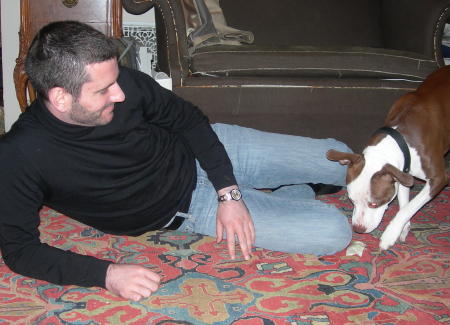 A rare privilege granted only to a select few, but Sean was so polite that he let Coco keep it all to herself. But Sean did not come all the way from Japan to visit Coco. (No need to tell Coco that, is there?) Following what has now become an annual (if controversial) tradition, we drove to Philadelphia to meet up with Tom Brennan. Anyone who hasn't read Tom's famous Agenda Bender blog is missing out on some of the wittiest, most unpredictable writing in the blogosphere. As I told Tom yesterday, he was one of my first role models (which is saying something for someone who disagrees with the idea of role models). In addition to being a blogger, Tom has now become a charitable entrepreneur (is that the right term?) in Philadelphia's trendy South Street area. With a couple of other people, Tom has started the Philadelphia AIDS Thrift store (aka PAT) at 514 Bainbridge Street. The store has its own blog (written by.... who else!), and unlike many of the gouge-em thrift stores in the area, everything is priced to go, and customers are helping a very worthy cause. Here's what they're about: If you're in the Philadelphia area, do check it out. A busy man, Tom was on a tight schedule, so I really didn't have time to take endless pictures of him posing before every item in the store, but I did catch him posing in front of this very fetching beach towel:  But please! Don't anyone think the shark reflects on the store's prices or business practices! The prices are so low I was shocked. Two fine books I'd been looking for for years cost me a total of $1.34. Regular readers who have heard about my struggles with fax machines might remember my stated goal of buying one. Well, I found one there without a pricetag, and they told me it was $25.00. Later on my way out, the price was dropped to $15.00, so I couldn't leave without it. I've checked it out and it works beautifully. Plus it came with a brand new cartidge (worth $25.00 on ebay), and it doubles as an answering machine with caller ID, multiple mailboxes, PC hookup capacity and more stuff than I need or understand. Now I feel really guilty. (So, bear in mind that notwithstanding the picture it's not Tom who's the shark.) From the store we went to have coffee at the Bean Cafe (615 South Street), a great little hangout where we could all dish the blogosphere to our hearts' content. When it was time to go I realized that I didn't have a group picture, so I perched my camera on a nearby shelf and did my best with the auto-timer, jump-in-the-photo feature. Here we are, all wired on caffeine and good times:  After dinner, wine, and talk, it was a little too late for Sean to do any more driving, so he stayed here in the guest house. And after breakfast, Sean was on his way back:  (Not quite all the way back. I don't think Japan is within driving distance.) NEWSFLASH!! Well, Japan is certainly within blogging distance! I now see that Sean had already written a post about his visit before I did -- and he did so right here, while I was asleep! (Which means I can't blame Sean for my tardiness!) MORE: At the end of the evening last night, Sean and I drank to Steven Malcolm Anderson. If only Steven could have been there in person. posted by Eric at 01:03 PM | Comments (10)
| TrackBacks (0) Saturday, December 17, 2005
Sexy versus conservative?
Via Charles G. Hill, I have learned that women who dress in a sexy manner face workplace discrimination: Harvard librarian Desiree Goodwin, who holds two advanced degrees from Cornell University, charged that she was passed over for promotion 16 times because of her attire and physical attractiveness. Goodwin claimed the jobs she sought were given to women with less experience and education and that a supervisor told her she was perceived as a "pretty girl" who wore "sexy outfits."As a result, dress codes are being imposed which ban such things as "clothing that is particularly revealing and of extreme fit," and "excessive use of makeup." The courts are upholding the codes, despite occasional complaints that they discriminate in favor of men. While it's considered "fair" if employers simply require men to "dress conservatively," I'm wondering whether even that's necessary in light of the phenomenon of Metrosexual Men who sport revealing attire and excessive makeup. If an employer simply forbids such things to both sexes, wouldn't that be enough? There's already a double standard in most workplaces which allows women to dress like men, but not vice versa. In any case, there are obvious issues of self interest and common sense: "If you flaunt your figure in a professional setting, colleagues and clients may question your judgment or make unflattering assumptions about your character," warns Susan RoAne, lecturer, author and business etiquette expert, who adds that several clients have sought her advice on how to inform employees that their revealing attire detracts from the company's image.Analogizing to men, I'd be likely to worry about my money if a banker wore blue jeans to work, or if a doctor's stethoscope dangled in front of a grimy Metallica T shirt. (Likewise, a "sexy" doctor might be unnerving.....) It's obvious to me that a lot of people are clueless, and lack the most elementary common sense. I'll never forget seeing a fellow UC Berkeley college student who went job hunting. He was told he should wear a suit, so he went out and bought a nice dark suit. But he failed to trim his frizzy, shoulder length hair, and it never occurred to him that conservative suits don't go with Birkenstock sandals. He looked so ridiculous that I couldn't believe it, but he really and truly had no idea, so I patiently explained what it was that employers expected to see. (The way he looked, I think he'd have had a better chance if he hadn't even bothered with the suit, as it's better to look like a slob than a certifiable loony tune.) I was reminded of this when I read about the flap over the girls wearing flip-flops to the White House. Whether flip-flops are sexy or not, there's no teaching common sense.
posted by Eric at 12:47 PM | Comments (5)
| TrackBacks (0)
High priced nihilism leads to involuntary servitude!
Dr. Helen has an excellent post about debt. I always laugh when I read articles such as this that describes why young people are in debt. The cause--rising college costs and easy access to credit cards they say. Uh, could it possibly have something to do with making $42,000 a year and spending $25,000 on your wedding? I realize this is not an expensive wedding but if you are in debt and crying about leading a "poor lifestyle" at the age of 29, it seems like you would pay off your debts first and have a tasteful but inexpensive wedding.The problem, of course, is a lack of self-discipline, aggravated by lenders who can spot that lack of self discipline as quickly as a vulture can spot fresh roadkill. The kids aren't really roadkill, of course, so that's not really a fair analogy. But I do think that debt -- especially student loan debt -- is the closest thing we have to modern indentured servitude. Despite this problem, there's a regular, ongoing campaign to make the government stop so-called "payday lending" as a form of exploitation that "hurts the poor." This Philadelphia Inquirer editorial if a good example: Were payday loans less available, no one would go homeless. Loans this size are not useful for major purchases such as a car, washing machine, or to replace a leaky roof.Is it the government's proper role to protect people from their own lack of self discipline? I'm not trying to be a moralist here or point the finger at anyone. I've incurred terrible debts, and I'm probably a lot more guilty than the average person. What I want to know is, by what standard are we to decide which form of debt is more harmful, and which debtors more deserve to be seen as victims? As the MSN article cited above makes clear, debts incurred by middle class college kids often haunt them for the rest of their lives. For reasons that aren't clear to me, there's a lot less sympathy for the student loan victims than the payday loan victims. That's despite the fact that "payday loans" are dischargeable in bankruptcy, while student loans are not. I think student debt is the closest thing we have to indentured servitude. (Well, at least there's no debtor's prison.) But clearly, I missing something. Obviously, there are moral issues, but what are they? Assuming that the debt problem is grounded in a lack of discipline compounded by gullibility, why are the gullible working poor more deserving of sympathy and government protection than the gullible middle class kids? Is it because they're more likely to become a public burden? Certainly it can't be that the middle class is less willing to escape their debts, otherwise the student loans would be as dischargeable as any other form of debt. Might the idea be to keep the middle class working -- no matter what? After all, someone has to pay the taxes to "fix" these problems. (At least in theory, bankruptcy is not supposed to make class distinctions between poor and middle class.) Considering the sort of Deconstructionist nonsense which passes as education these days, the cynic in me wonders whether it's worth a life of indebtedness. Lots of kids don't know why they're going to college, and some of them know less when they come out than they did when they went in. I'm not saying that the latter group of college students are in the majority, but I've sure as hell met some. And at the risk of being a bore, to the extent that kids are going to college to learn the intricacies of nihilist thought, I would humbly suggest that there are less expensive ways to do that. In real life, nihilism can be had for nothing. Plus, nihilism is less than worthless, so why not get more nothing for less money? Going into debt for nothing makes less than no sense.
posted by Eric at 09:40 AM | Comments (4)
| TrackBacks (0) Friday, December 16, 2005
Have a child, lose your freedom?
Not long ago, I touched on the problem of the presence of children as a threat to freedom: And suppose I decided that no undisciplined brats would ever enter my home. Even that wouldn't avoid possible contamination, as my child might end up visiting the home which created the problem, and on top of all that the busybody parents of the undisciplined brats might start asking all kinds of nosy questions about who I voted for in the last election and why I owned pit bulls and had over a dozen guns in the house.... and despite my attempts at avoiding other people's undisciplined children I'd still end up being visited by the Child Police.Today I found an addition to the list. Cigarette smoking. It seems that the anti-smoking lobby is now flexing its muscle to invade the homes of smokers dumb enough to have had children: Anti-smoking activists who are driving cigarettes from public places across the country are now targeting private homes -- especially those with children.Saying "I'm an adult" is just wishful thinking in our national kindergarten. Might as well try to say your home is your castle. One major organization in the drive to prevent people from being allowed to smoke in their own homes is Action on Smoking and Health (ASH). It is that organization's position that, children or not, there is no right to smoke in one's home: Many smokers apparently feel that the one place in an increasingly no-smoking society where they can light up is in their home, perhaps believing that their home is their castle. But, as Prof. Banzhaf notes, most other forms of child abuse also occur in the home, and parents have no right to light up marijuana cigarettes, abuse alcohol, use other recreational drugs, engage in inappropriate sexual behavior, or even allow garbage to pile up around a child -- even in their own home.I'd love to hear how they define "endangers or even unreasonably offends neighbors." I don't smoke, and I don't advocate smoking -- whether around children or anywhere else. But there is no certainty that in any given situation, exposure to second hand smoke will harm the health of a child. It's one risk among many. According to certain statistics, health risks from second hand smoke are more likely. But even that is disputed by other statistics. Take a look at the video at this site! Applying statistics to individuals is one of those things that really ticks me off, because there is no certainty that a risk will produce an effect on an individual. Evaluating risk is a relative thing, and parents are normally the ones entrusted to do it, for it is they who had the kids, and they are the ones who have their best interests at heart. Cars are a risk. Swimming pools are a risk. Hunting is a risk. Living in cities is a risk. Playing football is a risk. So why single out second hand smoke? Lots of people argue that guns are more dangerous than cigarettes, and there's a movement to declare this a "health issue" too. Anti-homosexual activists often claim that homosexuality carries great health risks. Should children be taken away from parents who own guns? Should gay teenagers be taken away from parents who allow them to be gay? Absurd as these ideas sound, I am sure that actuarial statistics could be found from some damned organization somewhere to justify them. Communitarian rot is destroying American freedom, and children are being used as a wedge. I thought I was being paranoid in my previous post on the subject, but it's becoming pretty clear to me that home invasion in the name of "the children" is a very real threat. Saying that the solution is simply not to have them seems like a cop out. posted by Eric at 06:51 PM | Comments (5)
| TrackBacks (0)
Too many permanent aliens on one plate!
To the left of the headline about the elections in Iraq, the Philadelphia Inquirer's readers are treated to a scary headline -- "It's in the river: The dreaded snakehead" -- accompanied by a photo and an article about the latest alien invasion. (Yes, we're still allowed to use the word "alien" when speaking about non-human invaders.) With so many snakeheads on the loose, officials have decided simply to educate the public about what havoc the fish can wreak.Cute, wiggly goldfish? Whatever happened to the good old days of fraternity goldfish-swallowing contests? Nowadays, even religious goldfish swallowing is frowned upon. What has happened to our culture of predatory ambition? While I cannot share the Inquirer's snakehead picture because it's not online, I did find a better one more in keeping with the spirit of an alien invasion. 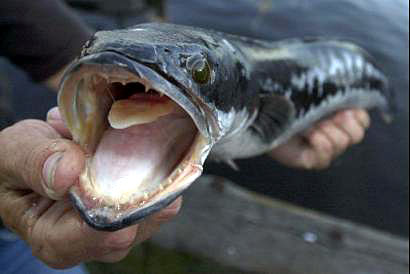 Gulp! According to the experts, these fish, which have been found all over the country now, have been brought here for years for food and for the aquarium trade: During routine sampling of Meadow Lake earlier this month, DEC staff found three snakehead fish. In response to the initial collection of these exotic fish, DEC conducted more intensive sampling and collected a fourth northern snakehead. The identification of the fish as northern snakeheads have been confirmed by fisheries scientists with the United States Geological Survey (USGS) and the United States Fish and Wildlife Service.Because of their aggressive and indestructible nature, they've even been called "pit bulls with fins," while paleoclimatologists claim that that summer precipitation aids their migration: “Killer fish,” “Frankenfish,” or “pit bull with fins” are terms that are given to snakehead fishes (Channidae) by the public, because of the predatory lifestyle and the high migration potential of this air-breeding fish. In summer 2002, snakeheads became a media superstar in the United States. Treated as an invasive, non-indigenous fish group in North America, it was feared that they seriously harm native ecosystems. An unexpected contribution to paleoclimatology gives the fossil record of snakeheads, reaching back to 50 Ma. The study shows that snakeheads are sensitive indicators of summer precipitation maxima in subtropical and temperate regions and occur regularly if the wettest month exceeds 150 mm precipitation and 20 °C mean temperature. The analysis of 515 fossil freshwater fish deposits of the past 50 m.y. from Africa and Eurasia shows two continental-scale migration events from the snakeheads’ center of origin in the south Himalayan region, which can be related to changes in the Northern Hemisphere circulation pattern. The first migration at ca. 17.5 Ma into western and central Eurasia may have been caused by a northward shift of the Intertropical Convergence Zone that brought western Eurasia under the influence of trade winds that produced a zonal and meridional precipitation gradient in Europe. During the second migration, between 8 and 4 Ma into Africa and East Asia, snakeheads reached their present-day distribution. This migration could have been related to the intensification of the Asian monsoon that brought summer precipitation to their migratory pathways in East Africa–Arabia and East Asia.Hmmmm...... If the snakehead population spreads, maybe Global Warming can be blamed. Meanwhile, I think we can expect to see more hard, um, hitting, law enforcement action like this: Wildlife Inspector Michael Williams, U.S. Fish and Wildlife Service, inspected the shipment to find three open boxes containing fish he thought were “unusual looking.” When he asked the driver what they were, his reply was that they were snakeheads that had been pond raised in China and shipped without water to Canada, adding this was the first time his employer had made such a shipment. Upon examining one box, Williams noticed the fish moved and, on further investigation, found that most were alive and some “capable of vigorous movement.” Williams informed the driver that possession of live snakeheads was in violation of Washington State regulations. The driver was asked to kill the fish and began striking them with a board. Williams notified the Washington Department of Fish and Wildlife and, after returning to the truck, found that the fish were still alive despite the drivers attempt to kill them. He seized the 80 fish at noon and placed them in a freezer. Washington Department of Fish and Wildlife authorities arrived about 12:30 and removed the fish from the freezer. Most were still alive. State authorities took possession of the fish to proceed with penalties against the companies involved (Mike Williams, personal commun., 2003). The shipping invoice listed the fish as “Fresh Snakehead Fish-Product of China.” The fish were subsequently identified as northern snakeheads.Beating and freezing these poor fish? Where are the animal rights activists when we need them? And why are we so much harder on piscine aliens than on the human variety? I mean, normally whiny environmentalist types are advocating brutal Gestapo tactics which would make those to the right of the Minutemen blush. Is it because the fish can't be rounded up and deported? Or is it because they're unable to assimilate? According to the Inquirer, once they're established, the snakeheads' presence is permanent: Absent the predators that keep the snakehead population in check in Asia, fisheries officials fear their numbers will blossom. The newcomers - which may be up to two feet long - could wolf down entire populations of indigenous fish, permanently changing streamlife.I'd be a little hesitant to use the term "permanent," especially if we factor in things like geologic time. Usually, the word "permanent" doesn't mean permanent in the eternal sense -- it just means for the duration of the lives of the people using the word. Besides, by all accounts the fish are highly edible (they're even raised for food in fish farms), and I see no reason why that might not cause them to be overfished in the same way as any other fish population. As things stand, there's no limit or season on them, and as the Inquirer points out, recipes abound. Nice fish here:
Much as I detest anthropomorphism, I had been planning some sort of analogy to the human invasions. However, even though I hate double standards, I think I'm heading towards, um, bad taste with my analogy, so I'd better stop or I'll have to eat my words. posted by Eric at 07:49 AM | Comments (5)
| TrackBacks (0) Thursday, December 15, 2005
Not in vain!
Today's historic election in Iraq celebrates freedom and democracy in the truest sense. While I'm very happy for the Iraqi people, I think this election is good news for Americans so accustomed to hearing that our troops died in vain. They absolutely did not. Via Glenn Reynolds and Black Five, my attention was drawn to an Iraqi blogger named Alaa who wrote this in THE MESOPOTAMIAN back in January: My condolences to the Great American people for the tragic recent losses of soldiers. The blood of Iraqis and Americans is being shed on the soil of Mesopotamia; a baptism with blood. A baptism of a lasting friendship and alliance, for many years to come, through thick and thin, we shall never forget the brave soldiers fallen while defending our freedom and future.Today proved that this blood was worth shedding, and it's deeply moving to see the results. As for the results, Glenn Reynolds has a great collection of links. A turnout of up to 84% according to Pajamas Media: More and more people are going to the polling centers and the turnout levels have exceeded 84% in some centers.If that happened in the United States, it would be considered the dawn of a new era. Well, even though it happened in Iraq, it is the dawn of a new era, and the only tragic aspect of it is that so many Americans are unable to appreciate the good their country has done. Tom Smith from an American soldier: Though bracing for any vote-disrupting violence, U.S. troops in Iraq are witnessing firsthand the celebration phenomenon.I don't expect to see such celebrations much reported in the MSM, and I do hope it's covered in my local paper. My God! Via Gateway Pundit (who links Michelle Malkin's big roundup and Boll Roggio post), I see that the BBC is saying "This is stability, at last"! (I can't think of a more remarkable development than that admission.) It pains me knowing that there are a lot of people in this country who will not be happy with the election news -- as if there's something wrong with seeing democracy actually working in Iraq. What gives? Do they have something against democracy? UPDATE (12/15/05): I'm glad to see that the election turnout made the front page of today's Philadelphia Inquirer, with a large headline, spaced as follows: Turnout High, Violence |
|
June 2009
WORLD-WIDE CALENDAR
Search the Site
E-mail
Classics To Go
Archives
June 2009
May 2009 April 2009 March 2009 February 2009 January 2009 December 2008 November 2008 October 2008 September 2008 August 2008 July 2008 June 2008 May 2008 April 2008 March 2008 February 2008 January 2008 December 2007 November 2007 October 2007 September 2007 August 2007 July 2007 June 2007 May 2007 April 2007 March 2007 February 2007 January 2007 December 2006 November 2006 October 2006 September 2006 August 2006 July 2006 June 2006 May 2006 April 2006 March 2006 February 2006 January 2006 December 2005 November 2005 October 2005 September 2005 August 2005 July 2005 June 2005 May 2005 April 2005 March 2005 February 2005 January 2005 December 2004 November 2004 October 2004 September 2004 August 2004 July 2004 June 2004 May 2004 April 2004 March 2004 February 2004 January 2004 December 2003 November 2003 October 2003 September 2003 August 2003 July 2003 June 2003 May 2003 May 2002 AB 1634 MBAPBSAAGOP Skepticism See more archives here Old (Blogspot) archives
Recent Entries
• Happy New Year!
• Detecting the direction of undirected readings • Reading as a weapon in the culture war • Stereotypes are for sheep? • A strange sign • Spears won't kill Piggy's traffic! • Drugs and terror. A nexus of evil? • As laughable as a hoax (Except I'm not laughing....) • Breaking the back of violence and other U.S. "exports" • The only real Christian is a loud and angry Christian?
Links
Site Credits
|
|