



|
|
|
 Monday, January 31, 2005
Just a thought on blogs and journalism
I pulled this from a Reuters piece on international support of the Iraqi vote: Paris, Berlin and Moscow were dubbed the "non-nein-nyet coalition" for opposing the U.S.-led war in the U.N. Security Council. The subsequent diplomatic chill has been described as the worst crisis in transatlantic ties since World War II. And I wondered if any of us would a) ever get away with something like that or b) even try to. But this is commonplace in journalism: stating hearsay as fact without any indication of the source. Who dubbed them the "non-nein-nyet coalition?" Who has described the diplomatic chill as "the worst crisis ... since World War II?" And in either case were the statements valid? Justified? Partisan? Does it matter? Does the lack of transparency lend an air of authority to the statements., What does the lack of attribution imply about the judgment, the judges, and the judged? We would find ourselves fisked in the comments or linked by critics on other blogs, and rightly so. Which is not to equate blogging with journalism, and I hate to dwell on this ubiquitous subject, but it strikes me that these kinds of statements at once fail to serve the avowed ends of journalism and violate the standards of its supposed bastard cousin, the lowly blog. Again, it's not the claims themselves but the shadows that surround them, their role in the piece, the implied narrative. posted by Dennis at 08:17 PM | Comments (5)
| TrackBacks (0)
Authentic warpath?
I've been really busy, but Justin directed my attention to this picture:  Yeeeaaagh! The above man goes by the "colonial name" of "Ward Churchill" -- and he's recently the subject of a great deal of attention in the blogosphere, reflected in Glenn Reynolds' large roundup of posts and thoughts. Among other things, Churchill claims that the 9/11 victims -- those who worked in various offices in the Twin Towers or the Pentagon -- were not ordinary Americans at all, but "little Eichmanns." They formed a technocratic corps at the very heart of America's global financial empire--the 'mighty engine of profit' to which the military dimension of U.S. policy has always been enslaved--and they did so both willingly and knowingly. If there was a better, more effective, or in fact any other way of visiting some penalty befitting their participation upon the little Eichmanns inhabiting the sterile sanctuary of the twin towers, I'd really be interested in hearing about it."Eichmann was a monster -- an architect of the Holocaust who was directly responsible for the murder of millions of people. By comparing ordinary American office workers to him, Churchill does more than attack the 9/11 victims; he trivializes the horror of the Holocaust -- which, by the way, is consistent with his thesis that Holocausts are everywhere. If we're all "little Eichmanns," then hey, I guess Churchill must think Eichmann is as Amercan as apple pie. (After all, don't Americans listen to Nazi music like "Eichmann Turner Overdrive," and "Eichmann Tina Turner?") Churchill is a piece of work, no matter how you look at him. He has solid leftist credentials, is a tenured professor, but not too many leftists are racing to his defense. Some are saying he's really "not the authentic face of the Left." I probably shouldn't waste too much of my scarce time with such crackpots (and this one has a distinct aroma of being an agent provocateur), but even a cursory glimpse convinces me that Ward Churchill is a pathological liar. Example: Rusty Calley ultimately was convicted; served about three days per victim for what was listed as murdering something on the order of 200 Oriental human beings (and that was a low count), before being pardoned by Richard Nixon.BULLSHIT! Calley (convicted of responsibility for the My Lai massacre) was never pardoned. Not by Nixon, nor by any other president. And that's just for starters. Here's Churchill on Wall Street: Earlier we mentioned de facto slavery. We might as well talk about slavery de jure. Because that’s the next queue in the line, the proportion of the roughly 30 million people who never survived the Middle Passage. Signified perhaps by those who were perishing in the slave market enclosed by a wall in New York City. You think slavery is a southern phenomena. No. That’s where Wall Street got its name.Wall Street's origin as an enclosed slave market is offered as a sort of cosmic justification for 9/11. The problem is, that's not where Wall Street got its name. At least, not according to the famed right wing Wikipedia: The name of the street derives from the fact that during the 17th century, it formed the northern boundary of the New Amsterdam settlement where the Dutch had constructed a crude wall of timber and earthwork in 1652. The wall was obstensibly meant as a defense against attack from Lenape Indians, New England colonists, and the British, but it was never tested in battle. The wall was dismantled by the British in 1699.There's also this gem about the "connection" between the Twin Towers and the Pentagon: 19 third-world individuals ostensibly armed with box cutters converted three airliners (set out to convert a fourth) into what was almost immediately referred to as 300,000 pound cruise missiles, in effect utilizing them as smart munitions, to take out -- what is it they call it when it’s Norman Schwarzkopf talking on TV? -- command and control infrastructure? They took out the command and control infrastructure symbolized and embodied in the Pentagon and Washington DC and the nerve center of the global trade apparatus whose stimulus impulses out into that funny ozone that we’re talking about, and wags that tail of the Pentagon. Understand that the Pentagon does nothing without instruction and dictation from the Twin Towers. And there are probably a few other places.I'll leave it to others to figure out precisely how two large commercial buildings consisting of thousands of rent-paying offices were able to instruct and dictate orders to the Pentagon! Why hasn't that stunning fact been reported anywhere? Might it be because people like Churchill are primarily preaching to way-out, far-left choirs and aren't part of the "respectable" left? If that is true, then why is it that critics of Churchill are subjected to merciless ad hominem attacks by the "respectable" left? Glenn Reynolds is being savaged for criticizing this nut (even as he points out that the left benefits from being rid of such liabilities). What amazed me the most was to learn that even Churchill's central claim to "moral authority" -- that he is an Indian -- is hotly disputed: We see self-hating white men like Ward Churchill, Jordan Dill, and others who are seemingly infatuated romantically and mystically with being Indian to the point that they are willing to fraudulently take on the identity of being Cherokee. Both of these individuals have white grandfathers and grandmothers, and consequently, white mothers and fathers. Our investigations have shown that these misinformation specialists have much more sinister motives.More here and here, with a contrary view here. The last web site is very pro-Churchill, but even they note the man's rather inconsistent background with Soldier of Fortune magazine. Is Churchill the white man -- and wannabe Indian -- that his critics say he is? How do we even know he served in the military as he claims? But let's give Churchill the benefit of the doubt. Even assuming his claim of Indian status is technically accurate, if his parents and grandparents were themselves white and he grew up considering himself white, it strikes me as more than a little disingenuous for him to loudly claim to be an oppressed minority. Doesn't Cherokee-descended Glenn Reynolds have just as much right to claim Indian status as Churchill? Indeed, why shouldn't Glenn sport the flowing hair, the rad sunglasses, the Che Guevara beret or the angry AK-47 pose? (And no! Don't expect me to do another PhotoShop with the precious few minutes I have for blogging today!) Hell, my father (who spent part of his childhood on South Dakota's Berthold Indian Reservation) once told me there was Indian blood somewhere in his background, but I never investigated because I don't care. Such race-based nonsense doesn't matter to me. I grew up white and I accept it as my reality. There's just something unseemly in strained claims of oppression. Especially when they're so unstrained, and unrestrained. UPDATE: In a flap over his "little Eichmann" remarks, Ward Churchill has resigned as Chairman of the University of Colorado's Ethnic Studies Department. Complaining of "grossly inaccurate media coverage" he now says he was misunderstood: Hmmmm..... What do you suppose he means? Have little Eichmanns have been turned into Big Eichmanns? UPDATE (02/04/05): Glenn Reynolds has much more -- here and here -- on Ward Churchill, and it appears very likely that he is in fact making a false claim of Indian ancestry. The sorry part of this is Ward Churchill has fraudulently represented himself as an Indian, and a member of the American Indian Movement, a situation that has lifted him into the position of a lecturer on Indian activism. He has used the American Indian Movement’s chapter in Denver to attack the leadership of the official American Indian Movement with his misinformation and propaganda campaigns.The above is signed by (among others) Indian activist Dennis Banks, Chairman of the Board of the American Indian Movement, and a guy who's been around. In fact, I well remember Banks from the 1970s, a period in which I was politically active on the left. (For what it's worth, I never once heard of "Ward Churchill" during that period.) posted by Eric at 09:54 AM | Comments (9)
| TrackBacks (0) Sunday, January 30, 2005
Justin is no lawyer -- and that's good!
As fate has it, I happen to be a lawyer by training. This ruined whatever potential I might have had as a writer, for many lawyers are ruined writers. I say "ruined" because when you are forced to think and write like a lawyer, your thought processes end up being captive to a different language -- a stultifying thought police that forces you to qualify, quantify, justify almost everything in a mercilessly redundant manner -- as if in anticipation of litigation of your very thought processes. That sort of mental corruption leads to a very different sort of writing style than whatever style would have evolved had the writer's brain not been subjected to the numbing torments of legalese. But hell, my legal career was interrupted by a decade of death and reactive self-degeneration, so it's easier for me to be at war with my legal self than for many of my brethren. The stuff in which I've been steeped the past few days reminds me of the yawning abyss from which I escaped by falling into a much worse abyss. And what an abyss it is! Listening in contemplation of the terrible fates which can befall any business owner unlucky enough to become an "employer" in California almost made me sit down and cry. Except alas, I paid for the damned course, and there was no time for tears! My purpose was to sit and listen so that I could obtain the qualifying MCLE hours. But it was just awful to hear that nearly everything -- including a hangnail (which prompted a serious "Don't laugh!" from the lawyer/lecturer!) -- can be considered a "disability" under California law, and employers are liable for "discrimination" if they fail to make accommodations. If a sexual comment is made in the workplace, anyone can be aggrieved, not just the party to whom it was directed. This went on and on, and I felt the way I felt years ago when Berkeley instituted rent control and some smartass lawyer asked me why anyone in his right mind would want to be a landlord in Berkeley. (I wasn't in my right mind, so did I mind?) And why would anyone want to be an employer in California? Or own a business in California? Ask the lawyers. Here's a typical example I found yesterday in a local freebie: JUST A FEW years ago, small retailers in San Francisco began noticing a disturbing trend. Plaintiff attorneys had started using federal and state disabled-access laws to make an easy buck off local merchants. They would go around looking for building-code violations, such as doorways that were too narrow or shopping aisles that were too close together. Then they would file suit and push for a quick settlement. For hundreds of small businesses that weren't prepared for all this, the consequences cost them thousands of dollars.Lawyers, of course, can fight all of the problems which lawyers cause. But it costs lots of money, and it doesn't generate much good writing. Justin, however, is not a lawyer, and his writing doesn't suffer from the legalistic clutter that plagues mine. (Self ridicule via legalistic parody of language is often my only resort, as the best defense is a good offense! Justin doesn't suffer from this self-imposed neurotic need to be so defensively analytical and superfluously redundant.) posted by Eric at 02:47 PM | Comments (4)
| TrackBacks (0)
Setting well . . .
I've been so busy that I failed to see until today that Glenn Reynolds linked Justin's excellent post on aging and life extension. I'm so glad, because his writing is great, and like most writers he needs encouragement. (And a computer.) And I'll remind my readers of what I've said before: that were it not for Justin I would never have started blogging! I can't praise him highly enough. Thanks again Glenn, and congratulations, Justin. I worked all day and haven't had time to check in until now, but I did take a photo of the sunset today:  That's the view from my bedroom. Something of which I never tire, and which eludes me on the East Coast. (Even if I do have faster Internet there.) Justin seems to be on quite a roll, which suits me just fine, because I am swamped. There isn't enough time in the day. Roll on Justin! UPDATE: As most of you know, the sun also rises:  Now, if I could I just figure out how to get it to rise in the same place it sets.... posted by Eric at 01:06 AM | Comments (3)
| TrackBacks (0) Saturday, January 29, 2005
Bring Me The Cone Of Silence
Eric has tactfully requested that I remind people of the notorious Kass "Ice Cream Quote", which was featured here at Classical Values on July 25, 2003. While it had appeared in numerous other venues in its truncated form, we here at Classical Values took rightful pride in presenting the great man's thoughts, unexpurgated, on July 29th. We think we may have been the first internet resource to do so. We fondly hope that the Chairman's words will follow him, "doglike", to the end of his days. Hence, this memory lane excursion, not short but plenty sweet. "Worst of all from this point of view are those more uncivilized forms of eating, like licking an ice cream cone --a catlike activity that has been made acceptable in informal America but that still offends those who know eating in public is offensive" "I fear I may by this remark lose the sympathy of many readers, people who will condescendingly regard as quaint or even priggish the view that eating in the street is for dogs. Modern America's rising tide of informality has already washed out many long-standing traditions -- their reasons long before forgotten -- that served well to regulate the boundary between public and private; and in many quarters complete shamelessness is treated as proof of genuine liberation from the allegedly arbitrary constraints of manners. To cite one small example: yawning with uncovered mouth. Not just the uneducated rustic but children of the cultural elite are now regularly seen yawning openly in public (not so much brazenly or forgetfully as indifferently and "naturally"), unaware that it is an embarrassment to human self-command to be caught in the grip of involuntary bodily movements (like sneezing, belching, and hiccuping and even the involuntary bodily display of embarrassment itself, blushing). But eating on the street -- even when undertaken, say, because one is between appointments and has no other time to eat -- displays in fact precisely such lack of self-control: It betokens enslavement to the belly. Hunger must be sated now; it cannot wait." "Though the walking street eater still moves in the direction of his vision, he shows himself as a being led by his appetites. Lacking utensils for cutting and lifting to mouth, he will often be seen using his teeth for tearing off chewable portions, just like any animal. Eating on the run does not even allow the human way of enjoying one's food, for it is more like simple fueling; it is hard to savor or even to know what one is eating when the main point is to hurriedly fill the belly, now running on empty. This doglike feeding, if one must engage in it, ought to be kept from public view, where, even if WE feel no shame, others are compelled to witness our shameful behavior." But wait, there's more! It's Kassfest 2005, a veritable dog's breakfast of Kassical Values, culled from a variety of sources. We have social criticism... "...young people need to acquire the sensibilities, tastes, and skills in reading character that can help them find and judge prospective mates—something they once gained from the study of fine literature and which they can never hope to learn from watching Seinfeld or Ally McBeal." "The question, admittedly complex, is whether in opting for abortion a woman is doing injustice to herself as a woman, contradicting her generative nature." "Whether or not we know it, the severing of procreation from sex, love and intimacy is inherently dehumanizing, no matter how good the product....It is not at all clear to what extent a clone will truly be a moral agent...." We have bioethical musings... "...mortal danger is contained in the now popular notion that a person has a right over his body, a right that allows him to do what ever he wants to it or with it. Civil libertarians may applaud such a notion, as an arguably logical expansion of the right of privacy, of the right to be free from unwanted or offensive touchings. But for a physician, the idea must be unacceptable." "even the perfectly voluntary use of powers to prolong life ... carries dangers of degradation, depersonalization and general enfeeblement of soul." "Paradoxically, even the young and vigorous may be suffering because of medicines success in removing death from their personal experience. Those born since the discovery of penicillin represent the first generation ever to grow up without experience or fear of probable death at an early age. They look around and see that virtually all their friends are alive." That last is a particular favorite of mine. We wouldn't want the kids growing up without some dead friends, eh? It builds character.
"If our children are to flower, we need to sow them well and nurture them…But if they are truly to flower, we must go to seed; we must wither and give ground." "Withering is nature's preparation for death, for the one who dies and for the ones who look upon him." Sociological alarums... "Our society is dangerously close to losing its grip on the meaning of some fundamental aspects of human existence." Medical predilections... "....if one could do something about Alzheimer's, if one could do something about chronic arthritis, if one could do something about general muscular weakness and not, somehow, increase the life expectancy to 150 years, I would be delighted." And political nostrums... "What we should do is work to prevent human cloning by making it illegal. We should aim for a global legal ban, if possible, and for a unilateral national ban at a minimum.... renegade scientists may secretly undertake to violate such a law, but we can deter them by both criminal sanctions and monetary penalties..." We've even got shining cities on a hill... "Michigan, for example, has made it a felony, punishable by imprisonment for not more than ten years or a fine of not more than $10 million, or both, to “intentionally engage in or attempt to engage in human cloning,” where human cloning means “the use of human somatic cell nuclear transfer technology to produce a human embryo”." What joy, to stride the earth in the same cosmic eyeblink as such a Titan. UPDATE: This "Wolcotting" nonsense is quite addictive. I must have an innate predisposition for it, perhaps going back to the old "epigenetic primordium". But seriously folks, one of these days I hope to best Eric's triple violation of "Wolcott's Rule®" and practice makes perfect. I was re-reading "Leon and Me" and these words looked like they could stand a re-airing... Perhaps my first mistake was in thinking of him as a Medical Doctor. He is a Medical Doctor who doesn't practice medicine. He didn’t care for it, much. "Even in my medical days, well before I acquired philosophical interests in these matters, I found the disappearance of a human life from a human body to be a simply incomprehensible occurrence. For this reason, I always disliked the autopsy room, where confident pathologists gave anatomical or physiological explanations, adequate to their limited purpose, that only increased my bewilderment regarding the questions that most troubled me: what happened to my patient? What was responsible for his extinction?" Umm, death? The limited purposes of the confident pathologists might help narrow the field a bit. And would one really prefer timorous pathologists? Arrogant doctors.... well, who would have thought? He retreated from clinical medicine and tried his hand as a Research Biologist…but he didn’t care for that, either. What he ended up becoming, is a Classics Professor. And, of course, a Bioethicist. "In more than fifteen years of discussing questions of medical ethics with physicians, I have been impressed by their reluctance to generalize the principals of their conduct. They counter philosophical argument of principals with anecdotal accounts of cases." Every case is altogether unique" they frequently insist. For several years, I must confess, I was impatient with this approach. It seemed to me then that my physician interlocutors were either too lazy or thoughtless to articulate the tacit premises of their conduct. Premises that seemed to me at least, readily accessible through analysis of their cases....I have come in large measure to appreciate the practitioners point of view...." So, after "several years" of pestering working doctors, doctors who actually had, um, patients, he finally worked his way round to thinking that they might (however inarticulately) know what they're talking about... I was starting to wonder what had happened to Leon. He's been so quiet lately. One could be forgiven for imagining that he had finally been graced with a piercing insight, an insight which elucidated for him the fact that, PR wise, he's his own worst enemy. Fortunately for my bile ducts, just the other day I found some of his wise commentary over at "The New Atlantis" (Their new motto, "Bringing Home The Bacon!"). And do you know, at first I thought he might be running up the white flag. Seriously. Sheesh, where was my head? As it happens, he pulls a quick 180 in paragraph 28. The gee forces made my head swim... For myself, I don’t know whether the earliest embryo is or is not my equal. I simply don’t know. I see the power of the argument from continuity, and yet my moral intuitions cut in a somewhat different direction, even if the existential choice were between preserving my embryo or rescuing someone else’s child. And yet, I stand in awe and reverence before this very human beginning, because I know that if we ran the process backward, all of us came from that. Okay, let me unpack that a little. Sentences one and two are self-explanatory. The "argument from continuity" is basically outlined in the final sentence, and it causes him to stand in awe and reverence of blastocysts. And yet, in sentence three he admits that he doesn't QUITE buy into that argument, for reasons of moral intuition. "...my moral intuitions cut in a somewhat different direction, even if the existential choice were between preserving MY embryo or rescuing SOMEONE ELSE'S child." If I am reading the above sentence correctly, Leon is admitting that he would probably save a walking, talking child before he tried to rescue a petri dish waif, even if said petri dish held his own child, and the toddler was some no-account peasant urchin from the lower decks. I thought we'd made a real breakthrough. But he promptly threw it away. "And since I don’t know whether the early embryo is or is not one of us, and since the choice before us now is not this child versus this embryo but whether to engage in a speculative project of embryo research..." Whoa, whoa, wait a minute, that's EXACTLY the choice before us now! That's why we're having this argument! You can't just huff it away with a hurried conclusion. " I am inclined not to treat human embryos less well than they might deserve. In order to do so, I don’t have to insist that the human embryo is the moral equivalent of my child." Can you? "I can call instead for a certain kind of expansiveness, a certain kind of generosity, a certain insistence that we should not wish to live in a society that uses the seeds of the next generation for the sake of its own." I guess you can. The above sentence reminds me of parental scoldings about cleaning your plate. "Eat your beets, there're people starving in China." How do my beets affect the kids in Beijing? Likewise, how do my medical procedures affect how many kids the Carter family up the street are going to have? To speak of "the" seeds of "the" next generation is a tenuously poetical notion at best. "This argument appeals to the dignity with which we conduct ourselves, not the indisputable equality of the early embryo." And here we descend once again into blithering blatherskitery.
"It is an argument grounded in prudence and restraint, not in equality or justice. It is an argument that remembers that we must not sacrifice the opportunities to live well simply in order to try to live longer." He really had me going for a minute. But I've been hurt before...
posted by Justin at 09:09 PM | Comments (4)
| TrackBacks (0)
Corrosion by collusion?
If you're thinking of building a deck or repairing outdoor structures, bear in mind that the EPA has recently banned wood treated with chromated copper arsenate -- long the industry's standard -- in residential construction. Why? Apparently, the usual concern about children: The EPA conducted risk assessment, and evaluation of public comments and input from an external scientific review panel on methodologies to perform a risk assessment for residential settings and potential exposure to children from CCA.I'd love to know what "public comments" we're talking about here. In practice, "democracies" like ours allow small organized minorities to dictate terms to ordinary taxpayers, while making us all pay for their hordes of consultants and government-funded Ph.D. candidates. Large businesses -- and (of course) government -- may continue to use CCA: The use of CCA-treated wood will be limited to certain industrial and commercial applications. Residential applications affected by the change include play structures, decks, picnic tables, landscaping timbers, residential fencing, patios, and walkways/boardwalks. Some applications not affected by the settlement include highway construction, marine (saltwater) applications, utility poles, pilings, and selected engineered wood products.(No wonder they had no problem pushing this through, what with govermnment and big business exempt.) But if there's no reason to remove it from existing structures, why ban it? And why would anyone care? Because, as I just learned, CCA's replacement, (ACQ) wreaks havoc with construction materials: With environmental and health concerns growing over the use of arsenic, the wood-preservative industry surrendered the right to use arsenic in wood for residential uses at the beginning of 2004.This all makes prices go up, of course, and forces suppliers to order new, "improved" materials. Are environmentalists and big business working in collusion? And is the concern really about children eating arsenic-treated wood? What happens if they eat ammoniacal copper quat, followed by copper azole and borate? (I'm not an expert, but I suspect there might be another corrosive effect.) posted by Eric at 12:19 PM | Comments (4)
| TrackBacks (0)
Mortal rendering?
Speaking of good writing, I found the following essay on an old floppy disk, and I thought it was worth sharing. The author, an ex of mine, died in 1995. So I guess you could call this a guest post from the long dead. It's Chapter II from an autobiographical essay called "California." While I ought to let Mark speak for himself, this has a distinctly haunted feel to it, although my objectivity is open to question, as I found this disk where it had been gathering dust for a decade. I hope he doesn't mind, and I really don't see why he would. I honestly think Mark's thoughts are culturally of enough interest to merit some immortal flavoring, and I see no rule against copying and pasting them into my blog. I hope readers will appreciate what follows. - Eric CALIFORNIA, Chapter II To no one's surprise, my arrival at my parent's household was duly recorded on many rolls of instamatic film. Whenever I visit my father in San Diego, I try to at least glimpse at the standard-issue drugstore photo album, swollen with the family archives. The pictures my parents took of each other before they adopted children, during the first ten years of their marriage, seem somehow incomplete, critical elements missing from their composition. My parents themselves seem perfectly alien, incomprehensible. The pictures reveal the careful frugality of my parents' lives; each photo solemnly records occasion and setting, self-consciously acknowledging its specific niche in their history together. Here is the efficiency apartment they lived in on Grape Street; here is the new car, Christmas, the trip to Catalina. Then, a series with my shirtless father, smiling as he builds a house with his own hands. When at last my sister was adopted, all photographic restraint was abandoned, and it is at this precise station of our family album that something vital comes alive, transforming these strangers into my parents. The impact is remarkable, as the forcible entry of bunnies and high chairs, playpens and bassinets, intrudes upon the bachelor austerity of their Danish teak; then the sudden herd of relatives, beaming in now perpetual attendance; above all, the inexplicable mystery of my parents turned suddenly recognizable, smiling wide against the reveille of shutters and flashbulbs. The casual viewer of my first photographs might well conclude I was Christ himself reborn, so evident and touching was my parents' joy, having bargained for me and won. It was not an easy adoption; my mother was 50 years old at the time of my birth, an unusually advanced age for a parent of either sex to adopt an infant. I was four days old. The pictures show her cradling me in her arms, her striking face glowing with love and fierce pride. Here, she is so undeniably beautiful, but I know this was the last time in her life she would enjoy her beauty or womanhood, and these pictures are painful beyond description. She would undergo radical surgery in my 18th month, removing two-thirds of her stomach in an effort to isolate and subdue a massively perforated ulcer. I never knew the still-young woman who triumphantly holds me up for the camera and all the world to see, her eyes flashing, glittering, alive. She left in her place a dying old woman, crazed by fear and pain, ravaged by drugs, annihilated by medicine. This is the last time we shall have together. For now, not so much as a whisper of doubt. For now, my father, greatest of shadows, loves me still. There is nothing yet for him to fear. I am still a miracle. Here is a picture of my father, holding me as if I were made of glass; he wears an expression of quiet wonder on his face; he does not seem to be aware of the camera's gaze. The visual perspective of the photograph suggests that the photographer took quiet aim from a doorway or hall, keeping secretive distance from the subjects, who held each other tightly, undisturbed. Today I bear upon my cheek a tiny scar, reminder of my reluctant passage from a now-forgotten womb into the bright steel jaws of a doctor's impatient forceps, implacably drawing me forth into the alien landscape as remorselessly as one might extract a tooth. Only the scar remains as proof of my birth. There was never a birth, there was only a child. We were the family who married each other. My life as an infant was one of purest bliss, spent contentedly in loving arms, pressed against these dim warm shapes, meadow-sweet and soft as old flannel. It was here that first I must have dreamed of all I had forgotten, in the ancient laps of grandparents, the proud arms of aunts and uncles, in the tenderly bemused arms of young cousins and friends. It was here that first I felt my flesh touch yours, or his, or anyone's, and somehow, I can almost remember knowing something ... big. Then nothing, nothing at all. Only flesh, singing lullabies and riddles in the language of hands. At the conjunction of flesh and sleep, the lessons of hunger are taught. Such is the function of memory. Not awake, I pressed even closer in response, snuggling deeper in sleepy reply. Tender and blind, in my father's strong arms I first learned of hunger. In his arms, and in my dreams, I still could fly like a dagger of light, a naked wicked beauty, not quite human, not yet mortal. I remember only darkness, darkness and flesh. I awoke to find myself a toddler, as if hurled, full-grown and squealing, into delighted consciousness, where I landed dazed but unharmed. I proceeded to amaze the world by reading aloud before the age of three, a skill I had not been taught. I only remember knowing how. With similar aplomb, I mounted the Wurlitzer chord organ, filling the air with song. I was alarmingly bright, very pretty indeed, a precious golden child. I went to Sunday School, drew pictures, read books, and watched TV with native excellence. I was yet a gift from God. A splendid child. No wonder they came to me in dreams, those mysterious, handsome young men who loved me ferociously and pressed me against their hairy naked chests. Why should they not make love to me? As I was regularly assured, I was truly the best little boy in the whole wide world, and everybody Loved Me, Loved Me, Loved me. In sleep I was delighted heir to a kingdom of delicious secret wickedness, a toddler's empire of license and permission. In sleep, sorcery was as common as flight. In sleep, anything is possible. Cartoon characters, man and beast alike, were my regular visitors. I was especially fond of Johnny Quest; I recently watched several old episodes after some twenty-odd years had elapsed. I noted with great amusement the powerful homoerotic elements at work. Nowhere is a female to be found, save the occasional maharini or scientist's daughter rescued by the determinedly squeamish Johnny, who knew only too well how her gratitude included the obligatory embarrassment of kisses, which he seemed to resent rather fiercely. The eternally invincible Johnny and his retinue of beloved male comrades won my lonesome heart. Even the dog was a fag. How I longed to conquer Namor the Submariner, arrogant and bitter Atlantean who cannot love or trust a human; I dreamed of the day when I, too, would become the beloved ward of a handsome, eccentric millionaire, who would give to me strange powers and a new name; he would lead me to his underground cavern, where together we would celebrate our secrets. Once I dreamed I lay in a storybook barn's tiny hayloft, next to Major West of Lost in Space, who fondled me affectionately and submitted as eagerly to my own caress. Incidentally, a neighborhood acquaintance kept the Monkees tucked naked inside her radio, who waited only to be brought out to dance under flashlight and blankets, performing hilarious obscenities for a carefully selected audience. At last, I found myself afloat, high above an enchanted Disneyland glittering magically beneath my feet. I landed on tiptoe, greeted by a host of Disney characters. From the highest turret of Sleeping Beauty's castle, we waved to the enormous crowd celebrating below, returning their wild cheers as thousands of multi-colored balloons were released, filling the sky. We had triumphed at last. A handsome youth with shaggy brown hair, naked beneath his ridiculously bulky dog costume, had taken the mask off his beautiful face, and motioned to me. He led me away from the castle balustrade, to the cool gray shadows beneath a plaster arch. We embraced. My child's hand slipped knowingly under the heavy plush of his costume, deliberately caressing the smooth warm skin of his naked buttocks. As he held me in his strong arms, murmuring and drawing me closer, I awoke, rolling frantically upon my belly, squirming circles into the mattress, my body grinding with unbelievable pleasure. After the eruption ceased, I lay quite still, awestruck and quite naturally incredulous upon experiencing my first orgasm at the approximate age of four years. I knew myself to be royalty, a miraculous child of heavenly brilliance, more angel than human. I felt as if I were an enchanted princess, spellbound with sleep, awaiting the embrace of a handsome prince. Sleeping Beauty and Cinderella had their obvious and devastating effects. To a startled world, I announced my desire to become a girl. These demands were first ignored, but as I became embarrassingly vocal in my insistence, I was first mocked, then punished, at last imprisoned in the horrid shackles of tiny cowboy outfits, complete with gunbelt and badge, forcibly inflicted upon me in their grim determination to rid me of my passion. Yes, there are pictures of this spectacle as well, and I am pleased to recall the expression of absolute loathing I wore whenever photographed in such hideous attire. I only wanted to be as beautiful as I knew girls alone could be. I recall another dream from this period in my childhood, in which I have been miraculously transformed into a dazzling fairy princess, resplendent in a silvery gown, my hateful crewcut now an elaborate blonde bouffant, billowing skywards and crowned with a diamond tiara, my face as eerily perfect as a porcelain doll's, with hugely exaggerated eyes and a perfect rosebud mouth, set in a delicate heart-shaped face. So great was my joy upon discovering myself thusly transformed that I began to urinate, awash in an ocean of contented warmth. I awoke not to the embrace of a handsome prince, but to a cold and soggy mattress and an unsympathetic world. As becomes a princess, I was a difficult child, forever at odds with the vulgar prison of my earthly station, thwarted at every attempt to realize my true destiny. I came to find my parents' plodding embrace of middle-class values to be shabby and crude, not to mention incomprehensible in a world which serves vintage champagnes and stylish canapés to its preferred guests. I once lovingly prepared a set of recipe cards for my mother's benefit, inventing elaborate and costly hors d'oeuvres calling for liberal portions of caviar. Perplexed and exasperated, she tried to explain that "we were not that kind of people." Bruised yet again by the infernal pea beneath my many mattresses, I haughtily informed her that it was she who was "not that kind of people," not I, earning for myself an invigorating gargle with Ivory liquid, preferred by my mother for such tasks, its ease of application further improved by the disappearance of tiny toothmarks from our bars of soap. They tried to bring me back to earth, too late, too late. Chores were assigned, then enforced. I resisted bitterly, weeping with shame: Sleeping Beauty never collected dog shit with a garden spade from her back yard. They would have their victory. They would speak to me of death. They explained to me that my grandmother had died, and that we would go and see her before she was buried. We drove to a small mortuary a few blocks away from the convalescent hospital she had ended her life in. She lay in state, the coffin open, seemingly asleep. My mother whispered to me, "Touch her." I did. She was cold as ice. It was too quiet. "Can I go outside?" I asked. I was allowed to exit, and I climbed into the front seat of the station wagon, taking advantage of their absence by helping myself to several candy bars I found in the glove compartment. Driving home, I asked if I, too, would die. They said yes, but I refused to believe them. The confirmation of my eventual death had a familiar hollow ring, like other pronouncements they regularly made, supposedly designed with my best interests in mind. I was immortal. I would live forever. I would never die. Now comes memory with lessons of fear. I had strayed too far out. I had gone too far. The night held monsters, hungry and unspeakable. One night I found the world turned cold, its face against me, love turned to hate as it so often does. I said the first of many prayers. Ghosts howled in the distance, zombies marched closer in militant formation, searching everywhere; they will not rest. The jungle of darkness pressed hard against my window, seeking entry, billowing into sinister shapes looming over my bed, where, trembling beneath the covers, I pray the dark will pass me by, too late, too late. The darkness wants me too. I screw my eyes as tightly shut as possible, for if those yellow orbs should meet my own, it will see my fear, and tear me to pieces. Helpless, I see its hideous gaze, burning through my eyelids as if lasers, and around those demon eyes congeals the darkness into terrifying shape, an idiot Frankenstein's monster angrily rises far above me in murderous silhouette. I have been found out. He reaches out his arms for me as a calm, inhuman voice explains inside my head that, while sounds alone cannot hurt you, shadows kill, and now the monster strangles the final scream from my little throat, a useless echo in the indifferent night. I had been rendered mortal, after all. I have been inconsolable ever since. posted by Eric at 12:11 AM | Comments (2)
| TrackBacks (1) Friday, January 28, 2005
Harbor Lights
I just watched the International Space Station slide by overhead, like a little amber bead on an invisible abacus wire. If you don't know what it is, you might mistake it for an airliner. If you do know what it is, it's too cool for words. posted by Justin at 09:23 PM | Comments (2)
| TrackBacks (0)
I Wish I Was A Better Writer
As it is, I have a hard time balancing flippancy and venom. The more sincerely I feel about something, the more I'm drawn towards shrill peevishness and bilious ranting. Except, of course, when I talk about Leon Kass... I realize that past a certain point, confident self-assurance sounds like arrogant dogmatism. This is counterproductive, but sometimes I just can't help myself. Jay Fox makes some arguments that I have made in the past, but makes them in such a pleasant, heartfelt way, that I just had to share them with you. His primary argument is that we should be thinking about longevity first. Literally. Well, maybe I don't agree entirely with that, but it should certainly be in the top ten. Some of you may wonder why I feel that way. For starters, helping people to stay healthier longer is so self-evidently virtuous as to require no excuses. It angers me that such excuses are even thought necessary in "certain quarters". To live a good life requires, first and foremost, that you have a life to be good WITH. The dead have had done with being good. But the life extension angle, isn't that just a little kooky? We have no proof at all that it's even possible, right? Aren't I just grasping at straws here? Well now, that's the funny thing. We actually DO have evidence that it's possible, at least in lab animals. Heck, it's not just possible, it's a done deal. Worms have had their natural spans trebled, and quintupled. Rats have gained fifty percent. If the rat comes from a truly screwed up strain, prone to a short lifespan, caloric restriction can triple their life expectancy. And we've known how to do this since the 1930's. It's only now that we have the tools to begin exploring the why of it. Given these FACTS, when I hear someone denigrate this type of research as hopeless, or immoral, or doomed to failure, I ask myself where THEIR evidence is...but perhaps I'd better quit while I'm ahead. Here are some things Jay has written that I (mostly) agreed with. Imagine aging has been cured. People no longer grow old. Old people can be restored to youthfulness. The first thing to understand is that death has not been cured. People will still die. Accidents will still happen, as will murder, war, suicide, pneumonia, fatal flu viruses, etc. Even heart attacks, strokes, and cancer will still happen, though far less frequently. It is important to understand this, because we need to be clear about the philosophical and religious aspects of curing aging. People will still die; mortality will still define existence. People will not live forever simply because they no longer have an expiration date. So what's the difference, then? Without aging, people will live a lot longer. 500 years, perhaps 1,000. There wouldn't actually be a hard limit, as there is today. Today, you might have a 50% chance of living to 80, but a 0% chance of living to 130. On the other hand, with aging cured, you might have a 50% chance of living to 500, but a 6% chance of living to 2,000, and a 1% chance of living past 3,000. Why did I ask us to consider the world from this perspective? Well, think back to today's world. We currently live in a world that openly rejects the mere concept of curing aging. We live in a world where it's okay to talk about curing heart disease, or cancer, or Alzheimer's, as long as we don't make people “live forever.” It's okay to let people live 10 years longer, or 20, but 50 years is too much—it's unnatural. As such, we live in a world where it's okay to spend tens of billions of dollars a year to cure cancer, but it would be considered a waste of time and money—indeed, it would be morally wrong—to spend half that much money to cure aging itself If we have a chance to save hundreds of millions of lives, and cure cancer and heart disease at the same time, for less than we currently spend on either cancer or heart research, aren't we obligated morally to carry out that research? Put another way, if aging researchers announced that aging would be cured in 30 years, would we actively try to stop them? Would we actively try to prevent hundreds of millions of people from living longer lives? Would we in fact condemn hundreds of millions of people to die? It's easy sometimes to remove personal responsibility for the misery and suffering of others, by saying that we did not cause that misery. Once aging was cured, and people were living hundreds of years, would we want to go back? Think of antibiotics. They are “unnatural,” just as curing aging would be. Would we want to go back to the days before antibiotics? If not, then why does today's world not want to go forward, into a world where people don't have to die by the tens of millions? ...Knowing that a cure for aging is possible, we must cure aging as fast possible. Looking back at 2004, from the year 2104, we will be ashamed that we did not act faster to save the millions of lives that will be lost by our collective inaction. Let us not allow 2005 or 2006 to be remembered so shamefully. You can read the whole thing here. Where I part company with Mr. Fox, is the notion of moral culpability. Also, though I am convinced that people will eventually live longer, I am not confident as to the actual numbers. Given those minor caveats, there is one thing he says of which I am dead certain. Let me say it again. Looking back at 2004, from the year 2104, we will be ashamed that we did not act faster... SECOND THOUGHTS: From second parties, namely Phil Bowermaster at "The Speculist". He read the essay by Jay Fox and had some observations of his own to make... Our ancestors engaged in a war against death that we're still fighting today. They threw everything they had and everything they could think up at the enemy, and as a result we now have science and medicine and religion and, really, the whole of human culture. They were relentless and tenacious fighters, but (being rational creatures) they understood the limitations of the war they were able to wage. As a group, the clan/tribe/people would fight on until the end of time, making what progress they could against death. But as individuals, it had to be acknowledged that each and every soldier would one day fall to the enemy. That was a terrible thing. An unacceptable thing. But it had to be accepted anyway. Refusing to acknowledge the inevitability of death would have made as much sense as refusing to acknowledge the inevitability of gravity. It was pointless, and you would go crazy if you thought too much about that kind of thing. It's only within the past couple of centuries that human beings have had our first real victories in the war with gravity. Getting to the first hot air balloons, much less to Kitty Hawk, required an enormous paradigm shift on the part of a few visionaries. Only after these heroes showed the rest of the world that gravity could be beaten did the mass of humanity come around to shifting paradigms. That's encouraging, but the "inevitability of death" paradigm is far more entrenched than the "inevitability of gravity" paradigm. There's so much more at stake. To acknowledge that life might go on for decades or centuries longer than we've ever known it to is to kindle a hope that lies hidden in the heart of every human being. You can read the whole thing here. THIRD THOUGHTS: A warm welcome to Instapundit readers... I hope you like what you've read so far, and also hope you'll look around a bit when you're done here. My blog-host Eric and I have very different interests, and though he has been previously instalanched, oh, a few times, this will be my very...first...ever. Have I mentioned how extra-special each and every one of you is to me? Didn't think so. That's why blatant and shameless self-promotion follows. You've been warned... For peevish bile aimed at Leon Kass click on his name up in paragraph two, or go here. For cool Israeli tech with a dash of paranoia try "Barking Dogs". "Bigger Dirigible" looks at the possibility of a government driven lighter-than-air Renaissance. Yeah, I know... If you prefer your science fiction clearly labeled as such, here's a review of "The Golden Age" by John C. Wright. I think he's as good as Charles Stross. Retrospectives on Paul Ehrlich and Jeremy Rifkin have (perhaps too often) graced these pages. Both "Estimated Prophet" and "Birth Of A Notion" are sentimental favorites of mine. "Machine Gun For An Idiot Child" asks the rhetorical question "What would it take to make those two happy?". Bjorn Lomborg supplies a plausible answer. To wrap up our commercial programming, some "Family Values" vignettes, At a conservative estimate, Eric cranks out more than 95% of the bloggage around these parts. Dennis and I sort of lurk in the crannies, firing off an occasional potshot, but if you look for us, we're here. Thanks for dropping by. Extra thanks to Phil Bowermaster, Reason, and Jay Fox for fighting the good fight.
posted by Justin at 12:14 AM | Comments (15)
| TrackBacks (1) Thursday, January 27, 2005
Terrorists as Equal Opportunity Martyrs?
E at the Dave, responding to one of the single most offensive pieces of post-9-11 relativist drivel I've seen, gives "cultural studies" darling Terry Eagleton a dose of righteous indignation that's worth reading. Notice that Eagleton starts right in with "insurgents." At my favorite blog the Bleat, James Lileks shows us the term "terrorist" in use in 1937, long before Reuters *ahem* altered the discourse, adding this: It’s almost jarring to see the word “TERRORIST” in 1937, since we think that belongs to the post 1972-Olympics world, perhaps. And it’s enlightening to read about violence and bloodshed and the usual cycle o’ violence instigated, in this example, by the publication of a commission’s recommendation to partition the area. posted by Dennis at 09:48 PM | Comments (4)
| TrackBacks (1)
Bigger Dirigible
I have long been a chump for the romance and glamour of airships. A credulous rube, a gullible hayseed, a sucker, a mark, a patsy. I wanted to believe. Seeing the Goodyear Blimp can still bring a vacant smile to my childlike face. It always has. Cruel the fate, that denies me a sky darkened at noon by majestic leviathans. Events have conspired again and again to raise my hopes, only to dash them pitilessly. I thought Cargolifter would be off the ground by now. In June 2002, the company made an application for insolvency. In August 2002, work on Cargolifter's other major programme, the CL 75 lifting balloon was also halted. Damn. And whatever happened with Skycat? I loved watching the videos of their drone test flights. Where are they now? I fear I'm setting myself up for yet another cycle of emotional abuse. The United States Office of Force Transformation (Did you even know we had such a thing? We contain multitudes!) would like to upgrade military logistics and civil cargo hauling with heavy lift airships. Be still my heart. I am in love again. With a tip o' the hat to Jules Verne, they are currently styling the project "Mobilus in Mobile", "Mobile within the Mobile Element". Here are a few bullets from their introductory pitch: • A new form of airlift dramatically increases the overall capacity of the transportation network from origin to destination (strategic and operational distances) and within theaters of operation • This maneuver capability can overcome area denial and anti-access measures by flying directly to the destination area and offload in austere areas • Humanitarian relief – massive amounts of food, modular hospitals, water purification equipment – can be delivered directly to the point where it is needed • The US air transportation system becomes a more robust and agile network capable of absorbing disruptions due to weather or attack • Military capabilities can rapidly maneuver to critical points across the earth at least three times faster than by ship and be ready to operate immediately – and do so at lower cost than existing airlift I suppose we can all come up with our own examples, some fairly recent, of just how useful such capabilities would be. What makes me feel all funny inside is that the Pentagon is aiming for dual use from the outset. The up front capital investment will be tremendous, and the time required for design, construction and certification (the latter often overlooked) is measured in years. To justify this tremendous investment, investors must be confident of significant profits, and this suggests many craft in operation to achieve economies of scale and return on investment. The military also needs hundreds of airships to exist so there would be enough to either operate in an arrangement similar to the Civil Reserve Air Fleet (CRAF) and/or to lease. This means there must be a large LTA industrial base similar to that of aircraft. LTA operations must demonstrate three things to investors and regulators: consistency of operations, complementary capabilities to existing assets, and commercial viability. Now I'm really in love. Advancing the art of force projection, at a profit. Airships for industry! Airships for science! We may yet reach that curious steam-punkish future of slow moving aerial shipping envisioned by Kipling in 1905... Yellow-bellied ore-flats and Ungava petrol-tanks punt down leisurely out of the north, like strings of unfrightened wild duck. It does not pay to "fly" minerals and oil a mile farther than necessary; but the risks of transhipping to submersibles in the ice pack off Nain or Hebron are so great that these heavy freighters fly down to Halifax direct, and scent the air as they go. They are the biggest tramps aloft except the Athabasca grain-tubs. But these last, now that the wheat is moved, are busy, over the world's shoulder, timber-lifting in Siberia. Or, we may not. It could all come to naught, yet again. Kipling's airships used clean, light, fictional atomics. Shades of "The World Set Free". We wouldn't have that advantage. Plus, I heard that the shadowy and enigmatic Tom Swift Sr. had Fleury whacked. We may have to make do with jet lifters. posted by Justin at 06:51 PM | Comments (1)
| TrackBacks (0)
No time for procrastination!
While it isn't especially related to this blog, it just so happens that I am an attorney licensed to practice in California. And right now I am faced with an inescapable responsibility called "MCLE" (Mandatory Continuing Legal Education). Because of my last name, I fall in the "N-Z" group, which means I must complete 25 hours of MCLE coursework by January 31, 2005. I started yesterday, so I have a ton of course work still in front of me to complete. Adding this to the rest of the stuff I'm supposed to be doing doesn't leave much time for blogging. I'll try to check in as I can, and I appreciate everyone's patience. (If I'm lucky I can get Justin to fill in!) posted by Eric at 04:38 PM | Comments (1)
| TrackBacks (0) Wednesday, January 26, 2005
Ecumenical Raving at the Carnival
This week's Carnival of the Vanities is hosted by The Raving Atheist, who not only does a great job, but was nice enough to allow my late entry. The posts are grouped according to religion (or lack thereof), and mine is in the Pagan category. (I have issues with religious differences, so I "define" myself as an apostate Christian Pagan or an apostate Pagan Christian -- depending on the judgment of the religious judge. This is probably related to my issues over sexual and political "definitions" -- which are too often used not to define, but to induce conformity to the will of others.) But enough of my definitional ranting. I don't have time to define myself out of existence today. Go read the Carnival. And do not be defined! posted by Eric at 02:40 PM | Comments (8)
| TrackBacks (0)
A key issue?
San Francisco Bay Areans have become much too complacent about a genuine threat to freedom -- in the form of RED LIGHT CAMERAS! These detestable, unconstitutional devices have sprung up all over the place, and so far they have survived court challenges. A neighbor was recently cited by one of the damned things, and she showed me the summons which was mailed to her. It featured not only pictures of her license plate, but of her face as she drove through the intersection. An accompanying notice recited the so-far fruitless nature of the quest to defeat this noxious idea in the courts, and explained that the citing officer (the one signing the form) was the "witness" who could be expected to appear in court against her. It goes on to explain that the ticket may only be contested "if you are not the person in the picture" and the whole thing made my blood boil. Because, with technology proceeding at its present pace, there'll soon be sensors linked to cameras on the highways, with automatic speed tickets being cranked out by computerized Big Brotherism, with the confrontation clause of the Constitution rendered meaningless. I'm not patient enough to wait for a good legal case, and I won't be in California for more than another week or so. But I had a few thoughts, and the first thing that occurred to me was, hey, if you're a deliberate scofflaw and you know you're running a red light, why sit there and be a victim? You could always do what disgraced respectable businessmen used to do in the 1950s when they were arrested on morals charges; throw a hat in front of your face! Now, I realize that this might interfere with driving, so it might help to punch a couple of holes through it beforehand. (An old baseball cap would serve just as well as the 1950s gentleman's fedora, of course.) Of course, if the "citing officer" (a whining socialist government clerk, more likely) saw that picture, why, he might not be too happy about it. Bureaucrats don't like being bested at their game, and besides, they'd have your license number. That's enough information to bring a possible charge of interference with a law enforcement officer, as proscribed in Section 148 of the California Penal Code: Resisting, Delaying, or Obstructing OfficerFar be it from me to advocate breaking the law! Freedom of expression is one thing. You can burn the flag, wear offensive clothing, even cover your entire head and face with a burka for religious reasons. But to defeat a camera? Most likely they'd call it a crime -- and I doubt the ACLU would defend you unless you were a Muslim woman. The hat trick would certainly piss 'em off -- but that self-incriminating license plate staring at their camera would be your primary problem. Which brings me to a completely unrelated idea more along the lines of Rube Goldberg than the ACLU. Remember, I would never advocate violating Section 148, so this is completely unrelated, OK? Ahem. Ever lock your keys in the car? What a humiliating, degrading experience that is! Well, you can buy those little metal Hide-A-Key sliding containers to stick under the fender, but thieves might find them and steal your car, and these days, there's not much magnetic metal under cars; the underside of my car consists of plastic "aprons." So how about hiding the key underneath the license plate? I think it would be pretty easy to make a license plate frame with a mousetrap-style spring hinge so that the plate would flap closed. (Some gas tank filler caps are located under hinged license plates.) But that's way too insecure, as thieves might figure it out...... So I thought, why not have the license plate spring going the other way, so that the plate wants to fly open all the time, but is held down by a small plastic catch? The latter could be solenoid-controlled by a remote hand held unit, so if you were to lock your keys in the car, you'd just press the button, and with an instant SNAP! the plate flies upward, and there's the key in its hiding place. Naturally, this would render the license plate unreadable, so you'd have to make sure to close it in place afterwards, and you'd never, never want to hit the "unlatch" button while driving, because then the cops (and the red light cameras) would be unable to see (or read) your plate. This might be a nice gadget for the man or woman who has everything, and it could be sold by the same places that sell radar detection equipment. But they'd have to include the following warning: "NOT TO BE USED IN EVADING RED LIGHT CAMERAS!" That would be illegal! (Far be it from me to say whether, in the philosophical sense, it would be wrong.) UPDATE: Wow, I was gone most of the day and then some, and just returned late at night to see that Glenn Reynolds has linked this post. Thanks Glenn, and welcome InstaPundit readers. I appreciate the comments, and if I could add anything it would be that I personally think that anyone who deliberately runs a red light is contemptible and dangerous, and I don't defend them. Two wrongs do not make a right, though, and when smaller freedoms are sacrificed (even for a good cause), that only greases the skids for much larger encroachments. UPDATE (01/27/05): Glenn Reynolds has more on the problems with traffic cameras: they not only increase the number of accidents, but raise serious problems involving legal process. In Virginia, personal service is required, which does not obtain by certified mail. In California, [W]ith red light cameras, there is no arrest, no promise to appear, no signature of the arresting officer to verify the traffic complaint, no personal service of process, no live witness, no right to confront accusers, no due process, no fair hearing and an automatic finding of guilt by the court.Sheesh! If that's the way of the future, I think it's time to return to the Constitution (at least the founders' intent....) And here's a description of how it works. According to another web site, several years ago ago, these tickets were being beaten routinely: If you get a ticket in the mail from San Francisco's red light camera program, think twice about paying up. Eight of every 10 motorists captured are escaping conviction. With a $270 fine for running a red light, many motorists are driving without front license plates and risking the $25 fine. (The cameras take a picture of the front of the car.) Also, since the owner of the car is mailed the ticket, some car owners are able to get the tickets dismissed if they can convince authorities that they were not driving the vehicle at the time. One woman is suing the city because she says the camera is not an appropriate witness in lieu of an officer, who can assess the situation and circumstances. Others argue that motorists who drive the same route past these cameras every day will have no recollection of the supposed infraction when they receive the ticket several weeks later, and are essentially left without a defense. It shifts the burden of proof to the accused.The site includes a Motion to Dismiss, which could be modified to fit the new changes. If they keep this up, they'll be losing more money then they get! (And now it's back to work for me.....) MORE: A reader who hasn't tried it yet emailed me about a web site advertising "Phantom Plate" -- which he describes as "a high gloss varnish that makes your license unreadable after the flash of the camera light goes off." I don't know how well it works, but I checked out the web site and I like the slogan: "Over 1,000,000 license plates protected."Hmmm..... To protect and preserve? Perhaps they should add that this product is sold only as a license plate preservative -- and is not intended to be used to evade law enforcement activities! posted by Eric at 12:20 PM | Comments (56)
| TrackBacks (1) Tuesday, January 25, 2005
Trenchant Political Analyses
Friday, October 15, 2004 "Bush talks and thinks like Milosevic. He will lose, but the most disheartening thing is the prospect of his religio-nationalist reality-deniers clinging fiercely to the sacred glory of their Lost Cause for the next hundred years. We live under the Confederacy. We're a podunk bunch of swaggering pious hicks." --Bruce Sterling, via email to William Gibson Saturday, October 24, 2004 It never ceases to amaze me, how Josh Marshall can keep this administration's lies sorted, handily enough to cite and refute them, crisply and authoritatively, day after day. This must amount by now to knowing two entirely different versions of history by heart, the one genuine, the other an endlessly (and indeed artlessly) exfoliating "tissue of sheerest horseshit*" Here, today, he does it again, skewering the sort of shameless (not to say surreal, grotesque) revisionism that no longer even causes our jaws to drop. Myself, were I to daily and directly subject myself to the full blast of ill-crafted lies issuing from the White House, I would quickly grow punchdrunk and confused. I simply wouldn't have the stomach for it. Not so Josh Marshall. Long may he wave. --William Gibson, blogging
posted by Justin at 08:41 PM | Comments (4)
| TrackBacks (0)
Room for more gloom!
Just the kind of day that makes you feel good to be alive! Gomez Addams's cartoon precursor used to say that to his family only on the gloomiest of days. The gloomy days here (wet and foggy, with temperatures in the 50s) actually do make me feel good to be alive, especially compared to the arctic East Coast conditions. I finally found my camera (which I'd concluded had been stolen out of my car), and thought I'd celebrate by sharing a couple of shots of the blessed, blissful, Bay Area gloom. Here's the view outside my bedroom window. Straight across and through the fog is San Francisco, with the equally invisible Golden Gate Bridge in the center.
 And here's a corner of the living room, looking towards the ceiling. 
posted by Eric at 08:15 PM | Comments (4)
| TrackBacks (0)
DIALUP SUCKS BAD.
This may sound crazy, but it's become clear to me that you simply cannot be a decent blogger without a fast (DSL or cable) connection. At this house in Berkeley I am stuck with dialup, and it is driving me crazy. Obviously, if I moved here I could go back to DSL, but for now it is sorely testing my patience. For starters, it takes several minutes just to load many typical blogs. Also, this is a much-neglected Windows 98 machine which I am rebuilding, and in the process of installing Windows 2000 I had to download SP4 (130 megabytes) and the connection failed again and again -- hours into the damned downloads. Utterly maddening. I suppose if you have nothing but time (and a phone line to waste), dialup is OK, but I am going nuts. For all the improvements in technology, bandwidth still has a long way to go. posted by Eric at 03:22 AM | Comments (4)
| TrackBacks (0) Monday, January 24, 2005
Farewell to Tsunamis
Well, now I'm really behind the curve. I finally got crosstown and retrieved my copy of " Tsunami: The Underrated Hazard". However, at this late date, the Boxing Day Tsunami is all but off the radar. That's too bad, cause' I wasn't FINISHED yet. Please indulge my slight monomania. Submitted for your approval...a few snippets from the book. You may remember my fascination with anomalous boulders? Most boulders found scattered across atolls consist of coral that is more than 1,500 years old; however, the boulders rest on an atoll foundation that is as young as 300 years. This fact suggests that the boulders were deposited by a large tsunami at the beginning of the eighteenth century. Local legends in the South Pacific describe the occurrence of large catastrophic waves at this time concomitant with the abandonment of many islands throughout French Polynesia. Significantly, the legends have the sun shining at the time of the waves…p 113 The Time Detective angle, you gotta love it. Onward to yet more boulders... Of the world’s entire coastline, the West Coast of South America is one of the most prone to recurrent large tsunami…at Herradura Bay in the Coquimbo region, large tonalite boulders over 2 m in diameter are exposed within nearshore beach sands on a 200,000 year old interglacial terrace that is now situated 35-40 m above sea level. The boulders originated 2 km away, on the Coquimbo Peninsula, which was an island at the time the terraces formed. p 127 I've been fascinated by great inundations for decades. One of my brothers (I can't remember which) told me the story of Lost Atlantis when I was just a little shaver. He also told me that scientists were worried it might happen to North America sometime in the next six months. Mmmm, family values. I am now about to perform my first "Wolcott"... "Dr. Bryant has done yeoman service trying to warn people of what he calls “the underrated hazard”. Coastal fortifications would be impossibly expensive and don’t work." Yup. That's the very first time I've quoted myself. Here's the relevant excerpt from Bryant. The Hokkaido Nansei-Oki Tsunami of 12 July 1993 The earthquake consisted of at least five intense jolts spaced about 10 seconds apart…two to five minutes later a tsunami with an average run-up height of 5 m spread along the coast of Okushiri Island and killed 239 people-many of whom were still trying to flee the coastal area. On the southwestern corner of the island, run-up reached a maximum elevation of 31.7 m in a narrow gully…Tsunami walls up to 4.5 m high protecting most of the populated areas were overtopped by the tsunami. Similar walls have been constructed in and around Tokyo and other metropolitan areas of Japan to protect urban areas from tsunami. They may be just as ineffective. p 170 By trapping the backwash within city precincts, the tsunami barriers may actually manage to drown a few people who might otherwise escape. It's arguable... Yet another recent killer wave, Papua New Guinea, 17 July 1998 …Tsunami flow depth averaged 10 m deep along 25 km of coastline reaching a maximum 17.5 m elevation. The wave penetrated 4 km inland in low-lying areas. In places, the inundation of water still 1-3 m deep 500 m inland…over 2,200 people lost their lives. With pyrotechnics... The wave was unusual because it was associated with fire, bubbling water, foul-smelling air, and burning of bodies. Eyewitnesses reported that the crest of the tsunami was like a wall of fire with sparkles flying off it…this sparkling was attributed to bioluminescence, while the foul odor was linked to a disturbance of methane-rich sediments in Sissano lagoon. The burnt bodies have been ascribed to friction…These explanations may not be correct. Subduction zones incorporate organic material, which is converted to methane by anaerobic decomposition. The sudden withdrawal of 1-2 m depth of water can cause degassing of these sediments, leading to bubbling water…The atmospheric pressure pulse preceding this wave may have been sufficient to ignite this methane. Certainly, the pulse was strong enough to flatten people to the ground before the wave arrived. Those exposed to this flaming wall of water would have been severely burnt before being carried inland. Fascinating, horrible stuff. I think part of the horror stems from the sheer scale, the speed and lack of discrimination. Saint, sinner, mother, child, all grist for the wave's maw. If I were still a Christian, it might make me question my sacred teachings. As it is, I actually feel better being snuffed out like an insect by vast impersonal forces. If this sort of thing were done intentionally, I would want better explanations than the ones I've been given. So, I'm philosophically naive. We already knew that. If you're not totally fed up with giant waves, check out these... posted by Justin at 03:02 PM | Comments (3)
| TrackBacks (1) posted by Justin at 02:54 PM | Comments (7)
| TrackBacks (0)
Portrait of the artist with a hot Berkeley bitch!
In the last post, I discussed a double standard where it comes to discussing the sex differences between humans and animals. (See Why Gender Matters, discussed by Glenn Reynolds.) Anyway, this has all gotten me thinking about the aging brain, dirty old men, sex, and of course dogs. A consummate con artist with the female sex (despite his age), Puff still has his testicles, and he's glad that Berkeley is not quite as uptight as San Francisco. While it might be true that "there just aren't as many hot bitches in San Francisco as there once were," Puff has found precisely the opposite in Berkeley. Here's Puff scoring with a beautiful, trim, sleek pit bull named "Nikki."  No matter what your preference, you have to admit that Nikki is a hot Berkeley bitch! (I'm sure she's not the only one.) posted by Eric at 02:06 PM | Comments (5)
| TrackBacks (0) Sunday, January 23, 2005
Intolerance is inhumane!
I must apologize to my readers for not weighing in sooner on the crisis involving the "gay-tolerant" Spongebob Squarepants. I have been extremely busy out here, and what time I have that hasn't been sucked up by other things has been spent repairing computers. The latter, even when they work, are nowhere near as fast as my DSL connection back East, which has spoiled me. At any rate, via InstaPundit, I see that James Dobson is most annoyed about Spongebob Squarepants' gay tolerance. Apparently, he thinks that tolerance is synonymous with promotion of homosexuality. I'm not quite sure I follow the logic there, because tolerance is not defined. It would seem to me that tolerance means tolerance not only of homosexuals (who of course practice homosexuality by definition), but it might also mean tolerance of whatever it is that "promotion" means. Religious tolerance means more than tolerating religion; it means tolerating the promotion of religion. Tolerance is of course a two way street, and it always struck me that if promotion is tolerated, then opposition to promotion must also be tolerated. Otherwise, promotion becomes intolerant. But if intolerance is promoted, it can eventually cancel the tolerance which allows it in the first place. Anyway, it's convoluted as hell, but I'm against intolerance of any sort, and I think James Dobson really ought to choose his targets more carefully. In any event, preaching tolerance is not the same as promoting homosexuality because tolerance -- even tolerance of promotion -- is not promotion. What strikes me as being worse than James Dobson's intolerance of Spongebob Squarepants is San Francisco's intolerance of dog sex. According to SF Weekly's Matt Smith San Francisco is downright puritanical where it comes to what used to be considered canine nature: In my day there were parks, riverbeds, alleyways, and railway beds where dogs could meet, hook up, and make love obscured from the embarrassing gaze of human beings.I could expect to see support for such laws coming from James Dobson. But San Francisco officials? What the hell is going on? Do they think that tolerating dog sex actually promotes it? posted by Eric at 09:24 PM | Comments (4)
| TrackBacks (0)
End Viewpoint Discrimination Now!
This seems utterly inane: Under a program begun in 2001, South Carolina drivers may pay a $70 fee to purchase license plates with the "Choose Life" message. The revenue generated goes toward local crisis pregnancy programs and may not, according to the statute that authorized the plates, go to any organization that provides or promotes abortions. I wonder if anyone will back me when I sue the state over alma mater discrimination. I'm tired of seeing Penn State alumni license plates everywhere. It makes me feel like a second-class alumnus, and I won't stand for it! The SC program actually sounds like a great idea, and a healthy one at that. I immediately thought of Thoreau. Civil Disobedience was Henry David Throeau's frustrated response to the actions of his well-meaning friends who paid his poll tax despite his efforts to challenge, on the court level, the government's use of that tax (this fundamental element of civil disobedience -- your day in court -- is missed by most protesters today who feel wronged when arrested. But I digress...). The issue of what the government does with your tax dollars is important to virtually everyone, but for those who oppose specific practices on fundamental ethical, moral, or religious principles the issue can be thoroughly vexing. This program in SC gives people who oppose abortion an opportunity to dictate the use of public funds by specifically targeting money toward organizations which work within their own ethics, and they may proudly display their participation in the program the same way one might support the Philadelphia Zoo or the wildlife refuge -- with a kind of vanity plate. One statement here strikes me both as ridiculous and frightening: Longtime Planned Parenthood lawyer Roger Evans also disputes the state's contention that the plates are a form of government speech. Noting that the 4th Circuit found it to be both government and private speech occurring in a public forum, Evans says, "When citizens display the 'Choose Life' plates, they will not be speaking as and for the government program, they will be speaking for themselves." Those who oppose the plates oppose them on the grounds that they express the beliefs of a private citizen? posted by Dennis at 09:39 AM | Comments (4)
| TrackBacks (0) Saturday, January 22, 2005
SPAM trackbacks -- and escapism . . .
I can't imagine why anyone -- even a spammer -- would do something like this, but I've been getting hundreds of spam trackbacks. It's bizarre, and there's no way to stop it. I guess that means I'll be missing legitimate trackbacks, because I won't be able to see them. It's sad that the biggest threat to blogs is the relentless spamming. You get the spam comments under control, and they use trackbacks. Why anyone would read a trackback and then go to a commercial site is beyond me, but I don't think the spammers are really interested in money or customers; at this point in their sleazy evolution they just want to be able to say they took a shit on your lawn. What a drag. ON THE BRIGHT SIDE, despite these and other (mostly computer related) annoyances it's all nothing compared to the East Coast with the snow. I feel like a total escapist, and I suspect Puff does too. To give you an idea of how wonderful it is, here are a couple of views of the San Francisco Bay, taken at the Albany waterfront with my cellphone, at sunset yesterday:
The Albany Waterfront Park sprawls for miles, with paths and overgrown brush, and it's right next to civilization, which makes its desolate nature even more appealing. Art has been made from the disintegrating junk lying about. One of Puff's favorite haunts. (And mine.) MORE: Via Glenn Reynolds, I see that plain old fraud is also infecting the blogosphere, and obviously there's nothing at all to stop some sickening SPAM site from rigging up a Movable Type "blog" to spread blog pestilence, disease, and infection while posing as a blogger. Once again, crucifixion is too good for them. posted by Eric at 10:14 PM | Comments (4)
| TrackBacks (0) Friday, January 21, 2005
Classical Values wins Hall of Shame Award!
I realized with a start that just the other day I linked to (gasp) Michael Moore, a man who, despite his protestations of patriotism, many would consider an anti-American bigot of the first order. Nothing new there; I often link to things I disagree with. If I only linked to stuff I agreed with, I'd be too bored to blog. Michael Moore is an easy example, because I disagree with almost everything he says and I dislike him personally. But there have been plenty of times I have agreed with a blogger I normally disagree with, or disagreed with a blogger I normally agree with. In every one of these cases, I have linked to whatever it is that's caught my interest. While it's not my style, I suppose it's possible that I might stumble onto something so onerous that I'd refuse to link to it or even mention it in my blog. I'm not quite sure what that would be, but supposing for the sake of argument that I really didn't think an idea should see the light of day. I'd probably not promote it or mention it in any way. Certainly, shouting about it in my blog would hardly be the way to ensure that no one would hear about it. Bear in mind, though, that I've never done this, because I think the best way to oppose bad ideas is to discuss them. What I find myself at a total loss to understand is this idea that if you don't like a blog or a blogger's ideas, that you start a blog devoted to attacking that blogger. This only draws sympathetic attention to the blog, and makes people want to read it -- a sort of blogger backlash syndrome. This sort of "attack" (if it can be called that) was launched against La Shawn Barber, and now I see the same technique directed against Clayton Cramer. Clayton Cramer is quite popular, and is one of the few bigger bloggers to have actually voiced support for sodomy laws. Obviously, I disagree with him, and I did so in some of my first posts in this blog. I've found him to be a gentleman despite my disagreements, and while I marvel over the fact that he'd apparently put people in prison for such private conduct, I don't see any harm in dialogue -- and I'd feel that way even if I were so unfortunate as to have been imprisoned under the now moot laws he has advocated. Plenty of people want to imprison others for private consensual drug use, and I disagree with that too. The idea that I shouldn't link to these ideas if they appeared in a blog is preposterous. Even more absurd is the notion that I should never be allowed to link to someone with whom I disagree if that person says something I agree with. (I happen to agree wholeheartedly with Clayton Cramer on Second Amendment issues, for example.) So shame on me for linking to Clayton Cramer! No, really: Bigot-LinkingWow. I'm listed ahead of Mike Silverman, Glenn Reynolds, William Sjostrom, Kevin Shaum, Stephen Green, and (gulp) the Claremont Institute. I'm quite proud to be the senior recipient of such hard-earned shame. Only in America can a modest blog like mine achieve such success. (While I'm tempted to interpose that my shameful linking is actually shameless, it's bad luck to argue with success.) There's a serious side to this, and obviously Clayton Cramer Watch thinks it's doing the right thing. It's open to question though, whether publicizing something you abhor will make it go away. In some cases, that might be true. In other cases, not. (Anita Bryant did more to advance the modern gay movement than she did to stop it.) Aside from the issue of the effectiveness of this strategy, I have a problem with anyone telling me to whom I should link or not link -- whether Clayton Cramer (who probably deserves shame for his comments about Classical Values), David Neiwert, Duncan Black, Howard Veit, Michael Moore, or Ted Rall. (Why stop there? I'm sure plenty of people would hate me for linking to Glenn Reynolds. . .) Telling me I shouldn't link to a blog is bad enough. But when the people telling me that not only provide links to the same blog, but have devoted an entire blog to attacking the blog, well, that strikes me as bordering on arrogant. I don't mean to sound like an ingrate, because I really do appreciate the honor of shame. I'm never satisfied, I guess. . . (And I'm probably a little hurt by the fact that no one has started a Classical Values Watch.) posted by Eric at 01:10 PM | Comments (11)
| TrackBacks (1) Thursday, January 20, 2005
Moore from Hollywood's closet?
I guess it's because I'm back in Berkeley, but certain blog posts -- like this one from Confederate Yankee --- are triggering intermittent outbursts of Berkeley nostalgia: I love the smell of hypocrisy in the morning, it smells like... bacon.I think Berkeley certainly counts as "do as I say, not as I do" country, and the whole Moore flap reminded me of a true Berkeley story about peacenik Sean Penn -- whose firearms were stolen from his car here. This, of course, offered no ethical challenges for the anti-gun Brady Bunch: "The silence from liberal gun control extremists is deafening," said Citizens Committee Chairman Alan Gottlieb in a statement. "Where are the traditional whines about irresponsibility in the Penn case? Why aren't the elitists demanding Penn's hide for not keeping better track of his guns?"Or am I being too hard on Penn by insinuating he's in with the gun grabbers? Roger Friedman speculated that Penn actually might have hidden, um, gun-friendly feelings: Penn has made his share of enemies over the years. He turned off a lot of people last winter, when he made a visit to Iraq as a self-appointed weapons inspector. But he must really be nervous if he's got that much artillery at hand.Is Penn in fact an anti-gun control liberal? I don't know, but I think he should be free to do his own thing, and I certainly don't believe in outing people. But why would Hollywood keep him in the closet? Hypocrisy? Or hoplophobia? posted by Eric at 05:49 PM | Comments (3)
| TrackBacks (0)
Traitor by accident of birth?
Because of public perceptions, some things just don't seem capable of existing, despite the fact that they exist. One such thing is the existence of Israeli Arabs. I was reminded of this after talking with an Israeli Arab friend. He told me that he is unwelcome in Arab countries, and when he traveled to Egypt and other countries with an Israeli passport he was treated very badly, called a "traitor," and suspected of being a spy -- all because of an accident of birth. He was born and grew up in Israel, and is fluent in Hebrew, Arabic and English. (Obviously, itself a dangerous combination in today's world.) His fear of being considered a spy is more than justifiable; consider the plight of this Israeli Arab. In general, Israeli Arabs tend not to be a hot topic of discussion in the media, because they defy easy analysis, and don't fit the conventional stereotypes. For starters, they are descended from people who refused to flee Israel -- something that tends to defy the conventional, U.N.-style wisdom of Israel as a genocidal, racist state. From the militant Islamic ideological perspective, of course, any Arab living happily in Israel would have to be considered an ideological traitor. Whether they're considered "traitors" or not, Israeli Arabs constitute between 20 and 25% of the Israeli Population, and their numbers are growing faster than the numbers of Jews, raising some interesting questions: ....[A]re they flourishing under the auspices of the Jewish state, as their ever-increasing presence in the Knesset and in much of Israeli life suggests? One of them, `Abd ar-Rahman az-Zu`abi, was recently appointed the first Arab to sit on Israel's Supreme Court. Miss Israel 1999, Rana Raslan, is an Israeli Arab beauty. Arab members of the Israeli parliament twice have served as deputy speaker; Husima Jahara become the first Arab Israeli woman elected to the Knesset; and an Arab broke a taboo by being named to the parliament's prestigious Defense and Foreign Affairs Committee.2It's not my purpose to answer these questions or offer advice or proposals to Israel or anyone else. I'm more drawn emotionally to the human tragedy involved when I see people get screwed simply because the way they are does not fit in with the political ideology of others. There's something odious about the belief that there's a duty to religious and ethnic identities imposed by others, especially when these duties are hotly disputed. Israeli Arabs are whipsawed by their very existence in a classic damned-if-you-do, damned-if-you-don't situation. This analysis by Dave Kopel raises questions about the extent to which Israeli Arabs can be fully assimilated in Israel: Atashi said that he does not "feel inferior as a minority in Israel." As a Druze, Atashi was subject to the same mandatory service in the Israel Defense Force as are Jews. Christian and Moslem Arabs, Atashi added, are not drafted, but may volunteer.The fact is that many Israeli Arabs (especially Bedouin) have proven themselves to be valuable military assets -- despite fatwas declaring their military service religious "apostasy." (According to Donna Rosenthal, they are "some of the best soldiers in the Israeli army.") While it's not up to me, I think it might be a very good idea to encourage Israeli Arabs to join the American "melting pot." But that's another question. (These days, a growing number of American ideologues consider the "melting pot" itself a form of treason to "multiculturalism." But, hey, at least they can't issue fatwas!) posted by Eric at 03:02 PM | Comments (6)
| TrackBacks (0) Wednesday, January 19, 2005
Life, death and free speech . . .
I'm haven't been keeping up as I should, and I'm running late in my posts, email, and everything... But I've noticed the rest of the world does not stop. A cruel white curtain of snow has descended over the East Coast while I enjoy balmy 60 degree weather! Naturally, I feel extremely guilty, and doubtless for my escapist thought crimes I deserve the severest possible shaming. But meanwhile, the blogosphere goes on, epitomized by this week's mind-bloggling collection of posts at the Carnval of the Vanities. Northstar (that's Jack Cluth) at the People's Republic of Seabrook does a truly fantastic job with all of them. Here are a few which stood out for me. Why do people think the most innocent things can be immediately called racism, homophobic, sexist, etc? And more importantly, why do rational people allow them to get away with it?To which I'd add another question: Why is it that real hate speech (such as calling for the death of Jews) is excused by the same people who hurl these accusations? So go read the Carnival, and keep free speech alive! posted by Eric at 12:12 PM | Comments (3)
| TrackBacks (0) Tuesday, January 18, 2005
Whose grass roots are showing?
When I telephoned a man named "Alex" in Los Angeles last week, I wondered who might answer. A Michael Moore operative? A media whore posing as a grassroots blogger named "Martini Republic?" Someone paid by George Soros to oppose the war? Or simply an angry deconstructionist with some mixed feelings about the American presence in North America? Until he picked up the phone, he was just a ghost on the Internet. For some background, a "grassroots" blog named Martini Republic (which previously upset my dog by using abusive anti-pit bull insults) has now launched a vicious ad hominem attack on Jeff Jarvis: I just can't decide whether to marvel at Jarvis's stupidity, or wonder at his hypocrisy in making this accusation. That's a race which goes down to the wire.Wow. It used to be that if someone disagreed, they merely accused you of being stupid and/or evil. Or out of touch with "reality." Now, you're a stooge, a dupe, or have vast unknown forces behind you. (Um, don't they realize that "stooge and dupe" Jarvis supported Kerry?) Not being much of a war blogger myself, I'll leave it to others to decipher the merits of the Iraqi bloggers (who stand accused of the serious crime of having met I mean, like, how dare they be on our side? What most fascinates me about this dispute is the use of a new term to bash blogs: "astroturfed." Astroturfing occurs when a supposedly grass-roots operation actually is getting help from a powerful think tank, governmental agency or any outside source with an agenda. Why else, Martini Republic asked, would the brothers have been feted in Washington?If your blog is noticed, and is eventually "helped" by "any outside source with an agenda," is it then to be discredited? Because of who liked it? What does that suggest about Martini Republic being featured in the New York Times? posted by Eric at 11:36 PM | Comments (6)
| TrackBacks (0)
Abominable souls for sale!
It's like pulling teeth trying to find the time to blog (and getting myself to blog at all during this transition), but I have to start somewhere. Might as well be with this fascinating pronouncement (culled by Tim Blair): They [right wing bloggers] don't care. They don't care about their own self-evaluations. What matters- the only thing that matters- is that they said something they think was really clever on the comments section of some person they've likely never met.The above comes from August J. Pollak, with whom I recall disagreeing about gun control statistics somewhere. While I think he has a point about bloggers who want to "win" arguments (something I consider a waste of time), and who leave comments they think are really clever, I must disagree that such behaviors are limited to the right. Plenty of leftist bloggers want to "win" and plenty of them leave snarky comments they think are clever. (I could provide numerous examples from this blog, but I think regular readers will see my point.) He's also right about college professors who lie. I had a bunch of them too! Whether they lied "knowingly" is another matter though; denial and ambition can blind even brilliant minds to the truth. But knowingly is a pretty strong word, and even if you can show someone was wrong, that doesn't show he knowingly lied. But there's a more intriguing assertion: "I've seen gay men sell out their very soul for the sake of pretending that their President doesn't consider them an abomination." Their very soul? How have these gay men sold out their souls, anyway? By supporting George W. Bush? Or by pretending that he "doesn't consider them an abomination"? Does voting for Bush only constitute selling out one's soul if the soul is gay? What about black souls or heterosexual souls? Did they sell out too? Jewish souls? Women's souls? What is it about Bush-voting male homosexuals that makes Mr. Pollak think they deserve such a special scolding? Why not gay women? Surely there are plenty of blacks, women, Jews, and heterosexual bloggers who were for Bush. Why didn't they lose their souls? I think the answer must be that they didn't have to pretend that their candidate didn't consider them an abomination, but gays did. What's the basis for this assumption? Is being appointed to things like the ambassadorship to Luxembourg really so abominable? I guess it could be said that campaigns of relentless harassment (particularly "outing") that conservative gays receive are an abomination, but the outing stuff doesn't really seem to be orchestrated by Bush or his supporters. So that can't be it. The only way that the selling-of-the-souls assertion can make any sense to me is if President Bush considers gays an abomination. Does he? It strikes me that handing out administration jobs is an awfully strange way to treat abominable people, but what do I know? It can't be the religious issue, for Bush is a Methodist and Kerry is a Catholic, and the last time I looked the Catholic Church took a harder line on these things. Ah! Maybe it's Bush's vague, lukewarm support for the FMA! Could it be that Bush thinks gays are such an abomination that they should be punished by the denial of the fundamental constitutional right to a marriage license? (Well, maybe not by the FMA, maybe just by letting the individual states take care of their own abominations...) The problem with that is that Kerry didn't support same sex marriage either; in his own words he and Bush had "the same position, fundamentally" on gay marriage. No one is saying Kerry considered gays an "abomination" (or that gays for Kerry sold their souls) so the abomination charge just isn't making sense to me. However, it's becoming more and more clear to me that conservative gays are considered a dreadful, horrible abomination! (Not by President Bush, though . . .) posted by Eric at 10:02 PM | Comments (4)
| TrackBacks (0) Monday, January 17, 2005
Seeing is not writing
My near failure to write my usual posts is not because of any lack of desire, but because of a complete lack of time. Between social obligations and much neglected repairs, I haven't had a spare moment. However, today (inspired by yesterday's comments) I managed to obtain some video editing software and took the time to convert some of yesterday's video from the bulky .avi to the easier-to-stream .wmv format. I hope this will give a better idea of what went on yesterday. Here are the additional video clips. (Simply click on them and hopefully they won't take as long to load as the other format.) I'll be back soon, and happy streaming! MORE: Little Green Footballs provides a link to these videos from Zombietime, who also supplies some actual transcripts of the anti-Semitic ravings, plus pictures of children waving hateful signs invoking the blood libel. Jews in Berkeley should arm themselves. UPDATE: The Berkeley Daily Planet covered the event, referring to the riotous protest I filmed as a "silent vigil." in the article, the protesters get the last word: Nadine Ghammache, who participated in the silent vigil, walked away still shocked by the display.Hmmm..... Are uprooted trees the moral equivalent of a busload of murdered civilians? To certain tree huggers, I suppose. . . posted by Eric at 11:21 PM | Comments (3)
| TrackBacks (1) Sunday, January 16, 2005
A rather disgusting Berkeley moment
In Berkeley today a group of pro-terrorist hecklers protested this exhibition of an Israeli commuter bus which was blown up last January by terrorists. As luck would have it, I just bought a cheap ($69.00) digital video camera, and I was able to film a group of them as they heckled the mostly pro-Israel crowd. Here's a video of some of the hecklers. (If you want to see it, you'll have to be patient, as it's in .avi format.) UPDATE: A commenter asked me about the $69.00 video camera I used. It's an AIPTEK Pocket DV2, available at the AIPTEK web site. The perfect choice for jobs like this. (Hey, if you're in a riot, it pays not to have to worry about expensive equipment getting trashed.) UPDATE (05/12/05): As I'm still experimenting with videoblogging, I thought I'd try converting the above loathsome harange into wmv format and make it available for streaming. Here it is: posted by Eric at 09:01 PM | Comments (11)
| TrackBacks (1) Friday, January 14, 2005
The Devil is always in the details!
Justin made me take this mystery picture! I don't see why that obligates me to say what it is, though. . .  Seeing the photo (which I was forced to take on my cell phone), Justin muttered something about "young muscular fascist youth" or something. (What's he trying to pull?) posted by Eric at 08:17 PM | Comments (4)
| TrackBacks (0)
Here's proof of the impossible!
An incredibly weird thing has happened which I can't explain, so I am going to attempt a post in order to prove it. Right now, I am online using the Sierra 750 aircard, which delivers Internet via GPRS. The card is a cell phone, and in order to make it work, you must insert the SIM card from the cell phone. What I cannot figure out is why it's working now without the SIM card! That's right; as an experiment I removed the SIM card while online, and amazingly, the signal strength meter stayed the same. Figuring this was a software glitch, I clicked a few links, and the pages opened! Then, I reloaded the pages and they still opened. Such things cannot be. I figured I must have them saved in memory, but then I did a Google search and that worked. If I can get this post up there, it will confirm that the aircard works without the SIM card, which I was told is impossible. If you can read this, I just proved that it is possible. Miracle, obviously. . . God is blog. posted by Eric at 07:28 PM | Comments (3)
| TrackBacks (0)
Soulmates
Serendipity can be both educational and amusing. Not long ago, I made some appreciative remarks about a book by Sherwin Nuland. That post generated more comment traffic than I'm generally used too, which was both novel and welcome. Now, by the merest fortuitous happenstance, I find that Dr. Nuland and Leon Kass are fellow travelers. Small world, eh? I should declare here that I have no desire to live beyond the life span that nature has granted to our species. For reasons that are pragmatic, scientific, demographic, economic, political, social, emotional, and secularly spiritual, I am committed to the notion that both individual fulfillment and the ecological balance of life on this planet are best served by dying when our inherent biology decrees that we do. Kudos to YOU, sir! This remark comes up in the context of an article about Aubrey De Grey, and I am serious about the kudos. Dr. Nuland is informing his readers (quite properly, in my estimation) of his ideological bias. With this I have no complaint, even though I disagree with said bias. It helps that he isn't, like y'know, crafting federal stem cell policy. Anyway, given his perspective on death and dying, I expected to dislike his article much more than I did. When we flense away the toxic blubber of Kassian doomspeak, we find a rather sensitive and admirable fairmindedness. I truly appreciate Dr. Nuland, who in turn seems to appreciate Aubrey De Grey. For example... Though he and his ideas may be sui generis, he is hardly an isolated monkish figure....he has a sheer talent for organization and even for his own unique brand of fellowship. The sheer output of his pen and tongue is staggering, and every line of that bumper crop, whether intended for the most scientifically sophisticated or for the general reader, is delivered in the same linear, lucid, point-by-point style that characterizes all his writings on life prolongation... I found myself wondering what sort of man would devote the labors of an incandescently brilliant mind and a seemingly indefatigable constitution to such a project. And what project was that exactly? Strategies for Engineered Neglible Senescence. Basically, a cure for aging. I am always and ever surprised that so many people seem to hate the idea.
Not only does the science seem more than a little speculative, but even more speculative is the assumption on which the entire undertaking is based—namely, that it is a good thing for the men and women now populating the earth to have the means to live indefinitely. Now THAT is classic Kass-speak, but it's mercifully leavened with a gracious and sincere humility, yielding a much more palatable product. One of the (many) problems I have with the prose of Leon Kass is that he never sounds more phony than when he is trying to be humble. People who know him say that he really IS a gracious and charming man, but I can only judge him by his execrable writings. He should steal a few pages from Dr. Nuland. Whether one chooses to believe that he is a brilliant and prophetic architect of futuristic biology or merely a misguided and nutty theorist, there can be no doubt about the astonishing magnitude of his intellect. Now I ask you, could that have been fairer spoken? I wanted de Grey to justify his conviction that living for thousands of years is a good thing...De Grey’s response to such a challenge comes in the perfectly formed and articulated sentences that he uses in all his writings. He has the gift of expressing himself both verbally and in print with such clarity and completeness that a listener finds himself entranced by the flow of seemingly logical statements following one after the other. In speech as in his directed life, de Grey never rambles. Everything he says is pertinent to his argument, and so well constructed that one becomes fascinated with the edifice being formed before one’s eyes. So true is this that I could not but fix my full attention on him as he spoke. Ideological differences aside, we seem to have an unabashed fan on our hands. Admittedly, some may consider his responses to have the sound of a carefully prepared sermon or sales pitch because he has answered similar questions many times before, but all thought of such considerations disappears when one spends a bit of time with him and realizes that he pours forth every statement in much the same way, whether responding to some problem he has faced a dozen times before or giving a tour of the genetics lab where he works. His every thought comes out perfectly shaped, to the amazement of the bemused observer. And Dr. Nuland is no mere bemused observer. Regarding De Grey's feelings for his wife, he observes: ...each member of this uncommon pair is touchingly tender with the other. Even my brief 15 minutes with them was sufficient to observe the softness that comes into de Grey’s otherwise determined visage when Adelaide is near, and her similar response. I suspect that his website photo was taken while he was either looking at or thinking of her. Right on target. As Kevin, over at Imminst.org forums remarked: it was.... I took it.. Adelaide was on his right.. one of the few moments they had to spend together at the hectic IABG10.. We should all have such critics. I found Kevin's quotes, along with many other good links, over at Fight Aging! Click on over and check out Technology Review's editorials. They made my hackles rise. Lest any Classical Values readers accuse me of undue credulity, let me disclose my own opinions on these matters. I don't believe physical immortality is possible in the universe as we know it. No matter how long the span of our lives, eventually we will surely die. The laws of physics tell us that nothing physical can last forever. That being said, I see nothing immoral or foolish in trying to prolong our lives to the best of our freely chosen ability. Just how successful we can be remains unclear at present. What does seem very clear however, is that we can do much more along these lines than we have heretofore accomplished, and that we will probably do better by aiming high. I have long wondered just what sort of payback it is that naysayers derive from the practice of their art. If we don't make an effort we end up with nothing. Let's say de Grey is wrong, off by a factor of ten in his projections. Rather than living five thousand years we would have to content ourselves with a meager half millennium. Curse the luck. From where I'm sitting even fifty years looks like a good deal. Let's give it a shot. God won't get mad.
posted by Justin at 05:40 PM | Comments (1)
| TrackBacks (0) Thursday, January 13, 2005
My first day, and already an "only in Berkeley" story!
This week is certainly not consistent with regular or sane blogging. I have spent the entire day feebly trying to catch up with deferred maintenance on my place here, and Puff and I are both discombobulated. Blogging will be light for the next couple of days, although I'll try to check in. (Much obligatory social stuff!) In local Berkeley news which might be of interest, Berkeley too has had an extremely close cliffhanger of an election: The recount of Berkeley’s Measure R has left the medical marijuana initiative 166 votes short of victory, and supporters still dissatisfied with the count hoping that legal action would overturn the outcome.I wonder if they'd be so lackadaisical had a Republican won. Hmmmm....... Maybe they should send in Stefan Sharkansky! (Latter link via InstaPundit.) In other news, I overheard a conversation between a Berkeley landlord and a contractor, involving a tenant who happened to be an "animal hoarder." (This is the psychologists' label for people who take in more animals than they can handle.) Obviously, this woman's disorder causes the landlord untold grief, as he was carrying on about how he didn't know what to do, was afraid he might be sued, he couldn't evict the tenant, etc. I am quite familiar with the pattern; in Berkeley it is almost impossible to evict anyone for any reason. But what really got me was to hear that the woman is allergic to all her animals -- and she's complaining to the landlord about it! (Discrimination against the mentally ill is illegal in Berkeley, of course.) Anyway, it's a typical "only in Berkeley" story, but I'm sure glad not to be the landlord! posted by Eric at 09:59 PM | Comments (2)
| TrackBacks (0)
Back to roots
Puff and I are finally back to Berkeley late tonight, and totally crashing out. Too pooped to post! Here was Puff earlier in the desert:  It's good to be back! posted by Eric at 02:06 AM | Comments (3)
| TrackBacks (0) Wednesday, January 12, 2005
Attention deficit hibernation disorder
The snow stopped (I hope for good) and I'm outa here for the final stretch! Now if I could just convince Puff.....
 He hates the snowy cold and refuses to cooperate and get up. Must be a syndrome. posted by Eric at 08:43 AM | Comments (2)
| TrackBacks (0) Tuesday, January 11, 2005
Bonfire 80
The Flying Space Monkey Chronicles is hosting this week's Bonfire of the Vanities. Spacemonkey obviously had fun burning them, and he "panned" my Pan post! (Pan fried it, till it scorched the "Pan".....) The Bonfire is fun, and I wish more people participated. Being riciduled keeps you humble. (One of these days I'll take my turn as cook.) Keep 'em burning! posted by Eric at 11:53 PM | Comments (1)
| TrackBacks (0)
Greetings from snowy Arizona!
Unbelievable as it sounds, I got stuck in a blizzard of snow and ice in the middle of Arizona. It just appeared out of nowhere, and now I'm stuck in Flagstaff for the night. (I had expected to reach Kingman, and now I don't know when I'll get out of here.) I'll did my best to take a picture without the flash, but it's tough to hold the camera still.  (You can read "Grand Canyon" if you use your imagination.)
posted by Eric at 09:54 PM | Comments (7)
| TrackBacks (0)
ADULT BOYCOTT!
Missing from yesterday's photo collection (just going too fast) was any documentation of Missouri's adult sign wars. (I'm sure what I noticed was nothing new, but for some confounded reason the search engines don't work right now and Google won't load at all.) While I lost count of the number of times I saw "ADULT BOOKS" or "ADULT VIDEO" or "ADULT EMPORIUM" signs on Missouri's Route 44, what intrigued me was that most of them were competing side by side with signs attacking pornography. Such as "PORNOGRAPHY DESTROYS WOMEN AND CHILDREN!" If you're a hopeless libertarian like me, you'll defend the rights of both forms of "advocacy." I concede the tackiness of the "adult" signage, but question the logic of how anyone is being "destroyed." But just as I was asking myself why men weren't also being destroyed, almost on cue sprung up another looming pair of signs, with the "anti" sign answering my question: "PORNOGRAPHY DESTROYS ALL PEOPLE!" Oddly, that made more sense, even though I think the argument is overly broad. What about people who don't buy or view pornography? How are they being destroyed? Anyway, the sign war reminded me how hopelessly intractable this dispute is. There's obviously a market for porn, or the stores wouldn't be there. The signs, one could argue, shouldn't be so large or visible, but then, what's visible? Only the word "ADULT" in front of a building. I'm wondering whether "ADULT" is becoming a dirty word. I mean, suppose in my quest to further the politically surreal as an art form, I placed a neon sign simply with the word "ADULT" in the window of my home or business. Am I free to do that? Or is the word too inflammatory? Sure, I'd be lying to call myself an adult, although at 50 am I not one legally? And it would only be for art. Hey now, how about if I butted into the mess in Missouri and offered a compromise? I know, I know, the words "Missouri" and "compromise" don't go well together, but let's just suppose... The legitimate argument against pornography is not that it makes men into rapists (the stats show that never happened) but that the imagery causes them to detach from their wives, and become sexually more dysfunctional. So how about a large sign proclaiming, "MEN! PORNOGRAPHY LEADS TO LOST ERECTIONS!" or "MORAL MEN ARE HARD MEN!" That would get the point across, wouldn't it? I mean, what's the goal here? (I think the problem may be that Missouri is a mix of liberal Midwestern Scandinavian types with Southern evangelicals, and it's showing up as cultural "signs of the times." If the culture clash touches on such ethnic and religious factors, there's no easy way to solve it. Multiculturalism encourages groupthink, which is another vestige of tribalism, which in my opinion sucks more than debates over porn, but that would involve another long-winded essay and I have. To. Drive.) posted by Eric at 09:27 AM | Comments (6)
| TrackBacks (3)
Kinsey: It's a Blue State Thing
It was a brisk winter's morn as Dennis sat, alone, at his wobbling computer desk--purchased in thinner days at an outlet store in some sparse suburban strip mall, all sweat pants and tennis shoes and what the French call les občses--there, in his two bedroom apartment on the hill, that he meditated upon the ... Wait a minute ... I'm not a journalist! Must have been the influence of this Variety piece in which Gore Vidal and Bill Condon find themselves vaguely interviewed by a frustrated novelist. If anyone understands the culture war it's Vidal, who demonstrates with impeccable logic that the issue is as black and white as ignorant Christians who lack a good federal school system ruining all the fun for the enlightened cosmopolitan readers of Variety: Vidal shakes his head slightly. There's nothing here he hasn't seen before. "What do you expect?" he says. "We have a totally ignorant people who are drenched in the blood of the lamb. We're stuck with this stone-age religion that has many, many superstitions about sex and everything else. And there is, by and large, no proper educational system for the lower classes. So how on earth are these people ever to know anything? That's why I call it the United States of Amnesia. Information does float about, the press does eventually write about everything. Even if people read the press at its most awful, they would've learned a little something. But they watch Fox News and they watch the football game and they're all just wandering around in a kind of daze with all this dumb stuff in their heads. The last election is proof of this." That's just to get your juices going, but I should note that I, who actually live in the real world and know a lot of Christians, can vouch for the fact that they're at least as capable of tolerance as anyone (it's sort of a feature of Christianity, if you've ever actually read the Bible), and those whom I know personally are among the brightest and most dedicated scholars without a hint of prejudice in their work. Here's an even more ridiculous quote: "The atom bomb made absolutely no difference on foreign affairs," he says, "but Kinsey changed how the whole world looked at sex." And that should make it clear that Vidal is just talking. He doesn't seem to have had an actual thought in decades, just cute leftist sound bites. Samuel Johnson would have little patience for Vidal: "Censure is willingly indulged, because it always implies some superiority: men please themselves with imagining that they have made a deeper search, or wider survey than others, and detected faults and follies which escape vulgar observation." I'm short on time so I'll just say that this is typical of the 'intellectual' élite, confidence in one's own intellectual and moral superiority, dismissive disgust at the commons--the 'herd.' They see themselves as shepherds and can't tolerate anyone who's beaten them to the flock. posted by Dennis at 08:45 AM | Comments (5)
| TrackBacks (0) Monday, January 10, 2005
The past is passed
After a lot of time wasted getting hopelessly lost in the outskirts of Tulsa, Oklahoma (they really don't do a good job with signs, and the whole system is under construction in that area), I finally put in some decent driving, and right now I am in Amarillo, Texas, and I've got decent wirecard connectivity. It's late and I haven't eaten much and need to walk Puff, who's just been fed, so there's not much time to shift gears and do a regular post (or even to read, for which I really wish I had more time). But I snapped a couple of hurried shots from the car. While I was lost in Sapulpa, Oklahoma (near Tulsa), I saw a haunted looking Victorian, which just screamed for attention:  (So I paid attention before the light changed.) I also liked this old bank building, which might not be haunted, but which radiated better days in the past:  Finally, the sunset along Route 40 was one of the fieriest I've seen in a while. It lit up the prairie even after setting, and I was able to snap a photo at 75 mph. (The truck is moving in the opposite direction.)  That's pretty much what happened today. MORE: In other news, journalism (or what passes for it) seems to be imploding with this report (via InstaPundit) which I wish I had time to read. The deterioration began with Watergate. That started an inexorable process in which regular reporting turned into sanctimonious investigative journalism, which led to saving the world, which led to "advocacy journalism" which gave us Howell Raines, Dan Rather, Mary Mapes, and company. And finally, here's a controversial political question I've thus far been able to avoid. Politics! posted by Eric at 11:04 PM | Comments (9)
| TrackBacks (1)
Braking for breaks in Missouri
Hey, it finally works! (Earlier I managed to post something at the Classical Values backup blog, and I'm repeating the post here.) Here I am in Jefferson County, Missouri with my aircard, and unable to post to Classical Values because HostMatters and all the blogs associated with it are down. It's frustrating after a 900 mile drive to be unable to post. What makes this tricky is that I'm using a new device (this Sierra aircard) and I'm not yet sure of myself with it, so I really can't tell whether the blog is down or the card isn't working. Fortunately, I found confirmation at the InstaPundit backup site. Glenn's seeing a hidden opportunity: Whoever's launching these attacks is doing a lot for my reading. I nearly finished the Harry Turtledove book during the last attack, and I'm starting a new book tonight.I can't say it's doing much for my reading, as I've been driving so long I'm still seeing moving roads when I close my eyes. But I'm glad I started the Classicalbackup thingie -- even if no one sees it! (I don't feel totally thwarted.) To sleep now -- again -- and then back to the road! It's 3:00 a.m. and I just thought I'd check in. Thanks for coming in spite of the repeated DDOS attacks. Someone out there in this mean, mean, world doesn't like the blogosphere. These DDOS attacks can of course be launched against any ISP, and I think Hosting Matters is behaving very conscientiously. They're a wonderful outfit, I'm proud to have my blog hosted with them, and I hope they catch whoever's doing this. (Last time there was a big DDOS, it turned out to be coming from an al Qaida front group....) posted by Eric at 03:18 AM | Comments (3)
| TrackBacks (0) Sunday, January 9, 2005
On the road . . .
So blogging will be light for the next few days. But hopefully, not nonexistent; I have a new aircard for my laptop. Thanks everyone! posted by Eric at 06:07 AM | Comments (3)
| TrackBacks (0) Saturday, January 8, 2005
Objective neutrality -- from the Twin Towers to the Sumatran Trench . . .
While I was mulling over Roger L. Simon's thoughtful post (via InstaPundit) about the two competing schools of journalism (admitted bias versus the pretense of "objectivity"), Justin pointed me to an utterly fascinating new theory: that the tsunami was deliberately triggered by a nuclear device. Who would do such a thing? Why, a conspiracy involving Australian Prime Minister John Howard, his Wall Street banker overlords, the Neo-Cons, and of course, the Jews: I will be circumspect as to exactly how a large American thermonuclear weapon managed to arrive at the bottom of the Sumatran Trench, though all of the seismic evidence and preparedness for the resulting mission indicates strongly that this is the case. After all, we are back to the age-old question of "who benefits?", and in this particular case, "Who is insane enough to kill more than 150,000 civilians just to hang on to power?' Based on their past performance in Iraq and other luckless countries, it would seem that the only realistic candidates are Wolfowitz and company, striving as always to create a "One World Government".Well, well. Can I prove that they didn't do it? Of course not! Which means that there are "two sides" to the issue. (Get to work Wikipedia -- once it has been ascertained whether there is such a thing as humor in the blogosphere!) After all, all theories, even supposedly outrageous theories (or theoreticians) have two sides, which must be discussed, debated, presented, in a fair and impartial manner. No doubt in furtherance of this policy of objective neutrality, Wikipedia links to this gem of a conspiracy site (which maintains that controlled explosions brought down the Twin Towers) and offers the following comment: Some people see this as evidence that it was intentionally demolished by pre-placed explosive charges.Well, we have to be fair! And balanced! I'm sorry, but where it comes to such palpable insanity, I'll take healthy, common-sense bias over mindlessly egalitarian "objectivity."
Conservatism shows respect for the collected wisdom that's accrued in custom and tradition over the ages -- what C.S. Lewis calls the Tao. Compassion, aid to the needy and the preservation of life run through the Tao. Savage jettisons this in favor of Ayn Rand's cold-blooded new morality. Fortunately, the rest of the conservative world has been very proactive in supporting tsunami relief.Quite true. I agree that Savage is not a genuine conservative, and while I've speculated before about what he might be, I don't think he's a genuine Objectivist either. The latter are sincere, consistent and generally quite principled. In my view, Savage lacks sincerity, consistency, or principles, and I'm glad to see him getting it from the right. posted by Eric at 07:20 PM | Comments (13)
| TrackBacks (1)
Ideas for sale are still ideas!
Taking cash in exchange for promoting an idea sounds, well, sleazy. All the more so when the idea is a government program and is paid for with taxpayer's money. Karol at Alarming News discusses the issue as it relates to her work and her blog: As many of my readers know, I work at a political consulting firm. We mostly do event planning for various politicians and political groups, but we also do PR, strategic consulting and a variety of other politically motivated tasks. I realize my reach on this blog isn't anywhere near as impressive as Williams, but at what point do I step over the line when I promote clients on this blog (something I haven't done yet beyond noting events that may be of interest, something I do whether or not I'm getting paid for it). The problem is that my clients are groups and people that I like anyway, and would promote anyway, that's why I chose to work at my current firm. So, where's the line? For example, I'm interested in the governor's race in New Jersey and my firm is in discussions about doing some work for one of the candidates. If we get the account, I'll have insider information that may be interesting to my blog readers. But, will I be doing something unethical by pushing the candidate (who I would prefer over the rest of the field anyway) on my blog? It's different from blogging while I'm on a campaign because you all know who my client is then, while my firm has many clients, with some I have no involvement whatsoever. What if I mention one of those without disclosing that they're a client? Is that unethical? There are groups that I openly love, like the NRA or the Club For Growth. What if I land one of them as an account someday? Will I then no longer be allowed to write about them? Will I have to disclose my relationship to them every time I do?Hey, and precisely what is a "relationship" and who the hell's business is that? Do I have to disclose that I'm a Life Member of the NRA? Do I have to provide a list of people I know? Do I have to disclose freelance political lobbying I've done in the past without pay? Political offices I've held? I really don't see why, because this is just an exercise in free speech. These are ideas and opinions, which anyone is free to take or leave. Like everyone else's, my opinions are shaped by experiences I've had, people I've known, and it isn't a conflict of interest at all; just part of who I am. What should matter is the idea, not the ultimate source of funds. Seriously; some bloggers work for the government; others work for banks. I'm the judge of what they have to say, but only if I take the time to read their blogs, and I couldn't care less about the origin of their money. Everyone gets money from somewhere, doh! It's real easy, however, for me to sit here and make these statements about ethics, because I am largely immune from that type of criticism. As Bill O'Reilly says, I "work for no one and can't be fired," and not only don't I take money for anything from anyone, I never affiliated my blog with any of the alliances like Blogs for Bush (or Dean, or Kerry), and I don't even have a tip jar. If anyone wanted to send me money (let's say he'd tracked down my Paypal account name), my antennae would be up, because I'd wonder what he wanted. Yet I'm one of the most corrupt people around. I take a broad general view of the world, and I have very low, very forgiving standards. Which is fine until something offends my low standards; then I explode with pent-up rage which I further repress by channeling it into writing. In practice, it would be rather tough for someone to pay me to write about something (even if I agreed with whatever it was), because I'd have trouble getting my juices flowing. As it is, there are lots of times news items come along that everyone posts about and I'm just pained. Why should I have to write about something just because everyone else is? It's the appearance factor; if you blog daily, and there's an important topic, there's an unwritten rule that if you don't write about it you'll be seen as not caring! Now the idea that I don't care (about the war in Iraq) or the deaths of hundreds of thousands of people simply because I don't write about it -- why, that's an offensive idea in itself. Certainly it's profoundly illogical. There has to be a spark of newness to get me going; if I'm saying what you can read elsewhere I'm not interested in writing it. Which is a long way of saying I'd be a poor choice as a paid writer for this cause or that cause. Beyond that, I'd never write an opinion other than my own. Glenn Reynolds cares a lot more about ethics than most bloggers, and has higher standards than mine, and I think the only reason he's accused of taking money to "promote" another blogger is jealousy. The allegation against him is pure, unmitigated hogwash. As Alarming News notes: someone has accused him of taking money to promote Wonkette. He denies it and I completely believe him. But, what if Nick Denton hit his tip jar that week? Glenn might truly like Wonkette's writing but it would look all wrong, wouldn't it, even if one action had nothing to do with the other?It wouldn't look wrong to me. So scold me for being corrupt! I'll say this right now: if someone links to me I try to link back. If I go to their blog and like something they say, I'll (gasp!) promote it! If someone put an ad here I'd probably plug their merchandise, or their blog if that was advertised. Hell, I'd promote the blog even if I disagreed with it. What the hell is wrong with being nice to people who've been nice to you? If that's corrupt, then it's my kind of corruption. Link to me, and I'll link back as soon as I find out about it. I'll try to get people to send money to the causes I like too! If an organization I liked ran an ad, I'd promote it shamelessly. I've hit a lot of tip jars too; and not once did I expect a link. None of this will change my ideas. I will continue to promote my own ideas as well as those I agree with. If you don't like it, don't pay me! If you like it, promote it! (This blog, I must disclose, engages in self-promotion with every post it publishes!) But either way, an idea remains an idea. It either has intrinsic value or it does not. Ideas cannot become corrupted by money, no matter how much, or how little. A worthless idea cannot be rendered valuable no matter how much is spent to promote it, and likewise a valuable idea is not rendered worthless by a lack of funding. Hmmmm...... Maybe I'm missing something. Perhaps someone should pay me to think this through again! ADDITIONAL THOUGHT: After a large infusion of capitalist-grown coffee (which was paid for by me), I have just thought it through again, and it occurs to me that some of the confusion is being generated by the ill-defined nature of the blogosphere. What I see as an idea, others see as a commodity. (The legal system increasingly treats ideas as commodities -- with McCain Feingold as a horrific example.) Political ideologues tend to see battles over ideas as being won by whoever spends the most money, and thus ideas are not seen as right or wrong, but as paid manipulations, the success or lack of success of which depend on the depth of the pocket. For example, movements to support or oppose, say, "Gay Marriage" will be called political trickery by both "sides" -- and the voters' "thoughts" will be said to have been bought by powerful forces who are able to manipulate not based on ideas, but on how much money they spent promoting them. This type of thinking is based on the assumption that ordinary people (the "little people") are stupid, and are incapable of independent thought. Much as I abhor thinking the thoughts of other people (one of my favorite gripes), I like to think of the blogosphere as being above groupthink, identity politics, and the herd mentality. Ideas here should stand or fall on their own. Those who are easily manipulated or misled, in my view, don't belong in the blogosphere, which is not here to protect and enshrine idiocy (or some lowest common denominator of mediocrity in thought). I suspect that many of those who complain about being "misled" were not in fact misled themselves, but seek to "protect" the "public" from "unregulated" thought -- the premise being that only an elite, select group should be allowed to do "professional" misleading. I'll run the risk of being misled on my own terms, OK? I don't need "help." UPDATE: In another act of shameless self promotion, I have just added another 30 links to the blogroll. (Link payola, no doubt.) MORE: Via Glenn Reynolds, I see that Jeff Jarvis (who's quite an authority on the subject) has a must-read post on the ethics of blog advertising: The idea that you can "buy buzz" is wrong. Buzz is what people talk about; you can capture it, like a firefly in the night; you can respond to it in a conversation. But when you buy it, that's not buzz. That's advertising. And if you do that surreptitiously, that's a lie.Read it all. (The only thing I'd add is that if someone tells me a consumer product is good, I'll still have to evaluate it for myself. The assertion of an ordinary consumer might turn out to be less valuable than information in an advertisement, and whether the "consumer" turned out to be a shill for the manufacturer, I'd still evaluate the assertion the same way.) La Shawn Barber has a brillant must-read post, clearly written from the heart: ...during the election, Rush Limbaugh disclosed that he was an unpaid consultant for the Bush campaign. It was out in the open. He had nothing to hide and he wasn’t outed by the media seeking a scandal.Again, read it all. I understand why La Shawn would take this personally, but I certainly would never remotely entertain the thought of judging La Shawn Barber because of the actions of Armstrong Williams. People who think and stereotype that way should be an exception -- not the rule -- in the blogosphere. Once again, I think there may be a growing disconnect between the blogosphere and the politically manipulated. I worry that as the blogosphere gets bigger, there will be more pressure coming from professional leaders as well as professional followers. IN THE INTERESTS OF FULL DISCLOSURE, I think I should make the following points clear: How much fuller can my disclosure get than that? AND MORE DISCLOSURE: For what it's worth, I have ridiculed advertisers on my blog before, and if I didn't like the contents or products of the ads, I'd do it again. Potential advertisers, be warned! UPDATE: Thank you Glenn Reynolds for kindly linking this post! Welcome InstaPundit readers. I'm quite flattered that this post was called "a rant that's amusing and informative." Hmmmm.... that would be a good caption for this blog, wouldn't it? (Or would it be more shameless promotion?) UPDATE: QandO has an interesting post on the illegality of "Payola" here. According to the FCC, it's a licensing violation, based on the public's right to know who's persuading them: Sponsorship identification requirements were first imposed uponDoes that mean I was entitled to know who Atrios was? Just kidding, folks! (The FCC, of course, has no jurisdiction over blogs. Anonymity in free speech has a long and glorious history, going back to the Federalist Papers.) posted by Eric at 09:54 AM | Comments (8)
| TrackBacks (6) Friday, January 7, 2005
Rock the Dead! And Bury the Vote!
Ed Morrisey is scaring the bejeezus out of me by resurrecting reports like this: At least eight people who died well before the November general election were credited with voting in King County, raising new questions about the integrity of the vote total in the narrow governor's race, a Seattle Post-Intelligencer review has found.(Via Glenn Reynolds, who thinks something smells funny.) As if that weren't enough, there's a picture which goes along with the story:  That's scary! And all this time I thought the worst election atrocity stories involved Republicans forcing impoverished Democrats to stand in long lines in Ohio. Child's play compared to this. Just curious, though. Does anyone know who the dead people voted for? While neither the article nor Ed Morrisey's piece offers any hard, cold, statistics, considering the following picture, I'd be willing to bet the dead voters were pro-Kerry, and therefore Democrats.  Yuck! It smells all right. Another instance where the blogosphere has the dirt on 'em -- absolutely dead to rights. Yet I predict it will all be buried. posted by Eric at 09:00 PM | Comments (6)
| TrackBacks (0)
Take away humor! And leave the incoherent truth!
Folks, I'm feeling very guilty, and I'm afraid the time has come for a painful thing called the truth. Considering the pronouncement I made in the last post -- "I haven't known Glenn Reynolds to lie yet!" -- I think I'd better address a few remarks I've made in the past. Because, I'm beginning to suspect that Wikipedia has about as much of a sense of humor as some of the rest of the people who dislike Glenn Reynolds, and if they started really digging, they just might stumble across some of my more virulent posts, and not understand the satire. The reason I say this is because of the pathetic attempt to malign Glenn Reynolds by picturing him wearing the "I HAD AN ABORTION" T-shirt. It was presented so out of context (and how could this be seen in context by those who don't frequent the blogosphere?) that I find myself wondering what in the world a clueless or humorless person might think. Certainly, this image of a man proclaiming he's had an abortion might not inspire, er, confidence among the ranks of the clueless.  There's nothing in Wikipedia to indicate that Glenn Reynolds is one of the finest humorists in the blogosphere, and without knowing that, you might think he's, well, I don't know what you might think! A robotically logical person, knowing he's a man, might conclude he was a liar, even a psychopath. A more intellectually sophisticated, more paranoid person might just be able to perceive that the T-shirt was not meant as a literal statement of truth, but was intended to satirize the abortion issue from a sexist viewpoint (possibly with an anti-abortion agenda in mind). A really clever person might suspect Glenn Reynolds of being some sort of comedian, but even then, they'd be wrong to assume he ever wore the shirt. Only a blog-frequenter, however, would know that it was an airbrush from Allah. That's the problem with superficially offering apparent facts without explanation or background. I see that Wikipedia has now had time to But there's one extremely glaring exception. WHERE THE HELL IS THE MENTION OF HUMOR? Here's Glenn Reynolds' take on the current flap: I mean, it's not as bad as Frank J.'s filthy lies, and I'd certainly ignore stuff like this if it appeared on a blog somewhere, but on the other hand, it's not exactly encyclopedia material, either. Presumably it will be corrected in time, but unlike a blog, users are unlikely to engage in repeat visits to the same entry.For some background, Frank J. started a quite major "war" against "Puppy Blender" Glenn Reynolds when I was quite new as a blogger. (Involving hundreds of bloggers of innumerable varieties.) Seeing it as my patriotic duty to avert a possible blogospheric culture war, I took it upon myself to gratuitously butt in and offer the Classical Values Peace Plan, and I did my best to drag the ancient gods into the bloody business. Frank J. was not deterred, and the war dragged on. A stalemate (a quagmire, perhaps?) resulted, and the hatchet was finally buried (at which time arrogant little me snottily declared "PEACE IN OUR TIME!") It's almost impossible for me to imagine that there is anyone out there clueless enough to not get it, but here's the deep, dark, inside truth, folks: the war, the "Puppy Blender" allegations, my "peace plan" -- all of it -- was a joke! Not only that, I was joking when I put words in the mouth of a distinguished journalist, and had him call Glenn Reynolds "the InstaLiar"! (My apologies to all concerned.) I joked when I accused him of fascism and called him, (gasp!) a "pseudofascist" and (gulp!) "the Blogfuhrer!" And I even meant this picture as a joke!  I'm really sorry, folks, and I promise that I'll never allow it to happen again. Sometimes, I forget my place, and I forget to take whatever medication I need. It pains me to admit it, but that picture actually does not show Glenn Reynolds being embraced by Mussolini! Seriously, Glenn Reynolds never knew Mussolini! Nor was he ever called "the InstaLiar" by either Baghdad Bob or Air America (neither of whose journalistic skills I should have joked about without solid proof of my jokes)! All of these and more were jokes. (And yes, even lies! I never meant to "celebrate diversity" either. I was just having fun! I'm sorry!) Fortunately, Glenn Reynolds had the good sense to ignore all of my filthy lies, because you never know when they might be taken seriously. (And if you don't realize that last sentence was a joke, I suggest sticking with Wikipedia.) posted by Eric at 11:32 AM | Comments (1)
| TrackBacks (0)
Rocks from the heavens?
I would more easily believe that two Yankee professors would lie than that stones would fall from heaven. Well, would Jefferson believe a non-Yankee professor? Despite the incoherent innuendo in Wikipedia, I haven't known Glenn Reynolds to lie yet! And today, the non-Yankee professor links to a report that they're revising the Torino asteroid impact scale: The devastation potential for an asteroid is assigned a letter based on the impactor’s energy delivery. While the scale is not calibrated at this point, it will be objective, proportional to the calculated kinetic energy of the rock or snowball. Large impactors such as the K-T dinosaur killer (to prevent the A-ha! emails, I acknowledge that it’s not known whether the K-T impactor was the true “killer” of the dinosaurs, or just another nail in their coffin, but let’s not get distracted by such things for right now) are rated the highest on the scale with a “J”, while comet tail dust, falling to Earth in a constant stream, is assigned an “A”. Other well-known impacts of the past are approximated on the scale.I've discussed NEOs and catastrophic theory before, and so has Justin, and I've always been quite taken by Thomas Jefferson's remarks on stones hurled from heaven. Islam has been at least as fascinated with stones from heaven. And they were merely following in the foosteps of their pagan predecessors: Occhigrosso (1996) affirms the moon God association and the astronomical basis of the black stone: "Before Muhammad appeared, the Kaaba was surrounded by 360 idols, and every Arab house had its god. Arabs also believed in jinn (subtle beings), and some vague divinity with many offspring. Among the major deities of the pre-Islamic era were al-Lat ("the Goddess"), worshiped in the shape of a square stone; al-Uzzah ("the Mighty"), a goddess identified with the morning star and worshiped as a thigh-bone-shaped slab of granite between al Talf and Mecca; Manat, the goddess of destiny, worshiped as a black stone on the road between Mecca and Medina; and the moon god, Hubal, whose worship was connected with the Black Stone of the Kaaba. The stones were said to have fallen from the sun, moon, stars, and planets and to represent cosmic forces. The so-called Black Stone (actually the color of burnt umber) that Muslims revere today is the same one that their forebears had worshiped well before Muhammad and that they believed had come from the moon. (No scientific investigation has ever been performed on the stone. In 930, the stone was removed and shattered by an Iraqi sect of Qarmatians, but the pieces were later returned. The pieces, sealed in pitch and held in place by silver wire, measure about 10 inches in diameter altogether and several feet high; they are venerated today in patched-together form.)"(Picture here.) As most people know, one of the Pillars of Islam is to visit this stone and circumambulate it in a ritual manner, in a ceremony which predates the Muslims. I'd love to know how it started. I'll bet somebody was scared by these things falling to the earth a long time ago, and (with good reason) figured they deserved respect. Actually, Muslims are not alone in their fears: In November of 1492, a 280-pound meteorite fell in a wheat field near the village of Ensisheim, France. A young boy witnessed it and led the townspeople to a three-foot deep crater where it lay. The people thought the object to be of supernatural origin. After seeing it King Maximilian of Germany declared that it must be a sign of the wrath of God against the French who were in a war with the Holy Roman Empire at that time. Maximilian ordered the rock to be moved to the church of Ensisheim where it could sit as a reminder of God's intervention. It stayed there until the French Revolution when the secular government seized it and moved it to a national museum at Colmar. Ten years later it was returned to the church and eventually moved to the town hall in Ensisheim where it rests today. The meteorite is now less than half of its original weight, the victim of souvenir hunters and scientists who removed samples from it for study while it lay in Colmar.1492? The earth was still flat in those days.... I'm not knocking walking around them and praying, and I guess ignorance is just as much a human right as denial, but I think it's a much better idea to divert these potential catastrophic impacts if we can. Or is it sinful to prevent acts of God?
posted by Eric at 10:22 AM | Comments (2)
| TrackBacks (0)
Watch your words ...
... especially if you're 'Loranger's biggest queer.' Digital self-defense just might get you expelled, or compared to Dylan Klebold and Eric Harris: "When you have students making threats to other students or groups of students on the Internet, talking about killing someone or blowing up the school or shooting a certain group of people, when there's a feud like that and certain words are used," explains Wartelle, "That's when you worry about something escalating or becoming the next columbine and these days you have to take threats seriously."(link via Drudge, emphasis mine) Remember, children: fighting back is never an option! (scroll to MORE FATALISM) posted by Dennis at 09:01 AM
| TrackBacks (0) Thursday, January 6, 2005
Now that's sharp!
I've heard that nasty little term 'gun culture', but what's all this about a 'knife culture' in Scotland? And 'knife culture' is the judge's phrase, approved by a political leader: Today Mr McAveety welcomed Lord Menzies' comments. He said: "His comments are positive and I welcome the strong sentences he has passed down. "It reaffirms my position that we must coordinate what everyone is doing to tackle this. "The police must capture the individuals carrying and using knives and the courts must sentence them. "I'd hope other judges take the same stance as Lord Menzies." We must capture those who carry knives! No kitchen is off limits! But seriously, does no one see that a 'knife culture' is a 'gun culture' without guns? In other words, the weapon isn't the issue. Dig deeper, lads. posted by Dennis at 11:27 PM | Comments (3)
| TrackBacks (0)
"Not to be used for identification purposes . . ."
This proposed federal legislation looks ominous to me: Under the new bill sponsored by Rep. David Dreier, California Republican and the chairman of the House Rules Committee, anyone applying for a job would have to get a new Social Security card with their photograph and biometric information on it. Employers would be required to verify a job applicant's legal status. Employers who violate the law would be fined $50,000 per instance, five times the current penalty, and the bill calls for hiring 10,000 new Homeland Security Department investigators to enforce the law.If I am reading this correctly, "anyone applying for a job" means, well, nearly anyone. Anyone who wants to work, that is. If this isn't national ID, I'd like to know precisely what would be national ID? The "reassurances" which are being proferred don't look terribly reassuring to me, and the ACLU (an organization I generally dislike, but support for lack of a decent alternative) opposes the bill: Opponents to Mr. Dreier's bill already are lining up, with the American Civil Liberties Union saying the new Social Security card amounts to a national ID — something that riles some in both the conservative and liberal camps.Let me try to analyze this. If you emblazon "This is not a national ID card" on a national ID card, does that make it not a national ID card? "National identification" means: I suppose the argument could be made that it isn't mandatory, as no one has to work. Really? How many people neither have to work nor will ever change jobs, or ever have to look for work? And what protection is offered by the statement on the card that "this is not" what it clearly is? Or that it will not become what it certainly seems destined to become? Frankly, I think the reassurances are scarier than the proposal itself. What kind of morons do they think we are? Don't answer! Obviously, it's a rhetorical question, considering the long history of government declarations that they aren't doing what they are doing. Unless, of course, you believe that bridge tolls are "temporary," that certain taxes aren't really taxes, or that tax withholding constitutes "voluntary compliance"! I remember Americans were told in 1965 that silver coins would "remain in circulation." (In 1967 they were withdrawn from circulation, of course.) The bill's author contends that the stated goal is to ensure that only bona fide U.S. citizens can work. Yet there is nothing to prevent this card from being used as identification, any more than there are any laws preventing a driver's license from being used as identification. I could see Dreier's argument having some validity were there specific language prohibiting the use of the new cards for any other purpose than employment verification -- with criminal penalties for anyone demanding one for any other purpose. I doubt they'd include such a provision, because I think it's pretty obvious the goal here is national ID. I'd be willing to bet that banks, businesses (I'll bet the airlines love it), and assorted police organizations will line up in support of the bill too, and not so that they can verify employment status. I guess I'm old fashioned, but I think that your money should be yours, that you should be free to work for anyone willing to hire you, to hire and fire anyone you want, and that the government has no right to turn employers into law enforcement agents. I'd enjoy knowing precisely which enumerated power in the Constitution authorizes the government to force employers and employees in a supposedly free country to get and use these cards. While still on the list of free countries, the United States no longer ranks among the top ten most free countries in the world, and with laws like this, we'll fall further behind. (We've only Sweden, Finland, Canada, and the Netherlands to beat before we lose the "free country" classification.) Pretty soon, someone's bound to ask basic questions like "Where's the freedom we're fighting for?" (Doh! It'll be in the burgeoning underground economy, stupid!) This proposal is not new. The Cato Institute's Stephen Moore analyzed a startlingly similar similar bill back in 1997: Recently, a congressional subcommittee held hearings on H.R. 231, legislation proposed by Rep. Bill McCollum, R-Fla., to "improve the integrity of the Social Security card." McCollum's bill would mandate a personal photograph on each Social Security card in order to make it as counterfeit-resistant as a passport. In theory, illegal aliens would be unable to use forged credentials when applying for jobs. Last year, McCollum narrowly failed to win passage of his bill in the House.I guess it's now seventy years later. Do bad ideas become good ideas with age? posted by Eric at 05:36 PM | Comments (5)
| TrackBacks (0)
Do we need to know why God created Hitler?
In an earlier post about the tsunami, I opined that "God didn't do it." I now see that a growing number of people have a different view: Some spiritual leaders see God's hand in the destruction.While my opinion is that God didn't do it, I have to concede that these are unanswerable questions, to which the answers will never be known, and have never been known. A great deal of the time people spend worrying about unanswerable questions might be spent more productively worrying about answerable questions. Why is it that when a natural disaster kills people, it's considered "worse" and gets more attention than when, say, a monstrous human being like Stalin, Pol Pot, or Idi Amin does the same thing? A recent opinion piece by Clifford D. May highlights this anomaly: When more than 100,000 people have been killed, and thousands of others are in danger, the international community has a moral obligation to do what it can to limit the damage and reduce the suffering of survivors.Why indeed? Especially when, as May notes, the man was Saddam Hussein. I took Morse code lessons from a World War II veteran Army radio man whose unit was the first to enter the Dachau concentration camp. I wish I could get him to write an account of this experience, but he says it's too painful, and I certainly understand. When he told me the story, nearly six decades later, he was still shaking with rage and emotion, so all I can do is try to recall it secondhand. Dachau was not a single camp, but a sprawling complex of camps, and the Americans in my friend's unit stumbled upon it unexpectedly. Theirs was not one of the units which systematically went around liberating camps in the wake of the last days of the war, so none of them had seen a concentration camp before, and at first weren't quite sure what they'd found. There were individual bodies, piles of bodies, and it was hard to tell the living from the dead. Apparently, the inmates simply starved in the chaos of German collapse, what little food they'd had was gone, and no one bothered even to separate the living from the dead, much less cremate the dead. He said you'd look at a "corpse," and occasionally eyes would open and stare blankly at you. One soldier, an American of Italian descent, simply lost it and started firing a machine gun at the nearest available uniformed guards, killing several until his superiors stopped him. What did it for my friend was when he heard a skeletal boy crying out "Wasser!" (Water.) He ran over and cradled the boy's head in his lap, opened his canteen and let the kid drink. The boy drank the water, then died right there in my friend's arms. At that moment, the radio man ended his relationship with God. He shook his fist at the sky, and cursed God, saying, "I don't know who the hell you are, but if I ever see you, I'll get you for this!" He spent over a year in therapy after the war, but he's never gotten over it, and has called himself "an atheist" (a term he uses with anger) ever since. He's also Jewish, and while I can't speak for him, I'm not sure whether his atheism is based on a genuine conviction that there's no God (he does think there's "something out there"), or is simply grounded in hatred of God. I'd find it easier to hate Hitler, but if I really thought God was behind such monsters, well, I guess I'd have to hate God too. I can't, because I believe in free will, and the random nature of infinity. In my view infinity makes God (or gods) inevitable, but not omniscient. Obviously, I can no more prove my beliefs than anyone else can, but it does occur to me that no matter what anyone thinks of God, and regardless of whether there is a god, simple reality shows that God cannot be relied upon to prevent disasters, whether natural or manmade. It also seems clear that human killers like Hitler are easier to stop than natural killers like the tsunami. So, if there is to be intervention, it would seem more productive to reduce the manmade killers than to attempt to stop a tsunami. Clearly, tsunamis are bad (certainly bad news), whether God sends them or not. And clearly, it's good to try to stop them if we can, or help victims after the fact. But if helping tsunami victims (and trying to prevent future ones) is a good thing, why is helping Saddam Hussein's victims (and trying to prevent future ones) considered such a bad thing by so many people? posted by Eric at 08:55 AM | Comments (10)
| TrackBacks (0) Wednesday, January 5, 2005
57 varieties at the Carnival
That's right. Vessel of Honour is hosting this week's Carnival of the Vanities. Maximus reviewed such a gigantic number (the magical 57) of excellent blog posts that he finally crashed with a THUD at the end! I can hardly believe that anyone could review that many, and had I known, I would have been merciful and sent him one of my shorter posts. (Next time, I promise to be more brief.) Check them out! posted by Eric at 09:27 PM
| TrackBacks (0)
Behind The Curve
This is embarassingly late, but then, I've had houseguests. Please forgive the lack of immediacy. Some days ago, I pointed out the work of Australian geologist Edward Bryant. He's the guy who maintains that Australia has been hit by some truly monstrous tsunamis in the past, perhaps even as recently as five hundred years ago. I thought it would be helpful to expand upon some of his observations. For starters, some practical advice on survival. Not all coastlines are exposed to tsunami. On the open coast, beaches, headlands, and cliffs are unsafe. Beaches are swamped while headlands that jut out onto the shelf receive the full force of any tsunami. Cliffs—even 100 m ones—also pose no barrier to a tsunami, because their height is puny compared to the 100 km wavelength of the tsunami. The back corner of an embayment is the safest place to flee to if a tsunami approaches one of our beaches. Islands are also dangerous. They tend to sit further out on the continental shelf. More important, tsunami will wrap around islands and become higher on the lee side. Here, the centre of the island is the safest place to seek refuge. If one is on a boat, one should never come into shore, shelter behind a headland, or enter a harbour following a tsunami warning. Tsunami increase dramatically in height in water depths shallower than 20 m depth. They also increase in size inside harbours where resonance can operate. Rivers leading from bays are also vulnerable... Coastal floodplains within a few meters of sea level are also at risk. Once a tsunami gets onto a floodplain, it moves inland—depending on the type of obstructions—as if it was moving through shallow water. A ten-metre high wave could conceivably travel 8-10 km inland on a delta covered in pasture. On a forested delta, the same wave would only penetrate 500 m inland. The fifteen-metre high tsunami in Papua New Guinea in 1998 never travelled more than 600 m inland through trees. If houses cover the floodplain, the same sized wave would only travel a few hundred meters. However, all buildings, including those made of reinforced concrete, would be destroyed. If the wave were only 3-4 m high, all buildings except wooden ones could survive... in an urban coastal area if you were standing on a beach such as Bondi.... You could simply turn and run to the nearest multi-storied building, making certain that it was not a block of flats with a secure entrance. You would then take the elevator to the top floor or run up the stairs one-to-two floors. Not only would you be positioned above flood level for most tsunami, but the building would also escape destruction. These safety points are universal. They are worth remembering on your next holiday to any shoreline whether it is Waikiki Beach, Hawaii, the windswept coast of Northern Scotland, or the banks of Warragamba Dam. A tsunami will happen again, sometime soon, on a shoreline near you—on a reservoir, a lake, a sheltered sea, inside a coral barrier reef, in the lee of an island or along an open coast. That was excerpted from Dr. Bryant's website. In his book, he considers the merits of climbing a tree. They are considerable, especially if you have run out of other options. If you examine the area of a tsunami incursion you will find that many (though not all) trees in the area stay rooted far more effectively than a wood frame structure, even one that is bolted to its foundation. It may be a slim hope, but if you can't outrun the wave, the right tree might save your life. Here's an interesting picture from Dr. Bryant's files. It depicts a minivan sized boulder perched on the edge of a seaside cliff. If you were like me, strolling along on a sunny afternoon, it might not occur to you to wonder where that boulder came from. There is nowhere it could have dropped or rolled from. Glaciers didn't carry it. Most likely it was washed up from below. The cliff in question is over one hundred feet high. Here are a few more boulders, a bit less than fifty feet above sea level. Some practical advice we might infer is that one should NOT stand on a cliff edge to view an incoming tidal wave "in safety". More to follow as time and guests allow. posted by Justin at 08:28 PM | Comments (1)
| TrackBacks (0)
New tires in the flash of an aircard!
What is one to do on a cold, bleak, rainy day like this? Iced roads tonight, they said on the weather..... I consulted the omens and portents (which means I thought about my balding tires). Then I remembered an established blogging tradition called tireblogging, and realized that I too was destined to share the same fate as the other bloggers. So here I am, at the Hub Tire Company in Norristown. Founded in 1927, they provide friendly, personalized service -- something tougher and tougher to find. All four tires are shot, and I was offered a very nice deal including tires, mounting, balancing, so I said yes before they could change their minds. On top of that, when I asked if it was OK to blog about the experience, they offered me this nice desk for my laptop. I'm also taking advantage of the occasion to try out my new aircard. (That's air for the Internet, not the tires....) Let's see whether I san save this thing; I'll upload the photos later. (Now, if I'd remembered to bring my PCMCIA to CompactFlash card adaptor...) Success! I'm happy to report that the air card has worked, and I can hear the air tools zipping away at my lug nuts, so they'll probably be done before I'm done with this post. More later..... Man they're fast! They finished with the tires before I finished this post! (Right now I'm finishing it in my car.) If you're in the Philly area and need tires, check this place out! UPDATE: Here's a shot of the inside of the place:
(Would have uploaded this earlier but the web site was down.) ADDITIONAL NOTE: The aircard I am using is the Sierra 750, which delivers a strong GPRS Internet signal, plus works as a GSM voice phone, so I can use my laptop as a phone while online. The telephone software is quite nice, and I plan to use it on long drives. You could use this all the time as a phone, but it might look a bit silly carrying around a laptop and talking into a headset. But what's silly, anyway? People look ridiculous enough already with these almost invisible earbuds -- as if they're talking to themselves. Would carrying around a laptop really be any sillier? MORE: Whoops! Almost forgot to upload the photo of the nice desk they let me use in the waiting area:
I know it's not the greatest picture, but it raises an important question for anyone contemplating tireblogging. How many tire companies provide bloggers with attractive desks? Anyway, I'm sure I'll get a lot of mileage out of these tires -- possibly more than I will from my car (which currently has over 159,000 miles on the odometer). There. I've done my part for tire blogging! Just don't expect me to follow every blogging trend. (I mean, it's one thing when tires go bald and have to be replaced. But no matter what I do, my hair could never look this good, so there will be absolutely no hair blogging allowed here! Clearly, some things are best left unseen.) posted by Eric at 02:52 PM | Comments (1)
| TrackBacks (0)
Stronger than rubber stamps . . .
I just received an email from a friend which deals with passport and border control issues in France: Subject: Fwd: FW: Passport problemIt's probably apocryphal, but truth is stranger than fiction. And it certainly has a ring of plausibility to it. I seriously doubt that there were French border control officials stationed on Omaha Beach. The border was policed by Germans, who were armed with things more powerful than rubber stamps. France's rubber stamp wielders lost control of the borders, of course, when France lost the 30-day so-called "Battle for France." Moral lesson, if any? A rubber stamp is only as strong as the country which wields it. (Or, I suppose, a country which defeats it.) posted by Eric at 10:55 AM | Comments (3)
| TrackBacks (0)
Stopping crimes by preventing the birth of victims?
I'm fascinated by this item from Drudge today about a woman who was ordered to stop having children: ROCHESTER, N.Y. (AP) - A Family Court judge who last year stirred debate about parental responsibilities ordered a second drug-addicted woman to have no more children until she proves she can look after the seven she already has.The ACLU has weighed in on the side of the mother, citing the "right to procreate": O'Connor said she was not forcing contraception or sterilization on the mother, who had children with seven different men, nor requiring her to get an abortion should she become pregnant. But she warned that the woman could be jailed for contempt if she has another child.Government in the bedroom? Where have we heard that before? What's next? Heterosexual rights? What fascinates me is that the right to procreate seems so basic that no one thought to list it in the Bill of Rights. Sure, they had free speech, freedom of religion, the right to keep and bear arms, freedom from illegal search and seizure, but that was because these were all freedoms which governments were known at the time to encroach, and the founders wanted a government which could not do that. But they recognized that future governments might attempt to encroach other rights not then recognized or even contemplated. Like the right to shave your face in the morning, or the right to have babies. Or not have babies. There's a split among so-called "strict constructionists" between those who see the Bill of Rights as a specific, delimited list, and those who see it as an incomplete list of the rights the founders deemed were most paramount, never intended as a restriction of rights. I've never been able to understand what it is that strict constuctionists fail to understand about the Ninth Amendment: The enumeration in the Constitution, of certain rights, shall not be construed to deny or disparage others retained by the people.One of the drafters, James Madison, made it quite clear what this meant: RIGHTS RETAINED BY THE PEOPLEI don't see how else a "right to procreate" might be said to exist. (In this respect, the often quoted "laws of nature and of nature's God" phrase is as instructive as it is redundant.) That's not to say that a hard core crack mother might not be able to have her right taken away in the same way (or for similar reasons) that someone might lose his right to keep and bear arms (insanity or incapacity), but forfeiting a right (assuming due process) is not the same thing as the right not existing in the first place. I'm not sure that these unlisted rights should have to be court-divined from the much-criticized "emanations from the penumbra" of privacy of Griswold v. Connecticut or Roe v. Wade either. In my view, the Ninth and Tenth Amendments shouldn't require judicial activation of that sort. If the government doesn't have the power, it doesn't have the power. In my view, the very existence of the 18th Amendment (prohibition of alcohol) reveals that there was a time -- comparatively recent in our history -- when it was recognized that the type of federal regulation now recognized as routine would only be permissible by constitutional amendment. Under the Tenth Amendment, the federal government had no specified power to regulate alcohol, the possession and consumption of which was one of the unenumerated Ninth Amendment rights nonetheless retained by the people. The extent to which a state can limit (or expand) rights in the absence of federal government power is often very problematic -- and hence often treated in a contradictory manner. As I've pointed out before, many of those who'd uphold a state's right to limit an asserted right (Lawrence v. Texas) would oppose a state expanding rights (also to control one's body) when the federal government has spoken (Ashcroft v. Raich). In the case of the crack-addicted mother, the judge apparently issued a "do-not-procreate" order absent any statutory authority forbidding crack-smoking mothers from procreating. For what it's worth from my own moral standpoint, I don't think she should be smoking crack while cranking out babies. But there are a lot of things people shouldn't be doing that they do anyway; that doesn't necessarily give the government the right to regulate them. She's already violating the law by smoking crack; what on earth makes this court think she'll obey an order? Hasn't anyone thought of prosecuting her for child abuse? (If she's in prison, she can't have more children, which would appear to moot further discussion of the "right to procreate.") I'm reminded of the case Dennis reported yesterday. Perhaps it makes more sense to prosecute the crack-smoking mom under the same legal theory that would allow prosecution of the mom who had her boyfriend beat her baby with a baseball bat. Couldn't that mom have been ordered not to procreate too? And what about the abusive parents who wait till the babies are born, then beat, scald and kill them? Why is it different if these crimes are committed before birth? Does the state have a right to prevent future harm by issuing "do-not-procreate" orders? Or must society wait for more victims? (I think I better stop here, because I've raised more questions than I can answer.) posted by Eric at 09:30 AM | Comments (2)
| TrackBacks (0) Tuesday, January 4, 2005
All Burned up, because I had nothing to burn!
If there's one thing worse than missing out on getting an entry into the Bonfire of the Vanities, it's when that same Bonfire happens to be hosted by one of your favorite bloggers! Alas! That's the case with this week's Bonfire, which is hosted by INCITE. Beck does a great job with all of the posts, most of which are quite funny. As to my own excuse, the vacation ran late and the dog ate my homework, plus I have to run now and so I won't spoil the posts by writing further. posted by Eric at 04:29 PM | Comments (3)
| TrackBacks (0)
Whose choice?
This is creepy on a number of levels, but might interest the lawyers in our midst. What happens when a woman chooses to abort her fetus in um ... unconventionally? (link via Drudge) What strikes me about this is that she was complicit, yet the law designates her the victim of the crime because the fetus can not be so designated. This is sure to be a highly politicized case, complicated by the fact that the action, regardless of anyone's view on abortion, was unconscionable. posted by Dennis at 03:15 PM | Comments (4)
| TrackBacks (0)
Good news for a change?
Can Drudge's report of the Zarqawi capture (already posted by Dennis) be true? If it's true, it's the best news in the war in Iraq, and the second best news in the war on terror, short of the capture of bin Laden. Since I saw the report, Drudge has added a cryptical comment, PENTAGON NOT COMMENTING ON MID-EAST PRESS REPORTS... DEVELOPING.Stay tuned. UPDATE: Now they're denying it: U.S. military and intelligence sources are denying print and broadcast reports that terrorist Abu-Musab al-Zarqawi has been arrested in Iraq, MSNBC reported Tuesday.Damn! The killing or capture of that guy is the single most important thing which needs to happen, and since there's not a damned thing I can do about it, I'll go back to shutting up. posted by Eric at 01:53 PM | Comments (3)
| TrackBacks (0)
al-Zarqawi captured?
Drudge says that there are reports of the capture of al-Zarqawi: Abu Mus'ab al-Zarqawi, whom the US occupation authorities declared to be the "target number one" in Iraq, has been arrested in the city of Baakuba, the Emirate newspaper al-Bayane reported on Tuesday referring to Kurdish sources. Al-Zarqawi, leader of the terrorist group Al-Tawhid Wa'al-Jihad, was recently appointed the director of the Al-Qaeda organisation in Iraq. posted by Dennis at 10:51 AM | Comments (1)
| TrackBacks (0)
A "deadpan" glimpse at Nature's God . . .
Much as I'd rather concern myself with pressing issues of the day, the fact remains that this blog has what can only be called a "classical conscience" that nags me from time to time, and won't let me rest until I do something to ease it. Said "something," while it might be viewed as an offering to assuage whatever god or gods supervise this conscience, usually takes the form of what most people would call a blog post. Anyway, I was very troubled to be awakened early this morning by a visit from one of the old gods -- who reminded me of the inescapable fact that he was both the Greek and the Roman God of Nature. Behold Pan, Nature's God.  The playful Pan has come up before in this blog, but only during a very dry discussion prompted by Professor Volokh's remarks about linguistics and SPAM. While SPAM is annoying, it's also very unnatural, so in spite of his known mischievousness, I don't think Pan is implicated. Certainly not if we look to Original Intent: Pan had many attributes as a god. He was the god of goats, and sheep, and their shepherds. He was the god of bee keeping. He was also a god of music, playing upon the reed pipes he made from the transformed body of the nymph Syrinx (the one that got away). It was said that this music could inspire panic (the root of the word) in any who heard it. Sometimes he was a minor god of the sea. He was a god of prophesy and was also famous for being randy (Greek women with a track record were known as Pan girls). Above all he was the god of nature: meadows, forests, beasts, and even human nature.Over the centuries, revisionists who hated Pan have tried to get his goat. To a certain extent, they've been successful. But unless I am mistaken, it seems Pan is not dead. He's merely been living in exile. (I'll leave the legal and constitutional theorizing to others, as I wouldn't want to start a panic.)
 (Camera panning by Dennis.) posted by Eric at 09:18 AM | Comments (3)
| TrackBacks (0) Monday, January 3, 2005
The con routine routine
Jim Lindgren (via InstaPundit), notes a fascinating outburst from liberal author Gary Wills, when the latter was asked about Michael Bellesiles (famous forger of anti-gun statistics, who was awarded the Bancroft Prize for his fraud): In April 2002, I asked Wills after a lecture at Northwestern what he thought of the book then. He replied, "I was took. The book is a fraud."It's stronger language than I'd use too, although it's certainly the truth. The problem is, "con man" is a label -- an ad hominem attack which, while technically true enough, does much to let Wills and others off the hook. While Bellesiles may be a con man, the point is that there are many others like him who did the same thing (fraudulent research coupled with bogus statistics), who have been rewarded and honored for it. But unlike Bellesiles, they haven't been "officially" exposed -- so they'd sue the hell out of anyone who called them a "con man." It's all part of their ongoing con of those who want to be "conned." If your lies are plausible, and if they help a particular side, well, that "side" will praise you, write wonderful things about you (like Gary Wills), and see to it that at least you advance in your career. If your lies are good enough, maybe you'll even receive high honors or awards. At that point, there's an investment in the lies, and those who want the lies to be true will do their damnedest to defend them. If the lies ever are uncovered, there will be a massive ad hominem counterattack against those who uncover them, and if it turns out that the lies are utterly irredeemable and can't be ignored, then and only then will the wrath be turned against the once-rewarded liar. He's then a "con man." And the ones who so desperately wanted to believe him, who launched vicious attacks on all who refused to be conned, why, suddenly they're victims! And they have every right to be furious, of course. (If you believe them....) Who's really being conned is almost beside the point. ADDITIONAL THOUGHT: I'm almost tempted to quote W.C. Fields and P.T. Barnum about how "you can't cheat an honest man," but the con artist in me insists on the appearance of innocence. And bewilderment. posted by Eric at 10:30 PM
| TrackBacks (0)
Have sodomites exiled the Declaration too?
A few days ago, I wrote a long post about the movement to insinuate anti-homosexual prejudice into the Constitution (and the American founding) by interpreting the Declaration's "laws of nature and of nature's God" phrase as being a Declaration Against Sodomy which controls and supersedes anything in the Constitution. Now (from Eugene Volokh, via Glenn Reynolds) I've read about a movement (er, well, allegations by Professor Cass Sunstein of a movement) to restore a "Constitution in Exile" even though few or no conservatives use that term. Why does it matter, you wonder? After all, some on the right do want the Supreme Court to bolster some constitutional doctrines that the Court deeemphasized in the post-New Deal era. Critics could decide that they think this agenda should be described as amounting to a wish to restore the Constitution in Exile. But if I understand it correctly, Sunstein's claim is different: the claim is that conservatives themselves use the phrase — "right-wing activists . . . talk about restoration of the 'Constitution in Exile'." The difference matters, I think, because describing something as being "in exile" suggests recognition of a revolutionary agenda. If a government is overthrown and the old leaders flee but remain intact, referring to the old leaders as "the government in exile" suggests that the old government is just biding its time before it can launch a counterrevolution. The rhetorical power of Sunstein's claim lies in its suggestion that conservatives see their own goals as truly revolutionary. If the phrase is not actually used by conservatives, but rather is a characterization by their critics, I think that makes a notable difference.Well, I'm glad the term isn't in wide use! Because, considering how the human mind works, the next thing would be for the "laws of nature and of nature's God" people to declare that the anti-homosexual prejudice (written into the Constitution by means of the Declaration) is a major reason for the Constitution's "exile"! Hey, it might even sound credible enough to help their cause, and get the homo haters to send in that much-needed money. Once these things get into play, and are asserted enough times repeatedly, people start to believe them. Professor Bainbridge explains why he doesn't use the phrase: In my experience, conservatives much more often invoke Scalia's distinction between the "living constitution" advocated by liberals (like Sunstein) and the "dead constitution" advocated by conservatives (like Scalia .. or me, for whatever it's worth). Note that this dichotomy also some rhetorical power. One imagines Dr. Frankenstein (i.e., the Supreme Court) standing above the dead Constitution sprawled out on slab. Throw the switch in time that saved nine, and "It's Alive!" So we spin the "living Constitution" as "Frankenstein's Monster." Heh.Don't expect me to defend the "living, breathing Constitution." I liked it fine the way it was originally written. (Not the way it's being interpreted, whether by leftist living breathers or rightists who think it's undeclarational.) UPDATE: Not that anyone asked me, but if I had to pick a phrase, I much prefer Restoring the Lost Constitution. (I also prefer the author's approach to original meaning.) posted by Eric at 08:55 PM | Comments (6)
| TrackBacks (0)
I'd like to sit this one out . . .
The stuff you find on the Internet these days! Sheesh! The following is a rather dark prophecy, which I think may be in need of some interpretation by better minds than my own. But I thought it interesting enough to share, so here we go: 1. There was a certain and known dissection deliberately to justify themselves claiming a right to change My Contract, meaning to give appearance it was allowed for religious leaders to change the laws "for hardness of heart" of the people. That was never true, nor will it ever be permitted to be said, not for a single letter of My Same Being LAWS. They deliberately rewrote and changed text and translated differences into the lineage of 'scholars' 'rethinking' 'Christ' which they did to make a different 'jesus' that suited them more than Me! They wanted and chose Lucifer, the Devil, to be their 'jesus King.' Not Us, the Holy Triune M Incarnate. "It was because of your hardness of heart you said Moses permitted a Bill of Divorce. I never permitted Divorce, never once from the Beginning and Never Will. There are, however, REQUIRED SEPARATIONS in the case of PORN-EIA! And others (Other CASES) where they are incapable of marriage because causes they were born with, such as irregularities of genitals, mental handicaps, Down Syndrome, body incapacities, inheritance diseases, and INCEST. And still Other Cases where they became incompetent to marry only after conception, by illnesses, accidents, or by sterilization procedures or efforts to make themselves less fertile, or because they chose other forms of PORNEIA, including because they have in any way acted or thought HOMOSEXUAL, i.e., thought about or have or voted to permit, tolerate, or call 'lawful' or worthy of 'benefits' in any way "a man laying with another man (meaning any arousing contact at all of lips, mouth, tongue, hands, genitals, hugs, or drinking each other's ejaculate), or a woman laying with another woman (any lip, mouth, tongue, hands, vagina, clitoris, or other genital region touching, any insertion of any tube, object, finger, syringe, into the vaginal opening for excitement or for birth prevention or fertility control, any and all lesbian fantasies or touching)" - WHICH ARE ALWAYS AND AT ALL TIMES MORTAL ("DEADLY") meaning AUTOMATIC EX COMMUNICATION SIN. Some are born incompetent to marry for physical, or mental deformities, or incapacities. Others are not made that way, BUT CHOSE OF THEIR OWN FREE WILL ARROGANCE TO BECOME UNABLE TO MARRY: SUCH IS THE CASE ALWAYS WITH LESBIANS AND HOMOSEXUAL MEN. I MAKE NO LESBIANS. THEY CHOSE TO BE THAT WAY, AND ARE ALWAYS AND AT ALL TIMES ONCE THEY HAVE BEEN LESBIANS UNABLE TO EVER MARRY. PERIOD. THEY HAVE SHOWN THEMSELVES IN ALL GENERATIONS, AND AGAIN THIS GENERATION WHEN WARNED AND SHOWN MIRACLES AND CHASTISING DIRECT OMNIPOTENT THREATS TO CHANGE - OR ELSE - THAT THEY WILL IGNORE EVERY WARNING, AND NEVER TRULY WANT TO END THEIR SINS, ONLY PRETEND THEY ARE NO LONGER LESBIANS. THEY ARE THEREFORE NEVER TO BE PERMITTED MARRIAGE CELEBRATIONS, NEVER, FOR THE DURATION OF THEIR LIVES, BECAUSE I CANNOT REPRESENT THEY CAN HONESTLY BECOME HONEST WITH ME IN TRUE CONTRITION. THEY ALWAYS WANT THEIR SINS, BECAUSE THEY HATE BEING MADE WOMEN. THEY WANT TO BE MEN. THEY WANT TO BE FREE FROM MY LAWS FOR THEIR BODIES. THEY WANT SEX WITHOUT RISK OF CHILDREN. TONGUES ARE SAFE TO THEM. A MAN IS NOT IF SHE HAS NO ABORTION, NO CONTRACEPTION, ONLY MY LAWS OF NATURAL FAMILY PLANNING. SHE WANTS TONGUE, AND SHE WANTS TO BE A WORLD WITHOUT NEEDING MEN. BECAUSE SHE HATES ME THE CREATOR! Women who have ever engaged in lesbian thought CAN NEVER BE PERMITTED WEDDING CELEBRATION, NOR ANY ATTEMPTED CLANDESTINE SEXUAL COHABITATIONS WITH MEN AS IF THEY WERE MARRIED TO THE MAN, NEVER; Such invalidating THOUGHTS include fantasies, but not limited to only fantasies, as Thought includes votes, acting as if it is holy, as if they can eat the Eucharist instead of violently condemning them for eating, and running them out, tolerance of homosexuals in any way, working side by side with, acting as if you can make a contract with a homosexual for any other purpose - all such 'agreements whether work, or business, including employment ARE ABSOLUTELY UNLAWFUL and ARE EX COMMUNICATING, speech, writing articles or letters in favor of, or 'prayers' (which ARE NEVER PRAYERS!) saying 'god made homosexuals.' I DID NOT! ANY NATION WANTING MY PROTECTION MAY NEVER DARE CALL OR TOLERATE, MEANING NOT IN ANY WAY PRETEND OR CALL OR GIVE BENEFITS TO ANY HOMOSEXUALS AS IF THEY ARE "CITIZENS" OF THAT NATION. FOR TO CALL THEM "CITIZENS" IN ANY WAY, INCLUDING FOR PUBLIC OFFICES, OR VOTING RIGHTS, IS TO REJECT ME THE CREATOR AND ANY AGREEMENT WITH ME TO PROTECT YOU! PERIOD! GEORGE BUSH IS GAY! HE IS NOT ELECTED TO PUBLIC OFFICE, AND CANNOT BE PRESIDENT. OR YOU CHOSE THE END! EVERY HOMOSEXUAL WEARING A JUDGE'S ROBE IS DEAD BEFORE JUNE 2nd, OR I COME AS A MALICE DIRECTLY AGAINST ALL CLINTONIANS AND THEIR CHILDREN AND THEIR CHILDREN'S CHILDREN AS NEVER SEEN BEFORE ON THE EARTH! ALL WHO VOTED FOR CLINTON TO UNDUE MY LAWS AND PLACE HOMOSEXUALS ON EVERY BENCH WILL DIE AND SO WILL YOUR CHILDREN AND THEIR CHILDREN ON 3 DAYS OF DARKNESS. I WILL DO TO YOURS, AS PROMISED, WHAT YOU DID TO MY CHILDREN!"The above was all in large red letters, and I found it (along with some interesting pictures), at this web site. It's pretty clear that the author thinks Jesus Christ is speaking directly through him. While many would be quick to label such a person "schizophrenic," I hesitate to call religious revelations mental illness, because I think it's possible that some people are able to "tune in" to things the rest of us can't hear or see. Just because the majority cannot see or measure these things, does it necessarily follow that they don't exist at all? After all, clearly they exist for the person who sees or hears them. The ancients had no problem with such phenomena, and made those with the capability of receiving strange signals priests, oracles, and interpreters of the gods. Modern scientists, of course, would call all of this superstition at best, mental illness at worst. Where the line is to be drawn, and who gets to draw it, are of course subject to heated arguments. In today's Philadelphia Inquirer, there was a report of parents who return to the sea to seek their children who disappeared in the tsunami: They hope the sea will return children's bodies.I can't blame them for doing that, and I'm not sure treating them with drugs is a great idea. I don't mean to engage in moral relativism, nor am I comparing AIDS victims to tsunami victims, but in 1986 two good friends in California (from all appearances healthy young men) decided to take the still fairly new HIV test. Both tested positive, which was a common result among my friends back then. Being health conscious, nature loving types, they were so appalled by the test results that their immediate reaction was to get in a car and make a beeline straight to the coast, where they leaped out of the car, and ran to plunge themselves in the water, to be "purified." It didn't work. They died like everyone else in those days. I'm sorry to admit that I laughed when I heard about their reaction, because it isn't very funny now, and I'm not laughing at the Sri Lankan parents who await their children's return. Gallows humor isn't for everyone. For me, it was just another coping strategy, I suppose. In the Middle Ages, they had the Dance of Death.  Today such dancing might be considered inappropriate. posted by Eric at 09:30 AM | Comments (6)
| TrackBacks (0) Sunday, January 2, 2005
Feeling left out of fascism
Speaking of book reviews, David Bernstein has a wonderful review of Philip Roth's The Plot Against America: I've heard that some readers of The Plot Against America see it as some sort of prescient warning about our current political situation. I guess this appeals to the Bush=Hitler crowd, but I honestly didn't see any reasonable parallels between the plot of the book and America today, with one possible exception: just as the right-wing anti-interventionists of the late 1930s blamed the Jews for being warmongers to protect their own interests, left-wing anti-interventionists (along with the Pat Buchanan crowd, too) are doing the same today.As Mr. Bernstein makes clear in another post, Democrats in the 1930s were considerably more anti-Semitic than Republicans. But others in the blogosphere still continue to insist that the Republicans are more fascist than the Democrats. As David Neiwert argues, religion is very close to fascism. Having a fascist ancestor also makes one suspect. As does contending that the Nazis were for separation of church and state. Declares Neiwert: "Separation of church and state" was not what occurred under Nazism.While that's technically true, Mr. Neiwert's attempt to analogize between Nazis and Christian theocracy does not withstand scrutiny in light of the Nazis' attitude towards Christianity. By way of example, here are some lyrics to the Hitler Jugend Marching song -- from a web site with a large trove of documentary evidence: "We are Hitler’s joyous youth,Likewise, it always struck me that putting thousands of priests and Jehovah's witnesses and other religious people in concentration camps was a form of separation of church and state. But I guess you could argue the Nazis were pagans. I don't think they really were, as I think they were opportunists without any real religion. Real pagans, being likely dissenters, would have been thrown into the camps along with the Jehovah's Witnesses. (As a Christian-Pagan, or Pagan-Christian, I doubt I'd have fared well.) I certainly hope these guys aren't trying to force the facts to fit an agenda, but as David Neiwert concludes, It's starting to sound like prophecy. Over the years, I've grown used to people improperly blaming paganism for Nazism, then homosexuals for Nazism. So now I guess I'll have to get used to hearing about Adolf Hitler, Christian theocrat. (Which of course, dovetails quite nicely into the myth of Bush as Christian theocrat.) Perhaps mythology breeds mythology. Sigh. (Considering that Mr. Neiwert has accused me in the past of improperly crediting him with the ideas of others, I should point out that here he gives substantial credit to another blogospheric bastion against fascism, one Brian Leiter. Wouldn't want to hurt anyone's feelings or cause anyone to feel left out.) MORE: Those who study the Nazis' religious connections shouldn't overlook Hitler's close ties with the Grand Mufti of Jerusalem, and the latter's efforts not only to prevent the Jews from emigrating to Palestine, but to actually assist the Holocaust: Bernard Lewis stated:Great guy, the Mufti. (More here.) Here's the Holy Warrior meeting with Adolf Hitler: 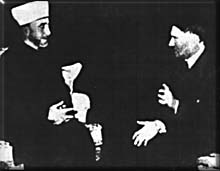 He was a "hero" of Yasser Arafat, his relative. (Via Charles Johnson, who'd probably be called a "fascist" for criticizing such fascists.) The Mufti, by the way, was described by Malcolm X in his autobiography: When I opened my door, just across the hall from me a man in some ceremonial dress, who obviously lived there, was also headed downstairs, surrounded by attendants. I followed them down, then through the lobby. Outside, a small caravan of automobiles was waiting. My neighbor appeared through the Jedda Palace Hotel's front entrance and people rushed and crowded him, kissing his hand. I found out who he was: the Grand Mufti of Jerusalem. Later, in the hotel, I would have the opportunity to talk with him for about a half-hour. He was a cordial man of great dignity. He was well up on world affairs, and even the latest events in America.I'm sure he was. posted by Eric at 12:02 PM | Comments (3)
| TrackBacks (0)
The irresolute disclosure of resolutions
In the long and arduous process of trying to get anything resolved, I found myself forced to look at the classical history of New Year's Resolutions themselves. I hate to be so two faced in my analysis, but the fact is, the god Janus is heavily implicated in any discussion of New Year's Resolutions: The tradition of the New Year's Resolutions goes all the way back to 153 B.C. Janus, a mythical king of early Rome was placed at the head of the calendar.Still not satifisfied? Or maybe readers are tired of my trying to drag the poor Romans into everything? Well, the Romans do happen to be our most recent link with the ancients, but the resolutions apparently go back to the Babylonians, so I think it's fair to mention them too: During the Middle Ages, the Church remained opposed to celebrating New Years. January 1 has been celebrated as a holiday by Western nations for only about the past 400 years.I think it's fair to conclude that the making of New Year's resolutions is old. Does that obligate me to make one? Or any? And if I did make a resolution or resolutions, would that oblige me to disclose them? Aren't we living in a free society in which secret resolutions are freely allowed? Can't I keep my resolutions in the closet? Or does having a blog mean that not even the most personal of things can be kept in the closet? On top of that, there's the question of living up to one's resolutions. Isn't that a personal thing too? I mean, suppose I had a personal habit I wished to break, like smoking. Suppose further that my smoking was itself in the closet. I mean, what business is it to the readers of this blog whether Eric smokes, drinks, chews tobacco, or eats too much? If I disclosed that, would I then be obligated (or blogligated) to give further reports on my success? What if my insurance carrier read my blog and found out I never told them that my personal lifestyle was not up to, um, snuff? Is this blog about my opinions, or is it about me? This is one of the problems with morality. When morality becomes political, then one's personal morality becomes fair game. Or does it? I mean, I'm always objecting to ad hominem attacks and the politicization of everything. Why should I help perpetuate a process which furthers the politicization of things I don't think should be politicized? As is my usual wont, I'm long on questions, but short on answers. While I'm at it, here's another thing which bothers me: the whole process of New Years is often laden with heavy drinking, which predisposes people to self-reproachful, guilt-based (possibly shame-based) thinking of the type I love to kvetch about in this blog. It's one thing to drink yourself into a regrettable stupor leading to a horrid hangover, but is it really logical to engage in further acts of self degradation (and make public resolutions you'll never keep) because you're feeling guilty or ashamed? Why not wait a day until your emotions recover to normal? Even right there I'm wondering whether readers will think I'm coming off a two day drunk or something. (It just so happens that I'm not, but the fact that I have to say something about it illustrates the pitfalls of public resolutions.) So, let's stick with blog resolutions. Via InstaPundit, I see that N.Z. Bear has a resolution which appears to be quite sage advice: There are many things I'm resolving for the New Year, not all of which are suitable for sharing in the bloggy world. So if you seek introspective, comprehensive lists of resolutions, you'll have to look elsewhere. I'll give you one, though, and I encourage you to take it up as your own:That would be fine with me, except the latter can get you in more trouble than the former. I'm often accused of being too nice, but the problem is, I know too much about too many sensitive things about the way the world works -- especially about the inner workings of that wretched, corrupt, contemptible thing we call the human mind. Being an asshole would require raising my standards. I'm not sure I could carry it off, and I'm not sure it would be right. I'm no better than the assholes who deserve my being an asshole to them, and I find you get more assholes with honey. I hate to sound so irresolute about such a resolute topic, but at the risk of being a Buddhist, I'll try to explain by offering an an example by way of an alcohol-soaked theme. Prohibition. For all the talk about the Greatest Generation, one of the things that is forgotten about this dying breed of American is that their earlier members have to be called the Prohibition Generation. Some of the wisest people I knew came of age during Prohibition. (It just so happens that I was raised by one of them.) They learned to drink, and many of them learned to make their way in business during an era when people drank even more than they do now, yet the whole business was illegal. A few kooky Elliot Ness types excepted, nearly everyone was corrupted. If you ran a successful restaurant or a bar, paying off the cops was just part of doing business. Life was real. People didn't say much about it. Corruption was just the way it was, a given. Not only did society not fall apart, a sort of realism was produced which has nearly died off. As the Prohibition generation dies off, we're losing the great American spirit of corruption that won World War II -- at least in part because, say, an abu Ghraib scandal (and that's just one example) would have been unimaginable. People knew that wars have casualties. People knew the difference between "Official Morality" and what people did, and they didn't care, or if they did care they did what that generation knew how to do: they looked the other way. To a large extent, Americans were (certainly more then than now) as writer William S. Burroughs put it, Johnsons: The old hop-smoking rod-riding underworld has a name for it: 'a member of the Johnson family.' Wouldn't rush to the law if he smelled hop in the hall, doesn't care what fags in the back room are doing, stands by his word. Good man to do business with. They are found in all walks of life. The cop who slipped me a joint in a New Orleans jail, for instance. Or when I was pushing junk in New York back in 1948, the hotel clerk who stopped me in the lobby: 'I don't know how to say this, but there is something wrong about the people who come to your room.' (Something wrong is putting it softly; ratty junkies with no socks, dressed in three boosted suits puffing out, carrying radios torn from the living car, trailing wires like entrails. 'This isn't a hock shop!' I scream. 'Get this shit out of here!' Regaining my composure I say severely, 'You are lowering the entire tone of my establishment.) 'So I just wanted to warn you to be careful and tell those people to watch what they way over the phone ... if someone else had been at the switchboard ...'I guess this means I should resolve to be more of a Johnson. The hard part is what to do about the shits. The assholes. I have to be more resolute about them, that's for sure. As irresolutely as possible. RESOLVING MORE: As Dennis's last post reminded me, there's a growing relationship (and corresponding growth in tension) between the extent to which politics is about personal morality and the extent to which politics becomes ad hominem. The question of who is an asshole has become ever more complex. Sometimes, political opinions are ad hominem attacks, while at other times ad hominem attacks are political opinions. (Drives me crazy, and keeps me humble.) MORE ASSHOLE TROUBLE: It should be borne in mind that even writing a negative review of a book can have serious repercussions: No self-respecting classicist will admit it, but there actually exists a book entitled Compromising Traditions: The Personal Voice in Classical Scholarship, edited by Judith P. Hallett (University of Maryland) and Thomas Van Nortwick (Oberlin College), published in 1997 by Routledge (who else?). In nine utterly amazing essays and a response, the book may be characterized as a churning, bubbling vat of anguish, apoplexy, bile, and other bad humors.Hey don't look at me! I'm no self respecting classicist, and I don't have to admit anything! UPDATE: Much to my horror, I see that I have (as I so often do) understated the scope of the problem. What Victor Davis Hanson experienced as the accused Unabomber is nothing compared to what's apparently in store for Glenn Reynolds. (And, shockingly, at the hand of one of his minions.) Must we endure another sickening beheading video? Apparently, yes!  On top of that, I see the film is to be released by Miramax, no less! I knew all along that Michael Moore would eventually be producing these things! Enough is enough. It's not enough to say "I TOLD YOU SO!" for the umpteenth time. Clearly, something must be done. posted by Eric at 08:56 AM | Comments (3)
| TrackBacks (0) Saturday, January 1, 2005
Annual homage to Momus
I forgot to bring my camera to today's Mummers' Parade! (Waaahh!) But with my flimsy, low-resolution phone camera, I was able to at least document a few of the many classical and paganistic elements which so characterize this annual extravaganza. (This is my second annual Mummers' Parade post, which makes this an established Classical Values tradition.) Here's a winged chariot from South Philadelphia's City of the Dead:  And here's a close-up shot of a dead Mummer:  Finally, the Blues Brothers are remembered as their ghosts overlook the Durning String Band:  Poor technology, but I hope it gives a general idea. posted by Eric at 11:22 PM | Comments (2)
| TrackBacks (0)
Team America vs. the World (and Robert Bork)
Crotchety ol' Robert Bork is hopping mad about American cultural exports, and he's arm in arm with the mullahs and censors: ... Mr. Bork, author of "Slouching Towards Gomorrah," thinks some conservative (not to say radical) Muslims have a legitimate point — as do American evangelicals and others on the religious right. "They have good reason to be very worried about" the spread of American movies, music and fashion, Mr. Bork allows. "I suppose it's better than what they have now, but I wouldn't celebrate too much if they began to adopt our popular culture." But the simplest critique is the American. Take me, for instance. I'm an American, and I'm apparently not very Americanized. I don't listen to popular music, wear trendy clothes, or rush out to see Hollywood films. That's not a point of pride, either. It's a matter of taste. There's no homogeneity among the Americans I know. In film, for example, nothing is more American than the work of John Cassavetes, but the critics will fail to see that because they mistake commercialism (which can occur anywhere) for character. The underlying message is that people who 'succumb' to 'American' commercialism must be protected by those who know better, and must be herded into inherited pens like sheep. The real critique is one made by Jose Ortega Y Gasset years ago: the ascent of the masses. Whether a valid critique or not, I'll leave that to you to decide. But one thing is clear, and that is that current critics mistake commercialism for national identity and have staked out a false heart for their monster. Reason editor Charles Paul Freund has a nice take, though, noting that 'Americanization' is most prevalent where native culture is stifled by oppressive controls: Mr. Freund offers an inspiring anecdote. In Talibanized Afghanistan, in 1997, all aspects of culture — movies, music, photographs, art — were strictly forbidden. Yet smuggled copies of "Titanic" (which many an American pastor preached against) found their way into Afghan homes. The movie was so popular that young men in the capital of Kabul wanted their hair cut in the style of star Leonardo DiCaprio. At weddings, cakes were shaped like the Titanic. It seems as if pieces of "Titanic," so to speak, are tastiest where local cultural cuisines don't nourish. At any rate, today is evidence that Philadelphia (America's birthplace) has retained its cultural identity. posted by Dennis at 10:24 AM | Comments (14)
| TrackBacks (0) |
|
June 2009
WORLD-WIDE CALENDAR
Search the Site
E-mail
Classics To Go
Archives
June 2009
May 2009 April 2009 March 2009 February 2009 January 2009 December 2008 November 2008 October 2008 September 2008 August 2008 July 2008 June 2008 May 2008 April 2008 March 2008 February 2008 January 2008 December 2007 November 2007 October 2007 September 2007 August 2007 July 2007 June 2007 May 2007 April 2007 March 2007 February 2007 January 2007 December 2006 November 2006 October 2006 September 2006 August 2006 July 2006 June 2006 May 2006 April 2006 March 2006 February 2006 January 2006 December 2005 November 2005 October 2005 September 2005 August 2005 July 2005 June 2005 May 2005 April 2005 March 2005 February 2005 January 2005 December 2004 November 2004 October 2004 September 2004 August 2004 July 2004 June 2004 May 2004 April 2004 March 2004 February 2004 January 2004 December 2003 November 2003 October 2003 September 2003 August 2003 July 2003 June 2003 May 2003 May 2002 AB 1634 MBAPBSAAGOP Skepticism See more archives here Old (Blogspot) archives
Recent Entries
• Just a thought on blogs and journalism
• Authentic warpath? • Justin is no lawyer -- and that's good! • Setting well . . . • Bring Me The Cone Of Silence • Corrosion by collusion? • Mortal rendering? • Harbor Lights • I Wish I Was A Better Writer • Terrorists as Equal Opportunity Martyrs?
Links
Site Credits
|
|