


|
|
|
 Tuesday, October 31, 2006
Happy Halloween!
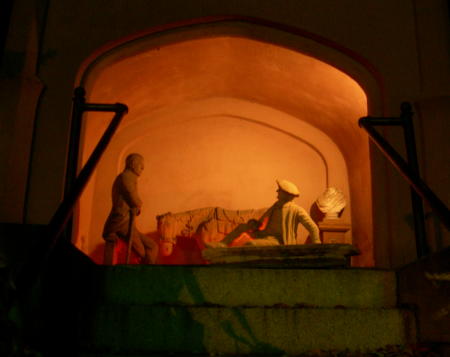
OK now it's time to take Halloween seriously. No more playing around. I attended Laurel Hill Cemetery's special Halloween tour, and I did my best to soak up the spirits, which did not disappoint. Lest anyone think I am kidding, the languid and maudlin angel shown in the next picture is literally prying open the lid of the crypt behind her to let the spirit out.
Many might think so, but then, they need their denial, and I will not interfere. (But in fairness, if they haven't seen an actual ghost, how can they know for sure that this isn't one?) Trying to beat the Halloween nighttime deadline, I managed to carve a pumpkin just before darkness had fully set in, and then right in this blog -- before my very eyes! -- another, even spookier cemetery scene managed to insinuate itself into the pumpkin image.
posted by Eric at 05:38 PM | Comments (1)
| TrackBacks (0)
Republicans caught in the act of mean-spiritedness!
As if we needed more proof.... 

And the victims? Why, the children, of course! posted by Eric at 11:45 AM | Comments (3)
| TrackBacks (0)
RINOs go trick-or-treating
Larry Bernard is hosting this week's special Halloween edition of the RINO Sightings Carnival. The posts take the form of trick or treaters, and Larry's an excellent creative writer, so it's very entertaining. Don't miss it! But I'm wondering. How many parents would actually let their kids go trick or treating as a Republican at all, much less a Republican In Name Only? Halloween is one thing, but certain things are too awful and scary to contemplate. NOTE: I was going to have something in the title about RINOs smashing pumpkins, but I see the group has already beaten me to it. posted by Eric at 10:13 AM | Comments (0)
| TrackBacks (0)
First they came for the gays....
Most of us are in the closet, or we get treated like the people in the article.So says Kesher Talk's Judith Weiss (via PJM), as she reflects on a growing trend noted in the NYT and on the minds of many -- the deliberate shunning and cutting off of friends and relatives because of their political beliefs. Judith outlines a pattern very familiar to me: "People just assume you're a Democrat." Boy do they.I've noticed this for years, and it seems to have gotten worse. You'd think that none of these liberal activists knew that about half the country voted for Bush, and the other half for Kerry. Like many people, Judith notices that Republicans don't behave this way towards Democrat friends. I think the reason is that Republicans are very accustomed to keeping their mouths shut, to not telling friends and coworkers how they voted. In some cases, their very livelihood depends on being "in the closet." While I can't prove my suspicions, I'd even go so far as to speculate that one of the reasons the outing of gay Republicans struck a raw nerve is because so many non-gay Republicans are so used to life in the closet that they were quick to react to the real reason for the outing: what makes gay Republicans so disgraceful is not their homosexuality, but their Republicanism! While Democrats might have missed it, few Republicans missed the fact that they weren't outed merely for being gay. They were also outed for being Republican. Thus, the outing generated sympathy in normally unsympathetic quarters. If you are a Republican surrounded by Democrats, being in the closet is all too familiar, and seeing any Republican -- even a gay one -- being outed is excruciatingly painful. Why, it's almost as if you could be next! UPDATE: Thanks to Glenn Reynolds for linking this post. Welcome all, and Happy Halloween! posted by Eric at 09:06 AM | Comments (100)
| TrackBacks (0)
only more acceptable?
It wasn't that long ago that things like creating a new human liver from scratch were entirely theoretical. I didn't expect to see actual hands-on results as quickly as this, but it seems to be happening (which is good news for Hepatitis C sufferers.) While they can't yet grow full-sized livers, this is quite a breakthrough, and growing usable sections of livers or whole, transpantable ones seems inevitable. Interestingly, the scientists didn't use embryonic stem cells, but umbilical cord blood: While other researchers have created liver cells from stem cells from embryos, the Newcastle team are the first to create sizeable sections of tissue from stem cells from the umbilical cord.I'm wondering what is meant by "more ethically acceptable than the use of embryonic stem cells," though. Does "more ethically acceptable" mean that there are any ethical objections to utilizing umbilical cord blood? Or is it just surplusage of language, like saying that good is more ethically acceptable than evil? I'm not going to spend all day on this, but I was unable to find a single objection to umbilical cord blood research. This statement is typical : There are no legal, ethical, moral or religious objections to using these cells.Perhaps the objections will come later, but I don't see them now. (Maybe they'll be along the lines of "why create new technology to extend life when people are starving/shouldn't they simply die with dignity?") posted by Eric at 08:04 AM | Comments (3)
| TrackBacks (0) Monday, October 30, 2006
This November, help implement martial law!
Today's Inquirer has a fun op ed by James Lileks, "The first 100 days if Democrats win": Day 1: Party like it's 1992; citizenship for all Gitmo detainees; a blanket amnesty; and a "Circle of Healing" ceremony held on the Capitol steps.I know that's only Day 1, but I don't want to spoil the op ed for people who haven't read it. Plus, I don't want to do anything that might upset the plan of angry Republicans to sit the election out. Otherwise, we might have angry Democrats taking it to the streets, and we can't have that. Instead, the Republicans should just lose, so they can declare martial law. Braving the inevitable midnight knock on the door, Lyn Davis Lear, the wife of activist/TV genius Norman Lear, proposed on the Huffington Post blog that angry citizens "take it to the streets" if the sweet anticipated victory is snatched away by the Cheneyburton overlords. Lear quoted Gore Vidal's dark view: If the election went against them, "the Bush-Cheney henchmen could simply call on martial law." No doubt. One last election, a few cleansing rounds from the Brownshirt burp guns, and it's the Reich Stuff for us and our descendants.As usual, I'm behind the learning curve (although in my defense I will say that Karl Rove deliberately keeps this blog out of the loop), but now I finally understand the Republican secret strategic loss strategy: The Republicans have to lose! Otherwise, if they keep winning elections, how will they ever be able to seize control, cancel the Constitution, and declare martial law? This explains why Bush and Rove are counting on the Republican brownshirts to do their duty to the Bushfuhrer and sit the election out. (Obviously, if you have been voting Republican but you prefer a one party superstate with complete dictatorial powers, now's your chance to stay at home and make it happen. Wink wink!) With any luck, by sitting this one out, you'll never have to vote again! But hey, let's not breathe a word of this to the Democrats, because if they get hip to the Republican brownshirt plan to lose power in order to seize it, they might just try to counter the Republican strategy, by staying at home themselves. You know, saving the Constitution and all that stuff. It's all simple logic, but alas, I don't think the Democrats will stay at home to save American democracy. That's because if by staying home they prevent a Republican power seizure, who would ever know that the strategy worked? They'd just continue to be thought of as a whining minority in a democracy dominated by Republican fascist wannabes (who'd be reduced to Fascist In Name Only status). Who'd ever thank the Democrats for saving the country? I realize that no good deed goes unpunished, but it's a crying shame to see the Democrats squander what may be their last chance to defeat Bush fascism. UPDATE: Glenn Reynolds is circulating a report that Karl Rove actually wants the Republicans to win. (Yeah, right.) Without revealing his real thoughts about the Rove plan he claims to have "revealed," Glenn poses a cryptic question: Will it work? We'll know in just over a week.If Glenn's blatant failure to mention the imminent coup doesn't frighten the Democrats into not voting, I don't know what will. posted by Eric at 09:46 AM | Comments (2)
| TrackBacks (0)
We should all have the right to be orphans
When I was still a kid, controversy raged in the Philadelphia area over whether an all-male prep school known as Girard College should be racially integrated. No ordinary boarding school, Girard College had been founded in 1848 according to the provisions in the much litigated will of philanthropist Stephen Girard. (A French born American patriot, Girard was the wealthiest man in America when he died.) While a bigot by today's standards, Girard's views reflected his times, and he believed his money would best be spent educating destitute white orphan boys in a strictly non-sectarian manner. It was the latter provision which first caused trouble. The United States Supreme Court summarizes: The persons who are to receive the benefits of the institution he declared to be, "poor white male orphans between the ages of six and ten years; and no orphan should be admitted until the guardians or directors of the poor, or other proper guardian, or other competent authority, have given by indenture, relinquishment or otherwise, adequate power to the mayor, aldermen, and citizens of Philadelphia, or to directors or others by them appointed, to enforce in relation to each orphan every proper restraint, and to prevent relatives or others from interfering with, or withdrawing such orphan from the institution." The testator then provided for a preference, "first, to orphans born in the city of Philadelphia; secondly, to those born in any other part of Pennsylvania; thirdly, to those born in the city of New York; and lastly, to those born in the city of New Orleans." The testator further provided that the orphan "scholars who shall merit is, shall remain in the college until they shall respectively arrive at between fourteen and eighteen years of age."This forced the Court (the case is Vidal v. Girard College) to grapple with the question of anti-Christian bigotry, for Girard had stipulated not only that there be no religious instruction in the school, but that no clergyman might ever set foot on the campus. It was argued that this was anti-Christian, because it violated the laws and public policy of Pennsylvania (said to be a Christian state). The Supreme Court ducked the religious questions as much as it could (I guess Wikipedia's assertion of Girard's atheism wasn't available), but ruled that prohibiting formal religious instruction and barring clergy did not preclude the teaching of morality (including Christian morality): All that we can gather from his language is, that he desired to exclude sectarians and sectarianism from the college, leaving the instructors and officers free to teach the purest morality, the love of truth, sobriety, and industry, by all apropriate means; and of course including the best, the surest, and the most impressive. The objection, then, in this view, goes to this, -- either that the testator has totally omitted to provide for religious instruction in his [*201] scheme of education, (which, from what has been already said, is an inadmissible interpretation,) or that it includes but partial and imperfect instruction in those [**194] truths. In either view can it be truly said that it contravenes the known law of Pennsylvania upon the subject of charities, or is not allowable under the article of the bill of rights already cited? Is an omission to provide for instruction in Christinanity in any scheme of school or college education a fatal defect, which avoids it assording to the law of Pennsylvania? If the instruction provided for is incomplete and imperfect, is it equally fatal? These questions are propounded, because we are not aware that any thing exists in the constitution or laws of Pennsylvania, or the judicial decisions of its tribunals, which would justify us in pronouncing that such defects would be so fatal. Let us take the case of a charitable donation to teach poor orphans reading, writing, arithmetic, geography, and navigation, and excluding all other studies and instruction; would the donation be void, as a charity in Pennsylvania, as being deemed derogatory to Christianity? Hitherto it has been supposed, that a charity for the instruction of the poor might be good and valid in England even if it did not go beyond the establishment of a grammar-school. And in America, it has been thought, in [**195] the absence of any express legal prohibitions, that the donor might select the studies, as well as the classes of persons, who were to receive his bounty without being compellable to make religious instruction a necessary part of those studies. It has hitherto been thought sufficient, if he does not require any thing to be taught inconsistent with Christianity.Over the years, many of the will's provisions survived legal attack, but it was in 1968 that the "white orphans" provision was struck down. Because the Will was so often successfully defended, it was considered sound and defensible. So it was until the 1950s, when courts began to consider social changes, and political expediency, when interpreting the constitutionality of a man's last wishes.Male students, of course. I remember when the place was integrated, and I thought it was wonderful. Which it was. It struck me as unfair that this dead, white, colonial-era, man could continue to discriminate long, long after his death. (Yet part of me wondered, if one will can be disregarded, what about others?) Eventually, the school was forced to admit "functional" orphans. And girls. Can't have tax-exempt sexism, can we? To broaden the base of potential students, in 1977, the Court authorized the admission of "functional" orphans. These are children who receive inadequate care from their natural parents because of separation, divorce, desertion, disability, or "any other reason."That covers a lot of kids, and it's probably the best way to keep the school alive (the days of orphanages being long gone), but there's just something about the idea of child from a single parent families being an orphan which just rankles me. The word "orphan" once meant something. But now, it means nothing. Why is there no preservation of orphans movement? And get this! Now, priests are allowed! Ironically, with all the changes to the Will, the Philadelphia Inquirer, on May 5, 1973 reported that "Girard College bars a priest." The priest came to the College to attend an organ recital. The recital was advertised as being open to the public. Based on the religious restriction in the Will, he was denied admittance. Finally, within the last year, the Board turned its head and permitted a Black ordained minister to enter the grounds and since then other clergy have been admitted to the campus.Times change, of course. And so do words. My dad died 16 years ago, and my mom died 7 years ago. I've only thought of myself as an orphan (well, an "adult orphan") since 1999, but now I know I was an orphan long before that. I don't see why the definition of orphan has to be so exclusive. Actually, in another case, the chocolate magnate's will which had created The Hershey School (with similar exclusions based on race, sex, and orphan status) was similar rewritten by the courts, and the word "orphan" was changed to include "social orphans": In 1976, the Deed of Trust was modified again to permit the enrollment of students without regard to gender. It was at this time that the deed was also modified to expand the definition of "orphan" to include any child not receiving adequate parental care at home, thus allowing for the enrollment of "social orphans."I don't know how hard it is to become a societal orphan, but it might be a fiction the school needs in order to boost enrollment. More than anything, the definition of "orphan" seems to depend on who wants to be one. Definitions seem to change not according to rules of logic, but according to the nature of the benefits the definitions convey. When words define rights, expect them to change. posted by Eric at 09:43 AM | Comments (0)
| TrackBacks (0) Sunday, October 29, 2006
My latest little friend...
...is a Northern Brown Snake (Storeria dekayi dekayi).  When I was a kid this was called the Dekay's Snake. Now it's usually called the Brown Snake, and sometimes "Dekay's Brown Snake." Believe it or not, this tiny thing is full-grown at 13 inches. The poor snake was in the middle of a well-traveled road looking very dead, as it wasn't moving at all. I thought it had already been run over, but when I looked closely I couldn't see any damage other than an old injury to the tail. I picked it up and it was very cold and made no attempt to get away, but I could tell it was alive. I didn't want to leave it there or in that condition, so I removed one of my socks, put the snake inside, knotted the upper end of my sock, and put it in my pocket. After an hour or so inside, I removed the snake and it was quite lively, even putting on a show for the camera by puffing itself up and appearing ready to strike. That's consistent with the description of the (completely harmless) snake's behavior: ...when these snakes do feel threatened they will flatten their bodies out to appear larger and place their bodies in an aggressive posture, and they will even release a musky smelling fluid from the cloaca (Harding 1997).No musk, nor did it attempt to bite. (I guess the snake wasn't feeling sufficiently threatened by the gigantic savior who'd stuffed it in a sock.) Another nearby Brown Snake had been squashed flat by a car, and what I think happened is that wherever they were hibernating was flooded in the recent rains and the snakes went out on the road to warm up, in a state of soaked half hibernation. I saved its life for now; I'll see whether I can get it to eat some earthworms. posted by Eric at 11:05 PM | Comments (1)
| TrackBacks (0)
married to the state?
It's all too easy to forget that some of the arguments for same sex marriage which drive the rank-and-file supporters involve -- surprise -- money (especially government "entitlement" money). From today's Inquirer: Since her heart attack and stroke in March 2005, Heggs has been in and out of the hospital and unable to work. A nurse for 35 years, Heggs now receives $1,400 a month in disability payments from Social Security.I never thought about it, but why on earth should person A be entitled to government benefits because person B died? I don't care whether they married or not; it's one thing for a spouse to leave his property to the other, but why should government entitlements be involved? It strikes me that there's nothing fair about that. The problem is, once something is an entitlement, it becomes like tangible property. Fair or not, an entitlement to something tends to create a sense of unfairness for others who aren't entitled, and so on. So, while I haven't given much thought to it before, I have to admit that same sex marriage would at least compound unfairness more fairly. Perhaps there's somewhat of a nexus between here libertarian and conservative thinking. But the nexus ends where it comes to the confusion between allowing something and the illogical belief that if a thing is allowed it must be good. I advocate allowing sexual freedom, so in the eyes of conservatives this makes me a "hedonist" even though I'm personally monogamous, and the type of person who refuses to take off his clothes at a nude beach. It's about as logical as saying that supporting heroin decriminalization means advocating heroin or saying it's good. Likewise, I don't think abortion is a "right," although I'd have problems with imprisoning women for doing that to themselves; in the eyes of moral conservatives this makes me complicit in murder. If I hear that "we" "slaughter" "millions" one more time I'll scream, because I am only responsible for my moral crimes. Am I to blame for my friends who died of AIDS because I believed in the right not to be arrested for screwing? People would say that I am. These are the sorts of things that make me tend to distrust social conservatives. It's annoying to be blamed for the acts of others, and reminds me of the endless scolding by gun control people for shootings. How am I to blame in any way for someone else's shooting spree? So, at the heart of my libertarianism is a sense of annoyance. It's the idea of reducing everyone to the level of the worst offender, and treating all people as suspects that I can't abide. Being personally conservative means nothing; to be an officially licensed conservative these days, you have to believe in moral seat belt laws for everyone else. My problem is, I hate the people who would reduce us to the level of the worst, and do not agree with anticipating their behavior by reducing everyone to the lowest common denominator. There are alcoholics. Therefore, no one should be allowed alcohol, and people who think it should be allowed are moral degenerates allied with the distillery lobby? If I heard that enough times, I'd reach for my checkbook and proudly send my money to the distillery lobby. As to the people who screw up, I know this will sound selfish, but there is no way to prevent people from harming themselves or being evil. All I can do is be prepared to kill them if they try to harm me. I don't think I have any illusions about humanity; I just don't think government solves problems. I go along with libertarianism to that extent, but I'm generally skeptical about anything that smacks of utopian thinking. Just restore the Constitution and leave me the hell alone. If I cared about the morality of other people (at least, to the point of intervening in their lives beyond arresting them for committing crimes) I'd go nuts. People who claim to care about my morality (which collective morality by definition includes) worry me, because they don't know me, and people who don't know me and want to tell me what I should think make me very suspicious. I know it sounds frivolous, but it's getting harder and harder to be left alone, and it worries me. Little stupid things, like not wearing the funny gun diversity t-shirt to an airport, not offending anyone lest they take it the wrong way. I mean, what if I had a kid? Might some insane bureaucrat want to take my kid away because I have a pit bull (yes, it happened in San Francisco) or a house full of guns? Are such concerns mere paranoia? Suppose someone with kids and guns decided to ridicule the local child protective bureaucrats relentlessly in blog post after blog post. While there's a First Amendment right to do that, aren't these "faceless bureaucrats" actually human beings with a huge amount of discretionary power to conduct home inspections on the slightest pretext? I mean, it's not as if the "Nanny State" is some wholly artificial externality. There are real people with real human failings, who have power, and who believe that they have the right to use it. (Not that I'd ever ridicule bureaucrats, but I do have a right to do that, don't I?) I think that as information becomes centralized, and moralists converge from both sides, perhaps these will not remain idle or theoretical worries. That's my main worry about broadening marriage; I think the goal is to broaden society's control net, safety net, whatever you want to call it. I used to think homosexuals wanted to be left alone; now it's communitarian lesbians with children supported by a network of government bureaucratic activists -- many of whom would probably love to inspect the homes of all neighbor children who expressed disapproval of communitarian lesbians. People are increasingly unable to keep their lives and lifestyles to themselves. I'll never forget a San Francisco Bay Area lesbian who hated and feared Newt Gingrich because she felt he was "threatening" her lifestyle. What, I wondered, could he possibly do to her? The answer was not much actually; it was a feeling thing. He made her feel uncomfortable, disrespected, disapproved. While no one likes being disapproved of or disrespected, I think it's better to tolerate disapproval than demand approval. But it's still a free country. People are allowed to demand approval. It's when they demand approval enforced by the power of the state that a certain line is crossed for many people. Not that same sex marriage does this by itself. But when there's an army of activists backed up by an army of bureaucrats, "hate crime" laws can lead directly from a kid teasing another kid to visits from the child police. I could see that eventually leading to SWAT teams enforcing laws against intolerance. Culture wars are bad enough, and I deplore them. But if the government gets into being the culture police, things could deteriorate further. In England a student was recently questioned by police for making a racist remark: "She asked to be taken out of her group because the other five students were Asians and four didn't speak English so there was no point in her being with them. When she pointed this out to the teacher she was accused of being racist.This country isn't England yet. Here, there has always been a right to disapprove of or disagree with lifestyles, and even to be a racist. But if laws are enacted to protect people against bigotry, where does it lead? Martin Luther King Jr. used to say that there was no way to police what was in a man's heart, but I'm not sure that represents the modern trend. I remain very distrustful of state involvement in the lifestyle business, and I'm wondering whether there might be more common ground between libertarians and conservatives than is commonly supposed. I do wish differences in philosophy didn't take the form of accusations of hedonism and murder (and of course bigot), but I guess if I can get used to being called a "RINO," I can tolerate being a hedonistic murdering bigot. Besides, if all things are relative, and there's no such thing as right or wrong, who's to say there's anything wrong about hedonism, murder, or bigotry? ADDITIONAL NOTE: My thanks to an unnamed muse who helped me generate these thoughts during an email exchange. posted by Eric at 07:43 AM | Comments (6)
| TrackBacks (0) Saturday, October 28, 2006
Redeeming my Values mailer
Have to say, I've been getting a kick out of some of the mailings I've been receiving lately. This one's such a classic that I partially scanned it, and made a couple of minor changes to protect the innocent. 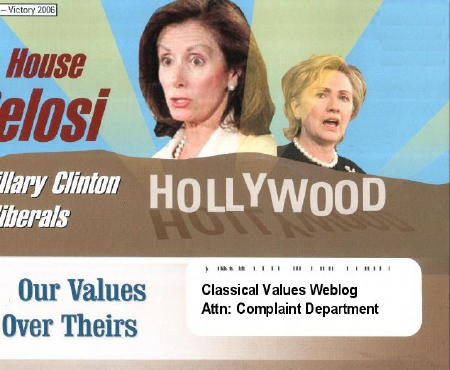
Far be it from me to complain that the "Values" meme is overwrought.... posted by Eric at 06:22 PM | Comments (0)
| TrackBacks (0)
depressing the vote
I feel like taking a vote right now between two choices: I think I lose no matter which way I vote. Certainly, I'm in the dark either way, and if I'm unhappy about it I'm wasting my time being unhappy, while if I'm happy about it I'm a deluded fool living in denial. Accept it. Fight it. Deny it. It's still there, isn't it? Hat tip to Dr. Helen, who's honest enough to admit she has problems this time of year when they roll the clocks back, and asks a few questions about Seasonal Affective Disorder: Could SAD be culturally induced, caused by the media or companies who want to sell light therapy devices? Or is it real? I think SAD is bad, but rolling back the clocks is SADism. To me it's like, isn't it bad enough the summer's over without the government rubbing salt in wounds? posted by Eric at 04:54 PM | Comments (5)
| TrackBacks (0)
Rainy day architecture
The train to Philadelphia:  I'm still in love with the Cira Center building. But the Rouse Towers aren't bad either (even though they snub the tradition of William Penn's hat).  posted by Eric at 10:06 AM | Comments (4)
| TrackBacks (0) Friday, October 27, 2006
Mountain of blowback at breathtaking speed?
Via Glenn Reynolds, Mickey Kaus argues that "the breathtaking speed with which this sort of radical cultural change [same sex marriage] has gone from being unmentioned to being a litmus test for all rational people is one of the things that worries ordinary voters and turns them into cultural conservatives" and he objects to the way the issue is being framed ("as 'law' and 'logic' against prejudice"). For the record, let me say that I don't like turning ordinary voters into cultural conservatives, OK? (Just thought I should make that clear.) You'd almost think there was a deliberate effort to prevent a public debate on same sex marriage. Seriously, it's one thing to do an end-run around the legislature by means of the courts, but when such efforts are accompanied by creating a climate in which people are afraid to even debate the issue, ordinary American voters are likely to feel rushed, even intimidated. Recently I made what I thought was a very uncontroversial statement (that I didn't it didn't think it was logical to equate opposition to same sex marriage with bigotry). For that I was criticized, then after I explained I found myself scolded by a commenter who demanded detailed answers to his essay length comment asserting quite vociferously that opposition to same sex marriage is bigotry: someone is a bigot if heHe then lists the arguments against same sex marriage, finds them all to be without any rational basis, which (he says) means that all arguments against same sex marriage are bigoted. Naturally, this caused me to wonder whether things have reached the point where it is bigotry to disagree over the definition of bigotry. On the other hand, might there be political consequences to calling people bigots? Obviously, there are no political consequences to a debate in a blog post, but what about that 70% of the voters (plus the leadership of the Democratic Party) who oppose a major change the marriage laws? How is it that all of a sudden they've become "bigots." Can anyone tell me how calling them bigots is going to change the way they vote? This is a democracy, and no one should be surprised to see evidence at the polls that people do not like being rushed, intimidated, pushed around. Mickey Kaus opines that even liberal voters, people otherwise willing to engage in social experiments like gay marriage, might very well balk. Looking at the overall situation as it has unfolded in the past few years, I think there is clear evidence of a condescending attempt to herd ordinary people, not only by telling them what to think, but by telling them how to think, and scolding them if they are wrong. I don't know what Karl Rove has been doing lately. But if he were still sitting at the controls of his blowback leverage machine, he'd probably be delighted with the call-em-all-bigots meme. But putting Rove nostalgia aside, I'm still curious about the apparent hurry to curtail serious debate on same sex marriage by such tactics. Assuming gay couples want to join the ranks of middle American respectability so they can proudly move in as the new married couple next door, isn't it a good idea to be polite about it? (I'm assuming, of course, that marriage is a serious and mature enough issue to warrant a serious and mature debate. Maybe I'm making the wrong assumptions...) UPDATE: University of Minnesota law professor Jim Chen (via Glenn Reynolds) thinks same sex marriage is analogous to interracial marriage, and maintains that Loving v. Virginia is controlling on the issue: Among life's challenges, none is more difficult to undertake, and none is more rewarding when achieved, than the mission of finding one person to love above all others, and persuading that person to love you in return. The law has no legitimate basis for regulating this quest on the basis of the race or sex of one's beloved.I couldn't agree more that the law has no legitimate basis for regulating the quest for love, but above all, marriage laws regulate marriage, not love. Bigamous couples may be in love, but they may not marry. Nor may minors, nor in some jurisdictions, persons too closely related to each other. They are free to love, and free to live together, but they cannot receive a piece of paper from the state that says they're married. In Loving, the state of Virginia made it a crime for interracial couples to marry, and adjuged cohabitation by such couples to be evidence of their crime: The two statutes under which appellants were convicted and sentenced are part of a comprehensive statutory scheme aimed at prohibiting and punishing interracial marriages. The Lovings were convicted of violating 20-58 of the Virginia Code:I think that's a far cry from laws which require that there be a legally qualified man and a legally qualified woman in order to obtain a license. There's no question that in Loving there was discrimination on the basis of race. But on what basis does requiring a man and a woman discriminate? Certainly not sexual preference, as there is no bar to a gay man marrying a gay woman. So, the discrimination must be based on sex. If a woman cannot marry a woman because she is a woman, or a man cannot marry a man because he is a man, is that sex based discrimination?"Leaving State to evade law. Ÿ If any white person and colored person shall go out of this State, for the purpose of being married, and with the intention of returning, and be married out of it, and afterwards return to and reside in it, cohabiting as man and wife, they shall be punished as provided in 20-59, and the marriage shall be governed by the same law as if it had been solemnized in this State. The fact of their cohabitation here as man and wife shall be evidence of their marriage."Section 20-59, which defines the penalty for miscegenation, provides:"Punishment for marriage. Ÿ If any white person intermarry with a colored person, or any colored person intermarry with a white person, he shall be guilty of a felony and shall be punished by confinement in the penitentiary for not less than one nor more than five years." Yes. If marriage is defined as requiring a partner of the opposite sex, it does discriminate on the basis of sex, and many people believe that such discrimination goes to the very basis of marriage. So more than anything, it's really a definitional issue. I don't think most reasonable Americans would deny same sex couples the right to love each other, cohabit, or enjoy hospital visitation, inheritance, or the rest of that bundle of "rights" typically associated with marriage. I think the resistance to same sex marriage is based not so much upon whether marriage discriminates on the basis of sex (because it does, definitionally) but whether eliminating that form of discrimination would obliterate marriage. In stressing the importance of marriage, the Loving court called it "one of the 'basic civil rights of man,' fundamental to our very existence and survival" and cited Maynard v. Hill, which is silent about sex, but which is laced with rhetoric suprisingly similar to what we read today: Marriage, as creating the most important relation in life, as having more to do with the morals and civilization of a people than any other institution, has always been subject to the control of the legislature. That body prescribes the age at which parties may contract to marry, the procedure or form essential to constitute marriage, the duties and obligations it creates, its effects upon the property rights of both, present and prospective, and the acts which may constitute grounds for its dissolution.I think a lot of people are still interested in -- even worried about -- things like that. I might not share their worries and concerns (and I'm hardly a purist) but I don't think such worries constitute bigotry. UPDATE (10/29/06): Tom Maguire has more on Loving (the case, that is!), and explains that the Supreme Court "followed, rather than led." posted by Eric at 12:48 PM | Comments (3)
| TrackBacks (0)
Everybody needs to hate somebody
But what do you do when you're the victim of anonymous machines talking to each other? I recently received an automatically generated notice from an agency which asserts that I engaged in a financial transaction I never heard of but may well have been conducted automatically on my behalf and which may have generated some electronic form. Various computers were involved, and I have no idea which computer either got it wrong or missed the number. So, I'd like to hate someone, but there's no one there. It's tough for me to hate myself when I didn't do anything wrong. But computers have a way of making trouble for humans by not talking to each other properly, then later imputing their misconduct to humans who had nothing to do with them, so that all you need to do is have a social security number, and VIOLA! You can be in a lot of trouble for the crime of not knowing what it was not possible to know. Which means you can be in trouble for doing absolutely nothing. One of the dumbest mistakes I ever made was "moving" (only temporarily and because I had to, not because I wanted to) from California to the East Coast. This caused taxing authorities there to impute income to me that I never had, but because I wasn't there to open the mail, the imputed income morphed into real income because of the simple passage of time. (Nor did calling myself "bicoastal" help.) Not knowing what computers are doing can get you in big trouble. But when you can't even figure out which computer to hate, how can you figure out which human (or group of humans) deserve the imputed hatred? I know the Christian approach is love, but isn't that also an emotion? When we get into trouble, our natural instinct is to either blame ourselves (which results in an emotion of guilt), or blame others (anger or hate). These natural instincts and emotions are useless when contending with electronically generated trouble. So, even if I put aside my feelings, I know that I am not the only person who has been treated this way by machines. My theory is that there's a lot of hate with no place to go. AFTERTHOUGT: It occurs to me that I forgot to mention the issue of fairness. Silly me. Can there be such a thing as "undifferentiated hatred"? I can think of few things more irrational, but then, nothing about is rational about being blamed for the mistakes of machines. posted by Eric at 11:34 AM | Comments (4)
| TrackBacks (0) Thursday, October 26, 2006
Softer core pumpkin values
The other day I wrote a moral equivalency post which touched on sex with pumpkins in what some might consider an unseemly manner. I really should be more ashamed of myself, but it could have been worse. (If I'd been really stirred up I might have said "Peter Peter pumpkin eat her" or something.) In the interest of proper atonement, I thought I should let readers know that thanks to Charles G. Hill (who also posted a computer snake I couldn't identity), I stumbled across a less lascivious, more practical use for pumpkins. All the steps are outlined, and the finished product looks like this:  See? Nothing sexual about it at all. (Besides, we all know that robots don't get laid....) posted by Eric at 08:12 PM | Comments (2)
| TrackBacks (0)
More marriage, more divorce?
Here's a Scandanavian study with results which strike me as counterintuitive, as well as stereotype-defying. Apparently, lesbian couples there have a divorce rate more than triple that of gay men. While the study has been cited by organizations opposing same sex marriage as ammunition for the argument that compared to heterosexual couples, gay couples have a higher incidence of breaking up, what surprised me was the large disparity between lesbians and gay men. The traditional stereotype is that it's the man who runs off, so I would expect the gay men to be less loyal to their partners. Anyone know what might explain this? I know that Norway and Sweden aren't the United States, but we're talking about Western countries, with cultures similar enough that unless there's something I'm missing, I think the same pattern would probably hold here. What I can't figure out is why. posted by Eric at 07:45 PM | Comments (15)
| TrackBacks (0)
Different strokes
Whipping as "therapy" for depression? Glenn Reynolds is right about the Siberian scientists being serious about this new treatment. They not only claim that being whipped works for depression, but the head doc has used the method to cure himself: Doctor of Biological Sciences, Sergei Speransky, is a very well known figure in Novosibirsk. The doctor became one of the authors of the shocking whipping therapy. The professor used the self-flagellation method to cure his own depression; he also recovered from two heart attacks with the help of physical tortures too.Punishment by the opposite sex? But isn't that what would be called heteronormative sadomasochism? I don't mean to quibble, but you'd think the Siberians could show a little more sensitivity. Why presume that everyone would want to be beaten by a member of the opposite sex? Have any control studies been done? Surely these doctors aren't arguing that only straight people get depressed, are they? I mean, it's not as if the word "gay" has to mean literally happy, all the time. Don't gay people get just as depressed as straight people? And aren't they just as entitled to treatment? Depression does not discriminate! Haven't they learned? This brings to mind another issue, which might be related. If torture is therapy for depression, what are the implications for the apparent "tortures" allegedly being inflicted on prisoners at Gitmo and abu Ghraib? I'm referring in particular to that stupid looking woman dragging the man on a leash. Was her victim gay? Because, unless he was, I'm thinking that in light of the new research, this might not have been torture at all, but therapy for his depression. Yes, depression. According to the Siberian scientists, "suicidal thoughts and psychosomatic diseases occur when an individual loses his or her interest in life." What could be a clearer example of a loss of interest in life than wanting to blow yourself up? If there's a treatment that works, why not send in the right personnel?  Hey, don't look at me; I'm only presenting this information for purposes of scientific discussion. (Please Mr. Siberian doctor, don't make me take the cure! I'm feeling so happy to be alive that you wouldn't believe it! I'm like, totally joyful! Honest! Please don't hit me!) posted by Eric at 04:17 PM
| TrackBacks (0)
fine young autumn for nature's cannibals
"Take this country back by force!" While the phrase brings only 13 Google hits, earlier I heard a man say that, and while he might have merely been venting because of a bad hair day, he sounded awfully serious. (There are so many assumptions within the demand that if I wanted to analyze it I wouldn't know where to begin.) I know it sounds nutty to be worred about civil war, but sometimes I think it's the nature of man. Not just in the nature of Iraqis, Chileans, Bosnians, Salvadorans, etc. Chester's "Autumn of the Patriarch" post (about Frederick Turner's piece on Iraqi death squads), made me think again about Dali's "Soft Construction with Boiled Beans" painting. Here's Chester: Turner believes that death squads are a sort of primeval slime from which governments emerge. But might they not also be the maggots that feast on their corpses? Perhaps the true victim of such squads and other proxies is the state itself, so long the leviathan that its demise is now both impossible to imagine and futile to escape.(Via Glenn Reynolds.) However, and much as I hate to be a relativist, considering the number of people killed by governments (156,000,000 in the 20th Century), perhaps even civil war needs to be seen in perspective. Or is that a distinction without a difference? Whether it's civil war or a government killing its citizens, such slaughters are usually perpetrated by one group of people killing another group of their fellow countrymen. Whether it's the government that's doing the killing or a faction that wants to become the government, when citizens of a country massacre each other, it's metaphorically cannibalism. And speaking of both autumn and cannibalism, here's Dali's "Cannibalism in Autumn": 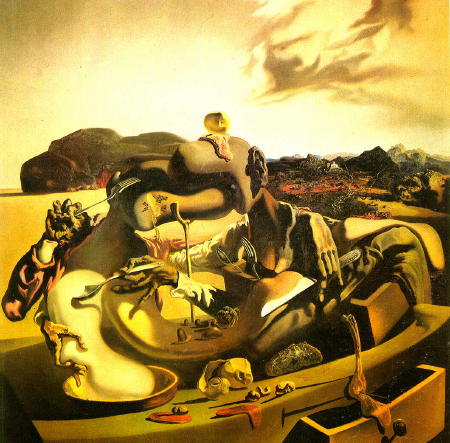 Painted shortly after the Soft Construction/Premonition painting, it's a continuation of Dali's treatment of the civil war theme. While the topic at hand was obviously the Spanish Civil War, Dali was thinking about the bigger picture, including natural history. Dali offered a much criticized explanation of the painting: "These Iberian beings devouring each other in the autumn express the pathos of civil war considered as a phenomenon of natural history, as distinct from Picasso, who considered it a political [phenomenon.]"Hmmm.... Is politics an excuse for cannibalism? I guess it depends on who's eating whom. Yesterday I spent a couple of hours seeing the Franklin Institute's Darwin exhibition, and I can't stop thinking about one of his observations: "Man tends to increase at a greater rate than his means of subsistence; consequently he is occasionally subjected to a severe struggle for existence, and natural selection will have effected whatever lies within its scope."I'd hate to think mass slaughter of human beings might be grounded in natural law. That might lead to people to hate natural law, man's nature, Darwin, or even God. But it wouldn't stop the process. As Trotsky is reported to have said, "you may not be interested in war, but war is interested in you." posted by Eric at 01:41 PM | Comments (1)
| TrackBacks (0)
my bigoted inner child hates all bigoted debates!
Despite the fact that I don't get a large number of actual comments, I am forced to go to a lot of trouble to keep the comments feature turned on. I get more spam than many readers might imagine. It pours in, day in and day out, and it consumes many hours of my time. I have almost reached the point where I will have to require commenters to be signed in and all that garbage -- not because I want to do that, but because the spammers are making my life too complicated, and I just don't have time to deal with them. But this post is about another problem. Maybe it's more a misunderstanding about the nature of comments, but I'll try to address it. A commenter named "Raj" seems to think that I have some sort of a duty to answer essay length comments -- one of which stated numerous views with which I disagree. I have no duty to allow, read, or respond to any comment at all or in part. That I made a couple of observations in no way obligates me to explain anything, as this is not a debating forum. I wrote my post and "Raj" (whoever he may be) left a comment. I can say whatever I want, or nothing at all. I don't know where anyone would get the idea that I have to respond at all -- much less matching detail for detail. Raj or anyone else can post whatever they want in their own blogs, and just as I would not be obligated to leave comments or respond to their posts, neither would they be obligated to allow me to comment or respond to any comment I left. I might as well take this opportunity to say again that I think much of what passes for debate over same sex marriage is silly name calling, and that I do not think it is bigotry to disagree over what represents a drastic change in the law. I would defend to the death the principle that adults have a right to engage in consensual sex of whatever sort they desire. However, I have a major argument with the idea that sexual interests define people as members of any group entitled to rights beyond the right to sexual freedom and privacy. I don't believe homosexuals are a separate or distinct class of citizens entitled to recognition, because I do not believe that sexual tastes constitute a form of human identity. (Any more than food preference, or styles in clothing, hair color, or ways of taking a leak.) Once sexuality is defined as an "identity," in my view it limits freedom by defining people according to what they do with their genitalia, and it leads to invasion of people's privacy and dignity. Already, we are seeing a division over "outing" -- which itself is a wholesale violation of privacy based on identity politics, which has grown like a cancer in this country. (I think all hate crime laws are wrong, and I would never support more of them.) But, for the sake of this discussion, even if we consider homosexuals to be a recognizable identity group, it cannot be denied that they are already allowed to marry members of the opposite sex, because the marriage laws allow that, and do not question people's sexual tastes. Some gay activists seek broadening these laws to allow same sex marriage, but as a gay rights issue, such a change is overbroad, because it would allow heterosexuals and homosexuals alike to marry people of the same sex, without regard to sexual orientation. This cannot be seen solely as a "gay rights" issue, because it is an expansion of marriage for everyone. Because of this overbroadness, it is entirely possible to disagree with the idea of same sex marriage without being "bigoted against gays." (For that matter, society has also made a determination only adults may marry. Is this "bigotry" against children?) I think all people have a say in this, I respect the opinions on both sides, and I don't think it is helpful for either side to to call the other "bigoted." Actually, considering the likelihood of political backlash, maybe it is helpful -- helpful to the cause of those being called "bigots." There are a number of definitions of bigotry (the modern trend often involves identity politics issues), and while I more lean towards a definition that includes hatred, it also means intolerance. That, of course, begs the question of what is intolerance? If I turn off comments because I cannot tolerate them, am I a bigot? Not that I am planning to do that, but a lot of bloggers don't allow comments, and I don't think that constitutes bigotry. Certainly, simple disagreement is not bigotry, but at what point might it become bigotry? I think a line is crossed when someone is called names. ("Evil," "stupid," "ignorant" and so on.) But the problem with that definition is that it might mean that calling someone a "bigot" is itself bigotry, which would render any further argument circular and pointless. That's why I suspect the word "bigot" is overused as a result of frustration. As a practical tactic, it's a good way to end a discussion while reassuring yourself that you've "won." (While I'm not sure that ideas are debates to be won, I guess that's another topic. Might it be possible to exchange ideas without debating?) posted by Eric at 08:49 AM | Comments (10)
| TrackBacks (0) Wednesday, October 25, 2006
Art and Death at Strathmore
I don't normally review the DVDs I rent, but I'm making an exception with Terry Zwigoff's Art School Confidential (IMDB link here). Anyone who wants to have a good laugh at Postmodernism (or modern art) should see it. Seriously, it's the art school equivalent of William F. Buckley's God and Man at Yale. Jerome (Max Minghella), the only student at Strathmore Art School unfortunate enough to possess genuine talent, naively imagines that attending art school might help him become the Picasso of his generation. Naturally, everyone at the school (with the possible exception of Anjelica Huston, who dared to opine furtively that DWM artists were actually alive when they painted) conspires to beat this out of him, because if there's anything abhorred more than the pretense of talent, it's real talent. His teacher (Professor Sandiford -- played to cliched perfection by John Malkovich) has no talent, originality, or teaching ability, but he conceals all of that beneath a smug facade of hip indifference to everything except genuine art. The latter he seems to hate, so he encourages the class to malign Jerome's drawings -- something the talentless, jealous peers are more than delighted to do. However, despite the abuse (maybe in furtherance of it; who knows...) Professor Sandiford invites Jerome to his home, where he reveals that he has finally learned how to paint triangles -- an achievement made possible only after decades of self discovery! And yes, there is still a ray of hope for Jerome -- provided he is really willing to learn. Though wholly incapable of teaching art, Mr. Sandiford nonetheless makes it abundantly clear that he is quite competent (and available) to teach Jerome how to open all sides of himself! 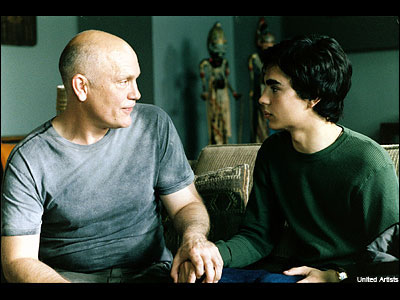 But alas! There's no real advantage to playing sexual favorites, because all students receive As anyway -- regardless of whether they open all sides of themselves to Mr. Sandiford. (I guess the postmodernist idea of eliminating grades does have at least one unintended side effect.) The snubbing continues unabated, until finally our hero realizes that there's only one way to play the game -- conceal real talent by deliberately substituting bullshit for art. But he outfoxes them at their game. Eventually, the kid befriends a psychotic, drunken middle aged artist with an ugly secret -- he's a wanted mass murderer who's been strangling people near the school so that he can render childish paintings of their corpses.... and what happens is a poignant indictment of the fraud that so often passes for art. Without spoiling the film, I strongly disagree with Roger Ebert that the mass murder aspect is "completely unnecessary, and imposes a generic story structure on a film that might better have just grown from scene to scene like an experience." Wrong! The mass murder subplot is absolutely necessary, and reminded me of Divine's memorable performance art line in "Female Trouble": Who wants to DIE for art?!I'd die for more films like Art School Confidential. UPDATE (10/26/06): IMDB link fixed. My thanks to all who never complained! posted by Eric at 09:45 AM | Comments (4)
| TrackBacks (0) Tuesday, October 24, 2006
Telephone spamocrats move on US?
According to a number of angry people who've posted complaints here, an organization called the Share Group is completely ignoring the Do Not Call registry. Says one irate commenter: These criminals use several similar numbers (877-499-2758, 2753, 2759) to illegally harrass people on the no-call list.I'm on the no-call list, but that apparently means nothing to these people. Here's another commenter, Sheryl: This number calls us at least FIVE times a day, starting in the early morning hours, right through until 10 PM. They don't leave a message either, after listening to the answering machine. We are on the NO CALL list too!Anyone else been getting calls from the "Share Group"? From the description at their web site, it seems to be engaged in activist telemarketing: Our core business is comprised of outbound telemarketing services: fundraising, membership mobilization and affinity sales calls. We are however a full-service provider, with offerings that include inbound calling programs, activist recruitment, online giving options, e-mail address collection and e-mail pledge fulfillment.I don't know who they're calling me about, but I notice one of their clients is MoveOn.org, which I consider to be one of this blog's competing web sites. Share Group, you'll never get a dime out of me! But look at how much money the Democratic Party and the Democratic Congressional Campaign Committee pay them! In 2003 the Share Group was purchased by a large Democratic political consulting firm: The Dewey Square Group (DSG), a Washington, D.C.-based Democratic political consulting firm with offices in several other cities, acquired The Share Group, a direct response telemarketing firm serving "progressive nonprofits." The new Share Group ownership consists of DSG, Trautman Wasserman & Company, a private equity firm, and Meadowbrook Lane Capital. The Share Group's senior management team remains intact, and company officials said the move would give it more resources to raise awareness and dollars for what is called "socially responsible" causes campaigns and candidates.The Dewey Square Group recently merged with the British WPP Group. (No idea what that means, and I haven't time for conspiracy theories; I only want to write a post about unwanted phone calls.) The Share Group seems to be hiring right now, so if you haven't been called by them yet, be prepared. I was curious to know how they got around the do-not-call list. They filed a request for an exemption from FTC rules and they also claim that their outfit's work is devoted to charity. Huh? While according to the FTC, political organizations are not charities, the telemarketing sales rule (TSR) does not apply to political solicitations: Political solicitations are not covered by the TSR at all, since they are not included in its definition of "telemarketing." Charities are not covered by the requirements of the national registry. However, if a third-party telemarketer is calling on behalf of a charity, a consumer may ask not to receive any more calls from, or on behalf of, that specific charity. If a third-party telemarketer calls again on behalf of that charity, the telemarketer may be subject to a fine of up to $11,000.There's probably a fine line between political and charitable solicitations, but telemarketing is telemarketing, and unwanted calls are unwanted calls. I think unwanted calls are like spam. The Constitution does not give anyone a right to stuff my mailbox with trash, flood my email with spam, or disturb my peace and invade my privacy by causing my telephone to ring incessantly against my will. In principle, the Supreme Court would seem to agree ...no one has a right to press even "good" ideas on an unwilling recipient. That we are often "captives" outside the sanctuary of the home and subject to objectionable speech and other sound does not mean we must be captives everywhere.It's more than just having the right not to answer the phone. I think there's a right not to be bothered in your own home by strangers and robots. As if this wasn't bad enough, another outfit sent me repeated junk text messages on my cell phone -- for which I have to pay! At least this blog gives me a place to complain. Calling the number back does not work, as humans do not answer; instead a recorded message recites that they're working "for a better world," are exempt from the Do Not Call registry, and requests that you leave your number. (Right.) AFTERTHOUGHT: This is not to disparage anyone's First Amendment rights, but when we're talking about unwanted (and invasive) speech, does it really matter whether it is commercial or political in nature? I mean, why should there be any more of a right to ask me to give money to a political cause than buy a company's product? It's easy to say that commercial speech is inherently more offensive, but is it? How could being asked to buy a product be more offensive than being asked to contribute to a political cause with which you disagree? This distinction is addressed here, but the legal issues are far from settled. One thing is clear though: phone calls are inherently invasive. And FWIW, I consider a call from a political activist seeking to "save the world" to be more invasive than a call asking me if I want cheaper auto insurance. posted by Eric at 03:28 PM | Comments (7)
| TrackBacks (0)
A horse is a rat is a dog is a pumpkin!
And slippery slopes slide both ways.... (And that is not a pun, but a political observation.) Bill Quick was gracious enough to leave a comment to my defensive post in which I probably misunderinterpreted a mutual misinterpretation or something, and in his comment he raised another topic which seems to be making a few waves -- libertarians and bestiality: ....I can advance some mildly libertarian arguments against [bestiality].... So can I, and while I don't know whether Bill will agree with me this time, I thought I should credit him for making me finish what I might have been inclined to neglect. I mean, who really wants to write about bestiality? Normally, it wouldn't occur to me, but reading this argument against sex with animals, it strikes me that what is missing from the debate is a libertarian argument against bestiality. For the record, let me state unequivocally that not only am I against bestiality (and have no problem with laws against it), but I consider myself a libertarian. This does not mean that I speak for all libertarians (much less the Libertarian Party, which for all I care can advocate for bestiality until the cows come home for more.) If being against bestiality makes me less than a full libertarian, I don't really care, as I am not in charge of their official doctrine, and I don't know whether even they are. Is there a "they" there? At the outset, I should address a recurrent annoyance. I do not like it when people disagree with me by putting words in my mouth, and imputing to me whatever it is that they claim "libertarianism" means, because often I do not agree with whatever it is they're claiming libertarianism to be, and the disagreement becomes complicated by my not only having to defend my own position, but by the additional annoyance of having to either defend "libertarianism" or else argue that whatever they are saying does not constitute libertarianism. I'd rather not do that -- which is why I describe myself as a small "l" libertarian. If that isn't good enough for you, then maybe I should call myself "libertarianish." On borders and national defense, for example, I tend to part company with many (but not all) libertarians. Perhaps it's the same way with bestiality; perhaps not. Anyway, yesterday I saw that Glenn Reynolds is being taken to task by another blogger I really respect, Sean Gleeson (inventor of the famed "Autorantic Virtual Moonbat"). Sean argues that because Glenn is a libertarian and "for" bestiality, that this is evidence that libertarianism is wrong: Within the narrow blinders of libertarianism, laws can only be justified by appeal to an unconsenting victim. Human dignity has no place in the libertarian worldview, and the libertarian is left with no basis to outlaw what he calls "victimless crimes." Prostitution, polygamy, pornography, incest, drug abuse, bestiality, and a host of other crimes, being consensual, must be legal, and that's that.I have no problem with moral arguments about innate human dignity or moral exceptionalism, except I think what's involved here does not rise to that level. I believe that forbidding sex with animals can just as easily be based on the common sense notion that because an animal is incapable of consenting to sex, it constitutes cruelty to animals to have sex with them. Even if an animal seemed willing to have sex (and how can such a thing be determined?), an animal is no more a consenting adult than is a child. A child molester's claim that the child "enjoyed it" is in my view, no more relevant than it would be if a man said that about a horse or a dog. Similarly, while I think grown men should be allowed to engage in public fighting exhibitions (because they consent to it), I have no problem with laws forbidding the pitting of dogs against each other even though they might appear to consent. While I think man is inherently morally superior to animals, that does not mean animals have no moral worth. For once I find something with which I can disagree (albeit slightly) with Glenn Reynolds. Back to Sean: These pro-bestial arguments are disarming to any honest and consistent libertarian. Even Instapundit Glenn Reynolds allows that he's "got nothing against" bestiality, explaining "since I'm happy to eat animals it's hard for me to consider people having sex with them to be, you know, more exploitative."Um, Glenn is wrong because libertarianism is wrong? If Glenn is wrong, can't he just be given credit for being wrong on his own? Why does "libertarianism" have to be wrong because Glenn Reynolds said what he said? It's almost as if libertarianism is wrong because Glenn is wrong, but Glenn is wrong because libertarianism is wrong. Of course, according to another school of popular reasoning, if someone like Glenn is wrong about something, that must mean he is wrong because he is not a libertarian. So, either he's bad for being a libertarian or else he's bad at being a libertarian! Far be it from me to explain others, but I think simply disagreeing with someone for specified reasons is preferable to sidetracking the debate into questions of ideological purity. (Easy for me to say; I'm ideologically impure!) Once again, I don't see the contradiction between my libertarian leanings and law prohibiting sex with animals, because I think sex with animals is cruelty to animals. And unnecessary cruelty at that. I think that because animals are alive and feel pain, and we humans are entrusted with their care, our enlightened self interest directs that we not be unnecessarily cruel in our treatment of them. What seems to not be receiving the attention it should here is the fact that the poor dog which was sexually violated was whimpering in agony: McPhail's wife told investigators that she found her husband on their back porch Wednesday night having intercourse with their 4-year-old female pit bull terrier, the Pierce County sheriff's office report said. The dog was squealing and crying, according to charging papers.That makes me very angry, and I am a libertarian. This is the third time I've read about a pit bull (or a close relative thereof) being violated like this, and if "libertarianism" really means letting that son of a bitch do that to the poor dog, then I guess it means I'm not a "real" libertarian. (So what? Will the world weep over my "treason"?) Libertarianism can be criticized for a lot of things, but I just don't see "libertarianism" in allowing this to be done to some poor dog. It's a little easier to analyze this case because the animal let the humans know it was in pain. In general, though, there's no way to know, as animals cannot complain. Nor can they consent. There is no such thing as a consenting animal, and unless the animal cries, there is no such thing as a complaining animal. While I disagree with the animal rights philosophy that animals are like people, I nonetheless consider them more than inanimate chattel. Thus, while I would support the right of a person to neglect his car until it conked out (say, to buy an old clunker and run it into the ground), treating a horse that way would be unconscionable, and I support making it illegal. Indeed, the first laws against animal cruelty were passed to prevent the routine working to death of harnessed horses in factories once they had outlived their usefulness. Laws prohibiting cruelty to animals may quite properly define cruelty as including having sex with them for the animals cannot consent to sex. This is no more inconsistent with libertarianism than supporting laws prohibiting sex with minors. Likewise, just as one cannot enforce a contract entered into by a child, there'd be no way to enter into a contract with an animal. Consent would be meaningless; suppose a valuable racehorse was "told" that it might sign a contract by imprinting a piece of paper with its hoof. If it did so, no court would consider that a valid contract because a horse cannot enter into a contract. I see the question of whether it is within "man's nature" to have sex with an animal as basically moot. No one can define with precision what man's nature is anyway. Is masturbation part of man's nature? What about having sex with a dead animal? Is that necrophiliac bestiality? What about sex with a butchered carcass? Is that more "wrong" than screwing a rump roast? How about a watermelon? Yeah, I know, it's considered by some to be an inflammatory symbol, and screwing fruit sounds pretty demented, but does it rise to that level of immorality requiring we punish the offender with criminal sanctions? And for those who are into smaller fruits or veggies and very different activities, how about bananas and cucumbers? OK, let's really follow this out.... How about sex with a pumpkin? Halloween is approaching, and I remember reading about a man who did just that: A Warren, Michigan, man has been sentenced to 90 days in jail for indecent exposure after neighbors spotted him having sex with a pumpkin. The man was already jailed at the time of his sentencing on a charge of domestic violence.(The full sordid details here.) Might the argument be made that it is against man's nature (and possibly violative of human moral exceptionalism) for a man to have sex with a pumpkin? Obviously, here he was offending neighbors by doing it in public, but does anyone really have a moral objection to screwing a pumpkin that would not also apply to the use of any other inanimate object -- or simple masturbation? Morally, there is no difference between a pumpkin, a banana, and a jar of lubricant. What makes sex with animals different is that there is a victim. Maybe not the same victim as a human, but a victim nonetheless. I barely touched on necrophilia, and while I know that corpses cannot consent, if a person may consent in life to having his body burned to ashes or dissected by medical students, might he give permission to sex after death? Is that a libertarian cause too? Some of these arguments are at least as ridiculous as arguing over how many angels can dance on the head of a pin, or whether handguns should be sold in vending machines to elementary school students. I don't know. And much as I try to be serious, some of those pumpkins can be distractingly sexy.....


 (Cinderella made me stop right there, lest the pumpkin of repugnance be transformed into a carriage of wisdom.) UPDATE: Sean Gleeson has left a very thoughtful comment below, and I don't think this is as serious of an ideological dispute as it might appear to some. Nor am I willing to engage in a speculative interpretation of Glenn Reynolds' "got nothing against bestiality" statement (that it's hard to consider sex with animals as more exploitative than eating meat). (I'm sure there are those who would argue that because Glenn Reynolds says eating meat is the "moral equivalent" of sex, then his tolerance of sex with people means Glenn endorses cannibalism for people, but I think that carries the slippery slope argument too far. Besides, aren't there enough slippery slope arguments without my raising anticipatory defenses before they're even advanced?) posted by Eric at 11:11 AM | Comments (10)
| TrackBacks (0)
Insides out
The concert I attended over the weekend is covered in much greater detail by Inquirer music critic David Patrick Stearns -- who noticed a somewhat disturbing political perspective: ...the sort of special attention the [Curtis Symphony] orchestra brings to whatever it plays allowed it to deliver Benjamin Britten's Violin Concerto from semi-obscurity Sunday at the Kimmel Center.When I was in my 20s I don't think I had a securely constructed worldview, as I grew up during the height of the Cold War and its much hotter Vietnam proxy war. While I was eventually blown to smithereens by certain events (namely the AIDS virus) I don't know whether to call that outside or inside. However, I am deeply concerned about the lessons of the Spanish Civil War, and I worry that this painting (Dali's "Soft Construction with Boiled Beans: Premonitions of Civil War") might accurately depict a recurrent historical pattern:  When democracy degenerates into one class being forced to feed another, the result is a cannibalistic orgy of horror. A war (brought on by cycles of violent political indigestion) between malignant "isms," one of which will "win." It's also interesting the way political food fights tend to be sexually packaged. (If I'm lucky I won't live to see America repeat the tragedy of the Spanish Civil War. I'd hate to have to become a "real" traitor.) posted by Eric at 08:31 AM | Comments (0)
| TrackBacks (0) Monday, October 23, 2006
Bigots deserve same sex marriage!
The above statement does not mean that all people who oppose same sex marriage are bigots. (It's just my way of opining that anti-gay bigots deserve same sex marriage in pretty much the same way that the Republican Party deserves to lose the election.) Daily Pundit's Bill Quick (a longtime favorite of mine) disagrees with my earlier statement that it is "illogical to claim that opposition to same sex marriage constitutes bigotry": There is no logical support for this statement whatsoever.I probably should have explained that what I meant by bigotry is that degree of intolerance of other people which falls into the category we'd call hatred. The Merriam Webster definition of "bigot" is pretty close to mine: a person obstinately or intolerantly devoted to his or her own opinions and prejudices; especially : one who regards or treats the members of a group (as a racial or ethnic group) with hatred and intolerance.Standing alone, I don't think that opposition to legally redefining marriage to include members of the same sex is necessarily grounded in hatred or intolerance. Nor is it necessarily indicative of a heterosexual preference. As I have maintained since the earliest days of this blog, I think a case can be made against same sex marriage from a gay perspective, because a "right" to marry can easily morph into a duty to pay alimony or palimony, and family court jurisdiction might be applied where it was never wanted, bringing the government into the private lives of people who never wanted the same kind of "protection" that marriage is supposed to offer. By April of last year, I was feeling burned out on this issue: I have to admit that I'm more than a little burned out on the subject, and over the years I've had so many pointless arguments that I just don't enjoy talking about it anymore. Megan McArdle is right: ideologues on both sides have long since made up their generally narrow minds.I'll stop there -- before I end up quoting my own self quoting quote! (Yes, you know you're really having blog burnout when you find yourself quoting yourself quoting yourself! And you can quote me on that!) Returning to the issue, after three years of blogging I still am not convinced that existing marriage laws are intolerant of homosexuals per se. Any man (heterosexual or homosexual) has the right to marry any woman, just as any woman has the right to marry any man. People are prohibited from obtaining marriage licenses for a variety of reasons including minority, lack of capacity, degrees of consanguinity, and pre-existing marital status, but their inability to obtain marriage licenses is not bigotry, and I don't think the simple opposition to changing these laws is necessarily that. This is far from saying that people who oppose same sex marriage are not bigoted, as some of them clearly are. Those who oppose same sex marriage because they hate homosexuals are bigots. Bill also equates opposition to same sex marriage with opposition to equal rights for blacks, but I don't see the right to a marriage license as falling into quite the same category as basic civil rights such as the right to vote or own firearms. As to the Jim Crow laws of the post-Civil War South, they were written with the specific intent of discriminating against black citizens, and as such, were grounded in bigotry. By contrast, my understanding of marriage is that it's an ancient custom grounded in the idea that opposite sex couples are in need of some sort of formal stabilization and legal protection lest the man run off and leave a woman stranded with a bunch of kids to raise and no recourse. I don't think that marriage laws were specifically drafted in order to exclude homosexuals, and while it is arguable whether marriage laws are needed at all, I am not entirely convinced that same sex couples are in need of the same type of protection. I may be wrong, but again, I don't think being wrong about this rises to the level of bigotry. Marriage laws are silent about sexual preference, and a change in the law would create no new "right" only for homosexuals; heterosexuals would be have just as much right to marry members of the same sex as would homosexuals. I agree with Bill that "percentages do not constitute logical refutation," and I did not mean to imply that just because 70% of the public disfavors same sex marriage, that this means they are not bigoted. However, if opposition to same sex marriage is defined as bigotry, then it flows that they (and most of the leaders of both parties) are. I just don't think that, considering all the circumstances, opposition to same sex marriage constitutes bigotry, and I'd say that even if only 20% of the country opposed it. I try to reserve the "bigot" label for people who want to do things like call me names, beat me up, put me in prison, or kill me. Bill concludes that he "usually expect[s] better from Classical Values." (That's OK. I always expect better from Classical Values, but I rarely deliver on my expectations! Especially when they're based on explanations of definitions...) UPDATE: My thanks to Sean Kinsell for the link, the kind words in my defense, and for more words of wisdom: ...things really have moved on in the intervening decade or so. Skeptics began discussing how a legal change in the definition of marriage could affect the choices of straight couples who planned to have children. The most sound thinkers among gay advocates (Dale Carpenter and Jonathan Rauch, notably) deliberated over the same issues and often made good counter-arguments; but at the same time, the pro-gay side was frequently stuck in a "we DO TOO love our partners!" mode that the debate had moved beyond. And "self-esteem," that all but infallible indicator that malarkey is on the menu, was frequently invoked.That's certainly true. The word "bigot" is, after all, another label, which doesn't do much to address the arguments of the person being labeled. (I'm reminded of Henry Kissinger's "Just because a man is paranoid does not mean he is not right.") posted by Eric at 04:42 PM | Comments (17)
| TrackBacks (0)
The art of recovery
The weekend was a very busy one, and not only didn't I have much time for blogging, but being busy with non-blog-related activities has a rebound effect (for me, at least) of making blogging more difficult. Crazy as it may sound, when I get away from blogging for a day or so it gets much, much harder. And unlike most addictions, withdrawal from blogging makes it harder (not easier) to return to the habit! That's why I have a little bit of a conceptual problem seeing blogging as a true addiction. Not that it isn't a problem I can't overcome, but the "recovery" lies in more blogging. If there is any truth to the theory that blogging is addiction, then there are only two ways to deal with it: quit or feed the habit. Feed the habit in order to keep it under control? Now, that statement may sound crazy as hell, and it certainly is counterintuitive, but it goes to a major difference between blogging as an addiction and other addictions, such as drugs, booze, or food. If you are an alcoholic or a drug addict, you must obtain these substances in order to ingest them. In blogging on the other hand, you must manufacture the very substance to which you are addicted! Blogging might be called an addiction to your own creativity, but that just isn't the same as an ordinary addiction. Moreover, the very existence of a condition known as "blog burnout" begs the question of whether blogging can really be called an addiction. I mean, what is the characteristic (if not defining) feature of blog burnout? Quitting! How many true addicts just up and quit because they got tired of the substances they were using? Few if any. If they could just quit, then they wouldn't be addicts. Bloggers, on the other hand, quit blogging regularly and readily -- and in gigantic proportions. So while "blog burnout" and blog addiction might be opposite conditions, I'm not all that sure that this form of activity can be called an addiction -- any more than the production of art. Unless we are prepared to call all artists and all writers "addicts," (and all who quit these activities "healthy") then I don't think the term makes sense. Quite coincidentally, one of the things I did over the weekend was attend the U.S. Artists show at the Philadelphia Armory. I liked it so much I went back twice.
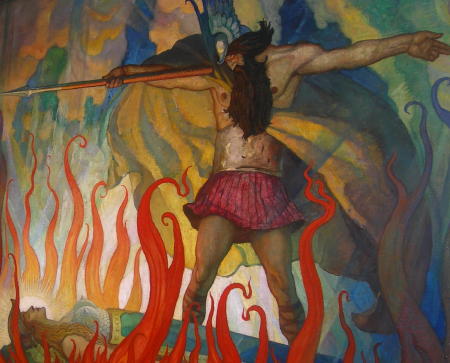
The Magic Fire Spell was one of a group of four canvases commissioned by Steinway & Sons as a means of promoting their piano, known as "The Instrument of the Immortals." This allegorical scene is taken from Richard Wagner's opera Die Walkure--The Magic Fire Spell, part two of Der Ring des Nibelungen. Here, Wyeth focuses on one of the most compelling moments in the story, when the Norse god, Wotan, punishes his favorite daughter, Brunnhilde, by taking away her immortality. Angered by her love for Sigmund, whom he wants to kill, he puts her to sleep on a rock encircled by magic fire--her fate until a true hero is able to pass through the flames and claim her.I liked it so much that I didn't want to ruin a good time by asking about the price (which I'm sure was in the hundreds of thousands). And last night I attended a wonderful concert at Philadelphia's Kimmel Center: Here's a view of the lobby:


As to Coco, I'm not sure. But while her master was away, she had a ball:

posted by Eric at 11:53 AM | Comments (1)
| TrackBacks (0) Sunday, October 22, 2006
The best defense against bad faith
Writing about the incredible determination and fiercely polemical nature of Glenn Greenwald's political diatribes, Lance at A Second Hand Conjecture makes a very important point: People confuse stridency and heated rhetoric with conviction.They certainly do. This is a major reason why activists win. Ordinary people don't lie down with signs in front of oncoming traffic, and while they might not mind sharing opinions and honestly discussing things, they tend not to spend their time waging endless hair-splitting debates. But they are making a logical mistake if they assume that the willingness to exhaust an opponent in a war of words is any more indicative of sincerity or conviction than a willingness to sit at a committee meeting until two in the morning in order to "win." Lest I be accused of ignoring reality, I do not deny that people who place winning first and who are willing to do anything to win are in fact more likely to win than people who want to get along, who'd rather share ideas than win debates, and who prefer sleep to listening to activists drone on all night. But attrition is precisely how activists win. Being right has nothing to do with it. Nor does having convictions. Or "good faith." It's about winning. Philosophically speaking, the desire to win by any means necessary has to be considered a form of conviction, and I suppose that people who are fanatic enough about something (like Communists, Islamists, or animal rights activists) believe that any and all tactics including demagoguery and bad faith are completely justified. That is why I think it is so important for non-activists to understand that when they are dealing with activists, the apparent issue at hand is never the issue, but is only part of an agenda, and nearly always temporarily expendable. If you are willing to waste a huge amount of time going to the mat over one of these issues, thus forcing the activists to "lose," the issue will be set aside but another one will spring up in its place. Likewise, if you decide to let them have their way on a particular issue in the hope that they'll go away, rest assured that they will not. (Thus, the removal of Robert E. Lee's name from a particular street or building only clears the way for a new campaign to demand the removal of some other dead white slaveholder's name from something, and the process will continue ad infinitum, even after George Washington has long vanished from the dollar bill.) Catching an activist in a lie or a misstatement of fact is like catching a troll lying in a blog comment. It means nothing, the particular issue will be summarily dropped, and the subject changed to something else. Hence, good faith debates tend not to take place between activists and non-activists. In addition to confusing stridency and heated rhetoric with conviction, people also tend to confuse good speaking and good writing with good thinking. No matter how articulately or how beautifully thoughts might be framed, that has nothing to do with whether they are right. Adolf Hitler's great oratorical talent is an extreme example, but most of the time, the process is infinitely more subtle. If a talented writer in the New Yorker dazzles us with his prose, it is natural for readers to be lulled into thinking that what he says constitutes original thought, and that it must therefore be right. That's an easy observation for me to make, though, as I studied Rhetoric in college, and I was taught that "critical thinking" meant being acutely aware that bias often lurks within mounds of beautifully created bullshit. It often seems that today, "critical thinking" has come to mean something very different. Instead of learning how to think for themselves and maintaining skepticism, people are taught that "critical thinking" means being led by such bizarre doctrines as "critical literacy." The critics with the loudest claims to having "convictions" seem to win these academic debates (for they will exhaust their opponents as surely as any activist, which I suspect most of them are). But few of "followers" in their admittedly captive audience stop to ask them why the self-canceling standards they're applying to Aristotle and Shakespeare might not apply equally to them. (Not that I really blame them. College is not a good time or place for normal people to confront professors.) I don't think critical thinking is dead, though. Just exhausted. The real challenge for me is that I am as biased as anyone else because I am human and have opinions. Thus, when I read something and agree with it, I tend to be less "critical" of it than when I read something and disagree with it. Nearly everyone does this to a certain degree, but just as some people are more exhausted than others, some people are more likely to succumb to uncritical acceptance than others. Uncritical acceptance can lead to being led, though, and that's how activists get their foot in the door. Next thing you know, you're being led! Now, I realize that avoidance of having to make an awful choice between leading and following presents a major analytical challenge far beyond the scope of this blog post, but I think I can fairly say that the best way to deal with an activist who is trying to lead you is to do what a lot of college kids do today. Just roll your eyes. And if you think eyeball-rolling is rude, you can always internalize the process. (Maybe by "all but" rolling your eyes.) MORE (10/23/06): Ann Althouse offers a free lesson in eyeball rolling. (Via Glenn Reynolds.) I wish more professors did that. posted by Eric at 09:22 AM | Comments (0)
| TrackBacks (0) Saturday, October 21, 2006
Mountain of brokeback identities
I think Iowahawk was really onto something with his open letter from Howard Dean, as the "outing" of gay Republicans is clearly a condescending attempt to confuse and aggravate religious conservatives -- especially those living in rural areas and in the South. While he wasn't writing satire like Iowahawk, a commenter to my earlier post shed some serious light on this mindset: Excuse me, but the Republicans have spent the last few years demonizing gays and the gay "sexual agenda". They have put forth and passed many laws against gay marriage, and have even tried to amend the Constitution of the United States in the process.I'll put aside whether "I" have appealed to the prejudices of the "family values" crowd or encouraged fear and loathing, because I like to think that a central focus of this blog is precisely the opposite. Still, the comment is pretty much a serious version of the "Howard Dean letter," and I do think it explains why (in the minds of many Democrats) "outing" gay Republicans, while it may be wrong as applied to the individuals, is nonetheless rendered morally excusable by the existence of bigoted Republicans. This touches on a point I don't think I stressed enough in my post. While it is true that there are members of the Republican Party who are actual bigots, I think the left is engaged in a very mistaken form of "connect the dots" conflation, in the following manner: First of all, it is illogical to claim that opposition to same sex marriage constitutes bigotry. But even if we make that leap in logic, it means that not only are 70% of all voters bigoted, but so is the leadership of the Democratic Party, including John Kerry, Bill and Hillary Clinton, and others. While there is no denying that there are people would love to see all gays expelled from the Republican Party and positions of power (I have criticized this mentality many times), the fact is that the outed homosexuals have neither been fired from their jobs nor expelled from the party. The latter is of course impossible, because anyone can join either party. Like it or not, NAMBLA supporters are as free to join the Democratic Party as Manson family supporters are to join the Republican Party. (And of course, David Duke is a Republican, while Fred Phelps is a Democrat!) So have the "chickens" in the Republican Party come home to roost? How many people are there who fit into that category? How many voters? It's undeniable that there is a hard core of genuine homo-haters in the Republican Party, and in addition to them, there are the people who genuinely believe homosexuality threatens Western civilization. To a certain extent, there's overlap between these two, um, "camps." The film "Brokeback Mountain" might be seen as both a symbol and a barometer -- as a measurement the strength and passion of the anti-gay groups, and as emblematic of the condescension which is often directed at people whose values systems are deemed in danger of total collapse at the mere idea that a cowboy might be gay. I saw the film, and I didn't like this condescending attitude towards red states and "country people." They're human beings, they think genuine human thoughts, and while they might not live in sophisticated cities or hold degrees from Harvard, they're just as likely to have a gay family member as anyone else. To impute bigoted and murderous attitudes to them struck me as a cheap shot. For every Matthew Shepard, countless gay victims die in New York, Chicago, Los Angeles, San Francisco. Bad things can happen anywhere, and I don't think it's any more helpful to stereotype rural red staters as tire iron-wielding homophobes than it is to stereotype gay men as limp-wristed hairdressers. But on the other hand, I found the hysterical WorldNetDaily reaction to the film even more offensive than the film itself. It never ceases to amaze me how utterly obsessed people can become over the idea that homosexuality threatens Western civilization, and the WND review left me with a disturbing feeling that a major aspect of (at least a major reason in favor of) a film I had disliked had been vindicated. Jokes about "hillbilly" attitudes aside, I don't think my disagreement with the Jesse Helms approach to human sexuality needs much explaining. There's little question that Jesse Helms and a number of the people of his time and place had indeed a strong animosity towards homosexuals. To the demagogic Glenn Greenwald, the very fact that Jesse Helms was a major figure in the Republican Party is an indictment of all Republicans today, and prima facie evidence that all gay conservatives are self-hating hypocrites. If you're in bed with people who hate you, you must be a hypocrite, right? But what does that mean? No one is alleging that gay Republicans get on their knees and admit to the doddering Jesse Helmses that they are sick moral degenerates who deserve to die of AIDS. Rather, it's their simple presence in the same tent with people who are alleged to think that way. The way Greenwald and company carry on, you'd think that there wasn't a single soul in the Democrat tent who hated his fellow Americans or wanted to destroy ("deconstruct" is a kind way to put it) the very fabric of Western civilization. Why, it wouldn't surprise me to discover that there were homophobic Muslims deeply embedded in the Democratic Party. True, the primary goal of the latter might more along the lines of defeating America, with killing homosexuals only a "religious" afterthought, but I have no doubt that they are there. There might be some in the Republican Party too, but I think Islamists (whether of the foreign Islamofascist or domestic variety) would generally choose the Democratic Party. That is because the Democratic Party, with its enormous value on "multiculturalism," appeals to all sorts of disunited anti-Western elements. To call them "anti-American" is inaccurate and inadequate, for what I'm calling "anti-Western" is a much broader philosophical movement, which finds a perfect staging ground in the Democratic Party by way of identity politics. This is not to say that all Democrats are anti-Western, or into identity politics, but to deny that followers of Michael Moore, Howard Zinn, Cindy Sheehan, Edward Said and their ilk are staunch Democrats is as much to deny reality as to deny the deep anti-Western philosophy that fuels them. If there are people in the Democratic Party who hate the West, does that mean that all Democrats who claim not to be anti-Western are actually self hating hypocrites? By the Glenn Greenwald standard, yes. I don't think the reason gay Republicans have come under such fierce attack is because their attackers really believe their main crime is self hatred. I think the "self hatred" meme is a cover for something else. In logic, self hatred involves a thing called low self esteem. Now, if you think about it, logic would dictate that the last thing anyone who champions the liberal principle of valuing and cherishing self esteem would do would be to attack and hurt people for the crime of having low self esteem. Rather, I think the ad hominem self-hatred canard conceals the primary split between gay Republicans and gay Democrats, which involves a disagreement over identity politics. Identity politics has become the stock in trade of political manipulation, and I believe it is pretty close to being the very life force of today's Democratic Party. The beauty of this now decades-old, well-oiled machine is that it forces people into categories which define themselves by leftist political principles, thereby insuring that all who are identified must support the left and must vote Democrat or else they have no right to describe themselves as having what is supposed to be their natural, unchangeable "identity." Thus, conservative or libertarian black people are not considered "real" blacks, and conservative or right wing women are not "real" women. They are traitors to their blackness and femaleness. Seen this way, right wing homosexuals are self hating traitors to their very genitalia. But their form of treason is infinitely worse, and far more threatening. That is because the left (and its colluding allies on the far right) see homosexuality as intrinsically leftist in nature, as something only tolerated at all because of left wing activism. Any homosexual who is not on the left has betrayed "his people" and himself in a far worse way than has a non-conforming woman or black person. Gay refusal to cooperate with identity politics is the highest form of treason, and a dire threat to the very workings of the Democratic Party machine. If this heresy is not stamped out and gay Republicans are tolerated, what becomes of party discipline? Women and blacks might be next. This means that gay Republicans are more than hated; they are feared. They're feared because they (like the articulate Gay Patriot) dare to say things like this: Not only do they lack sympathy for these individuals, but it seems that some of those involved in the "outing" campaign want to punish them for not being "good homosexuals," that is, by not adopting the party line on what it means to be gay. It almost seems that they want us to suffer. And their notion of coming out is not to promote the well-being of the individual gay man or lesbian, but so that her or she can become part of an interest group which promotes a left-wing agenda and works to elect Democrats to office.Individualism. The very concept is anathema to those who believe in the primacy of identity politics. I think the blatant display of such fierce individualism touches on another fear. What sort of person would dare defy a political machine which claims to have defined his identity in the first place, and uses the most personal of characteristics (sexual identity) as political fuel? Certainly it takes an independent spirit to do that, but I think above all it takes courage. Might some of the activists be afraid? Afraid of the very people they're attacking and "outing"? I don't know, but if they are, they better hope that the Republicans really are a bunch of rednecks with tire irons. (As a blogger I'd never heard of before put it, "if Matthew Shepard was a Republican that whole killing him thing was okay." It's amazing how total strangers can articulate what you think without your even knowing it....) MORE: Sean Kinsell is another brave soul who has managed to defy the strictures of identity politics, and in a recent post, he notes that the "outing" campaign supplies fuel for the old stereotype that gays suffer from arrested development: The petty vindictiveness on display is of a kind that most people associate more with a junior high school girls' locker room than with adults making serious arguments about social policy. It gives social conservatives more reason to think of gays as suffering from arrested development and poisons the atmosphere for gays thinking about whether now would be a good time to come out.God forbid that identity politics might poison anyone's atmosphere! I mean, aren't the Democrats supposed to be saving the environment? AND MORE: If Andrew Sullivan's post on the subject is any indication, the outing campaign is (as Glenn Reynolds says) generating blowback: Look: I loathe the closet. I despise the hypocrisy in the Republican party. But a witch-hunt is a witch-hunt. If the gay left thinks it will advance gay dignity by using tactics that depend on homophobia to work, that violate privacy, that demonizes gay people, then all I can say is: they are wrong. They will regret it. It will come back to haunt them. And they should cut it out. The fact that their motives might be good is no excuse. Everybody on a witchhunt believes their motives are good. But the toxins such a witchhunt exposes, the cruelty it requires, and the fanaticism of its adherents are always dangerous to civilized discourse.Good for Andrew Sullivan! I might not always agree with him, but I'm glad to see he's no slave to identity politics. (Why, on this one he's sounding a lot like Sean Kinsell!) MORE (10/23/06): Via Glenn Reynolds, Fire Dog Lake articulates the pro-"outing" position of the hard left (some would say "looney left") left: Gay Republicans are as bad as Nazi collaborators. They are working with the people who would outlaw and exterminate their own kind. And to any moral person, that would be an untenable position. They are not entitled to privacy. It's open season. I am going to be front and center enjoying every bit of the excruciating personal agony and political destruction that is going to rain down like fire from heaven on outed Republicans."Excruciating personal agony and political destruction" may well "rain down" on the outed Republicans, but the point it, it's a Democratic downpour, not a Republican one. The whole spiel sounds awfully like "eliminationist rhetoric," but that's not my term. (The gay Republicans should probably consider themselves lucky that for the most part they don't have children.) posted by Eric at 10:09 AM | Comments (6)
| TrackBacks (0) Friday, October 20, 2006
Some things are worse than being gay!
While it's hardly on the same level as Democratic activists outing gay Republicans, I'm wondering exactly what might have set in motion the series of events which resulted in the self "outing" of an actor who plays a popular television doctor: NEW YORK - "Grey's Anatomy" star T.R. Knight says he's gay, but hopes people don't consider that "the most interesting part of me." The 33-year-old actor addressed rumors of his sexuality in a statement to People magazine Thursday.That was the actor's public announcement (and I agree with him in general about keeping personal lives private) but what was behind it was a fight between the two other lead actors in the show. According to numerous confirmed reports, the dialogue of the fight went something like this: "What are we waiting on?" said Isaiah [Washington].This dialogue finds confirmation in the New York Daily News, which also quotes Enquirer editor David Perel as saying "the sourcing on this story is rock-solid." Wikipedia discusses the background of both Dempsey and Washington; apparently there'd been tension building between them for some time. Based on what I have seen in life, when a man calls another man a "bitch," that's usually not an anti-gay slur. Depending on the context, it might mean a lot of things, but I just don't quite understand why being called a "bitch" would force anyone to out himself. As it turns out, the word "bitch" wasn't what did it. According to the National Enquirer, what Washington said was the equivalent of the "N" word: "The melee has set off World War III on the show and may cost Isaiah his job," an insider told The ENQUIRER.There's a lot of discussion (these two posts are typical) over whether the dispute is what led T. R. Knight to out himself. I find it interesting that the dialogue is being sanitized, and while I normally avoid such tabloid gossip like the plague, I discovered a peculiar gay Republican connection which worries me. According to the New York Times, Washington (the man said to have used the slur) "once played a gay Republican in Spike Lee's "Get on the Bus." In a writeup on the 1996 film, Wikipedia has more on the gay Republican -- a character named "Kyle": Kyle is a Gulf War veteran who reveals that he was purposely shot by his own platoon because of his race and sexual orientation. Being gay, African-American and Republican, he feels persecution from all sides which has made him bitter.Interesting. What that means is that Washington did display at least enough human sensitivity to have played a gay character in the past. (Something many actors traditionally wouldn't touch.) And a gay Republican at that. Oddly, Wikipedia does not list that film in its writeup about Washington. Why? Might Washington be sensitive about it? In my evil heart, I wonder how he'd have felt had someone said "I'm not your little gay Republican." (The gay Republican issue may be causing more problems that I realized, but I guess some things should be left in the closet where they belong...) posted by Eric at 02:32 PM | Comments (0)
| TrackBacks (0)
Time to cool off on ozone?
Reading about the suddenly "record-setting" size of the ozone hole, I was puzzled by something: The size and thickness of the ozone hole varies from year to year, becoming larger when temperatures are lower.If that's true, and if (as we are told) temperatures have been higher, then why would the ozone hole be growing as we're now told it is? Might there be a scientific inconsistency somewhere? It's not so easy as it once was to blame ozone-depleting CFCs, because they've been banned for so long that in 2003, the hole was reported to be recovering: After 30 years, ozone is recoveringUnless science's "unambiguous evidence" has become ambiguous with age, something doesn't make sense about the recent growth of the ozone hole. I'm sure that the unambiguous scientists will offer many explanations. Somehow, though, I don't think "temperatures are cooling" will be one of them. posted by Eric at 11:24 AM | Comments (4)
| TrackBacks (0)
Misteaks explaned hear!
I may suffer from a hypersensitive imagination, but when I see a headline like this the first thing in the morning, I don't know whether to question my sanity, or question authority:
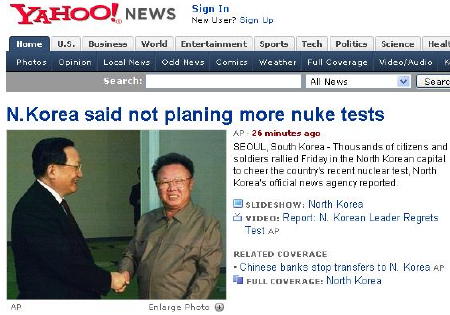
That made no sense. But I still had this lingering worry that I might be ignorant, and that there might a secondary meaning of the verb "plane" which involved putting something on a plane. (I mean, after all, you can ship things, and you can truck things around; maybe we've been able to plane things all along and I just never paid attention.) But when I'm lucky, my imagination is tempered by common sense. Even if there is such a secondary meaning of "plane," it's not in common use, and straining to read obscure secondary meanings into things that are probably simple mistakes violates not only common sense, but also the well established maxim that it's never a good idea to attribute to design what can best be explained by stupidity or human error. So, after my imagination calmed down and my common sense dictated to me that this had to be a typo, I still had to read the article, because typos don't usually appear in headlines. When I clicked on the headline, the word "planing" also appeared on top on the headline of the actual story, but in the text the word "planning" was spelled correctly: North Korean leader Kim Jong Il, meanwhile, was reported to have told a visiting Chinese delegation that the communist nation wasn't planning more nuclear tests.That's a releaf. No biggie. Everyone makes misteaks. Far be it from me to complane. MORE: This planing business is worse than I thought, and it's spreading! Not only that, I don't think it's Yahoo's fault. I just performed a Google news search on the word "planing" and while Google's robot knows I'm wrong and suggests "planning" instead, there are 287 stories about "planing." The AP story has been regurgitated without any correction by the Washington Post, the Guardian, Forbes, the Prescott Herald, the Niagara Gazette, the Spokesman Review and others. 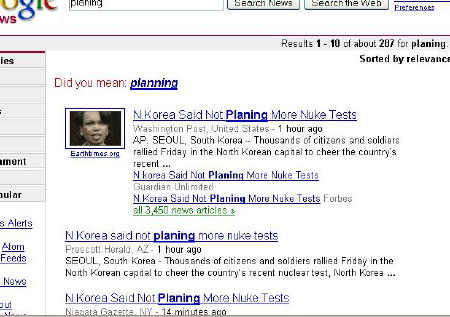 I think the problem lies with the Associated Press. (I hope they're not planing anything for the election.) MORE: To its credit, the Washington Post has corrected the headline's spelling! But as of 8:35 a.m., the Guardian, the Prescott Herald, Forbes, the Niagara Gazette, and the Spokesman Review have not. Now I'm really curious. Should we assume that this is all automated? Or should we assume that only the WaPo employs editors who read the headlines? Why did only the Post get it right? The reason I'm stumped is that Google News obviously caught the error. And there is a thing called Spell Check.... So maybe it's unfair to blame robots. MORE: It occurs to me that because AP reports are syndicated, there might be contractual obligations to use them as they are, or not use them at all. Thus, it might not be permissible to correct them (which would mean the WaPo may be breaking the rules.) Does anyone know? AND MORE: Kim Jong Il has explained that the nuclear test was itself a mistake, and has offered as an explanation the fact that he was molested as child: (2006-10-21) -- North Korean President Kim Jong-Il today reportedly told Chinese diplomats that he regrets his government's recent detonation of a nuclear device, and he revealed that he had been molested as a child.I knew I'd find an explanation for this mess! If we follow out this logic, it becomes clear that what happened to President Kim as a child is responsible for the entire chain of events which led to the misspelling in question. (It's a classic example of the old " MORE: Might planing have a future anyway? There are over 20,000 entries for "urban planing" 17,000 for "planing commission" and 700 for "planing department," so it might be a good idea to plane ahead! On the other hand, perhaps I should "stop complaning." MORE (10/22/06): Much as I hate to belabor the point, I forgot all about "family planing," which seems to be mostly a generalized process involving abortions, vasectomies, tubal ligations, etc. Hmmm.... While the word "planning" is suggested as a Google alternative, since the goal seems to be along the lines of preventing human reproduction rather than enabling it, in this context it seems that "planing" might actually be a better word than "planning." posted by Eric at 07:50 AM | Comments (1)
| TrackBacks (0) Thursday, October 19, 2006
Global insanity hurts local children!
"Be careful! There are a lot of crazy people out there!" Earlier this morning, a helpful checker said this to the woman just in front of me at the supermarket. As the customer left, I recalled a driver on the road in front of me who was doing 50 on a 30 MPH residential, two-lane road and had passed the car in front of him by crossing a double yellow line despite oncoming traffic. Always the conversation-maker, I helpfully echoed her thought. "Yeah, there sure are!" I might be wrong, but from her next remark, I got the distinct impression that crazy drivers were not what the store checker had in mind. "Everyone in the world has gone crazy!" I didn't have a tape recorder, so I'm paraphrasing the words. But she made this universal statement with a tone of such grim hopelessness that I just sort of intuitively knew that there was more involved than bad driving patterns. Agreeing again, I dropped the subject of mass mental illness, because it was just too early in the morning to hear a rant, and she was nice enough to clue me in on a canned dog food discount I might not have noticed. But if I may be illogical for a moment, I'd like to speculate about what may have been on her mind from the tone of her voice. I think it's safe to assume she reads the papers and watches the news, and if she does, surely she might be thinking along the following lines: I know it's a bit silly to cite media stereotypes as reasons for why a total stranger might think the whole world has gone crazy, but the above spontaneously came to mind. But in my defense, I think the statement that everyone in the world has gone crazy allows me a sort of artistic license in my analysis. This was a very nice woman, and I felt like reassuring her by telling her that the election will be over soon -- but that might not have seemed as reassuring to her as it does to me, so I held my tongue because I hate to seem like an insensitive and uncaring person in a world suddenly more insane than usual. Making wisecracks about elections would have been almost as insensitive as posting a picture of my dog holding what isn't really an AK-47. Or wearing this T-shirt:  (On the bright side, I should probably be glad I'm not in high school, nor subject to the jurisdiction of the Child Police. I think there may be a rule along the lines of "Have a kid, lose the humor!")
I mean, really. After all, we still have the First Amendment... (But my paranoid inner voice asks whether it might not be better to be paranoid before the fact than after the fact.) posted by Eric at 08:14 AM | Comments (9)
| TrackBacks (0) Wednesday, October 18, 2006
Which party persecutes more homosexuals?
Let's see if I can get this right. Back in the 1950s Red Scare era, homosexuals working in government or in visible positions in public life were persecuted if found out, and exposed to extreme humiliation and ridicule. There was such a thing as sexual McCarthyism then. But times changed, right? And while it seemed for a while that sexual McCarthyism had pretty much died out, it now seems to be alive and well -- but only in the supposedly tolerant Democratic Party. In what will go down as one of history's great ironies, in enlightened, modern America, there are still people engaged in exposing and persecuting homosexuals working in the government or in important positions, and they are activists in the Democratic Party. (Michael Rogers and John Aravosis are two notorious, longtime practitioners, and the latter was recently invited to lunch with Bill Clinton.) The difference is that the Democrats doing the persecution today can't fire gay Republicans directly; instead they are tracking them down and exposing them in the hope that the Republicans will be bigoted enough to fire them. Unfortunately, this has failed. Even Rick Santorum, supposedly the worst gay basher of the lot, refused to fire his gay aide after the man was outed. What this has created is a huge (if ironic) double standard between the parties. Gay Democrats have a right to their privacy, but gay Republicans are hounded and live in fear of the new (Democratic) sexual McCarthyism. The reason they are made to live in fear while their Democrat counterparts are not is because gay Republicans are said to be self hating hypocrites. According to this argument, because the Republican Party does not support same sex marriage, any gay Republican is by definition betraying himself -- even if he disagrees with the Republican Party on that issue. For that, it is fair to invade his privacy and make his identity and sexuality known to the world, in the hope that he'll be fired by bigoted Republicans. Yet the outed Republicans are not being fired. Their only persecutors are on the left. And they're redoubling their efforts in order to combat more "hypocrisy." Glenn Reynolds, Jonah Goldberg, Ann Althouse, Patterico, and Captain Ed are asking whether this might yet tilt the election in favor of the Republicans. I agree that it might. I think that most American voters (even the 70% who oppose gay marriage) take a dim view of persecuting homosexuals by invading their privacy. Homosexual witch hunts should have died with McCarthy, and the reasoning behind reviving them in the current political context is so convoluted that it would make sense only to a bigot. I'm not saying that the Republican Party is free of bigotry, because it isn't. But if the activists keep this stuff up and ordinary voters find out about it (I'm not sure whether they have) pretty soon someone's going to ask which party has more bigots. UPDATE: My thanks to Glenn Reynolds for linking this post (and my earlier post). Welcome everyone! Glenn also links Dean Barnett, whose observations about "outing" ought to be taken to heart by the Democratic Party: ...I wonder if any of these people would have the guts to look their target in the eye and express their passion for ruining their target's life. I'd wager not. Theirs is a sickening and pathetic kind of cowardice.I don't know the extent to which Democratic Party officials support these tactics, but I somehow doubt that the purpose of Bill Clinton's lunch with Aravosis was to deliver a sound scolding.... MORE: Satire meets reality! Iowahawk reprints a secret letter from Howard Dean to Glenn Reynolds' clique of Republican homo-haters who demonize gays to promote Cultural Tribalism: That's why we would like to take this opportunity to start a dialog with you, the conservative "values voter," by addressing an issue of vital importance to all of us -- the growing Republican homo menace.(Via the Gay Demonizing Tribal Chieftain himself) Read the whole thing; it's sheer genius. (And it's about time the Howard Dean nutroots started listening to those who know how to help their less literate kinfolks recognize the dire homo threat.....) UPDATE (10/20/06): My thanks to Bruce at Gay Patriot for linking and quoting this post! Bruce offers an additional conclusion: I am very proud of the excellent work by the conservative blogosphere by standing up for gay Americans while our own gay community turns on itself in a feeding frenzy. I'd like to think our voices have had some impact in how conservative bloggers view gay issues and how their perceptions may have changed over the past two years.Despite the many ironies, principles remain principles, and the blogosphere has done much break up the monolithic thinking so characteristic of identity politics. posted by Eric at 10:38 PM | Comments (17)
| TrackBacks (0)
The root cause of bigoted Cultural Tribalism
Earlier (via a link I was surprised Glenn Reynolds would dare provide) I read about an amazing claim that I initially hoped was a form of comedy: Glenn Greenwald is now claiming Glenn Reynolds is anti-gay!As it turns out, it was deadly serious. Glenn Greenwald in fact claims that Glenn Reynolds is anti-gay, in a long post which some might dismiss out of hand as unhinged, others as funny, but which I think should be treated at least as seriously as Greenwald's later claim that Republicans who defend gay conservatives against invasions of their privacy are actually anti-gay. It all sounds complicated, but it isn't. We have only to look at Glenn Reynolds' words and actions, and connect the dots. Let's start with the Greenwald claim (I'm sorry the link is missing, and for that I blame my internalized self hatred -- and this anti-Greenwald bigot): Reynolds -- as is so often the case -- is just spouting his own incoherent and deeply irrational thoughts and ugly biases and then pretending to be above them by sitting back analytically and oh-so-knowingly attributing them, with no basis whatsoever, to "voters."Yes, that's exactly what Glenn Reynolds does. And (as Greenwald makes perfectly clear) he doesn't just limit this to anti-gay bigotry; it's the standard modus operandi of virtually everything he does. To give just one example among many, rather than admit to the damning fact that he puts puppies in blenders, Glenn sits back and slyly demurs -- attributing the remark to others. Pretty damning, I'd say. How is it that Reynolds has gotten away with it for so long? Why is it that no one caught on until a distinguished New York litigator from Brazil finally figured this out? Greenwald explains and elaborates: It isn't "voters" who are making a connection between Mark Foley and the issue of whether gay people are entitled to equal treatment. It's the likes of Glenn Reynolds (cursory support for gay marriage notwithstanding) who are doing that, quite deliberately, in the hope that the old reliable strategy of demonizing gay people will strengthen the cultural tribalism on which they depend and will save them in this election.The logic is quite compelling, and I'll follow it out. By now it should be painfully obvious that it isn't "voters" who are putting puppies in blenders! It's Glenn himself, in his bizarre tribal ritual. But the pureed puppies are only a warmup act. After he drinks them, he's ready to engage in his daily, foam-flecked frenzy of gay demonization. A typical scenario follows..... "I'm pro-sodomy," growls Glenn sarcastically as he wipes the bloody puppy muck from his lips. Later, asked what he meant, Glenn blames the voters in his typically evasive manner: "Heh." (Which translates into "I don't really say I'm actually pro-sodomy, but I'm paraphrasing what I'm imagining the voters say.") After a brief pause to type another deeply irrational and incoherent post, Glenn grows reflective. "Fee, fi, fo, fum, bring me my happily married gay couples with closets full of assault weapons!" he cries. Until Glenn Greenwald's shocking expose, few of the hapless gay victims of this sinister closet realized that the policy Glenn claims to advocate (but attributes to his imaginary "voters") is actually a cryptically cynical neocon plot to massacre all gay couples! That's because according to an overwhelming consensus of social scientists, it is a documented fact that sooner or later, all guns will be used against their owners, and with couples this mathematical certainty rises exponentially until it becomes a double scientific certainty. Once the gay couples have machine-gunned each other to death, of course, bloodthirsty bigot Reynolds can sneer nonchalantly that "guns don't kill gays; gays kill gays"! How much more proof of Glenn's genocidal anti-gay bigotry do we need than that? Notice how slick he's being by not openly admitting that he actually favors a massacre of gay couples! Instead, he'll hide behind the "sitting back analytically and oh-so-knowingly attributing them to the voters" routine. (Or he might even try the more sinister approach of quoting himself as having been quoted as saying it before!) Really, until today I hadn't fully understood Gay Demonization To Strengthen Cultural Tribalism, but I think I now know how it works. It's simple, really. To activate the process, you have only to disagree with Glenn Greenwald. UPDATE: I'm not sure how I should interpret the fact that Glenn Reynolds actually linked this post (along with the post that follows), but I should probably thank him before he has me tracked down and massacred by his vigilante squad of right wing extremists. An equally cautious welcome to everyone! MORE: I just remembered another reason to be afraid -- be very afraid -- of Glenn Reynolds. When he says you're not gay, he really means you ARE gay! This sneaky process is called "double reverse outing" and it's another example of how dangerous right-wing extremists like Reynolds are far more treachous than their counterparts on the left. Beware! posted by Eric at 05:37 PM | Comments (17)
| TrackBacks (0)
No child gets ahead!
At the time it was pushed through Congress and signed into law, "No Child Left Behind" sounded like a noble, bipartisan idea. The mess that resulted is being called "Whole-group instruction": In whole-group instruction, all children are taught the same lesson at the same time, without regard to their ability or mastery of the subject. Education experts have long recognized that such instruction impedes high-ability students. Karen B. Rogers, author of Re-Forming Gifted Education, unequivocally states, "If educators should want to level the playing field of achievement so that all become mediocre in their output, then whole-group instruction is the answer!"Unfortunately, leftist egalitarianism has combined forces with the conservatives' laudable goal of school accountability and a mandatory bottom line. In practice, this political collusion means that gifted students are being systematically ignored. By federal mandate! As an acquaintance recently recounted, when his child requested harder math work, his teacher responded that he must "wait until the others catch up." This is, unfortunately, a refrain heard across the country.Political collusion is one of my pet peeves. What drives me bonkers about it is that so often it's unintentional. I mean, it's not as if egalitarian liberals and bottom-line conservatives sat down and deliberately contrived a system to ensure that future Nobel Prize winners would be held back. They just can't seem to learn that government-mandated, one-size-fits-all, committee solutions are inherently mediocre, and guarantee dumbing down -- from the top down. And for every problem thus created, more top-down "solutions" will be proposed. History shows that top-down government solutions don't work, not even when enforced by tactics like shooting incompetent administrators. (Stalin tried just that....) To interject a philosophical question, why is it better to waste more time on chronically low-performing students? This gets into a troubling area, because there is no agreement on why such students are low performing. Teachers are often blamed, but their reply is that the students' "home environment plays a larger part in determining his or her test scores than does the school environment." The other "side" blames teachers, of course, and I think it's pretty clear that both teachers and the home environment deserve blame. But there's an ugly, emperor-has-no-clothes question which no one in politics would dare ask. Being a blogger, I can ask it with relative impunity. Is there such a thing as human stupidity? Common sense suggests there is, and ordinary people know intuitively that there are differences in intelligence between people. To deny that some people are smarter than other people, and others are dumber, is, simply, to deny reality. But people in government have to deny that reality, because the educational system is based upon the premise that stupid people can be made intelligent. This requires suspending disbelief and reciting slogans like "every child is gifted." If every child is gifted, then of course a child with an IQ of 90 is the equal of an Einstein, if only the educrats can devote enough time and money to teaching him. It's disturbing to see both major parties agree on what I'd charitably call dishonest demagoguery. I said "charitably" because I hope they're just being demagogues; if they really believe this stuff, they may be suffering from a form of madness. The same mentality that opposes special programs for gifted students also opposes special programs for "slower" students. The result is called "mainstreaming" -- which mandates that a Down Syndrome child be treated like an intellectually gifted child, and that the former not be "left behind" the latter. In logic, the only way I could see that such a fiction might be made to work would be to somehow deliberately handicap the gifted child. While we don't yet utilize technology to acheive Kurt Vonnegut's handicap society, there are nonetheless signs that gifted children are somehow being transformed into losers: Up to 20 percent of high school dropouts test in the gifted range and nearly half of all gifted students are underachievers because the educational program they are provided is too easy.At least they're not being "left behind." Maybe the solution to the problem posed by these gifted children is to simply stop calling them "gifted." That would put an end to claims that they're being "misdiagnosed," and their neurotic tendency to "get ahead" could be treated and medicated. That way, the "getting ahead" disorder won't cause them to be "left behind." (Well, at least we can all agree that they need help....) posted by Eric at 08:28 AM | Comments (13)
| TrackBacks (0) Tuesday, October 17, 2006
Pre-election power luncheon
In what seems to be a sort of annual tradition (except for the absence of Sean Kinsell), this afternoon I joined Tom Brennan for lunch at an Indian Restaurant. This time the hush-hush affair was held at West Philadelphia's wonderful New Delhi Indian Restaurant. We had the all-you-can-eat buffet, and both of us went back for seconds and thirds. Finally (when I could barely stand) I asked a waiter take a picture:  Hmmm.... What's with the feet behind us? (Shhh! I shouldn't have asked!) Regular readers will remember Tom as the very talented Agenda Bender, one of my earliest influences as a blogger. As a blogger, he's unsurpassed; Colby Cosh called him "one of about five or six hitherto undiscovered genuine American geniuses that have been unearthed by the emergence of blogotopia".) But Tom is also doing great things for Philadelphia philanthropy as a charitable proprietor. Philadelphia AIDS Thrift is already a year old, and it's a great store with a great mission: Our mission is to sell the lovely, useful and interesting stuff generous people donate to our thrift store and then distribute the proceeds to local organizations involved in the fight against HIV/AIDS. We are pleased to announce that PAT has selected the AIDS Fund to be our beneficiary for 2006. The AIDS Fund distributes money to thirty-one AIDS agencies in the five county Philadelphia region. They pass on the money we give them every month with NO administrative costs taken out.If you're in the area and have time to visit, please do. Unlike many of the fake "thrift" stores with gouge-em prices, everything is priced to go, which means they have a high turnover, with more stuff all the time. Every time I go in there I buy something. Tom and I had a great time today, and while we discussed a secret plan to win or lose the election, my lips are sealed as to the particulars. posted by Eric at 07:03 PM | Comments (3)
| TrackBacks (0)
disinformation and unfair stereotyping
Just as most people who know how to drive know the difference between an automatic and a stick shift, most gun owners know the difference between an automatic weapon and a semiautomatic weapon. A fully automatic weapon is commonly called a "machine gun," while a semiautomatic weapon requires one pull of the trigger for each shot fired. It seems axiomatic that non-gun owners are more frightened by guns than are gun owners, and that they would be more afraid of machine guns than weapons that can only be fired one shot at a time. There is a clear desire on the part of gun control advocates to keep non-gun-owners as afraid of weapons as possible, and one of the ways this is done is by feeding them deliberate misinformation designed to make them think that there are a lot of dangerous people walking about with readily available machine guns. Blurring the distinction between machine guns and regular guns is accomplished by calling semiautomatic weapons by the names of their fully automatic counterparts. Just as the fully automatic M-16 is not the semiautomatic AR-15, the AK-47 is not the same as the MAK-90, or the numerous semiautomatic cloned versions of the Kalashnikov design. Calling a gun an AK-47 when it is not an AK-47 is more than a mistake; it is like saying a non-machine gun is a machine gun. AK-47 stands for "Avtomat Kalashnikova" developed in the year 1947. "Avtomat" means "automatic" and there are very few of them available for sale. Those that are for sale can only be sold to people who hold special licenses which are very hard to obtain. The last time I went to a gun show, one dealer had several actual AK-47s on display, and out of curiosity I asked how feasible it would be to buy the real thing. He said it would require a lengthy application, fingerprinting, an investigation, payment of a large fee, and a sign-off by the local chief of police (who will often refuse to sign the application). Fully automatic weapons are highly restricted, non-transferable and only those manufactured before 1986 can be sold even within the special restrictions. For those who are interested, the procedure is all explained here. As to the price of a legal, fully automatic AK-47, they are ridiculous. The ones I saw started at $15,000.00. It is therefore a very safe bet that the AK-47s complained of in this disinformation effort (discussed by John Tabin via Glenn Reynolds) are not real AK-47s. They are semi-automatic copies of the Kalashnikov design. Wikipedia (hardly a bastion of gun nuts) is in accord: Private ownership of fully-automatic AK-47 rifles is tightly regulated by the National Firearms Act (NFA) of 1934. The Gun Control Act of 1968 ceased importing of foreign-manufactured fully-automatic firearms for civilian sales and possession, effectively halting further importation of civilian accessible AK-47 rifles. In 1986, an amendment to the Firearm Owners Protection Act stopped all future domestic manufacture of fully-automatic weapons for civilian use.So why are all these people accusing people who don't have real AK-47s of having AK-47s? I don't take any of this personally, but I'm afraid Coco does. Here she is, gently holding a Yugoslavian M70AB2 -- one of the many semiautomatic Kalashnikov copies:
Sheesh. (I wouldn't have felt the need to point this out except I don't want some ignorant crackpot complaining about "dangerous pit bulls armed with AK-47s.") posted by Eric at 06:20 PM | Comments (6)
| TrackBacks (0)
May the punishment fit the crime
Speaking of RINOs, do not miss this week's RINO Sightings Carnival, held at Politechnical Institute. The theme is Crime and Punishment, and an election question: there is a lot of crime about, and will we see justice done now, or on November 7th?When a question like that is asked by a RINO, it's usually a rhetorical question. And there are plenty of other questions being asked, by plenty of RINOs. An excellent carnival with excellent posts; read them all. posted by Eric at 11:30 AM | Comments (0)
| TrackBacks (0)
hits and pieces
Anyone recall the New York Times' hit piece against Howard Dean's wife? Contrast that with yesterday's puff piece about Ned Lamont's wife. She's modest, petite, and just wants to help: Ms. Lamont, one of the most successful women ever in the lofty realm of venture capital, is the not-so-hidden hand behind her husband, Ned, the political novice who managed to topple a three-term incumbent in the Democratic primary.Now that's what I call generosity to a cause! I'd love to have her on my side too. (No wonder she's been included in a "private meeting with Senator Hillary Rodham Clinton and Mrs. Clinton's top strategist, Howard Wolfson.") And as a public service, the Times is even providing their readers with touching details that the Lamont campaign left out about the world's most frugal millionaire wife: Campaign literature does not even mention that Ms. Lamont works for a living, let alone how successful she is. One brochure features a casually dressed Ms. Lamont in the kitchen helping her husband, as he uses a mixing bowl, under the heading, "For as long as I've known him, Ned has been stirring things up." Inside, the mailing shows a beaming bride being dipped by her husband at their 1983 wedding.Why did they make Dean's wife (a doctor and a fine person, according to most accounts) look like a sort of kooky witch, and Lamont's millionaire spouse look so saintly? I'd almost swear it was because the NYT wanted Dean to lose against Kerry, but wants Lamont to beat Lieberman. How quickly people forget that Lieberman was once a standard bearer for the Democratic Party. Why, I can remember that way back in 2000, he ran for Vice President. Now they won't even allow him to be a DINO.... (The Times doesn't seem to have written up Hadassah Lieberman, who dares to be the wife of Lamont's disgraceful opponent. It's too early for a last minute hit piece, but they still have time to reheat and serve up Salon's hit piece accusing her of being "in bed" with big companies.....) UPDATE: Glenn Reynolds provides strong evidence that Lamont might be betraying his "netroots base" by moving to the center. I can certainly understand the abandonment of a losing candidate. But what's with the apparently urgent need to sanitize a losing leftist into a moderate? Might it be that certain powerful figures don't want to be seen as having supported the losing left? Could this be called damage control? posted by Eric at 08:11 AM | Comments (0)
| TrackBacks (0)
Distinctions with differences
Glenn Reynolds a RINO? I can understand the natural urge of Limbaugh and Company to call him that, but I have to speak up, for if there's one thing I hate more than an inaccurate term, it's seeing an inaccurate term being used inaccurately. Glenn Reynolds is not a RINO. There's only one way for Glenn to become a RINO, and that's to register as a Republican. Last I read, he was a registered Democrat. What that means is that Glenn can only be a DINO, and not a RINO. I'm of course a legitimate RINO, because of my Republican registration. Before that, I was a DINO, because of my Democrat registration. This is so easy that it shouldn't require any explanation. In order to prove my point, I'll explain how the process might work if I decided to become a DINO. Two steps are involved. First, I'd have go down to the county seat and register as a Democrat. All I'd need to do then would be to announce in my blog that I was a registered Democrat, and wait for official certification that I was a "Democrat in Name Only" -- which wouldn't take long. All it takes is having an opinion of your own. posted by Eric at 07:35 AM | Comments (1)
| TrackBacks (0)
Lost presumption
Another Republican congressional scandal -- this one involving Curt Weldon (a local congressman in the next district to mine). Regardless of any legal presumption of innocence, the reality is that he's presumed about as innocent as a Duke La Crosse player. Considering today's huge front page story, I'd say his goose is cooked: FBI agents searched the homes and offices of U.S. Rep. Curt Weldon's daughter, a local powerbroker, and a Russian energy firm yesterday for evidence that the Republican may have improperly steered contracts to his daughter's lobbying firm.Opponent Sestak is a former Clinton White House official, hosted recently by Sandy Berger and said to be hand-picked by the Clintons. And I'd say he'll win, even if there aren't any criminal charges or if they prove to be unfounded. What fascinates me is how the FBI raids managed to take place just weeks before the election. Today's story says it had something to do with "news reports": The FBI quickly arranged yesterday's six searches after weekend news reports alerted the Weldons that they were under investigation, sources said. In such situations, agents fear evidence could be destroyed.Whether the timing is questionable depends on whether you believe in last-minute pre-election coincidences. Sestak and Weldon were once considered to be in a tight race. But that was weeks ago. (According to an old saying, "two weeks is a long time in American politics.") posted by Eric at 07:21 AM | Comments (0)
| TrackBacks (0) Monday, October 16, 2006
Inconveniencing inconvenient truth
Geophysicist David Deming (an associate professor of arts and sciences at the University of Oklahoma) says that global warming advocates want to get rid of the Medieval Warm Period: Around 1996, I became aware of how corrupt and ideologically driven current climate research can be. A major researcher working on climate change confided in me that the factual record needed to be altered so people would become alarmed over global warming. He said, "We have to get rid of the Medieval Warm Period."Actually, they do a pretty good job of simply ignoring the Medieval Warm Period, as if it never happened. Here's Brian Carnell: Not surprisingly, the Intergovernmental Panel on Climate Change's climate models simply ignore the Medieval Warm Period. The models simply compare current temperatures to those of the immediately preceding pre-industrial societies. It is almost as if the Medieval Warm Period simply never happened as far as the IPCC is concerned (which makes it a lot easier to claim the current warming trend is completely unprecedented and, therefore, must be due to human-induced changes in the climate.There's also a serious effort to discredit (or belittle) the Medieval Warm Period, which was accepted until the 1990s. So now the battle over the Medieval Warm Period is being fought largely between skeptics and true believers, as this BBC article on stalagmite data reveals: the researchers analysing SPA-12 say that the stalagmite's temperature record is corroborated by ice-core records from Greenland and sediment deposits on the sea floor near Bermuda, both of which show evidence for a Medieval Warm Period.There's also an exhaustive Harvard study which concluded that the Medieval Warm Period not only existed, but that temperatures of the 20th century are generally cooler: Smithsonian astronomers Willie Soon and Sallie Baliunas, with co-authors Craig Idso and Sherwood Idso (Center for the Study of Carbon Dioxide and Global Change) and David Legates (Center for Climatic Research, University of Delaware), compiled and examined results from more than 240 research papers published by thousands of researchers over the past four decades. Their report, covering a multitude of geophysical and biological climate indicators, provides a detailed look at climate changes that occurred in different regions around the world over the last 1000 years.But scientific opinion is becoming as political as Amazon book reviews. Global warming skeptics are lucky if they're only considered dangerous morons. The recent trend is to compare "Global Warming Deniers" to Holocaust Deniers, and to advocate Nuremburg trials for them (about as sensible an idea as proposing war crimes tribunals for landlords who allow smoking.) Whatever the issue, hysteria only heightens my skepticism. posted by Eric at 05:02 PM | Comments (3)
| TrackBacks (0)
Tired of holding your nose?
On the subject of impending Republican defeat, Glenn Reynolds has a good Pre-Mortem roundup, which became quite lengthy, was linked by Pajamas Media, and has been followed by another (post-pre-mortem?) roundup in which Glenn asks whether he's a shill for Democrats (or something even worse, an "InstaLaphamite"). There are a lot of opinions, but nearly everyone is talking about the Republicans' impending defeat. And almost everyone (including me) is disgusted with the Republicans. The truth is, I can't remember a time when I wasn't disgusted with the Republicans. My first vote was for McGovern in 1972, and since then, my disgust has ebbed and flowed. It wasn't until Bill Clinton (whom I voted for) was president that my disgust over the Republicans was exceeded by my disgust over the Democrats. Since then, I've become convinced that the Democrats are irreversibly, permanently in favor of socialism -- much more than the Republicans will ever be. The 9/11 attacks and the post-9/11 fallout also convinced me that the Republicans are better on defense issues. (I suspect there's still a war, too.) While it is true that in general the Democrats are better on many sexual and social issues, there's also that sexual identity politics thing, which I don't like too much. And I just don't see sex as the leading issue in American politics. At least, I don't think it should be. In this regard, the Foley scandal has caused me to be more disgusted with the Democrats than the Republicans, for I think their exploitation of the scandal is cheap demagoguery at its absolute worst. It might be revenge for Monica Lewinsky, but at least that involved actual sex (as opposed to cyber raunch), and it also involved perjury. Ordinary voters, though, seem to think Foley/Masturgate is actually an important reason to vote the Republicans out. That people can be so stupid astounds me. I mean, it's not as if there aren't plenty of reasons to vote the Republicans out, but a single congressman talking dirty to street-wise pages? For which he's already out on his ass? Please. Anyway, back to my point. I have long been disgusted with the Republicans -- so much so that I'm almost tired of holding my nose when I go to the polls. Yet I plan to vote for them again, despite my disgust. What is it that makes my ability to hold my nose in spite of my longstanding, seasoned disgust so apparently special? The way people are acting, you'd almost think there's something new to be disgusted about. To me, it's the same old disgust. I don't like the war on drugs, the culture war, the endless politicization of genitalia, the pork, the refusal to stop the hemorrhage at the borders, but I don't see anything new other than the Foley scandal (which, contrarian as it sounds, only heightens my disgust at the Democrats). Maybe the problem is too much disgust, for too long. Is that an argument for voting Democrat? Why? I don't think any Republican voter is dumb enough to believe Democrats will be less disgusting, so the idea must be that it's time to change the disgust channel to a different kind of disgust program. I don't think it's a good solution or a good program. Let's assume the nation is now steeped in Bush Disgust. The man has been president for nearly two terms, many mistakes were made, and many problems remain unsolved. Disgust with Bush and the Republicans is so tired that it's already an old issue. Republican candidates have been outdoing themselves trying to distance themselves from Bush. It's almost as if, knowing how disgusted the voters are, they unconsciously buy into the change-the-channel argument. But what's the new channel? From what I can see, it's promising to be a Clinton rerun. Clinton II -- he's back with his wife, who has spent years assiduously repackaging herself as a moderate! (Fool me twice, or will that be three times?) Sorry, but that's old disgust. Bush will be out in two years, and I'm tired of being disgusted with Republicans, but I'll hold my nose forever before I return to the Clinton Disgust Channel. At a recent fund-raiser, the elder Bush put it quite well: At the fund-raiser, [George H.W.] Bush said he would "hate to think what life would be like" if Republicans lost control of Congress.I remember all too well the phenomenon of what he calls "these committees" and "crazy legislation." There's disgust, and then there's disgust. I'll vote Republican despite my disgust. Despite the fact that I've held my nose for so long that I can't stand it. Despite the fact that I'm tired of holding up my arm in order to hold my nose. Hell, I'll vote Republican even if I have to wear one of these.  Sigh. I'm afraid that's the best I can offer. And I'm afraid it does little to address the concerns Glenn Reynolds raised earlier: It's true, the Democrats are worse, but lots of people are starting to feel taken advantage of by that approach, as the GOP shows no signs of trying to get, you know, better.I realize that wearing a noseclip to the polls is not the perfect solution, but if the GOP isn't making an effort, I think Republican voters should. It's a visible and (at only $3.95) an inexpensive way to register a vote of disgust. UPDATE: Many thanks to Glenn Reynolds for linking this post, and welcome all! I wrote this post because not only do I complain a lot, but because nearly everyone is complaining, and I wanted to offer an election aid. (While I think libertarians are more accustomed to holding their noses than most people, these days there's so much stench at the polls that everyone needs assistance.) ADDITIONAL NOTE: Be sure to read Mrs. du Toit's comment below. She's "highly skeptical about the defeat warnings," and may be onto something. posted by Eric at 09:23 AM | Comments (31)
| TrackBacks (0) Sunday, October 15, 2006
Sliver up his sleeve?
Not too many people seem to realize it, but Bill Clinton has pulled off a hell of a coup in these past couple of weeks. First there was the staged tantrum with Chris Wallace, only to be followed by more than ample emotional justification by the Foley scandal (now an emotional outlet for years of pent-up frustration). And on top of that, Mark Warner decides not to run. Ever the centrist again, Bill Clinton is talking like a party leader, and more: Republicans, who control the White House and Congress, Clinton charged "paint themselves as pure and the rest of us who don't agree with them as stained" in order to divide the country and stay in power.Yes, things are "out of whack" and people have been upset about a lot of things for some time. As to the rhythm, until a few weeks ago, the number one worry was terrorism. (Well, for a while the voters were more upset about illegal aliens, but as that ebbed a bit, terrorism returned.) But people are sick of terrorism, especially the Iraq war. And the Foley scandal has created a perfect excuse to shed themselves of the whole mess without really having to think about it. Foley provided just the right lightning rod at just the right time. And the current flowed. While the rhythm was "severely disturbed," there was a cause. Foley. Republicans. And resolution. Get Them Out. Problem. Resolution. Rhythm restored. Political magician he is, the Great Conductor even plays the no-tax card: Clinton criticized the tax cuts President George W. Bush pushed through Congress and urged Democrats running for office this year to promise to correct the imbalance -- and promise not to raise taxes in the process.No tax hike? In spite of Pelosi's promises? Classic triangulation, if he can pull it off, and I think he can. Even ordinary Republicans are off the hook: "You cannot blame the entire Republican party for this reason. The entire government of the United States, the Congress, the White House and increasingly the courts for the last six years has been in the total control not of the Republican party but of the most ideological, the most right wing, the most extreme sliver of the Republican Party."No need to define who "they" are. We all have some idea. All that's needed is to restore the rhythm! As to Hillary, there's no need to pull her out of the hat yet: Clinton did not talk about his wife, Sen. Hillary Rodham Clinton's potential White House bid, but 'Clinton for President -- votehillary.org" placards were on display in the streets surrounding the banquet hall and volunteers handed out blue stickers bearing the name "Hillary."Seriously, the man is a political genius. An absolute master of the political sleight of hand.
HOW THE TRICK IS DONE: Note carefully the moving location of the "sliver." By asserting loudly the claim that the "sliver" is in charge of the Republican Party, the magician hopes that the audience will miss the fact that, far from being in charge of the party, the "sliver" has been relegated to its fringes. He also hopes the audience will forget that the sliver is very angry with the GOP leaders, and has wanted them out of power for many months. Nor does he want the audience to know that both he and the sliver share the same goal. Thus, he must attack the sliver all by insisting it is in charge of the GOP. If all goes according to plan, the sliver will both help the party lose and by doing so, actually gain control of the party. After the trick (he hopes) the magician will appear to have been right all along. "The sliver" will still be in charge! And the magician will continue to try to "help" the party get rid of the sliver! posted by Eric at 05:36 PM | Comments (0)
| TrackBacks (0)
Private derision and other thought crimes
Not often do I see my darker and more paranoid speculations confirmed in the MSM, but today is an exception. First, I'll repeat my darker speculations from last Tuesday: ....(Others would argue that George Bush himself is sick of the very people he's deliberately manipulated to believe he's one of; I heard Howard Dean say precisely that!)An AP story in today's Inquirer quotes a former Bush aide who complained about private derision in the White House: WASHINGTON - A former aide to President Bush contends that evangelical Christians were embraced for political gain at the White House but derided privately as "nuts," "ridiculous" and "goofy."This is not to say that Kuo is right, or Howard Dean (whom I heard accuse Bush of scornfulness towards the RR). It may be another last minute, pre-election attempt to make sure as many religious conservatives stay home as possible. As to the "nuts, ridiculous, and goofy" business, as a libertarian I'm quite used to it. It's politics. What ought to matter are not private attitudes, but areas of common agreement. I know I'm a compromiser, but I once tried to sum up (in admittedly blunt language) one way we might be able to get along: "You have a constitutional right to be sickened by anything and everything which sickens you. Just don't get mad at me for not puking."I think it's fair to say that being nauseated by something or someone is a personal and emotional experience. Because of the social graces, we generally keep these things to ourselves as private thoughts. Of course, it's easy for me to argue that my private thoughts are irrelevant, and that I have every right to deride or praise anything I want in private. Other people, I would argue, have a similar right to their private derision. I think this goes to the essence of freedom of thought. The reason it's easy for me to say this is because I'm not running for office and have no interest in doing so. Does that mean there's a double standard under which only private citizens are free to express private thoughts (and only as long as they realize that voicing such thoughts may bar them from ever holding public office)? If their private thoughts are public business, I actually feel sorry for politicians. Imagine living in a world where dishonesty is mandatory, 24 hours a day. posted by Eric at 08:10 AM | Comments (5)
| TrackBacks (0) Saturday, October 14, 2006
credit where blame is due?
Reviewing the polls at Real Clear Politics, Powerline's John Hinderaker predicts a "rout of astonishing proportions" for Republicans. Reflecting on the above, Glenn Reynolds adds: The GOP richly deserves to lose its majority in Congress. I just wish the Democrats deserved to win one.Yes, the GOP deserves to lose, whether the Democrats deserve to win or not. But I'd like to ask whether those responsible for the GOP loss deserve to win control of the GOP. Whether the loss is deserved or not there's no question that certain elements in the GOP wanted the GOP to lose, and for some time have advocated a deliberate strategy of defeat. Would it be fair for deliberate defeatists within the party to be heard to complain about the defeat they enabled, while blaming others for it? Further, should engineers of defeat be allowed to take control of the party whose defeat they engineered? That would make about as giving people who didn't vote the right to run the party they didn't support. And will the next step be the usual cycles of blame? Back in May, I reflected on a poll showing that 31% of conservatives wanted the GOP to lose. I opined that losing is a poor strategy, and I predicted a futile blame game: ...Pretty soon the losers will be able to go home and lick their wounds. Following a period of wound-licking, the intra-party blame game will start again, this time focusing on who was responsible for the 2006 loss. With any luck, the recriminations and finger pointing will prevent the ascension of a serious Republican challenger in 2008.I think such cycles of blame will be futile, and I hope my prediction proves wrong. I'm also worried because I think that once losing sets in as part of the status quo (as "something we can live with") winning will be seen as less important than ideology. Such thinking could turn a temporary rout into a Long March. posted by Eric at 02:50 PM | Comments (3)
| TrackBacks (0)
Paying alimony is so... gay?
Via Justin, I found a story about something I've previously discussed hypothetically -- gay alimony: Oakland attorney Frederick Hertz, author of Living Together: A Legal Guide for Unmarried Couples, says he's fielded many calls from people upset and surprised that they have to go to court to break up. Same-sex couples are often caught off guard, he says, because there's no culture of divorce in the gay and lesbian world, and it never occurs to them that they might have to, gulp, pay alimony. "The outrage most painfully is felt by the one who has to pay the money, share the community property, pay the alimony," Hertz says. "They have the same kind of outrage that high-earning husbands have been having a hundred years: 'Wait a minute, I support you for twenty years, you leave me, and now I have to keep supporting you?'"Personally, I'd concede the 12 step meeting, but then I'm a wimp where it comes to such things. There's more: Anyway, the real-estate agent, the couple's breadwinner who pulled in $265,000 in commissions last year, flipped when her ex demanded spousal support. In court papers, she claimed her partner had assured her before they registered that she would never come after her for money if they broke up. "So I felt betrayed by her retaining a lawyer and asserting that she was going to take half of everything I have," she wrote in a sworn declaration.If you're planning not to marry someone, it's always a good idea to ask: Are you now, or have you ever been, a domestic partner bigamist? There's a serious side to this. Marriage is not a thing to be entered into lightly, and people should think twice before entering into "domestic partnerships." What has long worried me about same sex marriage is that "rights" can become burdensome responsibilities, which can be imposed on people who never really wanted them, and might not need them. Especially people who might have thought they'd opted out of the whole heterosexual "system" under the belief the government would leave them alone. This is not to say that the people who declare domestic partnerships and file certificates certifying that fact should not have inheritance or visitation rights. But the obligation of alimony strikes me as an insane thing to impose on two people who have lived together. And once family court obtains jurisdiction, the foot's in the door for more, and aliminony leads to palimony. posted by Eric at 09:33 AM | Comments (1)
| TrackBacks (0) Friday, October 13, 2006
Wish-based reality?
This is an interesting statement by Bill Clinton: LAS VEGAS (AP) - The nation has been "jammed into an ideological corner" by conservative Republicans and is primed for a power shift in the November elections, former President Bill Clinton said Thursday.If that's the "reality," then what explains the fact that the right wing of the Republican Party has been so furious that they've been talking of boycotting the elections, and a deliberate campaign of "strategic defeat"? This is not to say that there isn't a "narrow sliver" of the of the GOP that is in fact "more right-wing and its most ideological element" but it sure as hell isn't George W. Bush. Far from having power, the narrow sliver is irate because they don't. They feel shut out and ignored, and I think that right now they share an identity of interest with Bill and Hillary Clinton. My theory has long been that more than anything else, the Clintons want this "sliver" to gain ascendancy so that they can win in 2008 by portraying themselves as moderates. So I see the statement as wishful thinking by Clinton. People who don't want him in the White House again should hope that his wishes don't become a reality.
MORE: The subject of collusion between Republican losers and the left is an old topic for me. Is it wishful thinking to hope the situation is not hopeless? AND MORE: In a long and thoughtful post, Clayton Cramer argues that libertarians are promoting a food fight in the Republican Party, in order to benefit from Republican defeat at the polls next month. I agree that this is no time to engage in the "battle for the heart and soul" of the Republican Party or to promote an intraparty "food fight." However, I see little hope for libertarianism prevailing in the GOP, and my worry is somewhat the opposite of Cramer's. I've seen a deliberate strategy of defeat advocated for months -- not by libertarians, but by social conservatives who urge those they view as the party's "base" to sit the election out. I worry that those in this "base" who see themselves as having been systematically sold out would prefer being the powerful faction in a minority party to being a powerless faction in a majority party. I think that staying home in November is a bad idea. If the Republicans lose, "food fight" won't be the word for what will follow. For what it's worth (which probably isn't much), I'm on record as supporting an alliance between Judeo-Christians and atheists, and as I said the other day I've long advocated compromise: politics is about compromise, and many Republicans have compromised with the "religious right." Hell, I've compromised my worthless principles every time I've voted for a Republican who supported the evil "Drug war," so what the hell is the big effing deal with the religious so-called right? I figure maybe if they don't want to kill me, why should I want to kill them? (Especially when millions and millions want to kill us!)I plan to continue my policy of compromising. Like it or not, that's the nature of voting. MORE: I'd say the hardest of the hard core defeat advocates are those who were enraged enough to want Bush to be impeached. Not to start a food fight, but do they prefer Hillary? posted by Eric at 09:52 AM | Comments (4)
| TrackBacks (0)
From my cold, dead arteries!
"We live in a country where they are trying to tell you what to do all the time." That's one New Jerseyan's response to a bill which would ban trans fats in restaurants: Trans fats, which increase the level of bad cholesterol in the body, are found in partially hydrogenated oils - shortening and margarine - and commonly are associated with french fries, doughnuts, cookies and other snacks.Remarkably, some of the supporters of the bill see it as a health issue: Doris Evans, 77, of Mount Laurel, said she supported a ban.There are a lot of dangerous things people tend to stop doing in order to live longer, and trans fat may be one of them. But I think it's remarkable to maintain that the state should use government force to compel what even doctors can't. Overexposure to the sun is another one of those health hazards in which unthinking young people engage, and the New Jersey shore has many beaches which account for untold numbers of skin cancers. Why not require government approved sunblock and a limitation of hours people can sit in the sun? Beach passes are already mandatory at most New Jersey beaches, and the money pays for lifeguards. It would be a simple thing to train and deputize them to enforce the Overexposure Protection Act, and while it might cost more, consider how many lives would be saved? Besides, isn't that the function of a life guard? New Jerseyans are the most over-regulated people I've seen, yet they seem to like it that way. Not only are their gun control laws some of the toughest in the country, you can't even pump your own gas there, and when there was a proposal to repeal this ridiculous law, the voters were furious, and it was abandoned. The unsettling fact is, some people like being over-regulated, and they think the function of government is to tell people what to do all the time. In theory, no one has to live in New Jersey. (But that's like saying no one has to live in a democracy where taxpayers are outvoted by tax eaters.) I've been writing about cream-filled donuts for years, but I never thought I'd see them as a symbol of freedom.  posted by Eric at 08:02 AM | Comments (1)
| TrackBacks (0) Thursday, October 12, 2006
Selective blog blocking by Interior Department?
I don't like blog blocking, especially selective blog blocking, and I am disturbed to see evidence (via Glenn Reynolds) that the Interior Department might be doing both. Here's Baron Bodissey's list of the blocked and not blocked: Blocked Blogs:If that's accurate, it does indeed reveal selective bias. This reminds me of a similar situation in Kentucky, and while it's one thing for a private employer to do this, when it's the government, the standard changes. Aside from the issue of blocking access to conservative or libertarian sites while allowing liberal or socialist ones, I'm wondering about the goal here. If it is to discourage employees wasting time on the job, then why allow access to any news sites at all? I'd like to know whether the Interior Department blocks yahoo news, the New York Times, the Drudge Report, and the Raw Story. If they don't, I'd wonder why; should employees be reading news? And if they should (or if they are allowed to), then what about analysis and opinion? Every major news site offers the latter in addition to news -- as do many blogs. The only common distinction is is that the latter tend to be less widely read than the former. Isn't it an editorial judgment (a content based one) to allow discrimination based on the economic value of the publisher? I don't see how the federal government can make these valuations based on types of speech in a manner consistent with the First Amendment. UPDATE (10/16/06): Via Pajamas Media, Sean Gleeson looks at the DOI's goal (which is to block all blogs, not just conservative ones), and explains why it makes no sense. UPDATE (10/17/06): Pajamas Media asked Baron Bodissey to perform an "up-close and personal" examination, and after an exhaustive review, he points to a subordinate as the most likely explanation: "The department started blocking certain categories of websites, and then made a list of exceptions that would be allowed through the filter. That's a long list, and it would be passed down the food chain from the Network Administrator through his subordinates until it reached the poor schmoe at the bottom of the heap who would have to do all the data entry to list the exceptions. posted by Eric at 12:14 PM | Comments (2)
| TrackBacks (0)
You can't hug a tyrant with nuclear heels!
While most of the world focuses on the megatonnage of his nukes, Manolo has noticed another serious Kim Jong Il excess: the extreme height of his high heels.  Yet while this was being ignored by most threat analysts, a lot of attention was being paid to the high heels worn by Michael Jackson. (Yesterday, Drudge linked this Daily Mail story which has disappeared now that Jackson denies it, but there are pictures elsewhere.) I'm not quite sure how to analyze this apparent double standard. But isn't Kim Jong Il more important now than Michael Jackson? Aren't his high heels at least as worthy of MSM attention than the apparently denied high heels of a Western entertainer? Or is the rule that high heels are OK for nuclear-armed tyrants, because the latter can inflict more damage than androgynous celebrities? (If that's the rule, isn't it de facto nuclear blackmail?) Maybe the lesson is that Michael Jackson should never be trusted with the bomb. posted by Eric at 11:04 AM | Comments (0)
| TrackBacks (0)
Your money or your penis? (A question for parents...)
There's a lot of talk lately about hypocrisy in Washington. Will someone tell me why the Harry Reid scandal (examined here by Ed Morrissey) does not involve hypocrisy? Is it because hypocrisy only involves sex? Glenn Reynolds (who linked the above) had an earlier observation which caught my attention: With Republicans, it's sex. With Democrats, it's money.While that wasn't a specific discussion hypocrisy, there certainly does seem to be a double standard. I know that the Republicans are said to be into sexual morality, but aren't the Democrats into money morality? ("Moral collectivism" versus economic socialism?) For many years the people who want the government to leave them alone have observed two apparently divergent tendencies: I realize there are numerous exceptions, but there's enough populist resonance there to give rise to stereotypes. (And, of course, you can vote for either, but we will get both.) Yet it seems that when someone on the right is caught up in a sex scandal, the cries of "hypocrisy" are much louder than when someone on the left is caught up in a financial scandal. Harry Reid's scandal was important enough to make it into today's Inquirer. Even if it was only on page 4 (just about a story about the federal deficit drop), at least it was there. I suppose they could have given it a sexier headline than the boring "Sen. Reid did not disclose land transfer, papers show." However (say the Democrats), while Reid was technically at fault, the real fault lies with a "larger culture": Stanley Brand, former Democratic chief counsel of the House, said Reid should have disclosed the 2001 sale. Brand said the omission fit a larger culture in Congress in which lawmakers were not following or enforcing their own rules.Well, at least the Dems are not blaming a "Republican climate"! That's progress, of sorts. And how can it be hypocrisy if it's just part of the culture? I'm just wondering. Suppose some Republican spokesmen had tried to blame the "larger culture" for Mark Foley's page problem. Would that have worked? I don't think so. Because according to certain "framing" principles (not to be confused with the principles of the framing, and I'm not imitating the Manolo's style of speaking, OK?) , Republicans are supposed to be the traditional daddies, while Democrats are supposed to be traditional mommies: To begin with, it has often been remarked, as, e.g., by P. J. O'Rourke, that liberals want government to be their Mommy, i.e., give them cookies and tuck them into bed, while conservatives want government to be their Daddy, i.e., give them a good paddling when they're naughty. A liberal, George Lakoff, wrote a book based on that concept, Moral Politics. In it, he argues that each camp views the country, and even the world, in terms of the kind of family in which they grew up, and/or their ideal family. For liberals, this ideal is the Nurturing Parent (either mother or father as the sexes are believed to be equal*) who teaches empathy (the primary virtue) through loving example. For conservatives, this ideal is the Strict Father (the man is usually perceived as by nature dominant*) who teaches self-discipline and self-reliance (the primary virtues) through rewards and stringent punishments. Conservatives view the world as a jungle, full of dangers and temptations, and one must be morally strong in order to deal with these. Libertarians, who don't want the government to be their parent, are a variant on the conservative world-view, emphasizing the value of self-reliance.That was Steven Malcolm Anderson's encapsulation, and I'm delighted to see the that the link still works. And here's Jonah Goldberg on Lakoff framing: Lakoff's argument boils down to this: Facts do not matter. "People think in frames," he writes. "If the facts do not fit a frame, the frame stays and the facts bounce off."That explains the double standard for hypocrisy. If a Republican preaches public sexual morality while being personally immoral, it is more than hypocrisy; it is profoundly evil. And it confirms everything we have suspected! But a millionaire Democrat is free to engage in whatever corruption the system allows. It's wrong, but it's not his fault, as he's on the side of good, and trying to change things for the better. There's something being missed that I think is important, and that's the idea of accountability and personal responsibility. Bad as Foley was, he's out, and no one is defending him, even though Democrats have gotten away with worse. I think the problem may be that sex is by definition sexier than money. Sexual hypocrisy is therefore sexier than financial hypocrisy, and logic has nothing to do with it. Thus, when there's a choice of frames, the "Republican-Daddy-Sex-Evil!" frame is a lot more attractive than the "Democrat-Mommy-hapless-financial-victim-of-complex-irregularities" frame. Whether the people who think this way can ever be trusted to leave ordinary people alone is beside the point. Who asked for such "parents"? I'd hate to think that voting implies consent. UPDATE (10/13/06): Far from defending Reid, today's Philadelphia Inquirer (in an editorial linked by Glenn Reynolds) has criticized him severely, arguing that "unless Reid comes up with a better explanation for this lack of disclosure, Democrats should not keep him as their leader in the new Congress in 2007." And in a classic understatement yesterday, Glenn opined that "if a Republican were involved it would be getting a lot more attention." I think Harry Reid should have clinched the deal with a dirty email. UPDATE (10/14/06): The Anchoress has a great post on what makes the Reid scandal so unsexy. (Via Glenn Reynolds.) Reid's sordid financial affairs are not sexy enough for the MSM. (His sex life would probably be considered even less sexy.) posted by Eric at 08:46 AM | Comments (2)
| TrackBacks (0) Wednesday, October 11, 2006
Who knew? Only everyone in Washington!
Radar Online is wondering how a secret that wasn't a secret at all managed to remain a secret until shortly before the election: The real wonder of the Mark Foley scandal may be how it stayed under wraps for so long. As the story continued to pick up momentum yesterday, Capitol Hill journalists came out of the woodwork to declare that they, too, knew that the Florida Republican had a reputation for coming on to teenage Congressional pages. One D.C. reporter recounted getting a number of email printouts from a source in May--the same messages that eventually brought about Foley's downfall after they turned up last week on an anonymous blog called Stop Sex Predators. The reporter said she found the emails "inappropriate and a little bit creepy," but not newsworthy enough to get her editor's support for a full-blown investigation.Not only did Washington insiders know, but Foley had been publicly "outed" by left-wing activists at least as early as 2004. And according to the street-wise pages, his predilections were known years earlier. They even had a clever nickname for him: "At first, not knowing who it was, it didn't overtly shock me. It's the Internet, it's the mid-90s. I'm a teenage guy. Things like that are less than unnormal. You get stuff like that all the time."And... no one knew?!? From what I know about the way Washington works, Foley's interests had to be common Washington knowledge for years. By both parties. Is it unreasonable to ask whether this is in fact the great big October "surprise" that everyone is claiming it is? I'm wondering. And while I am trying to be fair, the conclusion is inescapable that both parties knew all along. I have to ask: is it possible that the general public has simply been had? Can such things be? Why the national morality pageant just before the election? Something doesn't make sense. posted by Eric at 08:51 PM | Comments (2)
| TrackBacks (0)
Unregulated satire threatens efforts at manipulation?
Ann Althouse reflects on an unauthorized ad, and what she says speaks volumes about the national manipulation malaise: I like the way satire makes different people pay attention to politics -- not just your dreary politicos -- and I like the way it sharpens minds -- unlike the somber sonorously narrated traditional ads with their crude, piano-tinkling efforts at manipulation. I'm just waiting for someone to say this must be regulated.(Via Glenn Reynolds.) Well, it might not be regulated, but it's already been flagged as "inappropriate" by YouTube, according to Newsbusters. Via McQ at QandO, here's the link to the video (hope it works): I demand not only that the above video be regulated, but that this blog be regulated! The sooner the better. So go ahead, big, bad Sandy Berger-style, sock-stuffing bureaucrats! Regulate me now! Make my day! I grovel before your moral facade! posted by Eric at 09:29 AM | Comments (4)
| TrackBacks (0)
bloody sweaters, blue dresses, red capes, and other moral facades
Clinton's "tantrum" at Chris Wallace is making more and more sense. As a display of method acting, the man's ability to manipulate his emotions equals anything I've seen from Hollywood. But I do think it was acting. The goal was a display of righteous moral indignation. And now we know why. The Republican "moral facade" was soon to collapse. Spare me. I don't think there was any "moral facade," so much as a claim of a moral facade by people on the left who want to conflate all Republican (and "right of left") opposition into religious conservatism. While it's true that the Republican Party style has traditionally been a "Big Tent," that tent has consisted of many people who disagreed with each other. Some have been vociferous than others. I'm not all that into shouting about what I believe in, and what would be the point anyway? "END THE DRUG LAWS"? "STOP SOCIALISM NOW"? Not very likely, is it? Best to just shut up, hold your nose, and vote. But in logic, how can the loudest members of a tent be said to constitute a "facade"? Under what theory are the loudest people in charge of everyone else's moral compass? I've always thought that morality is a personal thing and no one is perfect, and that sanctimonious moral posturing isn't a good idea, but I don't see how not being loud coupled with a willingness to compromise constitutes agreement. Nevertheless I am "called a "conservative", and people (such as the complete stranger who knew only that I was voting in the Republican primary) have asked me questions like this: "You have allowed religious extremists to take over the Republican Party!"Really? How did I "allow" anything of the sort? Who, might I ask, "allowed" socialists to take over the Democratic Party (to the point where I felt I was wasting my time there)? I was a Democrat for 30 years; did I "allow" that? In all honesty, when I look at the socialist, communitarian, globalist, gun-grabbing, SWAT-team using, super nanny state I can only shake my head, and hope that the Republican Party just might be more likely to slow down its malignant growth. To vote at all is to compromise, and I've been compromised for decades. The real moral facade is in both parties. I try to ignore it in the vain hope that it will go away. What burns me out the most is having to listen to moral lectures which emanate from competing moral facades. I feel sorry for activist-driven voters who take moral facades seriously. They seem like bulls who think the matador's red cape is the real issue. While the process is discouraging, I like to think that ordinary voters are wisening up. I mean, how long can people fall for a moral facade condemning a moral facade over imaginary sex? If I said the culture war between reality-based-values and values-based-reality is becoming unendurable, I'd be understating the case. (But if I placed quotation marks around facade-based words, I'd be making fun of "reality.") posted by Eric at 07:34 AM | Comments (0)
| TrackBacks (0) Tuesday, October 10, 2006
Compromised to death
Love your enemies, for they tell you your faults. So said Benjamin Franklin. Franklin's political maxim becomes even more true when your enemies are your friends, as is often the case in politics. It certainly is for me, and earlier tonight a good friend found himself quite unable to conceal his happiness over something I don't consider my fault, but which maybe is. "The Republicans are getting their comeuppance!" he said. I'm sure similar arguments are being repeated over numerous drinks in numerous places... "Reap what they sow," "what goes around comes around," and all the usual-but-true cliches. And there's truth in it. But yet, not quite the whole truth. At least, not what my friend thought was the whole truth. As it turned out, he was talking about the "religious right" getting their comeuppance, which the rest of the Republican Party deserved through a process of conflation. They compromised with, and thereby "enabled" the "religious right." Even if Bush wasn't truly a religious conservative, he supported them while Republicans who should have known better looked the other way. And now, their tedious and hypocritical morality is coming back to bite them in the ass! Excuse me while I yawn. Is it really news that many Americans are sick and tired of the so-called "religious right"? I've been there, done that myself. (Ever wonder how I came up with the name for this blog?) Barry Goldwater's "good kick in the ass" has been long overdue, and according to the much-suppressed wisdom of the much-suppressed common man, it should have long ago been delivered by many a "good" American. (Others would argue that George Bush himself is sick of the very people he's deliberately manipulated to believe he's one of; I heard Howard Dean say precisely that!) But politics is about compromise, and many Republicans have compromised with the "religious right." Hell, I've compromised my worthless principles every time I've voted for a Republican who supported the evil "Drug war," so what the hell is the big effing deal with the religious so-called right? I figure maybe if they don't want to kill me, why should I want to kill them? (Especially when millions and millions want to kill us!) Compromise is life, stupid! Does that mean that I am to be punished for the crimes of Foley? Because I "looked the other way" when the religious right was in "ascendancy"? Hell, after this caper, they'll probably be in full ascendancy, but that sure as hell isn't my fault. Putting them in by getting the Republicans out is the whole idea, and it makes me sick to think about it, only because I've tried to warn about it in this blog more times than I can count. What happened in the Foley scandal was that certain elements on the left finally figured out how to get the religious conservatives to do the heavy lifting for them. The magic is that this requires no effort whatsoever by the religious conservatives. They don't have to do or say anything. It's just momentum that's been accumulated. On all sides. Religious conservatives have been smarting for the Republican Party to lose, and the left knows that. It makes it easier to tip the scales. All that was needed was something to offend absolutely everyone on a visceral level. The left finally came up with a losing issue on which to win. It makes no difference whether this is logical, and I don't think I have to address it logically. It's simply accumulated anger that found a catalyst. Let me state another ugly, plain fact: most Americans (including the hated Nixon's hated "Great Silent Majority") are not religious conservatives, and they never will be. That is not meant as an "attack" on religious conservatives, and people who think it is are in denial. To be divided means to hang separately, as Franklin also said. Atheists and Christians who want to be left alone have common ground whether they hate each other or not. Politics is the art of compromise though, and the people who compromised with religious conservatives now have to pay. And they'll keep paying, for those who don't compromise hate those who will. ("Death to compromisers!" shrieked the Ayatollah Khalkhali back in 1979.) I still prefer Franklin. MORE (10/11/06): A typical example of how this is being spun is this headline -- "Republicans' moral facade stripped off." But was there really a moral facade? I thought it was just a compromise. posted by Eric at 11:39 PM | Comments (2)
| TrackBacks (0)
One way to avoid public scrutiny
Unless they don't see you at all (an unlikely event unless you've been still for a long time and catch them sunning or something), photographing wild snakes is pretty difficult. But today I startled a garter snake (Thamnophis sirtalis) in my yard, moving way too fast for pictures, but not so fast that I couldn't manage to catch it with my hand.

  
(I think I'll spare readers the indignity of having to look at a picture of a crack. Some things are better left to the imagination.) posted by Eric at 02:26 PM | Comments (0)
| TrackBacks (0)
In the mood for blood?
Unless this USA Today article and the poll are a pack of lies, there's blood in the water: WASHINGTON -- A Capitol Hill sex scandal has reinforced public doubts about Republican leadership and pushed Democrats to a huge lead in the race for control of Congress four weeks before Election Day, the latest USA TODAY/Gallup Poll shows.According to the analysts cited, it's not so much that the Foley scandal is the issue so much as it's the last straw: The plummeting GOP ratings in the poll of 1,007 adults, taken Friday through Sunday, come amid a series of events that have given Democrats ammunition to argue that the country needs a new direction.In my mind, that's all the more reason to understand the dynamics underlying the Foley scandal. Except the election is not being held in my mind. The voters are exhausted, war-weary, and they want easy solutions. Now that Bill Clinton is taking charge, the Democrats have been smart enough to keep the left quiet (hardly a peep about "Indigenous People's Day" yesterday, and even "National Coming Out Day" is in the closet), and they're running candidates like Joe Sestak, three star admiral who was polling slightly ahead of Curt Weldon even before Foley became newsworthy. (The fact that Sandy Berger hosted a benefit for him would only be of interest to bloggers.) Sestak's campaign people were leafleting the local train station at 7:00 a.m. this morning. He's looking fit and trim, every inch the warrior. It's too early to tell, but I don't think the Dems have overplayed their hand as they have in the past. They're looking like winners. Foley provides a marvelous opportunity to play praeteritio. If I were advising the Dems, I'd tell them to remind the voters that they're running a clean campaign and aren't going to dwell on the "Foley Republican Problem." What frustrates me about the apparent fallout from the Foley scandal is that there's absolutely nothing logical about it. Iraq fatigue is understandable, but Mark Foley's actions really shouldn't affect any election other than that of Foley. Logic may be useful in the blogosphere, but it's useless with most voters. All they know is that they're pissed off. With good reason, they're told! Even Kim Jong Il setting off a nuke didn't bump Foley off the front page of today's Inquirer. (Well, at least it was only an underage nuke.) MORE: Victor Davis Hanson contrasts nukes with Foley's dirty talk and questions the wisdom of hyping a pervert into a national crisis: ...is the nuttiness because most Americans below 30 are now so poorly educated that they don't know, or care to know, the difference between Pyongyang and poontang? Or, given that these periodic fits of insanity about Dick Cheney's shotgun or George Bush's flight suit usually serve to denigrate some conservative, are these present pathetic efforts to hype a pervert to the level of a national crisis, just the frustrations of a liberal news media, angry that bright sassy minds like theirs have not been able to translate that self-proclaimed intellectual and moral superiority into political power?(Via Pajamas Media.) Part of it may be genuine preference for salacious gossip, and part of it may be that people are hungry for a good excuse to jettison their war fatigue without feeling guilty about jeopardizing security. It might be a good idea to look at the dynamics in light of Glenn Reynolds' time-tested rule of American politics: When the topic is defense, the Democrats lose. When it's sex, the Republicans lose.Right now, both topics are on the table, and unless something changes, the national question seems to be along the following lines: Is sex that didn't happen more important than a nuke that did? I think the logical answer is obvious, but since when was logic in charge? posted by Eric at 08:53 AM | Comments (3)
| TrackBacks (0) Monday, October 9, 2006
fear of shame that won't speak its name
While the expression "coming out" is associated with homosexuality, it's a lot more associated with speech than with activity. I've long thought that the real "homophobia" does not involve fear of homosexuality so much as it involves people being uncomfortable talking about it. In the old days, this discomfort was because of the taboo nature of the subject (i.e. "the love that dare not speak its name"), and while this traditional discomfort has not died out, a new discomfort has arisen which I'll call "fear" for lack of a better word. While it hasn't completely replaced the old fear, it's subtly insinuating itself into the well-worn, time tested touchy spots in the human psyche. If I didn't know any better, I'd swear that there was a covert psy war operation going on. To make sure that old prejudice is replaced by new fear, perhaps? Might not it be worth at least addressing the old fear before it's been completely replaced by the new fear? Let me admit my bias. I don't like traditional anti-gay prejudice, and I've discussed it in more posts than I can remember. However, I don't like the way gay identity politics has stifled discussion of things which need to be discussed. It is my thesis that discussing the gay issue in anything other than a politically-approved manner has become politically and professionally risky. Under the rubric of "gay rights," identity politics is generating a brand-new fear which is rapidly replacing the old one. Homophobophobia? Is such a thing possible? The answer seems to be no. Wikipedia has deleted the word as well as discussion of it as a topic, but defines it anyway in its list of protologisms. 1. the fear, abhorrence, discrimination, prejudice, and all other perceived bias and intolerance against political, religious, spiritual, and/or other groups who demonstrate signs of disagreement or confrontation of - or even the desire to help or restore to wellness and good health persons living with - homosexualism, or against those challenging the medical condition of homosexualism itself 2. The unmerited or erroneous perception, classification, allegation, or name-calling of persons displaying certain characteristics - based on their religious, spiritual, political, or otherwise personal preference - as being homophobic 3. The fear of being, or appearing, homophobic 4. Deleting a WikiMedia article in regards to homophobophobiaI'd say the last three definitions are what I'm talking about, but it's not a word. What's Wikipedia afraid of? Unending cycles of contradictory definitions and counterdefinitions? Dare we call it homophobophobophobia? Whatever any of this might be called, it's pretty clear that the love that once dared not speak its name may not be safely discussed in an unapproved manner. Yet at the same time this is happening, many of us are forgetting how profoundly divergent are the cultural viewpoints in the debate over gay rights. This "debate" (for lack of a better term) includes "sides" which might as well not be living in the same society, much less arguing on the same page in history. I am deadly serious: imagine trying to have a debate between people who want to bring back sodomy laws and people who want gay marriage. And the people who still believe in sodomy laws are nowhere near as fringy as an even fringier fringe which thinks in terms of the death penalty for "sodomy." For those who didn't grow up in a gay ghetto, sodomy laws existed until fairly recently in a number of states, and while they weren't enforced, they reflect a tradition which was once mainstream. To deny this is to deny reality as well as history. Times were changing gradually, but the "old guard" still exists, and it fought hard to keep the sodomy laws in the minority of states which still had them. For the most part, this old guard has to content itself by spearheading opposition to same sex marriage. While that's what leads gay activists to denounce opposition to same sex marriage as "bigotry," the fact that 70% of the public (including the leadership of the Democratic Party) also think the country is not ready for same sex marriage seems to receive less attention. However, admitting opposition to same sex marriage, mainstream though it is, is these days an easier way to be called a bigot than voicing opposition to affirmative action. The result of all this is that homosexuality remains the sensitive topic it has always been. A new taboo has quickly arisen to replace an old taboo. But a taboo is a taboo. Like it or not, the social and political taboo is there, and I think it's getting worse. Open and honest discussion of this issue in which people are free to say what they think is more often than not hopeless. Liberals are allowed to voice support for gay rights and same sex marriage (an excellent way for them to obtain Official Certification of Non-Bigoted Status, BTW), but conservatives are generally in a damned-if-you-do, damned-if-you-don't situation. Factor in privacy, and factor in a discomfort with public discussion of dicey sexual issues, and the general consensus is that the topic is best avoided. This is especially true in politics, and Republicans are a lot more uncomfortable with discussing the gay issue than are Democrats. And what about the repugnance factor? To deny that the traditional repugnance towards homosexuality is very much alive is to deny reality. Yet denial of repugnance is all but demanded -- especially for anyone involved in politics. Those who find homosexuality repugnant have learned that this repugnance must not speak its name. Not because they don't have the feelings of repugnance, but because it is one of the quickest ways to be labeled a bigot. And very, very few people want to be labeled bigoted. Thus, whether they realize it or not, their repugnance is quickly shoved in the closet. Traditional and personal repugnance runs head-on into identity politics, and the fear of being called bigoted. It's truly a no win situation, and the best resolution is usually the route of doing the politically expedient thing, and keeping repugnance in the closet. Jonah Goldberg touched on this phenomenon last week: So much of this current brouhaha revolves around the fact that Foley did at least one thing right: he resigned when confronted with the repugnance of his own deeds. This left a lot of angry people without someone to flay in public. Which in turn left the social conservative base of the GOP looking for a scalp at the same time the Democrats were eager to relentlessly exploit the issue for partisan gains. These high pressure and low pressure systems helped create the perfect storm we are in.But the Republicans couldn't sit and let this thing drag out. And even though the answer was staring me in the face, it still took me days to figure out why. That's because it seemed counterintuitive. People on opposite sides of the fence are driven by completely different forms of shame. On the one side are people who associate shame with homosexuality and on the other are people who associate that very same shame with bigotry, and declare that shame should be a source of more shame. Literally these cycles of shame each fuel the other. Who on earth wants to step into anything so toxic? Add the aroma of pedophilia (and the aroma is there, even though the reality is not), and it's painfully obvious why the Republicans were not about to sit around and hold hearings in which one of their own leaders would be forced to explain that yes, he thought the boys were very cute, but no, he did not have sexual relations with them. This can be called many things, and I have tried to identify some of the factors. But to call it a "coverup" as the Democrats are doing is disingenuous. This is not to say that someone didn't coverup something, as scandals inherently involve the making public of things that people wanted kept secret. But I think shame is at the heart of it. Not a "coverup" in the ordinary political sense of the word but an unwillingness to deal with uncomfortable feelings. If this is a coverup, it's the same sort of coverup which causes many a father of many a gay man to change the subject whenever the subject of his son's homosexuality comes up. Nothing like a national scandal involving an issue that people don't feel free to discuss. Well, some people are more free to discuss it than others. At least, people think they're more free to discuss it than others. Maybe the people who imagine they're freer will overplay their hand. (Hey, that it might lead to freer discussion, but I'd hate to end an essay like this on a note of optimism....) MORE: Ann Althouse thinks that the morals voters are not as naive as commonly believed, and that they can see through political opportunism: There is a tendency to assume the morals voters are naive, that you can play them and even talk about how you're playing them and they won't see the whole picture that includes you trying to play them. The aggressive politicization of the Foley story is itself a story and the voters witness it and react. It's hardly surprising if they've reacted with revulsion to politicians for their expedient use of the story to claw toward power, which really is more repugnant than self-indulgent sexual expression. Would it shake your preconceptions to find out that even hardcore morals voters see that?(Via Glenn Reynolds.) A lot of people can distinguish between real and fake repugnance. And it wouldn't surprise me if they found the latter more repugnant than the former. MORE: Be sure to read Mrs. du Toit's very thoughtful comment below. I think she's right that there's not much of a distinction between heterosexual and homosexual attraction to teens, but I think the latter is more touchy and more awkward to deal with for the reasons I discussed. There's just a visceral, teeth-set-on-edge reaction which wouldn't be the same had Foley talked dirty to young women. Its very nature makes it tough to acknowledge, much less discuss openly. AND MORE: Commenter Anthony has pointed out that the Wikipedia discussion (of the deletion of "homophobophobia") is still there, and here's the link. It seems to me that no matter what they do with the word (or who owns it), fearing the imputation of "homophobia" is as legitimate as many other fears. The refusal to attach "phobia" to it makes about as much sense as using the word "phobia" to denote bigotry or hatred in the first place. If "homophobia" is in fact an actual fear, then why aren't "homophobes" treated with the same compassion accorded sufferers of agoraphobia or arachnophobia? posted by Eric at 12:06 PM | Comments (7)
| TrackBacks (0)
What I missed seems to come out eventually...
Is President Bush going wobbly on the gun issue? If so, is that being kept secret? According an activist quoted in today's Inquirer, Bush is now saying "we" have to "do something" about guns: "It took the Amish to get killed for the president of the United States to say we had to do something about guns. If people can't get the guns so freely, maybe the violence can be stopped."I miss a lot, and I've been running around trying not to think about elephants, so I figured somehow I missed the president's latest remarks. Which is odd, because I read the Inquirer daily and I read pored over yesterday's New York Times, and saw no such remarks from the president. The closest thing I could find was a statement in his radio address about the need to keep schools safe: WASHINGTON - President Bush on Saturday lamented recent "shocking acts of violence" in schools and promised that his administration would do what it can to keep centers of learning safe for students.There's more about praying for the victims and the families, extending sympathy, as well as reauthorization of the No Child Left Behind law, but not a word from the president about guns. I'm thinking the activist must have been wrong. But is there any way to be sure -- to be absolutely sure -- about anything? Unless I had the text of Bush's radio address, how can I declare with 100% confidence what Bush did not say? Another problem is that not everything makes it into the paper, and not everything in the paper makes it into the web site. For example, this Wednesday, Philadelphia (like a lot of other cities) is celebrating National Coming Out Day. The front page of the local section has a picture showing what vaguely appear to be same sex couples dancing, and of the master of ceremonies dancing around in a funny hat. A large headline in the center of the page proclaims "A block party full of pride" and there's a short writeup about Philly Pride's OutFest: Philly Pride says its OutFest celebration has grown over the last 13 years into the lagest national Coming Out Day (officially, it's Wednesday) celebration in the world. Yesterday's event, on 12th and 13th Streets, between Walnut and Pine, featured outdoor cafes; more than 50 vendors and local merchants selling their wares; singing and dancing contests and demonstrations; local groups networking; and plenty more.You'd think that with a list like that, there'd be some mention of the basic theme of the OutFest event. I mean, I happen to know, but not every Philadelphian does, and how would an ordinary reader know from reading the piece? What's all this "Pride" about? And what's an "OutFest"? Why the mystery? Were I a conspiratorially-minded type, I might think it had something to do with not wanting the little people (you know, readers who skip to the sports page) to know what "National Coming Out Day" means. I figured I must have missed the main piece, so I entered "National Coming Out Day" on the Inky's search engine. Nothing came To be sure, Philly Pride has a nice web site, but the only mention of them or the Outfest was in a small paragraph at the bottom of a weekend events column in the magazine supplement to the Friday paper. I missed it and I missed the event, which is a shame because I was in Philadelphia yesterday and had I known, I might have gone. Not that I care one way or another about National Coming Out Day, but it's certainly a big deal from the activists' standpoint, and has been for years. At the Human Rights Campaign (HRC), however, there's only a bare mention of it (in a link to the snapshots page) on the front page of the main website, which seems very, very odd. It's so subdued you'd miss it unless you scoured. I thought it would be a blazing headline, although I did find a page about last year's event. If you click on last year's "more," it takes you to this year's theme -- "HRC LAUNCHES RE-IMAGINED COMING OUT PROJECT AND 2005 THEME -- 'TALK ABOUT IT'." (I'm sorry folks, but re-imagining last year's theme just doesn't sound terribly innovative. Why is it buried almost as an afterthought instead of being on the front page?) There's a history of October 11 here, but this year's description was not easy to find. Am I going crazy, or is "National Coming Out Day" being kept in the closet? What gives? I thought "coming out" was the whole idea. (There are plenty of local events, but you'd think there'd be more national interest.) posted by Eric at 08:25 AM | Comments (4)
| TrackBacks (0) Sunday, October 8, 2006
Unforgettable either way
I'm back from New York, and not quite in the mood for essay writing, so instead here are a few photos from the trip.




With elephants totally out of my mind, I attended the International Art and Design Fair, held at the Armory:


A commenter mentioned the piece while I was away, and I forced myself to read it. Author Charles Siebert's argument stretches the communitarian impulse to unheard-of new heights; he argues that "we" are all responsible for the actions not only of tyrannical Third World countries, but that the "we" should also include elephants. The elephants are waking us up with their dysfunctional behavior, which includes things like rampaging, killing people and (I am serious) raping and killing rhinoseroses."We" must ensure that people in Africa "live with wild animals like humans used to do." (Good luck with that!) The author also seems to be forgetting that elephants are semi-domesticated in Asia, and domestication as well as working on breeding techniques might very well save them. But I'm sure he and most of his readers think such things are profoundly evil. Man must become more like animals, and not the other way around. And in the name of "we"! Communitarianism nonsense on stilts. Siebert's a great writer, but his idea is about as sensible as Dali's surreal elephants. (The problem is, when bad ideas are well packaged, people are more likely to fall for them.) Well, I'll say this: the elephants did manage to resonate. And New York is always fun, whether you encounter elephants or not! posted by Eric at 07:36 PM | Comments (0)
| TrackBacks (0) Saturday, October 7, 2006
It's not fair that statues always have time!
I partied late into the night Philadephia last night, and I'll be a late night partier tonight in New York. What that means is that I won't have had the amount of time I should have had for blogging, much less thinking. (As the last post shows, there are too many things I'd rather not think about which get in the way of the things I'd really rather not think about! Too much running about and not enough not thinking about is my problem this weekend.) In Philly last night I took a picture of something they don't have and never had in New York:  On top of Philadelphia's City Hall is the famous statue of William Penn -- the top of whose hat was once mandated by a gentlemen's agreement to be the Highest Thing in Philadelphia. Lots of things are higher today, but the statue -- and the hat -- still have, well, "attytood." (So does the statue at the top of this blog, and he seems to be looking over my shoulder a lot lately. The time-and-perspective thing is something we mortals just wouldn't understand; it's a statue thing.) But I'm on my way to New York for the weekend, so posting will probably be nonexistent for the rest of today at least.
posted by Eric at 12:15 PM | Comments (0)
| TrackBacks (0)
Getting rid of elephants
I started this post yesterday with the unnecessarily provocative title of "Why Activists Win, Part III" (to supplement the needlessly provocative Part I and Part II) but I never finished it, because frankly I wanted the issue to go away. It hasn't. Well, the elephants are going away (because the Philadelphia Zoo is getting rid of them) but not the issue. Anyway, I'm such a loon that I can't let go, and I have to finish this post. For the life of me, I just can't stop thinking about elephants. Ever tried? Initially (when I read about it yesterday), the Philadelphia Zoo's action made me feel like an I-told-you-so scold, because I genuinely believed that the Philadelphia Zoo had caved to the demands of animal rights activists who'd been picketing the zoo, barred from the zoo, etc. I tried to put it out of my mind, and I thought, what the hell; there are more important issues facing the nation today than elephants. And I tried -- hard -- not to think about elephants, but the Philadelphia elephant activists came here earlier to gloat. (Yes, I confess, last week I saw them gathering signatures at a street fair, and took a picture of one -- not to debate elephants, but to highlight a nit-picky point about what I considered less than full disclosure on a T-shirt.) But still, I didn't want to deal with the issue. I had to go out, and I was gone all afternoon. I figured, the elephant issue will go away. Just as the elephants will go away. But as anyone who has ever tried not to think about elephants knows, elephants have a way of not going away. Things kept reminding me of elephants. There's something about them not easily forgotten. Seriously, I developed an acute case of stubbornly recurrent, unwanted thoughts about elephants. My thinking became so distorted that when I tried to catch up on my blog reading (an impossible task in itself) the elephant issue literally sprang into the text. Even a post by James Lileks made me think improper (well, at least incorrect) thoughts about the Philadelphia Zoo's struggle with animal rights activists. Here's what I thought Lileks said even though he didn't say it: It comes down to this: Animal Rights is being defined in the popular mind by three forces: the radicals who use violence and threats of violence, the PR-savvy activists who protest, and the officials who cave. The aggregate effect does not produce good will. Every time something gets cancelled out of fear of the Few, it works to alienate the Many, be they people annoyed by the cancellation, or those annoyed by the initial provocation.(Via the entirely blameless Glenn Reynolds, who didn't cite the mangled text which resulted from my trying not to think about elephants.) Fortunately, it turns out that I was totally wrong, and it was all elephant paranoia. Because the Philadelphia Zoo got rid of elephants not because the animal rights activists told them to, but because they wanted to: "The decision on elephants really is bittersweet," [Vikram Dewan, the new chief executive officer] said.Eh, come on lady! This is no time for tears! They're going to a better world! (Dulary is going to an elephant sanctuary where the public isn't allowed to go, which is where the activists think all elephants should go. But fortunately, that has nothing to do with the zoo's decision.) Everyone should try not to think about elephants! And remember, the animal rights activists had nothing to do with it. Damn! I was all ready to finish this post, but then I remembered a troubling question raised by some nameless zoo-going member of the public: I just don't understand how you can have a zoo without elephantsThis question seems to have been posed only to the zoo, and not the activists who have been pressuring them. Which is fortunate for whoever asked it, because the general public is in need of constant reassurance about these things. And they will be reassured. The zoo will go on! (You just have to learn to forget about the fact that it once had elephants.) However, from an activist standpoint, the question posed indicates a lack of understanding common among many ordinary people who think that the issue at hand (in this case elephants) is the whole issue. The Philadelphia Zoo would like the elephants to be the whole issue, and they would like to think that the issue is now behind them, that the activists had nothing to do with it, and that the activists will not make more demands. I keep saying it's a good thing that the Philadelphia Zoo did not cave to the activists, and we should all keep saying that. Because from an activist standpoint, the issue is not whether you can have a zoo without elephants. It's whether you can have a zoo at all. No seriously. The so-called "FRIENDS OF PHILLY ZOO ELEPHANTS" is spearheaded by In Defense of Animals. According to the American Veterinary Medical Association and the American Zoo and Aquarium Association, the plainly stated goal of IDA is to close all zoos. Which is why we should all be glad that the activists had nothing to do with getting rid of the elephants. Phew! (I'm hoping that now I can go back to actually not thinking about elephants, because trying not to think about elephants was preventing me from trying not to think about Republicans.) posted by Eric at 09:39 AM | Comments (8)
| TrackBacks (0) Friday, October 6, 2006
Foley does Philly. Clinton does benefit.
Well, that didn't take long. Today's Philadelphia Inquirer features a front page story -- headlined "Official vouched for sex offender" -- which I think is a perfect example of more to come: Republican State Rep. Eugene McGill urged a judge in 2003 to show leniency for a friend who sexually assaulted a 14-year-old girl and was later labeled a violent predator by the court.It's obvious what the issue is here. Republicans support perversion! Didn't you know? Also in today's Inquirer is an article about Bill Clinton's Philadelphia visit. It was disappointing to read that his main event was "closed to the press": Clinton, who turned 60 in August, raised an undisclosed sum for Casey in an event closed to the press. He also campaigned for Democrat Joe Sestak, who is trying to unseat U.S. Rep. Curt Weldon, and U.S. Rep. Chaka Fattah, who is debating a run for Philadelphia mayor.I'm almost tempted to say "careful what you don't wish for," but it might be taken the wrong way, and I'm probably taking his statement the wrong way. But I'd like to know whether there was any discussion of Mark Foley at the Bob Casey event, because I'd like to know whether they're going to go with my idea* of picturing Santorum and Foley together in a hit piece. "Closed to the press." Sheesh. (Any idea whether they're including bloggers in that definition?) I hate local news!
MORE: In addition to the cowering over the Foley scandal, many Republicans seem ashamed of their own president. Doesn't sound like a winning strategy, but I could be wrong. posted by Eric at 12:54 PM | Comments (3)
| TrackBacks (0)
Not all bad tastes are equal
While I'll probably be writing about it again because it's a scandal that doesn't appear likely to go away, I think I've devoted enough time to the sordid Mark Foley affair, and I'd like to change the subject to something less controversial. Cannibalism. By numerous accounts, former Ugandan dictator Idi Amin was one. But some people don't think so -- especially Amin's son Taban. A film has been made about his father, and he's threatening to sue: Last month, Taban Amin, 51, announced that he planned to sue the producers of "The Last King of Scotland" for defaming his father.If there's no such thing as African genocide, I'm wondering how the actor explains Rwanda. (Or, more recently, Darfur. ) As to Amin's cannibalism, I remember reading numerous accounts of it, and while Amin hasn't been hot news lately, an old remark I remember from him still survives: Idi Amin A big lad who, before taking over Uganda and killing up to 500,000 of his countrymen, became the nation's heavyweight boxing champion in 1951. He lost the title after allegations that, as a soldier, he was a keen torturer. A later diet of humans -- "Tastes salty," the gourmet noted -- meant muscle turned to flab, but Tanzania's Julius Nyerere refused a fight, invaded Uganda and deposed Amin instead.How did he know how it tastes if he never tasted it? More on Amin's opinion that human flesh tastes "salty" here. And an eyewitnessed account of him licking human blood from bayonets.) Amin was also a notorious anti-Semite who's credited with the horrid murder of Jewish grandmother Dora Bloch. I said "credited" because I've long thought that explained his comfortable retirement in Saudi Arabia. Whether that incident made it into the film, I don't know. It's a bit disturbing to think that the present Ugandan government might be enabling an Amin dynasty: Although Gen. Museveni and Taban Amin now seem the best of friends -- the latter backed the general's campaign for today's election, even offering the services of the Congolese jazz band that he fronts in his spare time -- many Ugandans view their alliance as ominous. Just the presence of the name Amin in the country's security apparatus resurrects grim memories of Idi Amin's bloody eight-year rule.I don't know how to interpret that, but I do know that his father wasn't especially known for having a heart. I'm sorry to see any effort being made to rehabilitate such a monster. Considering the monstrous nature of his genocide (300,000 to 500,000 Ugandans slaughtered according to CNN), I'd say Amin's cannibalism would rank as relatively minor, if there is a "relativity" scale about these things. Whether the cannibalism accounts are adequately documented is about as relevant to Amin's legacy as whether Hitler was a vegetarian or whether Charles Manson loves animals. posted by Eric at 11:34 AM | Comments (2)
| TrackBacks (0)
Outing closeted gays is good.
But outing anonymous accusers is despicable! When I wrote about "outing" yesterday I hadn't read this post, which has a very different view of what the word means. While I thought the term involved disclosing the homosexuality of someone who was trying to be discrete and wouldn't want it disclosed, here it seems to involve disclosing the identity of a 21 year old, self-described "political junkie" who has accused a congressman of homosexual dirty talk in a huge national scandal. Is that "outing"? It might be, if the accuser was discretely gay, and wanted that fact kept private. But the "outing" alleged here makes it pretty clear that he was not gay. Disclosing the identity of an anonymous accuser is not the kind of "outing" I was talking about. Regardless of whether such a thing is a good idea, once the identity has been disclosed, it's news. In this case, it was reported as news, and there doesn't seem to be much dispute that a blogger named Wild Bill was responsible for the discovery and disclosure of information apparently gleaned from examining ABC's web site. To my mind, commenting on what has already been reported is not outing, nor is it immoral in any way. I agree with James Joyner that this is a legitimate inquiry: The point of the original post was that one of the "victims" of Foley's instant messages was a then-18 and now-21-year-old and that ABC falsely lumped them in with messages sent to 16-year-olds. That's certainly newsworthy and relevant. Further, while my interest in this matter is in the conduct of a middle aged Congressman rather than the degree of consent given by the targets of his affection, there are some legal and moral distinctions between coming on to a grown-up versus an adolescent.Once the identity had been made public, Glenn Reynolds, Pajamas Media, Roger L. Simon, Newsbusters, this blog, and countless others behaved no differently in commenting on it than the site now accusing everyone else of "despicable" conduct. (Pot. kettle. black.) Oh, but the latter didn't provide the link. Instead, they merely named the site so even the dimmest dimwit could find it, and provided a picture of the traffic the site has gotten. I think the identity of the accuser is highly relevant, especially because whether or not a crime was committed depends upon his age and his credibility. How on earth could anyone determine the age or evaluate the credibility of an anonymous accuser? I don't see how. Unless, of course, this is supposed to be a scandal which dare not be discussed, but which guilt is determined based on anonymous accusations. A lot of people seem to want it that way. UPDATE: More news not from bloggers, but from NewsOK.com (the Oklahoma Journal's web site). Not only does the accuser work for the flagging Istook gubernatorial campaign, but his attorney is apparently a campaign contributor: [Attorney Steven C. Jones]Jones confirmed he has been in contact with the FBI and that Edmund has left Oklahoma. Jones, a $5,000 contributor to Istook, said he is not being paid by the Istook campaign.More non-blog (and therefore not "despicable") news here. While I don't think the latest Oklahoma news is particularly explosive, it does show that reporting it is hardly part of the blogosphere's "right wing agenda." MORE: Via a reader's email, a link about book deals. (Whether it actually documents anything of interest is of course a mystery to me.) UPDATE (10/07/06): Out all night and just woke up to see that Glenn Reynolds has linked this post in a roundup of "THE INEVITABLE FOLEYGATE CONTRARIANISM"! Thank you Glenn, and welcome all. Contrarian that I am, was out so long I didn't realize how much original and incisive thinking has been generated by the Foley scandal, and I'm trying to get caught up just reading the great posts Glenn links. I'm honored to be considered a part of it. But Roger L. Simon? Outing himself? Who'd a thunk it? I've met Roger twice, and I'd have never known. Bruce at GayPatriot didn't see a need to out himself, but he has a great post about liberal witchhunts, and hypocrisy at HRC. Bob Owens continues to be ignored and censored by ABC for asking the same basic questions he's been asking (What did Brian Ross know and when did he know it?), and AJ Strata raises serious questions about the emails -- especially the delays. There's a lot going on we do not know, and as I said before, I think there's a media scandal within the apparent scandal. Read them all, and thanks for coming! UPDATE (06/09/09): My thanks to Glenn Reynolds for linking this post again, in his discussion of outing anonymous bloggers. I especially liked what Glenn quoted (from an Ann Althouse commenter): The same liberals who out closeted gays who have sex in private insist that they have a right to publicly harangue people with complete anonymity.That's because they believe they are the moral superiors of their targets. And if you disagree, you're not merely wrong, you're evil! posted by Eric at 09:14 AM | Comments (15)
| TrackBacks (0)
Why MasturGate over Rathergate?
Did we learn nothing from Rathergate? An anonymous commenter left that rather good (if rather perplexing) question after I went to bed last night. If I recall correctly, "Rathergate" involved damning material of questionable provenance which was being used in the midst of an election. It was intended to attack the character of President Bush, and his moral fitness to be president. Now, an election attack has been mounted, but the actual target of the attack folded. Which means the target is, well, everyone in his party. What did they do and when did they do it? Well, what did Foley do? All that has been documented beyond dispute has been the sending of inappropiate emails. According to Audrey Hudson at the (moralistic) Washington Times, the editor would not have found the emails interesting enough to merit a story: The exchange was brief, but the congressman asked a former page for a "pic" -- questionable, but not enough to warrant a story.Only later did it come to light that the "child" was eighteen at the time of the IM exchange, and just yesterday an allegation surfaced that the dirty talk may have resulted from a deliberate prank played by two young men on Foley. NOTE: The young man's age at the time of the IMs is disputed. From what I can discern, the IMs started when he was 17, but the damning one -- the one that's caused most of the outrage -- occurred when he was 18. So what we have are transcripts of questionable provenance involving dirty talk. A dirty old man talking dirty to teenagers. But the man in question is not Howard Stern. Instead, he's a moralistic member of congress who probably would have condemned Howard Stern and wanted him taken off the air. Congressman or not, Foley's mouth should be washed out with soap at an absolute minimum. Which it won't be, because it's too late to do anything to him, because (at least at this point) it appears he was smart enough not to violate the laws he drafted. And besides, he's gone. Not much to do except blame the climate. Once again, I think Foley is a total sleazebag with no self control who abused his position of authority, and deserves the shame, ridicule, and disgrace he's getting. Even if he hadn't been a powerful man, talking dirty to teenagers by a man of his age is simply a bad idea (especially when they talk back). But can anyone explain to me why this is such a moral victory for the Democrats? I ask this not just because the Democrats are crowing, but because the Republicans are cowering. Why do they cower? Because Foley isn't there, and the rest of the Republicans are behaving like the kid who got caught with his hand in the cookie jar. They need someone to blame. Too bad they can't blame Foley. Too bad Foley can't drag this out and fight for his job as the knives are sharpened. Too bad Foley can't go on TV and tearfully say, "I never had sex with that young man!" (Ironic, but in this case, apparently true.) Too bad his colleagues can't vote for censure. Too bad and too late. Is this part of the infamous "strategy of defeat" we've been hearing about for months? Maybe, but I don't think it's deliberate. It's unconscious. I'm still thinking about that "accurate but fake" Rathergate memo. It might have worked had it involved dirty talk with teenagers. posted by Eric at 07:23 AM | Comments (0)
| TrackBacks (0) Thursday, October 5, 2006
a moral question now, not a legal question
That's pretty much what's left if the damning instant message exchange turns out to be a joke. And Foley has resigned, hasn't he? That leaves the dangling moral question(s) for the voters to ponder. I think at this point they're entitled to know the truth. And whether they are or not, I'd like to know the truth. I want to know what happened, OK? I don't want to be told which spin is best, because I don't think spin is what's needed right now. Not for me. Fortunately for both political parties, this is just my blog, and not the New York Times or ABC or the Drudge Report. As to what is the best course, via Glenn Reynolds, Ed Morrisey makes a good, hard-boiled utilitarian argument that we (which presumably includes this blog although I can't be sure) should just stop playing offense: Republicans should stop going on offense on this issue; it's a fight that is unwinnable.The violation here is Foley's betrayal of public trust by hitting on young and vulnerable pages, regardless of whether they had turned 18 or not. It's not ABC reporting on the IMs, and it's not whether anyone held onto the IMs for a period of time before ABC reported them. Arguing these points will not win any converts among the voters that the GOP could lose in this upcoming election, and it's not going to motivate the base to turn out for the vote. The constant argument only prolongs the embarrassments, and it sets up Republicans for a "gotcha" every time another former page comes forward ... and I think we can look forward to more of that as the days progress.Good point, and probably good advice, but I'm not playing offense here. I want to know what happened, and I don't feel I know. There are way, way too many loose ends. It isn't playing offense to want to know. Foley did it, and he's already pleaded guilty by resigning, but that hasn't ended it. Why should the rest of the party roll over and take his prolonged, excoriating, punishment for him? Because ABC says so? Another major player, Jonah Goldberg (via Hot Air), sees it a bit differently, also from a utilitarian standpoint. He argues that had the Republicans not sacrificed Foley so fast, they would be able to let him go now, which would have been seen as a psychological victory for the other side. Thus, they wouldn't have to be playing defense and fighting coverup allegations: So much of this current brouhaha revolves around the fact that Foley did at least one thing right: he resigned when confronted with the repugnance of his own deeds. This left a lot of angry people without someone to flay in public. Which in turn left the social conservative base of the GOP looking for a scalp at the same time the Democrats were eager to relentlessly exploit the issue for partisan gains. These high pressure and low pressure systems helped create the perfect storm we are in.Both Goldberg and Morrisey are right, but for me what goes to the heart of blogging is my need to know as much of the truth as I can know. My blog isn't written for ordinary public, nor is it intended to be part of the conservative spin machine, so I can just say what I think. (And yes, I'll vote for the damned Republicans. I'm not into the strategic defeat mentality, much as I think that has infected this mess from day one and before.) I'd like to look at a man who's been forgotten, and largely written off as a child. I won't name him, because a lot of people still think he's a child. (Or perhaps the morally utilitarian equivalent.) But let's assume you're 21. That shouldn't be too hard for many bloggers; perhaps some of my readers. Assume further you're a self-described "political junkie." What would it feel like if certain allegations involving your personal life had the power to alter the balance of power in the United States of America (which just happened to be the only real world power)? I think it'd be pretty heady stuff -- especially at age 21. Foley should have thought about stuff like that. (It's hard to forgive the son of a bitch.) MORE: I previously posted about my congressman, Jim Gerlach and the deliberate strategy of defeat proposed by some conservatives. I don't doubt that Gerlach has been photographed with Foley, and if his opponent has any sense, she'll circulate a photo as a last minute hit piece. If anyone can explain how running away from the truth will ameliorate this in any way, I'm all ears. AND MORE: If this is not a pedophilia sex scandal (which it has been shown not to be), then it is outrageous to claim it is. How is it politically advantageous to acquiesce to a false claim? posted by Eric at 11:10 PM | Comments (0)
| TrackBacks (0)
Final thoughts yet?
For the umpteenth time, I think Foley is an indefensible jerk and an asshole who betrayed the public trust and resigned as he should have. But if it's true that the young men were cynically playing with him... While that might not change the nature of what went on in Foley's mind, it hardly puts them in a moral position of being "child victims." As to whether "Foley the Child Predator" did anything that will "damage these children for the rest of their lives," if it does turn out that they were in fact playing some sort of joke on "that old queer" (or whatever they called him) I think the country is mature enough to dispense with the moral lectures. But regardless of whether the Foley scandal has in fact been deflated into the original (relatively innocuous) emails, this post at American Thinker is well worth reading: It had all the earmarks of a classic Democratic Party plan to depress Republican turnout. Take a barely disguised homosexual Republican Congressman, add salacious electronic messages that included masturbation, sex and other lurid flourishes, push the story to their eager and willing accomplices in the media right before an election, and as quick as you can say LBJ an instant scandal is created.That's just the beginning. It gets much better. And bear in mind that it was written before the latest development. I'll stay tuned, but what this is becoming? The comedy channel? MORE: The page reported by Drudge to have engaged in a prank denies it was a prank, and ABC News claims that more pages (whose names are being withheld) have come forward. CORRECTION: Reading the above closely, it doesn't appear they're denying the Drudge Story; they're just denying their own IMs were pranks: The three new verbal accounts are in addition to two sets of sexually explicit instant messages provided to ABC News by former pages.Have the verbal accounts been verified? Were the alleged prank IMs? MORE: Via Glenn Reynolds, Bob Owens of Confederate Yankee has been trying -- repeatedly -- to get ABC to answer two simple questions: Excellent questions. So why is ABC deleting them? I'm joining Glenn in asking: "What did Brian Ross know and when did he know it?" I'd also like to know why they're being released in piecemeal fashion. You'd almost think they were being held in reserve. MORE: Here's The Corner's Mark Levin: ...the reason ABC News looks foolish is because the story it originally broke was apparently based on Edmund's prank. Again, Foley's comments in the communications are indefensible. We all know that. But wouldn't it also have been useful to know that the page in question (who was almost 18 years old, if not 18 years old at the time) was knowingly provoking a rather ill member of Congress for kicks. But the reporter, Brian Ross, was so committed to promoting the "Republican scandal" aspect of this, including focusing attention on Hastert, that he took the Edmund e-mails and ran with them without much, if any, curiosity about their author and his motivations. MORE: More ABC shenanigans via Newsbusters: A blogger, William "Wild Bill" Kerr of Passionate America, using clues gleaned from ABC's own website, reveals the name of one of the "victims," and the fact that he was not, as reported by ABC, under 18 at the time of the Instant Message exchange. AND MORE: According to Wizbang, Betsy Newmark predicted the prank revelation. MORE: Plenty of inside information here. MORE: Don't miss the ongoing Pajamas Media Roundup. posted by Eric at 05:09 PM | Comments (2)
| TrackBacks (0)
Who you gonna call?
Why, the ACLU, says Donald Sensing. Seriously, Reverend Sensing is inviting the ACLU to call him. Franklin, Tennessee has declared that some flags may not be flown, while others must be flown, and that the First Amendment only applies to a small portion of the town which it designates to be a "First Amendment area": A "First Amendment area"? Mr. Berry, the entire United States is a First Amendment area! You have no authority to decide where a citizen may or may not exercise his/her Constitutional rights! They are not yours to grant - they come from Almighty God himself!(Via Glenn Reynolds.) A great post about politically correct tyranny run amok. Next they'll be saying I can't fly this!  Or, if that's too inflammatory, how about this one?  Did I just break the law? I don't know, but I hope this post can be seen in Franklin, Tennessee. Come and arrest me, Mayor Tom Miller! I'd enjoy the irony of being a Yankee getting arrested for displaying the rebel flag! AFTERTHOUGHT: Is it time for freedom riders from the North to storm the Old South again? posted by Eric at 04:25 PM | Comments (0)
| TrackBacks (0)
Help defeat radical Islamic extremism
Via Pajamas Media, I read of another outrage in Great Britain, in which a Muslim police officer was allowed to refuse for "religious reasons" to guard the Israeli embassy. Asks Marc, the post author: Are Muslim police going to refuse to protect shops that sell alcohol or butchers that sell pork, next?I suppose they might; cab drivers in the United States (Minnesota) have already been refusing to transport passengers carrying alcohol. Hey, aren't there "religious reasons" to refuse to transport homosexuals? And should a Muslim police officer be forced to render aid to gays who might have been assaulted, or arrest "fag bashers" if that violates his "religious principles"? I know such things don't typify the thinking of all Muslims, and I know that moderate Muslims like FreeMuslims.org do speak up regularly. So do moderate Muslims like Tashbih Sayyed, who does not mince words: In the United States of America, Islamists with clear ties to the Muslim Brotherhood of Egypt, Hamas in Palestine and Hezbollah in Lebanon are not only being awarded by the administration but are also influencing the U.S. policy in the Middle East. There are reports that the Muslim cab drivers are imposing there restrictive values on the Americans by refusing to accept passengers who carry liquor in their luggage.The problem is that moderate Muslims are drowned out by political extremists like CAIR -- which recently managed to impose censorship on YouTube. Moderate Muslims need help. So do bloggers like Ali Eteraz, who right now is campaigning against the Iranian government's impending stoning of a woman to death. Considering my complaint about cab drivers, I figured the least I could do is link Ali's campaign against stoning to death. As to the latter, Ali reminds us that time is short: If you fail to do any or even some of these, I assure you that you will remember the image of a bunch of stones pinging against a woman's head cracking open her skull sometime after October 12. You have eight days.I join with Ali Eteraz in urging readers to write to Supreme Iranian Leader Ayatollah Khameini, to Iranian ambassador Hamid Reza Nafez Arefi in London, and to Minister of Justice Ayatollah Shahroudi. (After that, they might want to consider my previous proposal to send President Ahmadinejad a necktie.) UPDATE (10/06/06): The above story about the police officer refusing to do is job gets worse: Now comes this.(Via Glenn Reynolds.) Bakri supports bin Laden, and praised the July 7 London suicide bombers as "the fantastic four." That one of his supporters could become a police officer is more than scandalous; it's insane.A Muslim police officer who asked to be excused from guarding the Israeli embassy was married by the radical cleric Omar Bakri Mohammed, The Daily Telegraph has learned. Also via Glenn Reynolds, a link to Brussels Journal's Paul Belien's discussion of the undeclared intifada against French police. Very disturbing stuff. posted by Eric at 01:45 PM | Comments (2)
| TrackBacks (0)
RINOs are always better later than never!
The Carnival of the RINOs is a bit late this week, as is my link to it, but who's counting the days when you're dealing with RINOs? There's not a conforming one in the non-herd, including the RINO who apparently was non-conforming about the deadline (no big deal to me), so Digger raised his horn and charged at the task. Nice job by Digger, and here are my favorite posts: I am not convinced we have done all we can to stop a nuclear Iran…not by a long shot. I am disgusted that the chattering classes sink into tabloid land over ultimately personal matters such as Mark Foley when we have the very real prospect of a true international disaster looming over us all. And I think AJ-Strata offers additional perspective: "Maybe The Dems Should Focus On Issues And Not Surprise Scandals"(That last link wasn't in the Carnival, but I just thought I'd link it anyway. AJ has a number of great posts on the Foley scandal, BTW.) Nice Carnival, so go check it out! posted by Eric at 12:11 PM | Comments (0)
| TrackBacks (0)
"Emails" that weren't with children who weren't? (A correction)
Maybe this is a correction, and maybe it's a partial correction, but Justin pointed out earlier that in a number of posts in which I referred to "emails," I was actually talking about instant messaging -- which isn't email at all, but a sort of text-oriented conversation, much like a phone call but accomplished by means of text. [FWIW, I don't use instant messaging.] This might not be as minor a point as it seems, because it raises another issue, which is the distinction between emails on the one hand, and telephone conversations and instant messaging on the other. An email is not a conversation. It is a single communication transaction, and it need not be answered. As we all know, an email can be annoying or unwanted, or it can be complete junk. The remedy in such cases is to not reply to the email, to delete it, possibly block the sender or ask him to send no more. In the case of conversation, the situation changes. If you are talking on a phone, or talking by way of instant messaging, as long as you remain on the phone or online, you're engaged in the conversation. There's a certain voluntary aspect to it that isn't present in email. If you don't wish to continue a conversation, you end it! If you don't want the conversation in the first place, you simply hang up (or in the case of IM, exit, and close the window). Continuing to chat means that you want to chat. What about harassment? Normally, we don't stay in conversations which are harassing. Certainly, not for an entire hour! Telephone harassment consists of repeatedly calling someone after being told to stop, and I think a similar rule applies to instant messaging. From what I've seen, there's no indication that Foley's "victims" (certainly not this one) asked Foley to stop communicating. Nor did they state that they were offended and terminate the conversation. In the case of the emails, though, I don't think they have to do anything. Receiving an email requires no response. Is this distinction relevant? I think it is at least as relevant as the age of the "victim." And now I'm I seeing reports that the young man whose lengthy chat with Foley created so much of the current uproar was eighteen at the time. Is it possible to have a "pedophile sex email scandal" that didn't involve pedophilia, or sex, or emails? Stay tuned. MORE: And how about this? XXXXX DRUDGE REPORT XXXXX THU OCT 5 2006 2:53:48 ET XXXXXA joke? I could have sworn people were taking it seriously.... MORE: Is it worth taking another look at all the facts and finding out exactly what Foley did? AND MORE (3:32 p.m.): It's now beginning to make sense why the former page would hire a prominent attorney. QUESTION: At the risk of being redundant, what did the MSM know and when did they know it? Sigh. MORE: New post here. Anyone who thinks that I am making excuses for Foley, please think again. The man's lack of self control got him into this mess -- and he got what he deserved. UPDATE: Thank you, Glenn Reynolds for linking this post, and welcome all. This origin and etiology of this thing just gets crazier and crazier, and I think the blogosphere needs to keep digging. At this point, it's not about Foley, who no one defends, and who deserves to spend his life skulking around as the shameful betrayer of the public trust that he is. This is more on the level of a post mortem of what has the makings of being a malignant hidden scandal wrapped inside the ostensible scandal. In other words, yes, there remains a Foley scandal. The question is, was it the only scandal? MORE: The media dispute is heating up. The page reported by Drudge to have engaged in a prank is said to deny there was a prank, and ABC News claims that three more pages (whose names are being withheld) have come forward. It's news versus news. I'm sure the real news is in there somewhere. CORRECTION: Reading the above closely, it doesn't appear the latest claimants are denying the Drudge Story; they're just denying their own IMs were pranks. MORE: This really has the feel of a media war to it. The latest allegations from ABC date back to 1998. Why did they not appear until hours after Drudge reported the prank story? UPDATE (10/06/06): Wonkette is claiming that Drudge's prank story "didn't work," because it's no longer featured as the main headline with the flashing light. The link is still there, though, headlined "CLAIM: FILTHY FOLEY ONLINE CHATS WERE PAGE 'PRANK GONE AWRY'..." -- so I don't know how to evaluate this. The story is now called an "Update" and here's the current text: **Update**Other than the denial by the young man's attorney, it's the same story. FWIW, I've never liked the fact that Drudge doesn't have links, and doesn't issue corrections, but it seems to be standard fare for him. posted by Eric at 10:11 AM | Comments (16)
| TrackBacks (0)
Closet liquidation values
Is the "closet" something to be ashamed of, or is it a one-way political portal? And what is a "closet"? I'm so damned frustrated by the national debate that I don't know the answer. I may have never known. I don't think I was ever allowed to have a closet, and now mine is so cluttered with skeletons that there's no room for me! Windows for closets are one thing, but what about the clutter? Is there any room for the baggage that life carries? Any room for weapons, literal or figurative? Isn't an undefended closet as ripe for invasion as an undefended house? If a man's home is his castle, well, don't castles have closets? What is a closet? Depends on whom you ask? Let's start with the guy I tried to answer yesterday, because I don't feel emotionally satisfied with my answer (or the questions he raised): "Had Foley lived his life openly and been proud of who he is, this never would have happened."That was from Michael Rogers, noted practitioner of "outing," who runs a web site devoted to invading people's privacy to terrorize them into political conformity. Rogers may be an extreme example, but it doesn't take an extremist to understand that "the closet" is something generally agreed by the forces of political correctness to be a bad thing. A toxic thing, even. Whatever you may think of them, Barney Frank and Andrew Sullivan can hardly be called extremists where it comes to outing people, but they do agree on the profound evils of "the closet." "It's a terrible place to be, and it's got to be worse if you're a Republican," says Frank. Ditto for Sullivan, who additionally implies that the closet might account for Foley's apparent preference for teenagers. If sexual preference is innate, predetermined, and unchangeable, it's a mystery to me why being in "the closet" would in any way facilitate a shift one way or another in what one likes (i.e. announcing to the world what you like is going to change the nature of what you like?) It would seem to me that if "the closet" is characterized by discretion, then a preference for congressional pages might not be the best way to be discreet. But never mind! The closet caused Foley to like pages. Were they more "available" than street hustlers who hang around Dupont Circle? I doubt it. Why he would prefer the former to the latter probably has more to do with Foley's own tastes than whether or not he is open and public about his sexuality, but I'm not a shrink. And shrinks are not supposed to opine about these things. Nor is anyone else. For "the closet" is now considered sacred ground according to the Rules of Identity Politics. If you are not certified as "out" (and approved politically by the forces of penile correctness), then you are "the Other" -- and you have no right to discuss the formation or liquidation of the closet! Even though the concept is ill-defined, it's clear that being in the closet is a very politically incorrect thing to do, that is, if you are in any way into homosexuality. Heterosexuals can be as closety as they want. They can marry or not marry, engage in the most lurid practices with the opposite sex, and it really isn't considered anyone's business. Not anyone's business. Whatever happened to that concept? It was once a garden variety Republican view of things, and when I was a kid, many Democrats thought the same way. Human sexuality was one of those things that was considered so, so personal in nature that it just wasn't considered polite to pry. Unless the person was coming onto you or something, you just didn't care. In the early days of the gay movement, there used to be a thing called sexual freedom. There was even an organization called the Sexual Freedom League (SFL), and I knew some of the founders. The idea of sexual freedom was that you pretty much had a right to be into whatever you were into as long as you did it only with consenting adults and didn't harm or bother other people. As to "the closet," why, there was of course a right to "come out" in the sense of telling people about what it was that you were into. But such a right included (as all rights inherently do) just as much right not to tell people. What you did with your genitals carried no particular duty of disclosure to anyone (aside from your intended object of desire, of course). But over the years, the politics of the personal crept into this, and gays began perceiving themselves (and being perceived) as a political special interest group. Identity group politics set in. Everything became political. Gays were targeted for special treatment by the left, and activist "leaders" materialized out of nowhere, claiming the right to speak on behalf of all who had similarly oriented penises. For reasons I have never been able to grasp, if your penis has any desire for members of the same sex, it is said to follow that you should be a socialist in your thinking. Otherwise, you have betrayed not only your penis, but all other similarly situated penises. (Sorry to be so crude about this, folks, but I am trying to simplify a laborious political process of thought control. Not that I've ever understood it, but I have a stubbornly slow brain.) So according to gay activist reasoning, "out of the closet" must also mean into socialism. And (especially) out of Republicanism! To recapitulate, it is not politically correct to be in the closet, and to be both right-of-center and in-the-closet is even more politically incorrect. Therefore, outing conservatives from their closets is the epitome of political correctness. While I'd like to think the above should be obvious, the Foley scandal seems to be shifting the debate, because certain conservatives have grabbed hold of a left wing idea, and now display a sudden peculiar interest in prying open closets which conservatives traditionally left alone. Here's Tony Perkins: "They discounted or downplayed earlier reports concerning Foley's behavior - probably because they did not want to appear 'homophobic,' " said Tony Perkins, president of the Family Research Council. "The Foley scandal shows what happens when political correctness is put ahead of protecting children."Wait a second. If being in the closet is politically incorrect, then whatever one might think of downplaying the Foley rumors, ignoring them would appear to be erring on not on the side of political correctness, but political incorrectness. What gives here? Is the Family Research Council now saying that gay Republicans should be outed? That because of what they do with their penises, they belong in the Democratic Party? Sounds like political correctness to me -- and from a supposed bastion of opposition to political correctness. Sheesh. Next thing you know, the people who claim the right to speak for "the family" will be in favor of this obnoxious thing called "The List" that's been floating around. Um, because "the family" hates "the closet," they need "The List"? (I never thought I'd see so many people who so hate each other doing so much to help each other.) posted by Eric at 07:12 AM | Comments (5)
| TrackBacks (0) Wednesday, October 4, 2006
This Fall, Conservatives Should Vote Democrat!
Pajamas Media links the Weekly Standard's analysis of conservatives who are rooting for Republican defeat. Considering that all politics is local, I'm wondering how the defeat plan might be implemented in my congressional district where incumbent Republican Jim Gerlach is being opposed by Democrat Lois Murphy. Am I supposed to sit the election out to punish Jim Gerlach? Or am I supposed to be punishing the Republican leadership? I'm trying to be logical and follow this out, but I'm having trouble, but I'm told the latter is the goal and not the former. Either way, though, the idea is to help ensure Jim Gerlach's defeat in the hope that with enough congressmen like him gone, Republicans will lose their majority and the Republican leadership will suffer. They'll tremble, they'll cringe, and they'll turn over a new leaf in time to stop Hillary Clinton from building the new Democratic Congressional power base into a victory in 2008. Either that or they'll have to allow "outsiders" to take the reins of the Republican Party. Who these outsiders are I'm not sure; according to the Weekly Standard, it appears to be a collection of people who don't agree on much. But never mind that. Let's just assume I'm a disgruntled Republican (which I am) and that I am so sick of being disgruntled that I'm rooting for Republican defeat. If Republican defeat is the goal, and I'm really rooting for that, isn't staying at home and hoping Lois Murphy will win a bit lame? I mean, why call for half measures? Wouldn't it be more logical to simply vote for the Democrats? If the goal is punishing the Republican leadership by guaranteeing the defeat of Republican candidates, I see no other way. Otherwise, the Republicans might still win. MORE: I just thought of something else. Isn't the Netroots Kosack wing of the Democratic Party supposed to be equally furious at their party's lame and ineffective leadership? While it's probably too much to ask them to vote Republican under the same logic, I'm wondering if perhaps they could shed some light on the effectiveness of lost elections as a punishment strategm. posted by Eric at 05:09 PM | Comments (5)
| TrackBacks (0)
Did Santorum just get rather big?
Or has he been rather big on an ongoing basis? In his discussion of "The List" (apparently consisting of gay Republicans who are traitors to their penises or something) David Corn says something about Rick Santorum I can't resist: Santorum in a 2003 AP interview compared homosexuality to bestiality, incest and polygamy. It would be rather big of Santorum to employ a fellow who engages in activity akin to such horrors.If that would be big of Santorum, then he's been "big" for more than a year. In April I remarked on an apparently anomalous fact about Rick Santorum -- his refusal to fire a gay aide: ...Rick Santorum refused last summer to fire a gay aide. (The original Knight-Ridder story survives at Free Republic.) A picture of the gay aide (who is also black) appears here. Even more ominously, the gay Advocate.com reported that "Santorum's praise for his gay aide didn't dim the ardor of the senator's conservative supporters." (More here.)As of a few weeks ago, the spokesman identified last summer was still employed by Santorum. Unless I am wrong in my analysis of David Corn's reasoning, Santorum has been "rather big" for quite some time. What gives? What if David Corn is right? (I don't much agree with Rick Santorum, so I'm still absorbing this.) posted by Eric at 03:08 PM | Comments (1)
| TrackBacks (1)
When "outing" isn't enough
it is hard to deny the sweet, sweet justice of Republicans being politically damaged by a lurid sex scandal in Washington.Yeah, and it's also hard to deny the irresistible nature of the Foley "pedophile sex scandal." Were I working for Bob Casey, I'd advise him to scour the record for every photograph taken of Rick Santorum with Foley. Similar photos could of course supply last minute hit pieces for every Democrat running for Congress unless the Republicans treat this as the hardball operation that it is, and do the same thing. (As Glenn Reynolds says, "it's starting.") The problem with politics is that watching these things happen is as predictable as it is frustrating (especially if you've seen it coming). Glenn Reynolds also links Gateway Pundit's speculations about why Michael Rogers and John Aravosis -- both specialists in that noxious invasion of privacy called "outing" -- kept so quiet for so long about Congressman Foley's penchant for male teenage pages: Radical Gay Rights Activists held on to information about Representative Foley for months and years. These "Rights Activists" knew that representative Foley had relationships with "young men less than half his age." They did their own investigation on Foley. They even flew in their sources in to be interviewed about the Representative. They shared this information with the Democratic Congressional Campaign Committee. They held on to the information for over a year. They wrote about how they would break the story at midterm elections.How true. But how loudly they complain that the nation's youth are at risk! As Gateway Pundit says, it's not as if their agenda wasn't made clear over a year ago: Everyone already knows Foley's a self hating closet case. When we get closer to the mid-term elections, I am sure more will surface.The "self hating closet case" stuff is critical to understanding this outing mentality. In 2004, Bill Clinton accused a gay Republican of "self-loathing" because he opposed Hillary Clinton, and as I pointed out, this was a transparent attempt to dictate gay ideological conformity: Sullivan devotes a great deal of time disagreeing with Hillary's position.But to make this work, Republicans have to be made to appear to hate homosexuals. Bush hates homosexuals, while Clinton loves them! Bush is the fake president, while Clinton is "the REAL president." And here's the real president with a real admirer (who seems to have forgiven him for supporting the Defense of Marriage Act): Good job well done! All homosexuals who support Republicans are not only guilty of supporting a fake president, but by definition they're guilty of self hatred for doing so. They're also in the closet whether they know it or not, and people who are in the closet either molest children or contribute to a loathsome climate where it will occur. "Sex with children" fits right in with the self loathing meme, which dovetails nicely into what I consider a central goal here: to reinvigorate anti-homosexual animosity within the Republican Party. Not that it matters whether there has in fact been sex with children. Here's Reason's Kerry Howley: ...as it turns out, the Mark Foley pedophilia sex scandal lacks two things: pedophilia and sex. (Emphasis added).(HT Justin.) But emotion stoked by demagoguery can supply pedophilia which isn't there, as well as sex which isn't there. Character assassination leveraged by identity politics is a powerful combination -- especially when antigay forces can be manipulated into working in collusion. I think Aravosis and company are, whether they admit it or not, working with the anti-gay crowd in what ought to be called "Operation Pink Triangulation." Outing gay Republicans has historically been shown to be ineffective. But this stuff works, and they couldn't be happier. (And there's even a hidden, unstated message -- sex with teens is OK if you're a loyal Democrat. Or someone who does their bidding.) Thus, the Foley scandal does what ordinary "outing" could not have possibly done. It emboldens those in the GOP for whom homo-loathing is a bread-and-butter issue, and if things go the way the activists want, maybe some of them will call for witch hunts. (According to the predictable meme of restoring morality or something.) That'll teach the cowards in the closet who their friends are! Whenever two apparent adversaries agree with each other, it worries me. Right now, I see agreement along the following lines: RESOLVED: Gays do not belong in the Republican Party. But there's still hope for these people who hate themselves. If they convert now, it's not too late. Why, the libertarian apostates will welcome them with open arms! (Aren't they forgetting that former leftists who become libertarians are already apostates?) Such condescension is a bit hard to take. In my view, identity politics -- especially the "self hatred" meme in conjunction with "outing" -- makes non-conforming gay citizens afraid to voice what they think. That's a first step towards not being allowed to think what they think. MORE: Please bear in mind that when I refer to the bread-and-butter antigay crowd I am not talking about people who oppose same sex marriage, or even those who have political or religious disagreements with homosexuality. I'm talking about the angry Peter La Barbera types who run web sites like Americans for Truth, and people who think that Western civilization itself is threatened by things like Brokeback Mountain. AND MORE: I should probably point out the obvious -- that I don't especially want Bill Clinton and his wife back in the White House. I realize that many Americans feel otherwise, and will work for what they believe in. But such political beliefs are not "self hatred." To say that they merely perpetuates endless cycles of what was originally called the "politics of personal destruction."
what an unidentified House GOPer called a "network of gay staffers and gay members who protect each other and did the Speaker a disservice." The implication is that these gay Republicans somehow helped page-pursuing Mark Foley before his ugly (and possibly illegal) conduct was exposed. The List--drawn up by gay politicos--is a partial accounting of who on Capitol Hill might be in that network.Is the GOP "a party that is anti-gay"? A lot of people on both sides want it to be. Who'd have ever expected to see gays and antigays rejoicing together?
Flirtation from a powerful adult mentor, with recommendations and network access to offer or withhold, is not in the same category as flirtation from one's prom date.Sean also criticizes some of the banter about "the closet": Talking about what "the closet" does in the active voice--as if it were some kind of independent baleful force--can be rhetorically effective, but the flip side is that it makes closeted gays sound helpless and passive.Sean is right, but then, he's one of the wisest men in the blogosphere.
"Had Foley lived his life openly and been proud of who he is, this never would have happened."That depends on how the phrase "proud of who he is" is construed. If being attracted to teenagers is part of who he is, and he'd been open and proud of that, I think it's highly unlikely that he'd have been elected to Congress. MORE: Via PJM, Fausta has more on the outrageous double standard, while Bruce at Gay Patriot has a great post on the Gay GOP Witchhunt: why have our national gay organizations (HRC, Log Cabin, NGLTF) not stepped in to stop this witchhunt which originated on the Gay Left in the first place? I think we know the answer. Tolerance and diversity of opinion is a one-way street for the Gay Liberals and their masters in the Democrat Party. Plus Ace of Spades envisions conversion camps for non-comforming gays! MORE: Masturgate!!!! Is that isn't the word of the day, I don't know what is. Gerard Vanderleun continues, with his thoughts on the obviously political nature of the conservatives-only outing campaign: This may well be the reverse Monica of the new century; the first time that a remote hand-job has had a hand, so to speak, in bringing down a government.Via Glenn Reynolds, who also links Gay Patriot's post, Tom Maguire's dead-on analysis, and this post! My deepest thanks to Glenn. I'm honored to be in such company. Welcome all new readers. Here's Tom Maguire: Does anyone seriously think that the Democrats can position themselves as the party of sexual restraint? The party that will be tough on gay men, straight men, or anyone else who gives off even a whiff of impropriety?Oh the hypocrisy! MORE: My thanks to Pajamas Media -- not only for linking this post but for putting it so well ("all the fixings of a shootout in a darkened saloon"). Be sure to check out the rest of the PJM roundup. (A word which seems to go with "saloon.") UPDATE (10/07/06): Thanks to Mein BlogoVault for the link! But more important, read "Newly Discovered Liberal 'Principles'": If you're a Democrat President, lying under oath about the affair you've been having with a nineteen year old intern isn't perjury and is in fact perfectly understandable; no harm, no foul, and anyone who seems at all concerned is to be dismissed as a "prude"There's a lot more, and it's great stuff. (HT Justin.) posted by Eric at 12:07 PM | Comments (9)
| TrackBacks (1)
Playing the God card?
In a comment to an earlier post, I asked if I was allowed to ask a question: Am I allowed to ask whether God put the Republicans in charge of morality?I guess there's no rule against my asking such a question, because it seems to be the question of the day. Unless I am mistaken, there are people who think the Republican Party is (or at least should be) the Party of God, and it would appear to flow from this that they have a duty to enforce and uphold God's moral laws. Whether God actually put the Republicans in charge of morality is of course an unanswerable question. But if there is a group of voters who see the GOP as the Party of God, they might think he did, and either way they're probably thinking that the Republicans have let God down. Personally, I think it would be a tactical mistake for the Republicans to claim that they're the party of God, because all people have moral failings, but a claim to godliness makes the same moral failing more egregious in a godly person than in a secular person. (The Jimmy Swaggart phenomenon.) This is not to say that the Republicans have officially made any such claim, for they haven't. But the political reality is that there are people on the left who think they have. And there are people on the right who think they have, or should. If these two groups are able to reinforce each other, it might spell trouble. (I'm glad I'm not in charge.) UPDATE: Via Pajamas Media (which also has a good roundup on the Foley scandal), a report in the Weekly Standard about conservatives who are rooting for Republican defeat. What if the voters go ahead and vote for Republicans just to spite them? How will the Democrats be able to mete out the lesson the Republicans deserve? Stay tuned. posted by Eric at 09:13 AM | Comments (0)
| TrackBacks (0)
To explain the inexcusable is not to excuse the unexplainable
As the evidence emerges, it's appearing that Charles Carl Roberts IV was a deeply repressed pedophile who never told anyone -- not even his wife -- about his evil secret. The fact that there are such people ought not to surprise anyone, nor should it be a judgment against society. But when someone like Roberts acts out, human emotions are set in high dudgeon, and people have a need to scold others for something with which they had absolutely nothing to do. A good example is Inquirer columnist John Grogan (author of the wonderful Marley and Me). He thinks that this is somehow about guns: Three schools in one week. My God, who among us has the gall to look those parents in the face and tell them we have adequate gun controls in this country?For those who have not been following the Philadelphia debate, the Pennsylvania legislature has been under pressure lately from anti-gun groups (of which the Inquirer figures prominently) to enact a one gun a month rule and ban so-called "assault weapons." As even the Inquirer acknowledges, none of the provisions under consideration would have had anything to do with Roberts' legal purchase of ordinary guns years ago, but never mind. The impulse to "do something" reigns supreme, but always after the fact Yet what can really be done about the existence of evil (especially hidden evil) and of evil people, other than being prepared to deal with them when they appear? As we all know, Nazi Germany was ruled by monsters, but enabled by evil people who appeared to be shockingly normal, even nice. I don't doubt for a minute that there are many thousands of people in this country who would not hesitate to pull the lever releasing cyanide gas into Auschwitz-style gas chambers -- and if someone behind the levers of power made such evil jobs available, they'd line up to take them. Looking for explanations for human evil by no means excuses it, but some people think it does. The debate surfaced in Dr. Helen's blog, which reports the following comment drawn by her radio interview on the subject: We have become inured to the idea that such a thing as "pure evil" exists, despite the constant evidence of its existence.Of course it's evil! So was Hitler. Yet how many psychologists have written books about Hitler, and about what made the German people report proudly for gas chamber duty? Are these books offering excuses? It's obvious enough to me that they aren't, because studying human evil no more excuses it than studying weather excuses killer hurricanes. As Dr. Helen points out studying these things might help prevent them: ...psychologists can add to the discussion of why people commit mass murder. After all, who has more access to the minds of killers and criminals than we do? If information is used in the proper way, without a political agenda, mental health professionals can help laypeople to understand and make sense of the worldview of a murderer. Does this excuse it? No. Does it mean that evil does not exist in the world? Not in my opinion. However, psychological data can be useful in preventing the next round of senseless killings, and I, for one, am not willing to say that doing nothing is the best tactic to take in protecting innocent victims from the next atrocity.I'm not a psychologist, but in my unprofessional opinion, I don't think there's anything that could have been done short of possibly a foolproof system of totally anonymous counseling. Roberts came from a religious background, and I think it's highly likely that he was deeply ashamed of his inner secret. His notes refer to this shame, and unless he was lying, he was angry at God for his plight, and obviously felt unable to tell anyone anything. Ever. For twenty years, the man ran around with this secret, and he doubtless obsessed over it. Short of outright door-to-door confiscation, gun control measures would have been as useless as the mental health system turned out to be. Even in theory, I'm wondering how might the mental health system have helped this man. He was not only evil, he was ashamed to be evil, and he had nowhere to go. Would anyone obsessed over having sex with little girls confide that in anyone? I mean, wouldn't there be consequences? It's not as if there's such a thing as anonymous confession available. Crazy and evil as the guy was, he lived in the real world, and he had to know that had he confessed to thoughts about suicide, hatred of God, obsession with little girls, they might not just let him walk out the door. So you've got an evil, deeply repressed man walking around without options in a world full of options, grief counselors, and conflict management experts. Forgive my cynicism. I'm only surprised that anyone's surprised. AFTERTHOUGHT: One of the reasons that psychological explanations are often seen as synonymous with excuses is because they are offered as excuses. In Slate today, Andrew Rice opines that Congressman Foley is attempting to "McGreevey" himself: Foley, meanwhile, appeared to be trying to McGreevey himself out of his predicament. A day after going into rehab for alcoholism and unspecified "behavioral problems," he announced, through his lawyer, that he was the victim of sexual abuse by an unnamed clergyman—presumably a priest, since Foley is Roman Catholic—when he was a teenager.I guess McGreevey has become a verb for psychological excuse making. But that doesn't change the fact that there's no excuse for Foley or McGreevey. Nor does it change the fact that explanations are not excuses -- even when they are offered as excuses. I'm a little worried that these endless cycles of explanations-offered-as-excuses only invite cycles of moral equivalency arguments (and hatred of the psychological profession). If McGreevey is Foley (and the morning after pill is Auschwitz) then surely it's not too much of a stretch to claim there's no moral difference (or surely some "we" type of "connection") between Foley and Charles Carl Roberts IV. I hate the conflation of moral relativism and moral absolutism, but I can't stop it, even though I might attempt to explain it. However, explaining it does not excuse it. UPDATE: Speaking of climates, here's a woman who thinks Harry Potter books are responsible for school shootings: Laura Mallory, a mother of four from the Atlanta suburb of Loganville, told a Georgia Board of Education officer that the books by British author J.K. Rowling, sought to indoctrinate children as Wiccans, or practitioners of religious witchcraft.I think the Amish children may have read the Bible, but never mind. posted by Eric at 07:12 AM | Comments (1)
| TrackBacks (0) Tuesday, October 3, 2006
What if the page had been female?
I'm puzzled by something. With all the talk about hypocrisy and double standards, I'm wondering whether the Foley case would be treated any differently had the page been female instead of male. Unless homosexuality is inherently immoral, I don't see any real distinction, but I think some people do, and I think this will become more and more of an issue as the usual intraparty recriminations set in. I see the problem as involving a major breach of the public trust by Foley. He was a big shot, a powerful congressman, and the page was at the bottom of the pecking order, and essentially his employee. I think it's wrong to mess with employees, and especially wrong for someone in a position of trust to mess with people new to life and just starting out their careers -- all on the taxpayers' dollar. Without the issue of age, it's the equivalent of a Monica Lewinsky deal minus the sex. Factor in the age issue, and it makes this situation even more egregious from a moral perspective, even though not all immoral things are illegal. But does it become more immoral because of homosexuality? If so, why? Remember, in the 1983 Congressional page sex scandal, two congressmen were caught having sexual relations with 17-year-old pages -- Dan Crane with a female page and Gerry Studds with a male page. They were censured and not expelled (although Crane subsequently lost his reelection bid). The current scandal is not alleged to have involved sexual relations, but dirty discussions in emails. So unless my logic is faulty, it would not appear to be as serious as the 1983 scandal. So what gives it the appearance of being more serious? (The way some people are acting, you'd think this was the Republican equivalent of the Vatican priest scandal.) Would it be less serious if a Democratic congressman had done the same thing? Would there be as much fuss if Congressman Foley had sent dirty emails to a female page? I honestly don't know, but I suspect not. (I'm pretty sure that certain leftwing gay activists are as happy as the anti-homosexual wing of the Republican Party.) MORE: In a heterosexual context, a sixteen year old girl would be considered "jail bait" in states which set the age of consent higher. But isn't it nonetheless considered traditionally more "normal"? What about songs like "Sweet Little Sixteen" and "Young Girl"? AND MORE: Those who think the Foley scandal is causing a Republican implosion might be interested in Rush Limbaugh's comments: Rush repeated his charge that the whole thing is a "strategic Democrat-timed scandal" to discourage the conservative Republican base and dissuade them from voting in the upcoming mid-term elections.I'm not a Limbaugh fan, but I think he might be right. Of course, if you take a look at this blog, you'll see "child" and "child sex predator" appearing too many times to count. I'm still confused. Is this all part of the Republican strategy of losing deliberately? posted by Eric at 08:29 PM | Comments (9)
| TrackBacks (0)
Speaking of stereotypes...
Much as I hate stereotypes, I grudgingly recognize that they fill a human need. Sometimes it seems that the absence of a stereotype can be worse than the worst stereotypes, and this is especially true when something awful happens. When I heard about the school shooting yesterday, my initial reaction was to hope that the shooter was not Amish, as it seemed he might have been. That's because I don't like stereotypes, because stereotypes are often accompanied by unbearable moral lectures I don't want to hear. God only knows what we'd be hearing today had an Amish man gone berserk and shot children in a school. I was also relieved that the shooter was neither a Goth, nor a punk, nor a gun-obsessed "militia" type. Nor did he sport sleeves of tattoos, multiple piercings, or a funny haircut. Why, he wasn't even wearing a trenchcoat, as far as I can tell. He was a nerdy-looking milkman, who had just dropped his own kids off at school. No criminal record, apparently no history of mental illness, and his guns not only weren't "assault weapons," they were purchased legally years ago. I mean, how much more of a relief can all of this be when you hate stereotyping? The problem for me is that it's not a relief at all. In some ways, the complete absence of stereotypes makes this worse. It causes people to "look deeper" for answers, and search far and wide for what it is that can cause anyone -- even the totally peaceful man next door -- to suddenly just lose it and go on a suicidal shooting spree. At least if people have funny haircuts and trenchcoats, there's something to hang it on, something to look for. Small comfort I know. But isn't small comfort better than no comfort? There's a human need for answers, and there aren't any here. At least, they aren't staring me in the face. But while the answers might not be staring me in the face, they are certainly staring the leading academic experts in the face. To them, the absence of stereotypes doesn't seem to be a problem, because the problem is a toxic society. "Unfortunately," said James Alan Fox, "the contagion effect can surface very quickly. And the bad news is, things could get worse."If a school is such an ideal place to exact revenge for undisclosed and unknown 20 year old grudges buried deep in the mind of an apparently normal man, then arming the schoolteachers would seem to be the easiest (and cheapest) preventative measure. But Dr. Fox (whose Ph.D. is in sociology) is against that, because, he claims, guns do not deter suicidal people. Really? (For reasons that aren't clear to me, he dismisses the possibility that shooting an attacker might act as a deterrent.) More on Dr. Fox, (aka the "Dean of Death") at Newsbusters.org. But, (continuing in the Inquirer), if you don't agree with Dr. Fox's copycat, normalization-of-violence theory, a top Harvard expert and medical school professor says that the problem is guns, which are inextricably intertwined with our "toxic society": "The copycat theory must be considered since these attacks happened in such close proximity to each other," said Deborah Prothrow-Smith, assistant dean at the Harvard School of Public Health and author of Murder Is No Accident. "But the copycat theory tends to minimize the true cultural aspects of this."It's easy to pronounce him "sick" after he suddenly went out and committed his awful crimes, but the day before that, he was an ordinary family man who loved his kids. So in the absence of an obvious stereotype, it must have been the gun, right? I don't know why this never occurred to me before, but now that I'm really thinking about it, what do all shootings have in common? Why, it's the GUNS, dummy! Elsewhere, Dr. Prothrow-Smith expounds on this obvious connection. In her view, violence is everywhere, spreading in waves. All that's needed is a "precipitating event" -- plus a gun: "This epidemic of youth violence appears... to now have a second wave," she continued. "It is in small towns and rural communities. The second wave is a bit different, but there are some striking similarities to the first wave: If you take a troubled child, a child at risk, and you take a society that glamorizes explosive responses to anger, add guns and a precipitating event - whether it is he said/she said, a boyfriend/girlfriend issue or a child being ostracized - all of that equals a dangerous situation whether you are in an urban context, a suburban, context or a small town."It's an epidemic (remember, this woman teaches at the Harvard Medical School, so she ought to know), and it's infecting everyone, even girls: If this epidemic is like others, such as the AIDS epidemic, the second wave probably won't peak as high as the first wave, but may follow the same pattern unless there is some intervention, Prothrow-Stith said.At last, the cultural factors. What is it that forces nice little girls to commit crimes? It's... It's.... The Power Rangers! In pink! "The Power Rangers are [dressed] in pink, yellow and light blue...There are movies now where women are getting beat up and beating people up. It is an interesting challenge for those of us who are looking for testosterone poisoning, Y-chromosome problem or genetic influences [as an explanation for youth violence]; we can't ignore social-cultural issues."I didn't grow up with the Power Rangers in pink, but when I was a kid they did have the Lone Ranger. He wore a black mask and he used to shoot his gun in the air too! That's probably why I'm so caught up in the culture of toxic violence. Dr. Prothrow-Stith goes on to cite the discredited Kellerman study, but I don't like being repetitive. It's the usual song and dance. Besides, the expert from Harvard already made it perfectly clear how she feels about guns. She hates them: "My own view on gun control is simple. I hate guns and I cannot imagine why anyone would want to own one. If I had my way, guns for sport would be registered, and all other guns," that is, guns for self-defense, "would be banned."Talk about eliminationist rhetoric! As a gun owner, I feel threatened. Unfairly stereotyped. And all because of a lack of the usual stereotypes. (Can't the mild-mannered milkman have at least listened to Judas Priest or something?) UPDATE: Jeff Soyer looks at what the Harvard experts seem to have missed -- a thing called perspective: People who don't like guns, and there's nothing wrong with that in itself, will say that firearms made it easy and we should ban them. Aside from the fact that banning guns will be about as effective as banning illicit drugs (so how's that war going?) it doesn't address the problem. We can ban cars but there will still be drunks. We could go further and ban alcohol but since we've already tried that...I wish more people thought like Jeff. Unfortunately, when emotions run high, people look for scapegoats, and easy answers. posted by Eric at 08:44 AM | Comments (2)
| TrackBacks (0) Monday, October 2, 2006
Base stereotypes
One of my pet peeves is when people are not logical. Another is when a minority of people (often manifesting itself in the form of shrill activists and ideologues) claims the right to speak for the majority. In this country, such shrill minorities often try to claim that they are "the base." I don't want to confuse the issue by attempting to translate that annoying phrase into Arabic, but what has me thinking about this "base" type of fraud is a speech by Bernard Lewis, in which he warns that the Wahhabi ideology has become a major force in Muslim communities in the United States: That there has been a break with the past is a fact of which Arabs and Muslims themselves are keenly and painfully aware, and they have tried to do something about it. It is in this context that we observe a series of movements that could be described as an Islamic revival or reawakening. The first of these—founded by a theologian called Ibn Abd al-Wahhab, who lived in a remote area of Najd in desert Arabia—is known as Wahhabi. Its argument is that the root of Arab-Islamic troubles lies in following the ways of the infidel. The Islamic world, it holds, has abandoned the true faith that God gave it through His prophet and His holy book, and the remedy is a return to pure, original Islam. This pure, original Islam is, of course—as is usual in such situations—a new invention with little connection to Islam as it existed in its earlier stages.If Lewis is right, this is not good news. (And as I've pointed out ad nauseam, the Wahhabi version is a major force right in my neighborhood.) While I can't think of a better reason not to stereotype Muslims, I worry that the more Wahhabism spreads, the more the stereotype will spread that all Muslims are Wahhabists. And that the Wahhabists are the de facto base. It's natural to expect that the Wahhabis would themselves claim to be the American Muslim base, just as the Buchanan-Keyes Republicans would claim to be the Republican base. But the right to claim that does not give either group any right to be the base. I agree with Glenn Reynolds and Dean Esmay that taxonomy is important, and I do not know what to call the Wahhabi Muslims in this country. "Islamic fundamentalists" is about as accurate a term as any. All I know that Wahhabists are not the base of anything but themselves, nor should they be, and I don't want them to get away with passing themselves off as the Muslim base. It's one of the sad ironies that the goal of Wahhabist hegemony is often aided and abetted by those who claim the most loudly to be against it. posted by Eric at 04:33 PM | Comments (3)
| TrackBacks (1)
Yet another school shooting by a psychotic adult
Another school shooting -- this one at an Amish school in Pennsylvania. The earlier report didn't identify the shooter, but this one does. Apparently he singled out girls, tied them up and killed them: The shooter, identified as Charles Roberts IV, 32, sent the male students and some adult females out of the school, bound the young female students and shot them execution style near the blackboard, Comm. Jeffrey Miller said.More on his identity here: Among those who are dead are the shooter identified as Charles Carl Roberts who turned the gun on himself after igniting the shooting spree.No idea whether Roberts is Amish. It wouldn't much matter, except that the way the headlines talk about "Amish school shooting," some people might take that to mean an Amish shooter was involved. I tend to doubt the shooter was Amish, because traditional Amish don't drive trucks, and they're extremely law abiding people. But anyone can go crazy. Here's more. Apparently, the shooter bore some sort of grudge: Police said he told his wife that he was acting out for revenge for something that happened 20 years ago. Investigators are trying to figure out what that incident is.I'd say he has to be a psycho. The children weren't born 20 years ago. UPDATE: The shooter was not Amish [something I did not see in any earlier report]: Roberts was a 32-year-old milk tanker truck driver from Bart, Pennsylvania.It's an awful, awful crime, and I hope the man rots in hell. But he's the guy who did it. Not someone who mistreated him 20 years ago. Not the permissive culture. Not Charlton Heston. Not goth or punk music. Not even the major news media for reporting these stories. (I refuse to subscribe to blame-the-village thinking.) posted by Eric at 02:34 PM | Comments (5)
| TrackBacks (3)
"Queers" hated here?
I love it. For my sarcastic ridicule of Michael Marcavage (an offense I've repeated many times, BTW), I'm being called a "queer hating site." I'm hoping this is satire. (What, I should be hoping it isn't?) MORE: For readers who aren't interested in following links, Marcavage is a local (Philadelphia area) antigay bigot, who thinks homosexuals should be executed, and who enjoys getting himself arrested for disrupting gay events. I would hope that regular readers understand that my satire about him is not only not endorsement; it's precisely the opposite. UPDATE: It occurs to me that I might be jumping to conclusions, so it might be worth a close look at the full context of the apparent criticism: Here's a nice queer hating site talking about how talented he is. Of course, by talented they mean he's a bible baiting winger just as Jesse Jackson is a race baiter.First of all, that wasn't what I meant by "talented." I have long suspected Marcavage of being some sort of agent provocateur -- along the lines of Fred Phelps and the Westboro Baptist Church. Such a thing requires talent, and if that's what he is, he is indeed talented, in the truest sense of the word. But now I'm thinking about the possible meaning of "nice queer hating site." That might mean that I'm a nice site that hates "queers." On the other hand it might mean that I only hate "nice queers." Context is everything. UPDATE: In a comment to his post, the author Dan says he was joking. No biggie. One of the problems with the Internet is that it's easy to miss sarcasm. (The busier I get, the more likely I am to miss it myself.) posted by Eric at 01:14 PM | Comments (2)
| TrackBacks (0)
"You can't get more incestuous than sex with yourself."
In today's Inquirer, Faye Flam takes a fascinating look at incest, hermaphrodism, and shrimp. She also factors in the movie "Deliverance": Without the males, the shrimp are stuck mating with themselves, says Weeks, and that's a problem. "That's often associated with something called inbreeding depression which is, basically... have you seen Deliverance?"I guess the moral lesson in this is that I should be glad I don't have sex with myself lest I have banjo savants. I'm embarrassed to admit that even though I saw "Deliverance" several times, I utterly missed the link to BSS. I can be so clueless and unsuspecting, though. (I'll have to watch it again.) MORE: Via Glenn Reynolds' link to Ann Althouse, I see that I'm on the right track: ...we won't have to talk about Iraq and terrorism and detainees anymore. Let's talk about sex.What I'd like to know is why there's so much incest in the red states. posted by Eric at 09:56 AM | Comments (1)
| TrackBacks (0) Sunday, October 1, 2006
Republican perverts menacing the nation's youth?
I'm a bit confused by the huge fuss over the Foley scandal, because while what he did (sexually suggestive flirting with a page) was inappropriate, this jerk was caught and he resigned. While Foley's conduct was a reprehensible breach of the public trust, what people seem to be forgetting is that nothing illegal happened. The age of consent in DC is sixteen, but there isn't alleged to have been any sex. Here's Say Anything: ....given information available now, it doesn't appear as though Foley has broken any laws. The age of consent in Washington D.C. is 16 years old, and apparently Foley never actually had sex with the boy. Also, Foley is not married. He was, as far as the law is concerned, a single man flirting with a young staffer in his office. Not exactly an ethical situation given the boy's age and that Foley basically manipulated someone who worked for him, but it wasn't illegal either. It's inappropriate behavior by a high-ranking congressman, and no more. (The conflation of earlier emails into the latest scandal changes nothing, as there's no actual sexual activity, and the email participant(s) haven't even been identified.) So why is the left acting like it's Watergate? I don't know much about Foley, and he may well be the hypocrite people are saying he is. But the whole thing is so puffed up as to be almost ridiculous. The nation's children are at risk? Spare me. When I was sixteen I had a pretty good idea what was going on. Then as now, there were occasional older men who were sexually interested in male teenagers. This was laughably obvious. Among my peers, such sexual interest was treated as a subject of amusement, and the men were regarded as worthy of either contempt or pity. (I also remember a couple of examples when physical violence was meted out against the older man.) But fear? The idea would have been absurd. Healthy young male teenagers did not fear lecherous old perverts when I was a kid. Do they now? Did I grow up too fast or have teenagers become helpless children? It's possible that times have changed, but I'm skeptical. MORE: Rick Moran looks at the incredible skullduggery behind the emails. I found myself wondering what kind of outcry there'd be if Republicans carried on the same way about a Democratic congressman who talked dirty to male teenagers. (Worse things have been known to happen in the past.....) AND MORE: A fake blog involved? (Via Glenn Reynolds.) Who'da thunk it? UPDATE (10/02/06): My thanks Glenn Reynolds for linking this post. Welcome all. I also agree with this comment from Glenn's reader: Once the FBI starts investigating, and they will, all sorts of lurid things are going to come out about the use and abuse of pages on both sides of the aisle.You mean, someone actually will get to read through Ted Kennedy's emails? MORE: My reading of the Adam Walsh Child Protection and Safety Act does not indicate that it creates any new sex crimes, so much as it mandates the creation of a database for existing offenses. There is an expanded definition of "specified offenses," but the offenses themselves would have to exist elsewhere: (7) EXPANSION OF DEFINITION OF ``SPECIFIED OFFENSE AGAINST A MINOR'' TO INCLUDE ALL OFFENSES BY CHILD PREDATORS.--The term ``specified offense against a minor'' means an offense against a minor that involves any of the following:The above assumes the existence of an underlying offense, so I see several problems with the argument that Foley is indictable under his own law: If I am missing something, perhaps a reader can point it out. UPDATE (10/03/06): According to Andrew Walden, sexual interest in teens (something I wouldn't call "pedophilia") is not limited to Republicans. Nor is hypocrisy (if it's not too hypocritical to point that out). UPDATE (10/03/06): Via Glenn Reynolds, Orin Kerr looks at the relevant statute, 18 U.S.C. § 2422(b), which makes it illegal to entice minors to engage "in any sexual activity for which any person can be charged with a criminal offense." Whether an attempt to entice occurred, depends on whether or not a sex act was contemplated, and where. Says Kerr, ...the legal question is whether Foley's communications were a substantial step in a course of conduct planned to culminate in persuading a minor to commit a sexual act that would be illegal where the act was expected to occur.From what I've seen so far, I don't think there's much of a case, but there might be more emails. It's interesting that the law descends from the Mann Act, under which musician Chuck Berry was convicted and imprisoned. The girl was 14. In a more recent post, I wonder whether there would be as much fuss if Foley's victim had been female. (Now that I think about it, Chuck Berry isn't really thought of as a pedophile....) MORE: More emails here, and the allegations now involve online sex. I don't think online sex can possibly constitute illegal sex (any more than phone sex), because sex has to take place in person. posted by Eric at 10:34 PM | Comments (12)
| TrackBacks (0)
Nice boys wear leather?
An animal rights activist gathering signatures wore a T-shirt that caught my eye. I asked a friend what on earth could be meant by the phrase "NICE GIRLS FAKE IT," and a spirited discussion ensued, as the word "nice" is subject to many interpretations -- especially in the context of sexual sincerity. Of course, we assumed that the word "fake" involved orgasms. On closer examination, it's obvious that it has to do with fur.

Nothing sexual about it. Well, at least they're logical, and not condemning leather! I'd hate to have to give that up to be nice. posted by Eric at 08:02 PM | Comments (13)
| TrackBacks (0)
Delayed hurry!
I've been on the road so much this weekend that I've barely had time to sit down at the computer, and now I have about two minutes before I run out again. While on the road, I managed to snap a photo of the cause of one of the usual long delays -- a car on fire:  Well, I guess it wasn't on fire by the time I got to it, but these days, they make a hell of a lot more fuss about such things than when I was a kid. (I'd hate to think what might happen if someone dropped a bag of flour....) posted by Eric at 01:59 PM | Comments (0)
| TrackBacks (0) |
|
June 2009
WORLD-WIDE CALENDAR
Search the Site
E-mail
Classics To Go
Archives
June 2009
May 2009 April 2009 March 2009 February 2009 January 2009 December 2008 November 2008 October 2008 September 2008 August 2008 July 2008 June 2008 May 2008 April 2008 March 2008 February 2008 January 2008 December 2007 November 2007 October 2007 September 2007 August 2007 July 2007 June 2007 May 2007 April 2007 March 2007 February 2007 January 2007 December 2006 November 2006 October 2006 September 2006 August 2006 July 2006 June 2006 May 2006 April 2006 March 2006 February 2006 January 2006 December 2005 November 2005 October 2005 September 2005 August 2005 July 2005 June 2005 May 2005 April 2005 March 2005 February 2005 January 2005 December 2004 November 2004 October 2004 September 2004 August 2004 July 2004 June 2004 May 2004 April 2004 March 2004 February 2004 January 2004 December 2003 November 2003 October 2003 September 2003 August 2003 July 2003 June 2003 May 2003 May 2002 AB 1634 MBAPBSAAGOP Skepticism See more archives here Old (Blogspot) archives
Recent Entries
• Happy Halloween!
• Republicans caught in the act of mean-spiritedness! • RINOs go trick-or-treating • First they came for the gays.... • only more acceptable? • This November, help implement martial law! • We should all have the right to be orphans • My latest little friend... • married to the state? • Redeeming my Values mailer
Links
Site Credits
|
|