



|
|
|
 Wednesday, November 30, 2005
Crazy unnatural thoughts . . .
When rational arguments fail, you can always denounce the opposition as sick. (Bloggers suffer from an "addiction" to the Internet, of course.) Might as well invoke "Natural" Law. Staring into a computer screen for hours on end is almost as unnatural as using your peepee for unauthorized entertainment. Me, I think getting up when it's still dark and having to scrub frost off the glass windshield of a metal box so you can go and sit in an agitated state in the middle of a crowd of other metal boxes is profoundly unnatural! But then, no one put non-nocturnal me in charge of the Natural Law. If they did, then by the gods, I'd declare blogging one of its profoundest violations! And I'd still do it, because I think it's part of human nature to be unnatural. (Another reason it's natural to hate all humans!) posted by Eric at 11:12 PM
| TrackBacks (0)
Global Warming is cold!
I've been in New Jersey all day, and now I return and see that science has officially confirmed that Bush's Global Warming has ushered in an ICE AGE: The ocean current that gives western Europe its relatively balmy climate is stuttering, raising fears that it might fail entirely and plunge the continent into a mini ice age.Like I say, that's cold! Does the evil axis of the Bushitler McHalliburton Rechimplicans leave no spin unturned? I have to say, it's very clever of them to disguise global warming as an Ice Age. (Intelligent design indeed.) Fortunately, they can't fool science! posted by Eric at 06:17 PM | Comments (8)
| TrackBacks (0)
Eggs, Babs! Eggs!
Via Wired News... Recently, the Family Research Council, a powerful conservative Christian organization, was invited by Leon Kass, the former chairman of the President's Council on Bioethics, to submit suggestions for new IVF rules. What a thoughtful thing to do. Anything to further the national dialogue, eh? The Christian group demanded that "the practice of creating more embryos than can be safely implanted and brought to birth, the practice of freezing spare embryos and the practice of 'selective reduction' or selective abortion of 'defective' fetuses or of fetuses in excess of those that can be safely delivered, should all be condemned." Did they really demand? Or did they ask nicely? Further: "All biotechnologies which aid in the treatment of infertility should be restricted to use by married couples." Huh. Maybe they did demand. I hope they didn't use up all their wish juice, wishing for this stuff. Cause frankly, I don't think they've got a snowball's chance. In effect, the Family Research Council was advocating something like a law that took effect in Italy last year. There, all embryos created during fertility treatments must be implanted, not stored (even when there's a good chance one of them carries a fatal genetic disease); IVF is limited to heterosexual couples in "stable relationships;" and donor eggs and sperm are outlawed. As a result, success rates have declined, women have had to undergo more procedures because they cannot skip steps and use their own stored embryos, and many patients have gone to other countries. Because we desperately need one. Because if you don't watch those science guys like hawks, they'll try and clone somebody. Because the world...needs...order... The council's model seems to have been the Human Fertilisation and Embryology Authority of the United Kingdom, which strictly regulates the industry, tracks embryos and issues research licenses. You can read the whole thing here. posted by Justin at 05:40 PM | Comments (1)
| TrackBacks (1)
Multi Culture War?
I haven't been keeping up with San Francisco Bay area news as I should, but my attention was drawn to an interesting multicultural war story in Oakland, in which local Black Muslims vandalized a store owned by immigrants from the Mideast for selling alcohol to American blacks: About a dozen men wearing dark suits and bow ties did tens of thousands of dollars' worth of damage to San Pablo Market and Liquor on San Pablo Avenue and New York Market on Market Street after demanding the stores stop selling liquor to African Americans. The stores are owned by people of Middle Eastern descent.That was a few days ago. Farrakhan and the Nation of Islam quickly disavowed the group, maintaining that they are not part of the Nation of Islam. Minister Keith Muhammad, a mosque leader and representative of Farrakhan, released a statement Friday about Wednesday's violence.Wow. Not one, but two investigations! The grocers (apparently Yemenis) have vowed to defend themselves, and I don't blame them: OAKLAND — The president of the Yemini American Grocery Association said Saturday that grocers have the right to defend themselves if their stores are invaded like two West Oakland markets were hit Wednesday night.Sounds like these poor folks haven't managed to escape the Culture War they thought they'd left behind in the Mideast. The latest news is that Bey -- leader of the "investigation" for the Black Muslim Bakery -- has himself been arrested as one of the perps! OAKLAND — Yusef Bey IV, 19, the self-proclaimed heir to the Your Black Muslim Bakery franchise founded by his late father, Yusef Bey, surrendered to Oakland police Tuesday in connection with the vandalism of two West Oakland liquor stores a week ago.I don't know how or why this clerk allowed himself to be disarmed in this way, but it's shocking to see attempted enforcement of "Islamic Law" in the United States. The San Fransico Chronicle has more, including a report of arson at another store, and the abduction of the owner later found locked in a car trunk. "This is crazy. This is America," Hernen [the store manager] said. "They got hate in their heart." Yes, but will any brave prosecutor dare charge it as a "hate crime"? I doubt it. That's because multicultural hatred is not hatred. Sigh. What's being left out of the media reports is that the founder of the Black Muslim Bakery (and father of the accused), the late Dr. Yusef Bey (no idea what the doctorate was awarded for) was a major powerbroker in Oakland for many years. This summary of the life of Yusef Bey just drips with Multi Culti possibilities: As we regain African consciousness, it is inevitable that our lifestyle is going to revert to traditional customs and values, that will of course be at variance with American social values. So what? Gays and lesbians are out of the closet, why should the Afrocentric lifestyle of men like Dr. Bey and the women and children who love him, remain in the closet?A 2003 LA Times piece assessed Bey's life, noting that his empire began to unravel after charges of concubinage involving girls as young as 13: Many of his supporters say the charges are nonsense, and others say it makes no difference even if they are true. “He was a born leader in the sense of an African chief or a Muslim caliph,” says 62-year-old supporter Maleek Al Maleek “What is prohibited here is not prohibited in East India, where there are child marriages. I can show you chiefs in Africa who have 30 wives . . . . The ways of the high priests are not shared by the commoner.”Separate but not equal rules are needed, obviously.
The problem is that the guy who runs the site appears to be an unreliable promoter of pseudoscientific racist nonsense, so I am not sure that I can rely on him even to quote the LA Times accurately. (My intention, of course, was not to quote him; only the LA Times.) posted by Eric at 07:03 AM | Comments (5)
| TrackBacks (0) Tuesday, November 29, 2005
When fingers fly, traffic spikes
Ian Schwartz has been linked on Drudge ("FINGERS FLY ON CNN..." -- with a picture, no less), and his server seems unable to handle what is obviously a huge spike in traffic. I can't open it, so this post will serve as congratulations to Ian (and a reminder to me to try the link later). UPDATE: I finally saw the video, which is another example of a small group of people (there were a hundred or so demonstrators) achieving enormous political leverage they do not deserve. They know that few people agree with them, so they concentrate their resources on carefully selected targets -- in this case a media bus -- in the hope that their hapless marks will confuse intimidation with "democracy." It often works. posted by Eric at 07:29 PM | Comments (2)
| TrackBacks (0)
Enjoying the heat
When the Philadelphia Inquirer is good, it is very, very good. And because I find myself criticizing the paper so often, I think I have a responsibility to speak up when I have something good to say about it. So it is with "Packing heat - and political punch" -- the title of Beth Gillin's review of Tammy Bruce's The New American Revolution: Tammy Bruce calls herself "a new radical individual," which conjures up a masked anarchist with a baseball bat running through the streets shouting "Death to the state!"Now that's good! And it's right on the front page of today's "Magazine" section along with a sexy (if I may say so) picture of Ms. Bruce. The Inquirer is simply letting Tammy Bruce speak her mind, and the readers who like what she says can go buy her book, while those who don't can go pound sand. Or go buy her book and then go pound sand! While I try not to brag much, I'm proud that I've linked Tammy Bruce's site from the very beginning of this blog, because I've always admired her, and I'm delighted to see that she's done as brilliant a job as a blogger as she has as an author and activist. I think it's a testament to her combination of irrefutable logic and irresistible charm that the Inquirer's treatment of her is so wonderfully fair. Yes there's more, and it's almost all very refreshing stuff. "I spent years compromising, and at times saying things I didn't totally agree with, in order to belong to the left," Bruce says, and she didn't become a true individual until she learned to reject group-think. "It was part of my growing up."Much the same thing happened to me. Group think and identity politics are a sickness that destroys the self. For me, blogging is a counterweight which helps the constant struggle for individualism against group-think and identity politics. Tammy Bruce's answer to the charge that America is locked in a war between competing camps? Despite all the media hoopla, most Americans abhor idiotarianism: But how can she presume to describe most Americans when everyone knows the country is polarized, split, and shouting insults across a red-blue divide?I think that the new American middle consists of this unacknowledged, much-feared libertarianism. It is, of course a direct threat to the phony power games which would force us to choose between, say, Jesse Jackson and Jerry Falwell. Despite the radicalism inherent in such talk of a libertarian middle, the Inquirer's conclusion is shockingly favorable to Tammy Bruce: "The power no longer resides with the elites. The power belongs to whoever wants to take it," says Tammy Bruce with utmost confidence, sounding for all the world like a Sixties lefty at the barricades and signifying that in the fractured and shifting terrain of American political culture, labels have lost all meaning.How very true. Labels have lost all meaning, because so many of them were bogus to begin with. At this rate, the Inquirer itself will defy all attempts to label it. I couldn't be more pleased. posted by Eric at 05:56 PM | Comments (2)
| TrackBacks (0)
Being against violence is way cooler than violence!
(Except where violence is way cooler!) As the last post reminded me, a number of people on the left (presumably including the Green Party) believe that there is no difference between Israelis defending themselves and the deliberate targeting of innocent civilians by Palestinian terrorists. And to some of these people, "peace activism" means opposing Israeli self defense while supporting Palestinian terrorism. While murderous leftists have long intrigued me (and I've known some), I think there's an antisocial aspect to this -- as several posts by Dr. Helen (aka the InstaWife) have reminded me (to the point where I'm feeling a bout of morbid nostalgia coming on). The contradiction posed by such a species as "violent peace activists" is so self-apparent that most peace activists are forced to sublimate their natural hostility lest they look hypocritical -- or even ridiculous. Support for murderous radicalism therefore must be couched in terms of support for peace, opposition to war, advocacy of the downtrodden, belief in a better world based on "social justice," and above all an abiding belief that the violent people being championed are victims. (Usually, they are considered "victims" of the the activists' own country or close allies.) Dr. Helen's touches on what I think is a similar mechanism in her post about vegetarianism: I had a tremendous amount of free-floating hostility within me as well as downright aggression--I thought being a pacifist (which included being a vegetarian) could control my inner feelings of rage. But it only sublimated those feelings for a while. I sat quietly while peers at school made fun of me. But I learned the truth about what worked when one of my siblings brought down a boy who taunted me about my wild kinky hair on the school bus with threats of violence. My pacifism did not work.While I am not saying that her pacifism was ever the equivalent of leftist support for violent people or causes, contrast it to her realism today: I now look skeptically at people who preach vegetarianism to others as a type of religion--they are often the same ones who tout peace and brotherhood while trying to mask their feelings of aggression. My husband once said that he did not worry about violence from peace activists but frankly, I would rather hang out with a crowd of hard core gun addicts. I find them more capable of understanding and controlling their own aggression. People who preach peace in the face of appalling violence deny their aggression and target it at others who are not deserving of it or who are trying to protect them. I cannot justify that.This is someone who gets it, IMHO. I think that many pacifists and "peace activists" have the same violent urges that we all have, but because they deny them and suppress them, they tend to come out in indirect ways, such as the "peaceful" position that there is no moral difference between terrorism and a country's self defense against it. Ditto for the gun control pacifists who seem unable to distinguish between armed criminals and law abiding citizens armed for self defense. The guns and are equally evil. Without them, the world would be a better place. Frankly, it terrifies me that there exist people whom I have never threatened in any way who would use force to disarm me and leave me unable to defend myself against violent criminals. And make no mistake about it; that's precisely what gun control is all about. I believe that sublimated rage is a major factor, as is pure hatred of people who would defend themselves. Doubtless they would claim that I am hateful for owning a gun and that my being armed to defend myself is also a form of sublimated rage. Even if we grant them this argument, the fact is that I am not bothering anyone. I am not an aggressor in any way; I am only in a state of preparedness to defend myself. I am not making anyone do anything, nor am I asking anyone to do anything except leave me alone. It's plain to me that those who will not leave me alone, who would either invade my house as criminals, or cause the government to invade it to take away my guns, these are the aggressors. If anything, I am the true pacifist. Yet the people who'd use violence to disarm me and leave me without my defenses are the ones claiming to be pacifists. Such a contradiction is what results when deeply antisocial feelings are allowed to masquerade as precisely the opposite of what they are. Dr. Helen also touches on this mindset in her discussion of leftist celebrities who rally behind violent criminals: I have very strong feelings about celebrities who rally to get murderers sentences reduced or released. The legal system should deal with this, not a group of actors. It just makes me think of the Norman Mailer fiasco.While Mailer and many leftists claimed at the time to have been horrified by Jack Abbott's crimes, I think "crocodile tears" more accurately describes their mindset. Similarly, I think the people who want Mumia freed because they claim he's innocent really know he did it. And (I believe) many of them secretly approve! (Ditto the Tookie Williams supporters.) They keep that a dirty little secret, because, like the people they claim to detest as "violent" and "evil," they too are violent and evil. Except they can barely control it. Like the unacknowledged mob they are, they thirst for blood. But they can't admit it, so it's all sublimated under the rubric of "saving" a murderer claimed to be "innocent." No such nonsense for Weather Underground leader Bernardine Dohrn: Dorhn incited the assembled radicals to join the war against "Amerikkka" and create chaos and destruction in the "belly of the beast." Her voice rising to a fevered pitch, Dohrn raised three fingers in a "fork salute" to mass murderer Charles Manson, whom she proposed as a symbol to her troops. Referring to the helpless victims of the Manson Family as the "Tate Eight" (the pregnant actress Sharon Tate had been stabbed in her womb with a fork), Dohrn shouted: "Dig it. First they killed those pigs, then they ate dinner in the same room with them, they even shoved a fork into a victim's stomach! Wild!"While they're much more slick, today's activists are more lame. Instead of actually supporting the crimes of someone like Manson, they meekly nominate murderer Tookie Williams for the Nobel Prize. Why? Because nominating murderers for the Nobel Prize is cool, that's why! All this leaves me with only one question to ask. What the hell is wrong with nominating Charles Manson for the Nobel Prize? Charlie never killed anyone, plus he loves the earth. Read the Truth. We need to support the earth and get past this violence thing, folks!
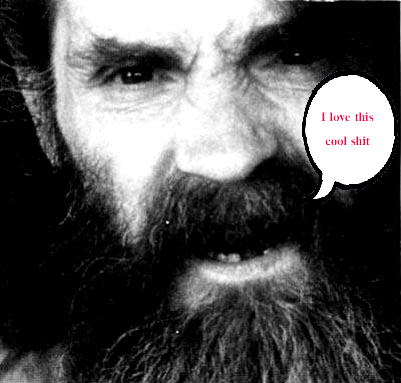
UPDATE (12/02/05): Baldilocks calls the celebrities on their B.S. by applying something I love -- basic logic: If Misters Foxx and Dogg really believe everything that Mr. Williams says about his case, let them be brave enough to ask Arnold to pardon the “innocent man.”(Via Pajamas Media.) If Tookie is innocent, his sentence shouldn't be commuted to life imprisonment; he should be FREED. He may or may not have reformed his life, but even if he has, that's still not innocence. They can't have it both ways. UPDATE (12/03/05): Hube, at La Shawn Barber's blog has a real shocker about Oakland, California students being "educated" about Tookie by scolding activists claiming Tookie was innocent because the jury was "all white." (A claim Joanne Jacobs debunks as a lie.) posted by Eric at 03:16 PM | Comments (2)
| TrackBacks (0)
I just hope tolerance doesn't beget intolerance . . .
Joining the likes of such groups as Aztlan.net, the Green Party is calling for a boycott of Israel: 1. The Green Party of the United States (GPUS) publicly calls for divestment from and boycott of the State of Israel until such time as the full individual and collective rights of the Palestinian people are realized.Via Little Green Footballs. The anti-Israel movement appears to have been spearheaded by the Wisconsin Green Party and by Madison activists affiliated with this University of Wisconsin site, which also champions Rachel Corrie and is organizing against Caterpillar (subject of an earlier post, and an example of bad art here.) What is it that keeps the activists in Madison stoked with such endless moral fervor, anyway? I lived in Berkeley for years, and while Madison was always one of our chief competitors, I never quite understood the dynamics of the latter. Why Madison? Perhaps I should relax. According to Forbes Magazine, Madison's openness and tolerance for all things (including radical ideas) may have sewn the seeds of its own destruction -- by capitalist forces! This hotbed of radicalism has grown into a seedbed of biocapitalism, propelling the region to the number one slot on our list of Best Places for Business and Careers. Scientists are developing artificial skin (at a company called Stratatech), vitamin D therapies for patients with chronic kidney disease (Bone Care International) and proteins that inhibit cancer-cell development (Quintessence Biosciences). Such biotech ventures cluster around the university and nearby Milwaukee, home of the Medical College of Wisconsin and a unit of GE Healthcare (2003 revenues: $10 billion), which acquired Lunar, a Madison maker of bone densitometers and ultrasound equipment, in 2000. Some 120 technology companies employing 8,000 people have sprung up in Madison during the past decade. Average annual salary: $60,000.There's a lot more. Perhaps some of the more bitter Madisonians are feeling left out of the fun, and are doing what bitter people have so often done in history. (Blaming the Jews.) All things considered, I still think this Green Party is funnier. posted by Eric at 01:00 PM
| TrackBacks (0)
Same dog, different result?
This news report about the sicko accused of burying a puppy alive is horrifying: ST. CLOUD, Fla. -- An anonymous tip led animal control officers to a shocking case of animal cruelty. A puppy was found buried alive in a yard near New York Avenue and 192 in St. Cloud. Osceola County Animal Control said they had never seen anything like this.Something not mentioned in the story became immediately apparent to me when I saw the picture of the poor puppy:  Unfortunately, the puppy appears to be a pit bull. Sigh. And, of course, no one would blame it for the conduct of its abusive master. Nor would they blame pit bulls and demand that they be banned. Not this time! But if that same tortured puppy had reached maturity and mauled a child as a result of the demented state which often results from such abuse, the outcry would have been very different. Scum like the guy who buried his dog should be punished to the extent the law allows. Unfortunately, most of them aren't caught. While I can't help wishing that the guy's dog had survived to maturity and mauled his owner to death, the problem with that is that in the media story which would result, the thug would be the victim, and his dog the villain. And all "pit bulls" -- like my dog Coco -- would be blamed as "the problem." Which means that our communitarian society might pass laws making me into a criminal. Because of someone else's crime! posted by Eric at 11:53 AM | Comments (5)
| TrackBacks (0)
Why I Am Not A Burkean Conservative
Get comfortable. This is going to be a long one. All of the variations in typeface were added after the fact by yours truly. Likewise, all of the links. C.S. Lewis on Moral Education
By practicing such cavalier reductionism, a map of the human Tao is created that seems to me to be too compact and tidy, even if we opt for the deluxe 3D multi-axial projection. We might display it as a vaguely liver shaped mass (all those lobes, you know), with smoothly extending, yet still decorously restrained pseudopodia. Add back all the excised behaviors and it more closely resembles a sea urchin, the central mass of squishy consensus customs surrounded by unpredictably bizarre extreme behaviors. I just don't think it's fair to wish away the spines. And yet, Lewis himself would find my objections irrelevant. In his own words... The following illustrations of the Natural Law are collected from such sources as come readily to the hand of one who is not a professional historian. The list makes no pretence of completeness...But (1) I am not trying to prove its validity by the argument from common consent. Its validity cannot be deduced. For those who do not perceive its rationality, even universal consent could not prove it. (2) The idea of collecting independent testimonies presupposes that 'civilizations' have arisen in the world independently of one another...It is by no means certain that there has ever (in the sense required) been more than one civilization in all history... Fair enough. Even though he's doing a nose count of different traditions, locating and tagging the moral commonalities, such samplings are ultimately a mere illustrative convenience, and not binding. Back to Meilaender... Lewis provides an illustration of the Tao in That Hideous Strength, the third and last volume in his space fantasy series. He himself subtitled the book “A Modern Fairy-Tale for Grown-Ups,” and in the short preface he wrote for the book, he says: “This is a ‘tall story’ about devilry, though it has behind it a serious ‘point’ which I have tried to make in my Abolition of Man.” We can follow his hint and illustrate the Tao by remembering the scene in That Hideous Strength in which the sinister Frost begins to give young professor Mark Studdock a systematic training in what Frost calls “objectivity.” This is a training designed to kill in Mark all natural human preferences. Hmmm. The moral inheritance of mankind is not susceptible to rational analysis. It merely is. Rather than opening a discussion on morality, Meilaender seems more intent on closing and locking it. The Need for Moral Education Which no doubt explains creatures like myself. Now, where did my trousers get to? Why not? Because—although Lewis does not put it this way in Abolition of Man, a decidedly non-theological piece of writing—human reason and desire are disordered by sin. What Iris Murdoch once called the “fat relentless ego” constantly blinds us, so that the mere fact of opening our eyes does not guarantee that we will see truly. Indeed, if Lewis really held that the precepts of the Tao are “obvious,” the central theme of Abolition of Man could make little sense; for it is a book about our need for moral education. Who then were the first educators? How did they discover the truth? We may be very bright and very rational, but we will be what Lewis calls “trousered apes.” Lacking proper moral education, our freedom to make moral choices will be a freedom to be inhuman in any number of ways. The paradox of moral education is that all genuine human freedom—a freedom that does not turn out to be destructive—requires that we be disciplined and shaped by the principles of the Tao. Our appetites and desires may readily tempt us to set aside what moral reason requires. Hence, from childhood our emotions must be trained and habituated, so that we learn to love the good (not just what seems good for us). And only as our character is thus shaped do we become men and women who are able to “see” the truths of moral reason. Again, I'm puzzled. From where do the shapers derive their correct truths? How can our teachers discern good from evil on our behalf? Moral insight, therefore, is not a matter for reason alone; it requires trained emotions. It requires moral habits of behavior inculcated even before we reach an age of reason. “The head rules the belly through the chest,” as Lewis puts it. Reason disciplines appetite only with the aid of trained emotions. Seeing this, we will understand that moral education does more than simply enable us to “see” what virtue requires. It also enables us, at least to some extent, to be virtuous. For the very training of the emotions that makes insight possible has also produced in us traits of character that will incline us to love the good and do it. To call this a circular argument is to understate with extreme prejudice. Moral education, then, can never be a private matter, and Lewis follows Aristotle in holding that “only those who have been well brought up can usefully study ethics.” Hence, the process of moral education, if it is to succeed, requires support from the larger society. Ethics is, in that sense, a branch of politics. This argument is spherical. In particular, it reminds me of a Magdeburg sphere. Perhaps you've seen one. It consists of two metal hemispheres joined together to form a full sphere. As air is pumped out, the two parts are pushed together by atmospheric pressure. Hermetically sealed, the sphere contains absolutely nothing, yet that nothing ensures that the sphere cannot be opened, not even by two teams of horses pulling in opposite directions. The sphere becomes a sealed vacuous hollow, unbreachable. Thus, for instance, to take an example that Lewis could not precisely have anticipated, consider the problem of protecting children from internet pornography (which the U.S. Congress attempted in what was known as the “Child Online Protection Act,” but which the Supreme Court ruled, in Ashcroft v. ACLU, was in probable violation of the First Amendment’s free speech guarantees). True as it may be that this protection should be the primary responsibility of parents, they face daunting obstacles and almost inevitable failure without a supportive moral ecology in the surrounding society. Moral education, if it is to be serious, requires commitment to moral principles that go well beyond the language of freedom—principles that are more than choice and consent alone. Moral education should go well beyond choice and consent. I like it. It's catchy. We should not think of this moral education as indoctrination, but as initiation. Why not? It is initiation into the human moral inheritance: “men transmitting manhood to men.” We initiate rather than indoctrinate precisely because it is not we but the Tao that binds those whom we teach. We have not decided what morality requires; we have discovered it. We transmit not our own views or desires but moral truth—by which we consider ourselves also to be bound. It's kind of like watching a car crash, isn't it? Let's recap. First, there is an objective morality in the universe. But it's really hard to figure out. You can't use logic or reason. Induction can't get the job done. The best thing you can do is just "see" it. Even that usually doesn't work. A firm guiding inflence is called for. Training, and lots of it. From an early age. Without it you're not even qualified to discuss these matters. Here, have a banana. Don't get any on your trousers. So far, so good. But now it gets tricky. Who should train you? Wise elders. Tradition. Wholesome tradition, wholesomely imparted. Call it initiation, not indoctrination. Because why? Because your teachers went through what you're going through, back in the day. Tradition has its own reasons, that reason knows nothing of. Everything is a big mystery. Hence, moral education is not an exercise of power over future generations. To see what happens when it becomes an exercise of power by some over others, when we attempt to stand outside the Tao, we can look briefly at two ways in which Lewis’ discussion of morality in The Abolition of Man takes shape in That Hideous Strength, his “‘tall story’ of devilry.” That's really nice. Artistic even. But if he'd put in just a little more effort, he could have selected lines that formed a coherent narrative of his own. That would conform more closely to the activities he's denigrating. This train of thought was first suggested to me by one of the findings of the Human Genome Project, a finding that got quite a bit of attention in news articles announcing (in February, 2001) the completion of that project by two groups of researchers. We were told that the number of genes in the human genome had turned out to be surprisingly small—that human beings have, at most, perhaps twice as many genes as the humble roundworm (downsized even more with new findings in 2004, so that human beings and roundworms have about the same number of genes)—and that the degree of sequence divergence between human and chimpanzee genomes is quite small. Considering the complexity of human beings in relation to roundworms and even chimpanzees, it seemed surprising that, relatively speaking, much less complex organisms should not have far fewer genes than human beings. I would hope that some of the links I've chosen demonstrate just how badly we can treat each other, with no recourse to science at all. Indeed, we've been treating each other quite badly for several millenia now, with nary a test tube in sight. This is not to say that science can't be perverted and used for bad ends. But since we've already learned how to torture each other to death, wholesale and retail, it's not really all that enabling is it? A few Pathan women with nail clippers can do amazing things. The Abolition of Manhood? Simple nomadic horse barbarians were technically capable of raising pyramids of severed heads, over and over again. And while they did it, they were observing the moral niceties of their own sacred traditions, imparted, no doubt, at their daddy's knees. Where do we go when Taos collide? From this angle, developments in biotechnology are likely to affect most our attitudes toward birth and breeding. But there remains still the fact of death, and once we take free responsibility for shaping our destiny, we can hardly be content to accept without challenge even that ultimate limit. When Mark Studdock is asked to trample on a crucifix as the final stage in his training in “objectivity,” he is—even though he is not a Christian—reluctant to obey. For it seems to him that the cross is a picture of what the Crooked does to the Straight when they meet and collide. Mark has chosen the side of what he calls simply the Normal . He has, that is, begun to take his stand within the Tao. But then he finds himself wondering, for the first time, about the possibility that the side he has chosen might turn out to be, in a sense, the “losing” side. “Why not,” he asks himself, “go down with the ship?” I bet you could see it coming. There are things we might do to survive—or to help our species survive or advance or, even, just suffer less—which it would nonetheless be wrong or dishonorable to do. Duh. Yet another reason to abolish professional bioethicists would be their propensity for stating the obvious while imagining that they're somehow enlightening us. They sweat, and strain, and eventually they pass a stony, gnarled fewmet which we're supposed to oooh and ahhh over. Look, he made some wisdom for us. Indeed, we do not have to look very far around in our own world—no farther, for instance, than the controversies about embryonic stem cell research—to see how strongly we are tempted to regard as overriding the claims of posterity for a better and longer life. “We want,” Lewis’ Screwtape writes, “a whole race perpetually in pursuit of the rainbow’s end, never honest, nor kind, nor happy now, but always using as mere fuel wherewith to heap the altar of the Future every real gift which is offered them in the Present.” Here comes my favorite line in the whole address. Better to remember, as Roonwit the Centaur writes to King Tirian in The Last Battle—the seventh and final volume in Lewis’ Chronicles of Narnia—that all worlds come to an end, and that noble death is a treasure which no one is too poor to buy. Nor should we neglect the instructive Doom that Came to Sarnath. Go, go and ask the Numenoreans. Then go tell it on the mountain. This is at least something of what Lewis still has to teach us about the education we need to make and keep us human. In the modern world it is the task of moral education to set limits to what we will do in search of the rainbow’s end—to set limits, lest that desire should lead to the abolition of man. “For the wise men of old,” Lewis writes, “the cardinal problem had been how to conform the soul to reality, and the solution had been knowledge, self-discipline, and virtue.” But when freedom becomes not initiation into our moral inheritance but the freedom to make and remake ourselves, the power of some men over others, it is imperative that we remind ourselves that moral education is not a matter of technique but, rather, of example, habituation and initiation. And, as Lewis says, quoting Plato, those who have been so educated from their earliest years, when they reach an age of reason, will hold out their hands in welcome of the good, recognizing the affinity they themselves bear to it.
Gilbert Meilaender, the Phyllis and Richard Duesenberg Professor of Christian Ethics at Valparaiso University and a fellow of the Hastings Center , is a member of President George W. Bush’s Council on Bioethics. He received his Ph.D. from Princeton University and has also taught at the University of Virginia and at Oberlin College . He has served on the board of directors of the Society of Christian Ethics, as an associate editor of Religious Studies Review, and on the editorial board of the Journal of Religious Ethics, where he currently is an associate editor. Dr. Meilaender has published numerous articles and books, including Friendship: A Study in Theological Ethics; Faith and Faithfulness: Basic Themes in Christian Ethics; and Body, Soul and Bioethics. The above is adapted from a lecture delivered at Hillsdale College on September 12, 2005, at a Center for Constructive Alternatives seminar on the topic, “C.S. Lewis, J.R.R. Tolkien and the Inklings.” Reprinted by permission from IMPRIMIS, the national speech digest of Hillsdale College, www.hillsdale.edu. The opinions expressed in Imprimis are not necessarily the views of Hillsdale College. posted by Justin at 10:50 AM | Comments (8)
| TrackBacks (0)
What Mayor Street's critics "don't read"
In another story that wants to be an editorial, the Philadelphia Inquirer's Marcia Gelbart is having trouble understanding why Mayor Street got booed at a U2 concert last summer, and contrasts Street's "velcro" with Ronald Reagan's "teflon": During a U2 concert here last month, lead singer Bono gave a shout-out to Mayor Street, thanking him for allowing the city to host Live 8 in July. The crowd booed.Well, some of them read the Inquirer. And while the paper's archives are only temporary, there's still plenty of information available on line about the huge scandal known as "pay to play." There are even web sites like this devoted to stopping it. And blogs like this. And this. On the inside pages, today's article mentions the pay-to-play scandal: Equally as significant, the pay-to-play probe tied Street to an unappetizing crew of defendants. Street's former city treasurer is in jail. A Muslim cleric who is a longtime supporter of the mayor's is appealing a seven-year sentence. Nine other people have been convicted.The pay-to-play scandal was much bigger than the Inquirer makes it appear now. How it works is explained here: As a political insider with the ear of the Mayor and officials throughout the Street administration, including City Auditor Corey Kemp, White is accused by the FBI of directing the distribution of these lucrative bond deals to various banks and lenders, notably Commerce Bank. In exchange for political contributions to his PACs, White provided inside information on other contractor’s competitive bids as well as, according to the FBI, directly ordering various members of the Street administration to deliver non-competitive contracts to those lenders and contractors that “played ball” with White and Kemp. Other financial rewards given to buy White’s influence include extraordinarily generous personal loans to among others Mayor Street, White himself, Kemp and White’s girlfriend, Renee Knight. Lavish meals, junkets to the Super Bowl, and lucrative “consulting” contracts were among the rewards White is accused of receiving in exchange for city contracts. White is also accused of landing exclusive airport food concessions, service contracts and government printing contracts for his wife, members of his family and Knight.(More here.) Despite the contention that Street supports ethics reforms, his anti-reform allies on the City Council -- a group known as "the Status Quo 5" have been able to defeat pay-to-play reform legislation. Not only is the name of Ron White left out of today's The indictment rests in part on conversations monitored by the government pursuant to judicial authorization for approximately nine months during 2003. During that time, according to the indictment, White and Kemp openly discussed their criminal scheme, in which Kemp permitted White to take over Kemp’s official decision-making in exchange for benefits from White and others. For example, on February 12, 2003, while discussing the selection of financial services firms favored by White, White stated, “well, we moving s---, ain't we Corey? . . . there ain’t nobody in it but me and you now.” Kemp replied, “That’s it, everybody else out the picture, huh?”It was fortunate for Mayor Street that his close friend Ron White died of fast moving pancreatic cancer before the trial. But the Inquirer and other local papers covered this scandal extensively. I read about it, and wrote about it extensively in this blog. And I'd be willing to bet that the nameless little people in the booing crowd had read about it too. Of course, these days it's gotten more and more difficult to read about it much less find the details -- what with all the disappearing links. (Occasionally, however a cached piece like this will still turn up. . . But the days in the life of a Google cache are numbered, and sooner or later the critics Street says "don't read" won't be able to.) I don't want to bore my readers, but here's just one example of a Street tidbit once available on on line at Philly.com, but which can now be found only at blogs like this: A HIGH-RANKING Commerce Bank official told his boss in 2002 that Mayor Street had approached him after a City Hall meeting and asked about refinancing the mayor's home mortgage.That's the sort of thing that might cause a local crowd to boo at a U2 event. (Even critics who "don't read" but still have a memory cache. . .) MORE: While the "Duke" Cunningham scandal also involves a form of "pay-to-play," it can at least be argued that there seems to be a higher standard at work in Washington. (Occasionally.) AND MORE: At the risk of being a bore, another example (in another disappeared news story saved here) shows how deep the corruption runs in this city: In spite of contract language saying that airport-concession opportunities should be spread "to as many different subtenants as possible," the city allowed the same politically juiced bar-owner, Eric J. Blatstein, a $36,000 contributor to Street, to control eight bars in airport terminals. Blatstein's partners in the bars included White's physician-wife, Aruby Odom-White, the wife and daughters of former state Sen. Frank Salvatore, the wife of late South Philadelphia political potentate Henry J. "Buddy" Cianfrani, and a woman identified by federal authorities as Ron White's paramour, Janice Renee Knight. Isdell has refused to answer questions about the situation.BTW, the "South Philadelphia political potentate Henry J. "Buddy" Cianfrani" went to prison for corruption in the 1970s. Few remember stuff like that. Even airport security is alleged to have been corrupted by the scandal: Robinson contends that she was denied promotion, transferred to a meaningless job, and shunned by her fellow workers and supervisors because she raised questions about the grate at Blatstein's property - a restaurant known as Cibo in the new international terminal.I know how boring this is, but one of my pet peeves is that I hate to see information disappear. What I really ought to be posting about is the role of bloggers in breaking the corruption scandal which just caused the Canadian government to fall. If the Canadian government had had its way, few would have known about the scandal, and the no-confidence vote might not have occurred. (Now, if they'd just been able to get the UN to silence Captain Ed..... ) Mayor Street said he would sign all of the bills that passed yesterday, which included legislation to ban big donors from receiving city financial assistance worth more than $50,000. Only Councilwoman Jannie Blackwell opposed that measure.I don't know what accounts for the "dramatic change." As to the provision that failed, Street and his allies were against it, and Councilman Michael Nutter illuminates: Street had criticized the one measure that failed yesterday, an effort to restrict competitively bid contracts, arguing that bans on big donors could effectively eliminate low bidders from some projects and needlessly complicate the procurement process. Those doubts were shared in Council by the six members who traditionally vote with Street - Blackwell, Darrell L. Clarke, Blondell Reynolds Brown, Juan F. Ramos, Rick Mariano, and Donna Reed Miller - as well as two others, W. Wilson Goode Jr. and Marian Tasco.Having an "independent board" to oversee ethics sounds like a good idea. But then, who decides who gets to sit on the board? posted by Eric at 07:53 AM
| TrackBacks (0)
This Title Will Be Released On May 16, 2006
If you're as big a fan of Vernor Vinge as I am, this should interest you. His newest novel is only five and a half months away. Rainbows End (Zones of Thought) Thanks Amazon.com! Here's their bland summary... Four time Hugo Award winner Vernor Vinge has taken readers to the depths of space and into the far future in his bestselling novels A Fire Upon the Deep and A Deepness in the Sky. Now, he has written a science-fiction thriller set in a place and time as exciting and strange as any far-future world: San Diego, California, 2025. So he's explicitly labeling it as a "Zones of Thought" story. I wouldn't have expected that. Here's the cover art (Just so you'll know what to look for). Is that a bunny rabbit gazing pensively out over the City of the Future? He seems to be wearing clothing of some sort. For your listening pleasure, here's a keynote presentation Professor Vinge delivered in September at Accelerating Change 2005. And here's a story set in the same milieu as the upcoming novel, available as an eBook. A brief sample follows... Final exam week was always chaos at Fairmont Junior High. The school's motto was "Trying hard not to become obsolete"--and the kids figured that applied to the faculty more than anyone else. This semester they got through the first morning--Ms. Wilson's math exam--without a hitch, but already in the afternoon the staff was tweaking things around: Principal Alcalde scheduled a physical assembly during what should have been student prep time.
posted by Justin at 07:50 AM | Comments (1)
| TrackBacks (0) Monday, November 28, 2005
Ramsey Clark speaks truth!
According to Drudge, Saddam Hussein says he's still president: A defiant Saddam has refused to recognize the court and has declared himself president of Iraq.The BBC reports that Saddam is being represented by Ramsey Clark, has taken to carrying a Koran (despite his previous aversion to religion), and harangued the judge about occupiers: He was similarly argumentative on Monday, complaining about the fact that he had to climb four floors to the courtroom because the lift was broken.What I want to know is why Ramsey Clark seems to be so alone in honestly recognizing what logically flows from the antiwar position. Quite simply, if the war was wrong, and if the U.S. occupation is wrong, then it's wrong for Saddam Hussein to be on trial. By all logic his overthrow was illegitimate and he should still be president. Why are his supporters so silent? UPDATE: The forward thinking Lee Harris was thinking along similar lines way back in 2003: Bush misled the American people, arguing that Saddam Hussein should be removed from power because he possessed Weapons of Mass Destruction. But it turns out that this was all a pack of self-serving lies. From which it follows that we should never have fought the Iraq war, and, furthermore, that Saddam Hussein should never have been removed from his position at the head of the Iraqi government.
Sheesh! (This makes Saddam look more like my dog Coco than Michael Moore. And poor Coco finds the word "bark" most offensive in this context!) posted by Eric at 01:35 PM | Comments (12)
| TrackBacks (2)
But what do you call it when you're sick of attrition?
at·tri·tion n. Bill Roggio says U.S. soldiers and Marines are frustrated with the media: These guys are extremely frustrated with the media and make no bones about their distaste for those who are undermining the war effort by calling for withdrawal.(Via Glenn Reynolds.) They must love the Philadelphia Inquirer. I share the frustration of the soldiers and Marines. It is as if there's a professional, well-financed effort to reach into every American home with constant calls for withdrawal from Iraq. While I can ignore it, it's becoming clear to me that many people can't. They believe what they read in the papers, and much as I hate to say this, public opinion appears to be fickle and too easily influenced. I guess it should renew my faith that there is still support for the war. People are certainly free to have the opinion that the war is wrong. But if those holding the antiwar mindset are charged with shaping public opinion, and they deliberately, constantly undermine support for the war effort, then it begs the question of whether the real war of attrition is in Iraq. posted by Eric at 07:57 AM
| TrackBacks (0) Sunday, November 27, 2005
High fashion model remains undiscovered!
While she may have missed out on Black Friday's shopping extravaganza, Coco wants to her fans to know that it wasn't because of any lack of interest in glamor, but because her master didn't take her anywhere. Sleek and svelte, Coco is very glamorous -- and rapidly coming into her prime!

Imagine how she'd look in more sophisticated surroundings. . . MORE: In the background behind Coco and to the right, a tree has grown around some old metal which appears to have once been part of a rail switching apparatus or something:  Sheesh. The things a girl has to put up with to be fashionable these days. posted by Eric at 05:03 PM
| TrackBacks (0)
Why disillusion heroes?
In a (Sunday-after-Thanksgiving) front page headline, the Philadelphia Inquirer is claiming that Army Spec. John Kulick (who was killed last August) was "A war supporter disillusioned in Iraq." Expecting to find some evidence that Kulick had in fact been disillusioned, I read through this huge piece, only to discover that while he had expressed various concerns about various things at various times, the appellation "disillusioned" originates not with Kulick but with his mother, and that five days before his death, Kulick wrote that "the war was justified"": "I think his greatest disappointment in the Army was the way that the soldiers were treated," Jill Kulick said. "John had the same concerns that we all have here, and that is the fact that it doesn't look like we've really accomplished a lot in the improvement of the Iraqi people's lives and in eliminating terrorist activity."The word "disillusioned" is his mom's interpretation of things he said, and tragically, now that the guy is dead, their interpretation is all that's left. Reading his August 4 remarks, couldn't it also be asserted that he was disillusioned about the American people for forgetting 9/11? Clearly his parents are disillusioned -- and they're also described as attending a Cindy Sheehan event: His father, once a war booster and Bush supporter, turned against both.Look, these folks are grieving, and they have every right to be against the war and attend Cindy Sheehan events. I don't think that's what their son would have wanted, and I can't shake this feeling that he wouldn't have enjoyed reading about his mom's immediate reaction to his death: ....Kulick's mom got the news from an officer at the other end of a telephone line.I can't speak for Kulick, but I'd hate to lose my life for a cause I believed in (and said so just days before my death), and then have my family and the Philadelphia Inquirer claim I was "disillusioned." (If that happened, then I'd be disillusioned about my family.) I think this is demoralizing, and I think it degrades the cause for which John Kulick died, and in which he said he believed just days before his death. No wonder soldiers (like Special Forces Capt. Jeffrey P. Toczylowski) are writing things like this in advance of their deaths: Don't ever think that you are defending me by slamming the Global War on Terrorism or the US goals in that war. As far as I am concerned, we can send guys like me to go after them or we can wait for them to come back to us again. I died doing something I believed in and have no regrets except that I couldn't do more.If there's one thing I've learned blogging, it's that people who disagree with you will put words in your mouth. But at least if you're alive, you can speak up. Who gets to speak up if you're dead? I certainly can't speak for John Kulick, but I have to ask a question: wouldn't he have preferred being seen as a hero? I'm probably old fashioned, but I just never saw disillusionment as a particularly heroic trait. (Maybe times have changed.)
“But I remind myself, on the other hand, that there are those kids in Iraq, who are reintroducing into the public consciousness the virtues of bravery and determination and love of country so long forgotten by a people grown stale in its blessings and privileges. May their tribe increase.”(Via Glenn Reynolds.) Perhaps I'm new fashioned. Anyway, I don't think the anti-Vietnam left has the right to speak for an entire generation. MORE: What worries me is that if the United States withdraws from Iraq, and the democratic government then fails, the anti-Vietnam left will spin the war as another American defeat, and they'll never stop screaming "WE TOLD YOU SO!" Is that why they want the U.S. to lose the war? So they can falsely claim they were right, that war is wrong, and that the U.S. was rightly "defeated"? UPDATE: Thank you, Glenn Reynolds, for linking this post! I'm not much of a serious war blogger, (although I know bias when I see it), so it's flattering and unexpected to get InstaLanched in the discussion of Marc "Armed Liberal" Danziger's Winds of Change post about gratuitous, smug, antiwar bias in the L.A. Times. "Reverse-Vietnam" is a good way to describe what's happening. (The term even sounds prescient, if I may be so optimistic.) posted by Eric at 08:39 AM | Comments (13)
| TrackBacks (0) Saturday, November 26, 2005
Viva fashionismo!
Yes, that's right! I am so tired of some murderers being glorified as "people's heroes" while other murderers are vilified as "evil butchers," (based upon no logical standard ascertainable to me) that I finally decided to apply some old fashioned moral equivalency in protest. I humbly offer a fashionist/fashionista statement combining two murderers, one a commie we are told to love (and who's been morphed into a Hollywood legend), and the other a fascist we are told to hate. Without further ado, here it is -- the unveiling of the never-seen-before (and probably never-seen-again).... 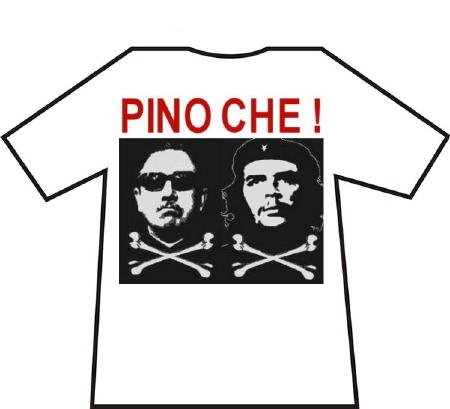 I mean no offense to the victims of either of these two men, as it is not my intent to glorify them. Only offer a little perspective. (And symmetrical ridicule.) MORE: The Manolo, he would seem to agree: Nothing is more worthy of the ridicule than the fashion sense of the dictators, politburos, autocrats, and tyrants.(Via The Glenn.) posted by Eric at 11:01 PM | Comments (4)
| TrackBacks (0)
Following my inner shepherd (while ramming around)
I've been spending a lot of time driving and socializing, which accounts for the light posting. Long out-of-state drive today, return tonight. (I'm glad to see Dennis has been taking up a little slack.)
 (I hasten to add that the above is not meant as any sort of cultural or political commentary!) posted by Eric at 10:05 AM | Comments (2)
| TrackBacks (0)
Heaven knows Mr. Allison . . .
The "Sober" virus writers must be desperate to attract my attention. For the last few weeks I've been deleting countless distracting versions of the latest zip attachment, just as I'll delete this one, but it's too cute not to share. Dear Sir/Madam,I'm not going to share the "list" however, as it is a zip file containing the virus. Hope readers will understand this act of censorship. MORE: The obviously beleaguered FBI has written this web page denying any role in sending out this notice. And they're investigating: These e-mails did not come from the FBI. Recipients of this or similar solicitations should know that the FBI does not engage in the practice of sending unsolicited e-mails to the public in this manner.When I was a kid, impersonating the FBI was a serious offense. posted by Eric at 09:13 AM | Comments (4)
| TrackBacks (0) Friday, November 25, 2005
The Great Enlightened North
The progressive promised land to which deserters still flee and to which sore losers threaten to move is once again far ahead of the curve. What do you do when convicted criminals engage in unsafe behavior contrary to the rules of incarceration? Enable them to do it more safely, and on the cheap too! Canadian inmates can now get tattoos in prison parlors under a pilot program aimed at cutting down use of unclean needles and the spread of disease. Tats for the low, low price of $4.25 USD! By the same logic the Canadian authorities ought to supply lubricant to ease the pains of ... er ... forced entry. Not all prison behavior is voluntary. They're going to smuggle in drugs, too, so oughtn't we to provide reasonably priced smack confirmed to have been manufactured safely? Oh, if only there were some higher intelligence to whom we might turn, who might sort out these dilemmas for us! But there may just be, and again the Canadians are boldly at the fore: A former Canadian Minister of Defence and Deputy Prime Minister under Pierre Trudeau has joined forces with three Non-governmental organizations to ask the Parliament of Canada to hold public hearings on Exopolitics -- relations with “ETs.” Now if you're already snickering, open the floodgates: Hellyer warned, "The United States military are preparing weapons which could be used against the aliens, and they could get us into an intergalactic war without us ever having any warning. He stated, "The Bush administration has finally agreed to let the military build a forward base on the moon, which will put them in a better position to keep track of the goings and comings of the visitors from space, and to shoot at them, if they so decide." Canadian beer must be much stronger, eh. PS: I should add that this isn't meant as a slight against Canada (I think a commenter took it that way). And it's fair to note that Hellyer was addressing nuts. But the point is that lefty Americans paint an absurdly fantastic portrait of the Canadian holy land, and it's awful good fun to soil it. The portrait, that is. That said, I have no love for the loony Canadian government. posted by Dennis at 07:18 PM | Comments (7)
| TrackBacks (1)
Making every symbol count
In a previous post, I quoted from a blog post and a Washington Times news report which claimed that Oreo cookies were "pelted" at Michael Steele. I now see that the story I linked is being contested (a "complete fabrication," says Kos). Because I dislike inaccurate news reports (especially those I've linked), I think this is worthy of closer examination. Roger Ailes claims that "no one but a right-wing lunatic would think Ehrlich's story is plausible," and he cites the Baltimore City Paper, which states: no published news report [] has independently confirmed that Oreo cookies were even present at the debate. What constitutes independent confirmation? Amy Ridenour has quoted an eyewitness who says he saw cookies passed out, and at least one thrown: The term Oreo and the symbolism of the cookie is meant to imply that a black person is really wants to be Caucasian and otherwise ashamed of his or her race. The mere mention of them is insult enough. It is outrageous that Michael Steele's political opponents are trying to deflect their improper behavior by implying the event never happened. It did. Michael Steele may not have been pelted with a large number of cookies that night, but the epithets were there - both baked and yelled.Is an eyewitness independent confirmation, or must we have an actual cookie taken in evidence from the 2002 event and preserved in an official chain of custody? As to the number of cookies involved, this may be a classic example of a story having been exaggerated over time, although I am not sure how much the cookie count has to do with the substance of the story. Either the man was the target of an Oreo cookie prankster attack or he was not. If he was, then how many cookies were actually thrown is a secondary, not a primary, consideration. If the number of cookies was exaggerated, that does not tranform what they're referring to as "the story" false. Is the number of cookies the point? Would the number of rocks thrown by demonstrators be as relevant as the fact of rocks being thrown? A single rock makes the same point, and can be just as fatal if it strikes a single human being on the head. Unlike a rock, there's nothing fatal about an Oreo cookie. It's a symbol -- an idea meant to insult and degrade -- and the point can be made without throwing the cookie, but by merely displaying one, or just screaming the word "Oreo!" Throwing is simply a more graphic, physically demonstrative way of making an ad hominem attack. Obviously, the larger the number of cookies thrown, the more open and unbridled the hostility of the crowd. Some symbols are more powerful than others. I don't make these rules, but common sense suggests that a single swastika would "count" more than would a single Oreo. Ditto for the display of a single hangman's noose (or even the picture of a noose.) Unless there are more eyewitnesses than the man Amy Ridenour quotes, I don't think the news report should have used the word "pelted," as the plain meaning of that word denotes the throwing of a large number of Oreos. I wouldn't use the word to describe a single cookie toss, any more than I'd say that Ann Coulter was "pelted" by pies when only one was tossed. There are too many contradictory reports of this story, and there is no video. Considering the eyewitness report, I don't think the story is a complete fabrication, although I do think it has been exaggerated -- and I don't think that reflects well on the Washington Times. Regardless of what happened, the Oreo as a symbol isn't going anywhere. But because I like to play Devil's Advocate, I'd like for a moment to assume that Kos is right about this being a Republican fabrication, that all witnesses to the contrary are lying, and that no Oreo cookies were present or were thrown. Do Kos and the other people denying the story agree that it would have been a despicable thing to do to Steele? Do they condemn the throwing of Oreo cookies as a despicable tactic? Or just Republican lying? I'd like to hope they'd condemn both. . . posted by Eric at 08:35 AM | Comments (6)
| TrackBacks (0) Thursday, November 24, 2005
Is "America" becoming another weasel word?
"Few New Yorkers are aware that their city essentially was a capital of U.S. slavery for 200 years." So says a bold print image placed directly in the middle of today's Thanksgiving day scolding in the Philadelphia Inquirer. The bold language appears nowhere online, so I photographed it: 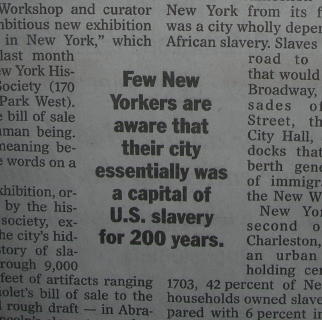 It is certainly to be hoped that few New Yorkers are "aware" of such a thing, as it simply isn't true. The U.S. wasn't founded until 1776, and slavery was abolished in New York in 1827 -- a grand total of 51 years. How the hell do they get 200? I want to be fair to the writer but I'm having a bit of a problem, because I'm not sure who wrote the bold faced heading. The words do not appear in the article -- itself a reprint from a piece (by the Pulitzer Prize winning Robert Lee Hotz) which appeared in the LA Times. Perhaps the misstatement of history isn't Mr. Hotz's fault. Whoever is at fault, a correction is certainly in order, so I'll be sure to look in tomorrow's edition. Ahem. Here's what the Hotz text says (from the Inquirer): Few New Yorkers are even aware that their city essentially was a capital of American slavery for 200 years, as the exhibition documents.Question: Is this a contradiction, or is "America" meant to be synonymous with "U.S."? Or is the goal to blur any distinction between America and the United States in the hope of shaming as many Americans as possible? I don't think it's a minor point, and the confusion is heightened if we continue to read the article: "Most people don't know it existed here," said the exhibition's chief historian, James O. Horton, professor of American studies and history at George Washington University. "I have people tell me they are shocked that slavery ever existed in New York."There! That word again! "American" -- as in American Studies. (The latter is a North American, United States oriented discipline. If you're interested in matters south of the border, the discipline is called "Latin American Studies.") As I read on, the more I saw the word "America," and "American," the more confused I became: The society's effort arises from a broad reassessment of how thoroughly slavery permeated American life when - in what historians consider the largest forced migration in history - 12 million Africans were kidnapped and transported across the Atlantic. In the decades before 1800, more Africans came to America than Europeans.Wait a minute! While it is commonly asserted by historians that 12 million Africans were transported across the Atlantic, when this statistic is interspersed between the statement that "slavery permeated American life" and the discussion of slave transportation as a "challenging part of our history," you'd almost get the impression that "Americans" (those mean people living in United States) are historically accountable for transporting 12 million Africans. From Africa to America. So it's no small issue whether America is a synonym for the United States. And whether this is "our" history. Or, for that matter, even that of North America before the founding of the United States. What is being left out of the Thanksgiving lecture is any discussion of how many of those 12 million were actually transported to North America. As it turns out, the number is a small fraction of 12 million -- a little more than three percent, to be exact. Most were taken to Brazil or the Caribbean: The vast majority of African slaves were taken to Portuguese Brazil or the Caribbean. Only about 399,000 were brought to British colonies in North America.I don't like moralistic scoldings, but even less do I like scoldings based on misleading numbers, outright misstatements of history, and the sloppy misuse of a perfectly good word: America. I don't want to see "America" added to the list of undefinable words. Not on Thanksgiving. While I'll still try to keep in mind Feynman's maxim that we should "never ascribe to malice that which can be adequately explained by stupidity," I'm still getting stuck. Can't stupidity ever be malicious? posted by Eric at 06:35 PM | Comments (7)
| TrackBacks (0)
Happy Thanksgiving Everyone!
When I was a kid, kids knew where turkeys came from, and tasteless beheading videos used to be shown on television (typically they were in children's cartoons made in the 1940s and recycled over the years for Thanksgiving -- although I don't know the origin of the animated gif below):  The country was more rural in the 40s, and rural people tend not to have as much of a problem knowing where their food comes from. Even today, some people at the USDA think you should know your turkey, because they made this educational turkey head gif:  I didn't know my turkey anatomy either. (A "snood"?) I'm having ham today. Not that it's more "humane" (because the pig is a far more intelligent creature), but I'm on a strange experimental diet which doesn't allow me to have stuffing. Why? Don't axe, don't tell!
Just enjoy! UPDATE (12/01/05): Anyone still crazy enough to be rereading my Thanksgiving post should by all means watch this crazy turkey video, which was emailed to me by a friend. posted by Eric at 08:46 AM | Comments (10)
| TrackBacks (0) Wednesday, November 23, 2005
Bigotry deserves respect!
Britain's George Galloway (Islamofascism's leading apologist there) is accused of pandering to Islamic anti-gay bigotry by killing a gay rights plank in his party's platform: The reasons that Galloway and the Respect leaders killed any reference to gay rights in the party's platform -- or its electoral "manifesto," as party platforms are called in the U.K. -- are quite simple. The district in which Galloway deliberately chose to run had a huge Muslim population, and it was thanks to the votes from that population that he was able to be elected. The party "manifesto" is to be the basis for Respect's campaign in municipal elections this coming May, and the party leaders' strategy is to try to elect local city council members from ares that have high Muslim populations. Moreover, “Respect is in alliance with the right-wing, anti-gay Islamist group, the Peter_tatchell Muslim Association of Britain [MAB],” as Peter Tatchell (left) -- the veteran gay and human rights campaigner who heads the militant British gay rights group OutRage -- pointed out, adding that the party does not ally with liberal and left-wing Muslims. And, U.K. Gay News reported, "Respect’s right-wing Islamist backers demanded the axing of gay rights as a condition of their electoral support for the party."The piece goes on to note Galloway's love affair with Islamofascism: Galloway has long made common cause with despicable, homophobic dictators, from Saddam Hussein to Syria's Bashir Al-Assad, without ever denouncing the reign of terror and repression their despotic regimes have visited upon gay Arabs and Muslims in their own countries. Now, Galloway and the leadership of the party whose principal spokesman he is have demonstrated beyond argument that, from them, gays and lesbians can expect no....respect.Coming as this does on the heels of Iran's execution of two gay men, I think this is another example of the moral bankruptcy of leftist multiculturalists who claim to support gay rights. I think we can expect a similar silencing of feminist concerns about wife beating (and genital mutilation) in the future. Like dissenting gays, dissenting feminists will be told that "real feminists" should simply shut up.
A village council in Pakistan has decreed that five young women should be abducted, raped or killed for refusing to honour childhood "marriages".It's not for us to impose "Western standards" on people. Nor should feminism ever be allowed to serve as a proxy for U.S. Imperialism! posted by Eric at 08:59 AM | Comments (6)
| TrackBacks (0)
But is Main Stream really mainstream?
Would the United States lose in a war against China? Tokyo Governor Shintaro Ishihara thinks so -- apparently because he's under the impression that the U.S. military can only withstand a maximum of 2,000 casualties: Tokyo Governor Shintaro Ishihara has gone public, warning that the United States would lose any war with China.Where might Governor Ishihara be getting that 2,000 figure? Might it be the Iraq War "milestone" so loudly trumpeted by the MSM last month? I don't mind the MSM trumpeting whatever milestone they want, but I wish world leaders wouldn't view media hype as representative of American public opinion. I mean, it's not as if the MSM is running the U.S. military, is it? Doesn't Ishihara read any warblogs? MORE: Speaking of warblogs and milblogs, today's Philadelphia Inquirer has a positive editorial piece focusing on Bill Roggio (who also posts at Threats Watch) with mentions of Michael Yon, The Word Unheard, and Andi's World. MORE: Ishihara is well known for his dislike of Americans. But the good-hearted round-eyes put him on the cover of Time:  He doesn't appear to be terribly fond of Koreans either, but the latter (judging from this Korea Times editorial), take a harder line than Time magazine. (I do hope his thoughts aren't a true reflection of Japanese opinion.) posted by Eric at 07:48 AM | Comments (3)
| TrackBacks (0) Tuesday, November 22, 2005
Iran executes gay men -- AGAIN!
Human Rights Watch reports that two more gay men were executed in Iran last week. (New York, November 22, 2005) – Iran’s execution of two men last week for homosexual conduct highlights a pattern of persecution of gay men that stands in stark violation of the rights to life and privacy, Human Rights Watch said today.And this is a country which is developing nukes and has threatened to wipe Israel off the map. I guess we'll have to sit around and be patient. (There's no solid evidence that they actually have WMDs....) posted by Eric at 07:02 PM | Comments (2)
| TrackBacks (0)
But wait... I thought
Here's an environmental irony: THE drive for "green energy" in the developed world is having the perverse effect of encouraging the destruction of tropical rainforests. From the orang-utan reserves of Borneo to the Brazilian Amazon, virgin forest is being razed to grow palm oil and soybeans to fuel cars and power stations in Europe and North America. And surging prices are likely to accelerate the destructionHuh? One of the most environmentally damaging commodities on the planet??? As bad as oil? But biodiesel is supposed to be renewable! Green! And green is good! Right? Remember the bumperstickers which said "SPLIT WOOD, NOT ATOMS"? (Woodburning is now illegal in many cities, because it hurts the environment.) Remember the environmentally-friendly windmills? (They're bad! Among other things, they chop up endangered birds.) Sheesh. If everybody switched to electric cars, what if someone discovered that 70% of that electricity came from fossil fuel? And that 14% came from nuclear reactors (which use nonrenewable fuel) -- which means that 84% of our electricity is made from nonrenewable ("bad") fuel. What if they said that electric cars were bad for the environment? What then? I think this calls for a little nostalgia:  posted by Eric at 01:48 PM | Comments (3)
| TrackBacks (0)
Less crime causes more crime?
Do law abiding citizens make nearby criminals commit crime? My blogfather Jeff Soyer's Weekly Check on the Bias (debunking the usual "criminals aren't responsible for their behavior" nonsense) reminded me of the fascinating uproar in New Jersey over Camden's designation as the most dangerous city in the United States. For a little background before I get to the uproar, let me remind readers of a few facts: Anyway, I'm having a lot of trouble following the logic of this, but according to certain "ministers, community activists, school children and police commanders" in Camden, Philadelphia is responsible for Camden's crime problem: With Camden facing the prospect of being named one of America’s most dangerous cities for the second year in a row, residents rallied yesterday with gun-control activists to complain that Pennsylvania’s gun laws undermine crime-fighting in the city.Fifth and sixth graders? I wonder how they got time off school to "support" such a feat of illogic. There's more here: At a news conference in the Fairview section, Brian Miller, executive director of Cease-Fire New Jersey, called on New Jersey elected officials to pressure their counterparts in Pennsylania to tighten their gun laws.Has it ever occurred to anyone to ask how a city with a lower crime rate can be responsible for the crime in an adjoining city with a higher crime rate? Might it be at least as reasonable to ask whether the presence of 28,000 concealed carry permits might account for Philadelphia being less dangerous than Camden? Of course, to the extent that guns are bought in Philadelphia and used in Camden, the criminals are already violating umpteen state and federal gun laws, but never mind that. Even though the conduct complained of is already illegal, we need more laws. In Pennsylvania! Because there's more crime next door! posted by Eric at 11:06 AM | Comments (7)
| TrackBacks (0)
Uppity bitch just won't shut up!
Ann Althouse is not convinced that the Democrats (including Atrios) care about feminism. I think they care about it as sincerely as they care about gay rights. (i.e. if you don't agree with our philosophy, you are guilty of "self hatred" and we're free to abuse you.) Gay conservatives or libertarians are not gay, nor are feminist conservatives or libertarians "real" feminists. I can remember when feminism did not have anything to do with socialism. Nor did gay rights. The idea was freedom and independence from all oppressive and domineering forces. Unfortunately, too many feminist and gay activists have surrendered their independence to oppressive and domineering forces. This is not to say that supporting a socialist agenda is necessarily incompatible with feminism, or gay rights, only that once the former dominates and subordinates the latter, the latter ceases to have an independent existence, and ends up substituting a new master for the old. I submit that if feminism means women are not free to make up their own minds, then it is not feminism. Unless the word "feminist" has been redefined as meaning support for socialism, I'd say Atrios is not a feminist. (Of course, I didn't think Bill Clinton was much of a feminist either, despite his lip service. But to borrow a phrase, "I'm not going to tell people what should or shouldn't offend them.") UPDATE: Roy Edroso accuses me of "predictable willful misapprehension." And in the same post, Steven Malcolm Anderson stands accused of being a "peach," plus commenters accuse him of "hardcore craziness" -- and he's in big trouble for typing an "a" instead of an "s." Naughty, naughty, Steven! Hmmm.... Well, isn't willful misapprehension more rational than accidental misapprehension? I'd rather engender the former than the latter. How might this look up at the top? Predictable willful misapprehension engendered here! Nah. I don't think I can live up to such a lofty goal. MORE: Clive Davis (via Glenn) thinks Ann Althouse is right about sexism in the blogosphere. Sounds like another willful misapprehension to me. posted by Eric at 10:28 AM | Comments (7)
| TrackBacks (0)
Too incompetent for malice right now . . .
This X business fascinates me, and while I'm inclined to go with Evan Coyne Maloney -- "CNN should get the benefit of the doubt. There's an old saying: Never ascribe to malice that which can be explained by incompetence" -- I find myself wondering if there would have been a similar reaction on the left had Fox News committed a similar blunder by flashing a big black X over Hillary Clinton's forehead. Watching the video (which Ian Schwartz has available for streaming), it's certainly understandable why conservatives would react, especially because the hated Dick Cheney is always a favorite, well, target for lack of a better word. I'd also give CNN the benefit of the "never ascribe malice" maxim, but this brings to mind another maxim called "trust but verify." There's also such a thing as malicious incompetence, but if I get started I'll be more late for a dentist than I already am, and we can't have my dentist thinking I'm incompetent or malicious, can we? (That might not be, um, safe!)
A well-placed CNN insider claims a control room staffer "laughed" when the image appeared shortly after 11 am.Are control room staffers supposed to laugh at their work product? MORE: I kind of like enjoy the CNN explanation in there from the control guy who said it was like your computer will glitch: And it's the sort of thing that just like your computer will glitch and will suddenly lock up and do something weird, our equipment does the same thing on occasions.I'm going on occasion soon myself. posted by Eric at 07:19 AM | Comments (5)
| TrackBacks (0) Monday, November 21, 2005
A big carnival for a big debate
Glenn Reynolds' Pre War Intelligence Carnival has been posted at OSM.org. It's huge, with lots of posts on both sides. How Glenn managed to tackle a project of this size I don't know, but he did a great job, and I thank him for including the post I wrote over the weekend. And here are the posts which stood out for me: ....we have found nerve agents in roadside bombs, a large chemical weapons factory in Mosul, 1.7 metric tons of enriched uranium, parts for gas centrifuges, yellowcake uranium from Iraq in Rotterdam, and the parts of long range missiles (pdf) he wasn't supposed to have. Also I would remind the reader that Iraq had a history of using chemical weapons against Iran and the Kurds and had an advanced nuclear project in the 80's before Israel bombed it. This Carnival covers every question you could possibly ask about pre-war intelligence, and many that you'd have never thought to ask. Much as I dislike debates, this one has been forced upon everyone, and the blogosphere is more than living up to its part.
They say that curiosity killed the cat, and while I don't normally stick my nose where it doesn't belong, I cannot say the same thing for my dog Coco. Right now, she's making a lot of noise in the background, and that's because because she takes issue with the cat Laurence calls "Haley" who states: My two secret agents here gave me faulty info. I told them to sniff out the weapons of mass destruction. I should have realized that when they said they found the mother load, they meant shredded cheese, not shredded documents.Coco wants the whole world to know that she has no fear of shredded documents, nor any fear of shredders for that matter. She leaves no stone unturned in her dogged determination to rid the world of bad documents, while valiantly attempting to save the good ones from the shredder!  So brave is Coco that I don't think she'd fear a huge plastic shredder. Me, Ow! posted by Eric at 01:20 PM | Comments (5)
| TrackBacks (0)
illegal pedestrians can ruin your whole day!
As one of my worst driving fears has always been hitting a pedestrian, this report in the Philadelphia Inquirer struck a nerve: Police said the men were driving south on the highway at about 2:30 a.m. when their car became disabled in the lefthand shoulder near the Girard Avenue exit.The problem with driving on a freeway or a turnpike is that there is no way to stop. Pedestrians have no right to be there, and there's a legal doctrine that one has the right to assume that other people will obey the law. So what the hell are you supposed to do when you're going 70 and some complete maniac runs out in front of you? It's like hitting a deer, except that hitting a deer only ruins your car and your evening. The psychological stress of hitting a person can ruin your life. The article also states that the "police are using clues from their disabled 1991 Plymouth to find the three who ran away and to identify the dead man." Clues? Didn't the car have license plates and registration? What kind of people carry no identification, abandon a car on an Interstate highway, and then run away from a companion who gets run over? I don't know, but I'd be willing to bet that if you were unlucky enough to have them run in front of you, whoever you hit would manage to find a lawyer. And don't think that the lawyer wouldn't be able to establish a theory of liability. All it takes is an allegation that the defendant was going faster than the ridiculous 55 mph limit which no one obeys. Sheesh! Next I suppose they'll use illegal pedestrians as an excuse to lower the speed limits. At the rate things are going, the East Coast will have to start putting up signs like this (which I thought had been limited to border areas in California, Arizona and Texas):  AFTERTHOUGHT: Might it be "offensive" to call illegal pedestrians "illegal pedestrians"? UPDATE (11/23/05): The dead man has been identified, and police are looking for the driver: One of the men told police they ran because they were scared and did not know Molina had been hit, Golden said. Police say they know who was driving the Plymouth but have not been able to locate him.I doubt that it is "unclear" whether the car was properly registered, as the police have the VIN numbers and such things are a matter of public record. All the men were running from the scene of the first accident, and their claim that they didn't know their companion was hit strikes me as implausible. On many stretches of I-95, it would not be safe to pull over after hitting such a "pedestrian." Unless the driver had a cell phone, I think the only thing he could do safely would be to drive to the next exit, call the police from a pay phone, and wait. Pennsylvania law requires a mandatory one year minimum prison sentence for failure to stop at the scene of a fatal accident (judges are specifically not allowed to give probation or suspended sentences.) I doubt the driver will be turning himself in anytime soon. posted by Eric at 12:36 PM | Comments (4)
| TrackBacks (0)
All the Rage with RINOs
This week's RINO Sightings Carnival has been posted at Searchlight Crusade. Host Dan Melson does a great job. BTW, Dan also has this riveting essay on dangers posed by the illusion of privacy. I'm not about to summarize every post, but the following stood out: The minority party is in tatters and it's because of people who call anyone they disagree with a "gook bitch". If you want to be taken seriously, be serious. Stop throwing pies at conservative speakers, stop the Bush=Hitler rhetoric and stop the "Bush lied" meme, these are baseless and frankly make you look like exactly what you are--a group of people who should never be trusted with political power again. Nice job, Dan! Now, go read 'em all. posted by Eric at 11:34 AM | Comments (2)
| TrackBacks (0)
Unrepentantly unrepenetrated?
If there's one thing that wakes me up in the morning, it's a sudden collision with another undefinable word. This morning it was a word I thought I'd understood for most of my life: virginity. As it turns out, it's suffered the fate of many a word these days: It's all laid out in the new book Virginity Lost: An Intimate Portrait of First Sexual Experiences by sociology professor Laura Carpenter. She's now at Vanderbilt University in Nashville, but Carpenter was working at the University of Pennsylvania when she did most of her research in the last few years. She interviewed 61 Philadelphia-area residents about how and why they lost it.A double standard for gays and straights? Why would that be? Why am I not perceiving the "certain logic" said to be involved? (Yes, I do realize that "certain" means the opposite of "absolute" here. The more isolated "certain" becomes, the less broad certainty there is.) It strikes me that either oral sex represents the loss of virginity or it does not. While participation in homosexual oral sex certainly indicates the presence of homosexual or bisexual urges, I don't see why there would be a more rigid standard for what constitutes virginity among gays and lesbians. Besides, I thought gays were supposed to be more sexually immoral. At least less prudish. If the standard for loss of virginity -- a cornerstone of traditional sexual morality -- is to be defined in a more puritanical manner for them, doesn't that undercut the view of them as less sexually moral than heterosexuals? Frankly, I see the opposite of logic at work. Who's setting up these definitions, anyway? And should there be a different standard for lesbians* than for gay men? Has the ancient concept of penetration been lost in the modern cultural shuffle? Needless to say, there's a double standard surrounding virginity for everyone, which, stubbornly, remains more of a stigma for women than for men: Historically, virginity was always more of an issue for women, who were seen as property, and one who lost her virginity was considered "ruined" for potential marriage. In many cultures, it's believed that virginity can be "proven" if a girl retains her hymen, a small piece of skin that covers the vagina. Sometimes, but not always, the hymen will tear and bleed when a woman has sex for the first time. A small number of plastic surgeons around the country now perform "hymen reconstruction," apparently mostly for women from Muslim countries.Plastic surgeons performing "reconstructive" surgery? If virginity is a valuable commodity (the loss of which is considered akin to damaged goods), isn't there an element of fraud there? Or is that not the doctor's problem? There's little question about the historical importance placed on virginity, which is both a modern and an ancient virtue: Virginity has been often considered to be a virtue denoting purity and physical self-restraint and is an important characteristic of some religious figures such as the Virgin Mary (often called simply the Virgin), the Ten Virgins and the Greek goddesses Athena, Artemis, and Hestia. The Maiden or Virgin is one of the three persons of the Triple Goddess in many Neopagan traditions. The constellation Virgo represents a wide selection of sacred virgins.Then there's cultural honor: Female virginity is closely interwoven with personal or even family honor in many cultures. Traditionally in some cultures (especially those dominated by Christianity, Islam and Judaism) there has been a widespread belief that the loss of virginity before marriage is a matter of deep shame. In some countries, this loss has been linked to honor killings.In the West, there's a cultural split (which I guess could be lumped in with the "Culture War" -- if disagreements are that) but no one's getting killed over it: Some elements within western culture no longer regard premarital virginity as a virtue and may allude to it disparagingly. The increasingly-common belief of some western youth that virginity is no longer to be regarded as a virtue has become a matter of considerable debate, especially related to controversies involving sexuality among young people. Continuing virginity after a certain age is even regarded by some to be a negative thing, implying that the person is unattractive, prudish or sexually immature.It strikes me that virginity and honesty are inextricably intertwined. Certainly, there is no way to know whether a man is a virgin. His partner has only is word for it, and if he lies, he lies. But even with a woman, if we consider modern cosmetic surgery's ability reverse the loss of technical virginity by restoring the hymen, again, it's the woman's word. People who prize virginity and demand it of their spouses need to be more careful than they did in the old days. There's no longer any sure way to "trust but verify." Still, it has always struck me that there's inevitably going to be an element of sexism involved. I attended an all male school, and most of my peers regarded the concept of "virginity" as a joke. Most of them lied, too -- and not about having kept their virginity. This "loss" -- something that's supposed to be a source of shame among girls -- was a source of pride among boys. When I was a kid, a boy was expected to lose his virginity, and he was expected to brag about having done so -- regardless of whether it was true. Let's face it, folks, virginity has never been associated with virility. Why, I'd be willing to bet that more kids lie about having lost their virginity than about having kept it. But let me return to penetration. In our attempt to be egalitarian and non-sexist about these things, I think that's what's being ignored. At the risk of being sexist, I must ask: Is there or should there be any cultural distinction between penetrating and being penetrated? There's a stubborn but persistent belief -- among men and women -- that it's better to penetrate than be penetrated, and I don't see that going away. Likewise, I see no practical way to avoid the ancient (if undeniably sexist in modern terms) feminine origin of the word virgin: "Virgin" originated from the Greek and Latin word "Virgo," or maiden. It was used often in Greek mythology to classify several goddesses such as Artemis (also known as Diana) and Hestia. Virgin was a label of strength and independence -- it described the goddesses who were immune to the temptations of Dionysus, Greek god of seduction and wine. Artemis is the Greek virgin goddess of the moon and the hunt; she protects women in labor, small children and wild animals. Hestia is the Greek virgin goddess of the hearth. She never takes part in the struggle of men and gods. Virginity was once a term of power.Power? But that's not fair to the men! As we all know, the word virgin has "evolved" to the point where men and women have just as much right to be virgins. But is that really fair to either sex? What about common sense? When a man loses his virginity, who's to know? There's no physical evidence, no bloodstained sheets, no pain. It's an event almost as ill-defined as "becoming a man." You're never quite sure it really happened, or when or sometimes even how. The whole business is so murky that, historically, virginity has been a term applied mainly to women. Because for a woman, losing it is generally a more clear-cut, tangible affair. The first time a penis penetrates her vagina is often memorialized with blood, pain or both. That's from the rupturing of her hymen, a fibrous membrane that may partly or completely cover the opening of her vagina.Nothing fair about it. Nor is it fair that women can have have their virginity surgically restored and men can't. What's a man to do if he wants his virginity back? See the film about the 40 year old virgin and fantasize? There's nothing fair about any of this.
...[T]he word [Virgin] may come from her uncorrupted state, as virago, because she does not know womanly passion. posted by Eric at 07:06 AM | Comments (5)
| TrackBacks (0) Sunday, November 20, 2005
Debating beats persuading?
The last post reminded me of a topic which has long plagued me: what is the use of debating anything? This is not to say that there's anything intrinsically wrong with debating, because there isn't. Many people love to debate things, and one of the reasons is that they want to win. Litigators are usually excellent debaters. Possibly because of my discomfort with litigation at an unfortunate time in my life, I prefer the exchange of ideas to debating. My problem with debating is related to a reason I disliked litigation: in both litigation and debating, there is no particular correlation between winning and being right. One can "win" only because of the fact that one's opponent didn't get enough sleep. Or isn't as attractive, articulate, or intelligent. Or because the judge (or the audience) is biased or stupid. Nor are litigation or debating likely to ever persuade anyone of anything. I can't think of the last time I was persuaded by a debate, and this is all the more true when I have strongly held convictions about something. For example, nothing that a gun control advocate might say or do could ever persuade me of the correctness of gun control, or the wrongness of the Second Amendment. If the greatest debaters in history (say, Cicero or Clarence Darrow) were to rise from the dead and engage me in debate, they'd probably "win" the debate, but they'd never change my mind. And no matter what they said or how well they said it, it would never make them right. That's why I'll always prefer an open exchange of ideas to a debating contest. When the process is not contaminated by the messiness of wanting to win or lose, the exchange of ideas can lead people to a greater understanding of the other side's position, even though they disagree with it. The idea that war can be abolished strikes me as wildly silly and impossible. But I'd much rather hear someone's ideas of how this might in theory be made to happen than I would try to defeat that person's argument in order to score points. Defeating arguments (the best possible outcome in a debate) never defeats or changes minds. Whether God exists is an even sillier thing to debate, yet I cannot tell you how many times I've heard it debated. The idea that an atheist can be transformed into a believer or a believer into an atheist by this process strikes me as absurd. ("I've won the debate! Therefore, God does not exist!") By merely exchanging ideas without expecting to win, though, I think it is sometimes possible for each side to understand why an opponent thinks what he thinks. (Something not of much value in debating or in litigation, because the goal is winning, not explaining thought processes.) Of course, to reach such a point it is first necessary to do something which is very difficult and often clouded by the need to win debates. That is the honest acknowledgement that what one says is actually what one thinks, and not someone else's idea, opinion, platform, or position which is being regurgitated out of a belief that it is a "winning" argument. To give an example of this, I once represented a tenant in a rent control dispute. Even though I abhor rent control, I had to present my client as the wrongful victim of a landlord's illegal rent overcharge scheme. This was something I did not believe morally and did not agree with philosophically, but the law not only allowed it, it required me to take that position or else not take the case. In debating, people often take positions in order to win. If the goal is simply to win, that's fine. But winning isn't a form of persuading. I don't even think winning is persuasive. If it were, then all the Kerry voters would be for Bush.
Highly uncivilized. (Which is a good argument in favor of debate.) posted by Eric at 04:37 PM | Comments (2)
| TrackBacks (0)
Unknown Intelligence?
When I saw the topic for Glenn Reynolds' Carnival of the Pre-War Intelligence -- "what was known going into the war in Iraq, who knew it, and more importantly, what should we have known that we didn't?" -- I sighed. That's because I'm not a war blogger, never served in the military, don't have any sort of security clearance or access to "military intelligence." So what I could I say or offer which might be of any conceivable value? I'd just be adding clutter to the blogjam. At the risk of boring readers by repeating what has been widely discussed, evidence from publicly available sources has demonstrated beyond any reasonable doubt what no one needs a security clearance to know: that longstanding pre-war intelligence not only indicated the presence of al Qaida operative Mohammad Atta in the United States, it also revealed substantial connections between Al Qaida and Iraq as well as evidence of WMDs in Iraq. This is the sixth person to corroborate Shaffer's claim that Atta was identified prior to the Sept. 11 attacks.There's a growing chorus in Congress for a full-blown investigation, too. That American officials had constructive notice is also confirmed by former FBI Director Louis Freeh's WSJ opinion piece (via Glenn Reynolds), in which Freeh makes clear that Atta was identified by the Able Danger team more than a year before the 9/11 attacks.
"In the four years since the inspectors left, intelligence reports show that Saddam Hussein has worked to rebuild his chemical and biological weapon stock, his missile delivery capability, and his nuclear program. He has also given aid, comfort, and sanctuary to terrorists, including al Qaeda members. It is clear, however, that if left unchecked Saddam Hussein will continue to increase his capacity to wage biological and chemical warfare, and will keep trying to develop nuclear weapons." There's of course another detail which requires neither military intelligence nor a security clearance to know: this country was infamously attacked on September 11, 2001, and thousands of American civilians were killed. Sigh. None of the above is new or classified, and none of it should come as a revelation. As I thought over the problems I face as a civilian with no special knowledge trying to contribute anything to an intelligent discussion of pre-war intelligence, common sense came to my rescue, quite accidentally. I had dinner last night with a friend from New York who was not only in New York on September 11, but he had seen something like it coming. Why? How? For the same reason that I -- and a lot of other people -- saw it or something like it coming. A little thing called "street smarts." Over dinner last night, we talked about the litany of pre-9/11 stuff you didn't need a security clearance to know about. Things like the first WTC bombing, the Somalia debacle, the Khobar Towers bombing, the African Embassy bombings, and last but not least, the U.S.S. Cole. My friend remarked the obvious: that the enemy had been acting just like a street bully who begins with verbal slights, moves up to stronger words, then maybe a small push, and who finally decides you're a "pussy" and he can just go ahead and deliver what he understandably considers a risk-free beating. Let me back up a bit. To childhood. I was the smallest kid in my class, and because of that I had to think about stuff like being picked on by bullies. I developed many strategies, and while it's not my purpose to psychoanalyze myself here, suffice it to say that the notion of a "fair fight" was something I soon discarded as unworkable in the extreme. There's no such thing as a fair fight when dealing with bullies. I don't care whether you use dishonest diplomacy, psychological warfare, or actual combat; whatever tactics work against a bully are the tactics you must use. Anyone who's been bullied or who's been in a street fight knows (or ought to know) this intuitively. We call it "having street smarts." If you're attacked by a group of street kids, your best bet is to single out one of them and go all out. You might lose the fight, but at least you've fought, and it will slow down the others a bit. Actually singling out one of the least menacing of the group is one way of increasing your chances of beating them in their game of terror, for they're all cowards. This is incredibly obvious stuff for anyone who understands how it works dealing with bullies. Yet for some reason, a lot of people just don't get it, and it seems they never will. After September 11, Iraq was no longer a single bully we'd bested in an earlier fight but was still itching for more. Iraq was a member of a whole group of bullies -- any one of which would have been acceptable as a target for retaliation. But Iraq stood out for a lot of reasons -- strategically, militarily, and most important of all psychologically. Terrorism, like schoolyard bullying, is all about psychological war. We had as a nation been shaken down and had our lunch money stolen more than one time too many, and Iraq just stood there. Daring and defiant. But patience please. Afghanistan had to be dealt with first. The other bullies would have to stand in line. However, once the mission was largely accomplished in Afghanistan, to have not gone after Iraq would additionally have been cowardly and disgraceful. Iraq was a country which refused to cooperate with a previous deal, which provided refuge to the bully which attacked us, offered to allow the bully leaders to settle there, attempted to assassinate our president, had a decades-long policy of development of WMDs, and treated its own people as mercifully as the Romans treated condemned criminals in the arena. I knew immediately, intuitively, and from the heart what I didn't need a security clearance or military intel to know. Of course, some kids are lucky enough never to have been picked on in school. They may grow to adulthood thinking the world is a nice, civilized place. There are others who probably were bullied and accepted their fate, never fighting back. Or who complied with the bullies' demands. Some kids join the bullies in the hope they'll be left alone. And then there are the bullies themselves. (They're always quick to become victims in the event of resistance, but that's another rant....) I guess that will have to do as my way of addressing "what was known going into the war in Iraq," and "who knew it." As to "what should we have known that we didn't," I think we failed to take into account that not all Americans have common sense, or street smarts. It may not have been fully taken into account that this might have been both a cause of the 9/11 attacks, as well as a factor in Iraq being so unrecognizable as a threat. I wish I could say that all Americans want the bullying to stop. But they don't. Those who think we deserve terrorist attacks are, I'm afraid, lost causes. But there is a majority who want the bullying to stop. The problem is, in my view, what to do about the Americans who for whatever reason never got their street smarts. Especially the people who are too "smart" to have street smarts. There are people who simply think that because violence is wrong, self defense against violence is wrong. People with street smarts are often unable to have meaningful dialogue with people who simply think that violence -- which is a form of reality -- can be abolished. People with street smarts tend to see the rejection of self defense as a form of self hatred -- sometimes leading to the misperception that those who reject personal and national self defense are motivated by hatred of their country. What has any of this to do with military intelligence, you ask? My point is that it shouldn't have required street smarts to have seen this coming. Able Danger (ignored, in my view, by people lacking in street smarts) only confirmed that yes, the bullies were here, yes, they were bad and yes, they were after us. The intel was there. But without street smarts, the best military intelligence in the world means nothing. Ideally, one should be a component of the other, but we don't live in an ideal world. Public opinion includes a lot of people who don't have street smarts, and not only does their opinion have to be taken into account, so does their absence of street smarts. Such people can be presented with the most compellingly overwhelming evidence possible, and they will still ignore it. They'll ignore it before a threat of an attack. They'll ignore it during the attack. And they'll continue to ignore it long after the attack. Some people run from things they don't want to know. I guess we should have known that. While I recognize the need for dialogue on these things, it's probably worth pointing out that the counter-argument -- that "Bush and his gang overstated (to be polite about it) the overstated intelligence" -- is of little relevance to those of us (like my friend and I) who saw Iraq as but one member of a group of bullies. That's because even if it's true that the intel was overstated, that complaint presupposes a duty to engage in a scrupulously "fair fight" with a bully. (In other words, if the bully deserved to get his ass kicked, it really shouldn't matter whether that really was a knife you thought he had in his hand.....) UPDATE (11/21/05): My thanks to Glenn Reynolds for including this post in the Pre War Intelligence Carnival. More here. posted by Eric at 01:00 PM | Comments (5)
| TrackBacks (0)
Twin evils of power
Is this a hybrid bike?
 (Via Glenn Reynolds' recent discussion of hybrids.) The yellow "juice guzzler" above (rapidly being banned in China) appears to be powered by electricity alone -- unless the ability to pedal the thing is considered an additional form of power. If so, then this (a bike with an attached small gasoline engine) would have to be at least as much a hybrid. (Unless the word "hybrid" countenances only the inclusion of electricity -- which would be illogical.) I suppose there could be a three way hybrid if someone developed a bike which could run on electricity and gasoline, and could alternatively be pedaled. I'm curious. Is there any standard industry definition of the word "hybrid"? Does it have to be gasoline and electric? How about a horse and buggy assisted by a small gas engine? A lightweight car with a gasoline-plus-electric engine which could also be pedal-powered? Today is Sunday, so I don't want to omit morality from this hybrid dilemma. As we all know, oil is a profoundly evil thing. But aren't we also forgetting that batteries are evil too? And under certain circumstances, we also know that bicycle riding can be very evil, even in the absence of oil or batteries. Seen this way, might not hybridization simply involve the mixing of evils? Since when does mixing evil with evil dilute evil? While one evil may be greater than another, aren't we kidding oursleves if we imagine that any good will come from hybridizing a Great Satan with a Little Satan?
I'm afraid "hybrid" might be another one of those words without any clear meaning. posted by Eric at 10:19 AM | Comments (4)
| TrackBacks (0) Saturday, November 19, 2005
Optimistic about symbiosis
I'm glad to see that Daniel Rubin (best known as the Philadelphia Inquirer's blogger extraordinaire "Blinq") is not only being evenhanded in his treatment of Open Source Media, but he had this to say about OSM's premature critics: ....it's not fair to rip something so soon, even if the players are veterans at the game. Dozens of cyberscribes, from Glenn Reynolds of the right-of-center Instapundit to David Corn and Marc Cooper, of the left-of-center Nation, will write at one place. And bloggers will get paid based on the traffic they generate. Its cofounders are Roger L. Simon, a screenwriter and novelist, and Charles Johnson, of Little Green Footballs.Well said, and it's much to the credit to the Inquirer. Despite my editorial disagreements, it's my hometown paper, I and my family have been loyal subscribers for decades, and I probably need to speak up more often (and MORE LOUDLY) whenever I see my paper doing the right thing -- and in this case the smart thing. Being blog-friendly, IMHO, bodes well for the future of the Inquirer -- something I say in full awareness of depressing reports like this. Keep up the great work, Daniel! posted by Eric at 12:00 PM | Comments (4)
| TrackBacks (0)
A pound of nihilism eases ism digestion . . .
In a comment below, I used the term "NeoNihilism" to describe an emerging (if unacknowledged) coalition between left wing deconstructionists and certain fringe thinkers on the right. Shortly before 9/11, my dark side envisioned a revival of that marvelous Nihilist thinker, poet Ezra Pound. I even composed a musical montage for the avatar of our future, and the next thing I knew, the Twin Towers were struck, and I had to forget my lovely idea. Things -- old fashioned things like patriotism -- interfered. But the future of nihilism's starting to look bright again. All hail the Helmsman!  MORE: In unrelated news, Zarqawi is sowwy. That's right; Michael Moore's patriot apologized: "People of Jordan, we did not undertake to blow up any wedding parties," he said. "For those Muslims who were killed, we ask God to show them mercy, for they were not targets. We did not and will not think for one moment to target them even if they were people of immorality and debauchery."He's also threatened to behead King Abdullah, but he's full of love anyway: "Your star is fading," Zarqawi said, referring to the king. "You will not escape your fate, you descendant of traitors. We will be able to reach your head and chop it off." Oh well. Must have an artistic temperament. Ezra would approve. Let's bring him more up to date:  AND MORE: Hey, I see that that Beretta guy owes $30 million for killing his wife. If he just could go and capture Zarqawi, he'd only be short $5 million. (A mere pound of flesh.) AND MORE: At Least Ezra Pound was Nuts, says James Lileks. Since when has a little thing like that been a bar to hero status? posted by Eric at 09:38 AM | Comments (1)
| TrackBacks (0) Friday, November 18, 2005
Going somewhere!
A professor at Brigham Young University named Steven E. Jones is attempting to revitalize the idea that controlled demolitions (not hijacked planes) brought down the Twin Towers. In a paper posted online Tuesday and accepted for peer-reviewed publication next year, Jones adds his voice to those of previous skeptics, including the authors of the Web site www.wtc7.net, whose research Jones quotes. Jones' article can be found at www.physics.byu.edu/research/energy/htm7.html.Well, I'll go there! This has all the telltale signs of a NeoCon Skull-and-Bones Trilateral Commission conspiracy of Sodomitic Bilderbergers. But at least Jones is being taken seriously by commenters at Crooks and Liars. Isn't it obvious that Libbygate is just another distraction? (No wonder Karl Rove has been so quiet lately.....)
At the heart of Professor Jones argument is that the controlled demolitions theory is more scientific than flying planes into buildings because the former has been repeatedly tested in actual demolitions, while the latter is said to have happened once, and (I am serious) has not been independently confirmed! Apparently, to satisfy Jones we'll simply have to build an exact copy of the Trade Center Towers to the original architectural specs, then fly large jetliners with full fuel tanks into them. Any volunteers for this reenactment? posted by Eric at 02:07 PM | Comments (8)
| TrackBacks (0)
Elitist nihilism? For Straussians only?
At least, that's how the philosophy is summarized by Strauss expert Shadia Drury, whose views are discussed in an excellent post by Jon Rowe. While Rowe disagrees with Drury's assessment of Straussians, he acknowledges a Straussian tendency which I've always found disturbing: The Truth is not a Pearl, but rather is, or at least often is, harsh and something that most ordinary persons cannot handle unadulterated, because it can be so unpleasant. The wise philosopher receives intense pleasure from discovering the Truth even if what he discovers is horrifying. Therefore, certain knowledge should be kept off limits ("nihilism for the elite"?): the Straussians genuinely believed that keeping nihilism confined to the wise few was better for society, in a sort of utilitarian sense (though they weren't utilitarians). It was, I sincerely believe, out of genuine concern for society. This is important: While they believe that Nietzsche and Heidegger were correct as to the ultimate nihilistic nature of reality, such a "Truth" could not be used to found political orders. And indeed, such a Truth gaining wider public acceptance made Weimar Germany more receptive to Nazism.It's a mischaracterization of the Straussians to call them moral nihilists, for their morality is horrified by nihilism, even though they tend towards a sort of brutal honesty about nihilism which demagogues might characterize as championing nihilism: ...the Straussians genuinely believed that keeping nihilism confined to the wise few was better for society, in a sort of utilitarian sense (though they weren't utilitarians). It was, I sincerely believe, out of genuine concern for society.Such genuine concern is not true nihilism.
Jon Rowe's post reminded me that this collusion might revolve around a common core. Disturbing as it might be to acknowledge the dark side (I find it tough to ignore), I think that attempting to restrict it to a certain tiny elite is far worse. The idea that truth is too dangerous for the masses has a poor historical track record. My own thoughts about nihilism are beyond this post, but I certainly have years of practical experience. I think that nihilism is one of the dark sides of truth, but I also think truth includes a lot more. (At the risk of oversimplifying, it's not an either/or choice. Light is not possible without dark.) posted by Eric at 10:37 AM | Comments (7)
| TrackBacks (0) Thursday, November 17, 2005
Libbyrinth?
My reaction at the time the Libby indictment was announced: It's almost a labyrinth.Now that Bob Woodward has entered the picture with another one of his now-you-see-it-now-you-don'ts, "labyrinth" is almost too weak a word. This stuff has been going on for so long, it's a wonder someone hasn't outed Woodward. Worshiped as a god though he may be, Woodward does not pass my smell test. MORE: Carl Bernstein says that it's "outrageous to question Bob’s integrity." Does that mean I have to apologize? MORE: From Captain Ed: ....it does make the indictment look even more foolish if the CIA itself outed Plame to Woodward, one of the most famous journalists in America."Journalist" might be understatement. Or hyperbole. Or both. (Via The Tar Pit.) AND MORE: Michelle Malkin asks whether "a journalist at the Post" will be indicted. Careful, Michelle. Carl Bernstein might think you're questioning Bob Woodward's "integrity." AND MORE: Arianna Huffington and others continue to buy into the decades old myth of Woodward as a hero of investigative reporting and great exposer of the Watergate coverup (if not out-and-out savior of the Republic). In large part because of this deification campaign, many lingering questions about Watergate remain unanswered. If only there'd been a blogospere in the old days.... AND WAAAAY MORE: Speaking of the old days, Michael Barone's piece (via Glenn) made me think about whether an unelected group of spooks occupies a role similar to that of the Praetorian Guard during much of the later Roman Empire. After a while, this overthrowing business gets to be a habit.... UPDATE (11/18/05): As if Woodward's latest shenanigans weren't enough, John Dean is now sanctimoniously scolding Special Prosecutor Patrick Fiztgerald for not being "vigorous" enough in the perjury prosecution. Well, I guess experience counts. (They don't call Dean a "serial perjurer" for nothing!) UPDATE: Glenn Reynolds has been calling this case "complicated" from day one, and he's right. Heh. And Heh! (And why not an Indeed?) While I don't think this was ever intended to be figured out, I do think Zell Miller's piece (about a "spy thriller" and an opportunity to undercut the national leadersip) is worth rereading. posted by Eric at 05:45 PM | Comments (1)
| TrackBacks (0)
More prawns in a culture war?
Today Glenn reminds us that there are people who still believe that God hates shrimp. The last time the issue was raised, my, um, thoughts were convoluted, but I offered this picture in the hope that perhaps a few
 Sigh. So what's the lesson for today? "Love the scamp, but hate the scampi"? MORE: Yes, I'm afraid that's what the sign says....  (Sign made with Church Sign Generator, via God Hates Shrimp.)
posted by Eric at 12:41 PM | Comments (8)
| TrackBacks (0)
Ex post facto live memory blogging
I arrived late to yesterday's Open Source Media launch, so I missed Jeff Goldstein's keynote address (although Roger L. Simon filled me in). But I had a wonderful time yesterday. I have no idea what to expect from Open Source Media (I'm not an insider, of course), but it's amazing and inspiring to see so much major talent involved, enthused, and in one place. 1. Be honest about how you are and what your agenda is and who?s funding you. She says we ?don?t have to look far? to find examples of bloggers who are now. Who, Judy? I hope someone presses that. If you?re going to throw out that accusation, back it up with facts. Good reporting, you know.I was a bit skeptical too, but the fact that the MSM and the blogosphere are discussing things like "rules" (and accusing each other of not living up to them) evidences that the "battle line" has morphed into a highly permeable membrane. What will happen is anyone's guess. (Senator Cornyn appeared on a live video hookup and appeared to be quite pro-blogger and anti-regulation. He agreed that MSM should not have any special privileges not shared by bloggers, and quoted William Safire likening bloggers to Tom Paine!) I see that OSM is receiving the inevitable criticism, which I think is quite unfair, as it just started. Things like this have to start somewhere, and I'm glad that Roger and Charles and the many people who are involved with this have shown some initiative. (I think critics who don't like it ought to put their money where their mouth is and show some initiative themselves.) Anyway, this is only the second blog event I've attended (the first one was Blog Nashville), and I was just thrilled to meet so many bloggers I've known for years without ever meeting them. Here's as best a list that my foggy, groggy, not-enough coffee memory, can recall -- pretty much in the order that I met (or re-met) these fine bloggers: My memory is probably lagging behind my fingers, but I wanted to get this post up when what remains of my memory is still "fresh" if that's not too much of a contradiction. It amazes me to meet people in person that I already "know" from their writing, as it's the inverse of what we normally do, which is to meet people before we know them. Anyway, Bravo, OSM! This was a wonderful event, and I'd like to offer my thanks to the organizers, and my sincerest hope for future success.
UPDATE: The pictures didn't come out too well because of the lighting. I have a very small camera and the flash just doesn't perform well at indoor, nighttime functions, which this was. But I hope these will give a flavor of the fun that was had. Only one was posed; usually I try for spontaneity through stealth.
 (Vik Rubenfeld, La Shawn Barber, Evan Coyne Maloney.) UPDATE (11/20/05): Neo-neocon summed up the spirit of the festivities better than I could: When I say bloggers can talk, I mean talk. We're talking serious talk here. Stamina, breadth, depth, decibel level. Get a group together, and it's not for the faint of heart--if you don't jump in quickly and vigorously, you may never get the floor, because the competition is hot and the topics change at the speed of light as one thought follows another, like group chain-smoking.Via Stephen Green, with whom I was able to converse before I got hoarse from talking. (I guess hoarseness is what results if you're the quiet type like I am, and you start talking....) posted by Eric at 09:09 AM
| TrackBacks (0)
Stuck on intelligent?
Justin had a fun post (about ID) yesterday, although I didn't get back till midnight so I didn't see it until this morning. In my view, the problem stems from a lack of agreement on what God is (and of course whether God is). Not surprising. If God is an infinite spiritual force which existed before man, then man is by nature incapable of defining God, or deciding upon the attributes of God or gods, or knowing what God does or might have done. (Certainly, there is no way to do this which can be agreed upon; hence the plethora of religions.) "Intelligence," however, is a creation of man, defined, measured, and tested by man. Some people think man can understand God, that God can be reduced to a textual format, and that God is "intelligent." Others think God is a spiritual force which cannot be measured. And others think there is no God and no spirituality. IMHO, government should not get involved in this debate. "Intelligent design" (as I've argued before) rests on two assumptions: one, that God designed life and man, and the other that this was "intelligent." Based on the physical evidence, one could just as easily make the argument that God was "stupid." Why not "stupid design"? The whole thing is crazy, and is based on religious assumptions and speculation. This is not to knock anyone's religious views or lack thereof; only to say that I see a First Amendment issue with the government taking a stand for the religious proposition that God is "intelligent." It should not be forgotten, for example, that some people say Allah is intelligent. Others think he's stupid and bigoted. Or fraudulent. But regardless of anyone's religious views or lack thereof, I just don't see how it is possible for human beings to assess the intelligence of deities -- especially in a scientific manner. However, I may be wrong. So in the classical tradition of this blog, I'm going to submit this question to our panel of experts.  UPDATE: The Vatican's chief astronomer has weighed in against ID: The Rev. George Coyne, the Jesuit director of the Vatican Observatory, said placing intelligent design theory alongside that of evolution in school programs was "wrong" and was akin to mixing apples with oranges. posted by Eric at 08:14 AM | Comments (9)
| TrackBacks (0) Wednesday, November 16, 2005
(Last minute stampede)
AJ Strata is hosting this week's RINO Sightings Carnival, so check it out. I especially enjoyed Michael Demmons' piece on gas price gouging. (My state, Pennsylvania, is the second worst!) SayUncle treats Pat Robertson to fairness and logic. (Which is more than Pat Robertson usually does unto others.) Bostonian Exile on "talking points" -- and dumbing down: Give me the ideas of someone who is truly grappling with issues, not just feigning difficulty because it is politically expedient. Give me those of someone not afraid to be critical of those in his own fold.I couldn't have said it better. And I'm off for another long New Jersey drive. Maybe more later tonight; maybe not. It's been a beautiful Fall around here so far. Here's how its looking lately:

 posted by Eric at 10:12 AM | Comments (2)
| TrackBacks (0)
"What Immortal Hand Or Eye"
Lately, I've been trying to ignore this business about Intelligent Design. Not because it's not fascinating, but because I don't see any way to definitively settle it. Perhaps I just lack imagination. Anyway, I've been fairly successful so far, but a post I saw at Dean's World got me to thinking. What if I.D. could be proven? I'll freely admit that I have no idea how one would do such a thing, but if we simply allow that single postulate to stand unchallenged, we are rewarded with an embarrassing richness of further questions. It's great fun, and I thought I would share a few of them with you. But first, here's something that puzzles me. If my cursory skimming of the popular media is correct, most proponents of I.D. are Christians of one flavor or another, in a nominal opposition to "Darwinists" pushing "evolution". My first question would be "Why is that?". I mean, it's a pretty big leap from the irreducible complexity of the blood clotting process to the God of the New Testament. Isn't it? Perhaps some Christians are drawn to I.D. not because it strengthens God, but rather because it weakens Darwin. That seems like a bad strategy to me, prone to blowing up in their faces. Here's why. It is simply not predictable when science will solve yet another of those long standing mysteries, and as the labcoat boys push back the barriers of ignorance, well, folks who bet on the "god of the gaps" end up having to yield ground in a pretty humiliating manner. Or so it seems to me. Based on past experience. The thing that struck me immediately about Intelligent Design is that the simple fact of our creation, our design by some intelligent agency or other, in no way tells us what that agency might be like. Do we know its origin? Do we know its nature? Do we know its intentions? No, no, and no. In the interests of dispassionate intellectual inquiry, I'd like to pose a few more simple questions, just off the top of my head, based on the assumption that we are the products of intelligent design. I'm pretty sure that they can't be answered easily or soon... Was there one designer, or many? Do they still exist? Are they matter? Energy? Spirit? Are we the product of a committee? Are we the product of a lone genius? Are we the product of a school project? Do they care about us, either as a species or as individuals? Were we a mistake? Did they leave, and forget we were here? Are they ignoring us deliberately? Are they watching us every minute? Do they love the other animals too? Are we a one-shot or an ongoing effort? Are there other creations like ourselves elsewhere? Are the designers space aliens much like ourselves? Are they magma monsters? Are they silicon life forms from the deep hot biosphere? Are they tenuous comet creatures, fascinated by our fast, hot little lives? Are they time travelers from the end of the universe, come to safeguard their own future existence? Are they inorganic computer intelligences, and we their helpless research tools? Did they make the entire universe too, or just us? Maybe they just made this galaxy? Do they get into fights with each other, or are they all good friends? Did they happen to leave any of their tools lying around? If so, will they get in trouble for it? Do they move among us even yet, unknown and unremarked, dating our women? Well, the possibilities for novel inquiry are quite literally endless, high as the freaking sky and ten times as deep. But where are the definitive answers we all seek? Huh? Tell me that. What has Intelligent Design brought us? Just more mysteries. Perhaps I shouldn't have had that second cup of coffee. posted by Justin at 10:10 AM | Comments (16)
| TrackBacks (0) Tuesday, November 15, 2005
Pointless Whining, Well Earned Smackdown
Via Fight Aging and Stephen Malcolm Anderson, an interesting interchange at Dean's World regarding life and its true worth. Read the whole thing. Samples follow, to tempt you over... I make no secret that I side with the anti-aging forces. Senescence is a horrible killer, a disease that should be fought with every available weapon. Thank you. Thank you. The choir likes what it's hearing. On the other hand, it seems there's a contrarian in every crowd. Jesse Hill had this to say... While I agree that the "God is against it" argument is exceedingly irrational, I would caution against throwing away our mortality on a whim. Isn't "Death is bad" just as simplistic?...a never-ending mortal life would be akin to being locked in Purgatory forever, never ascending to whatever life lies beyond death. Mr. Esmay responds to these timorous thoughts with a wee, well earned fisking of marvelous clarity and vigor, which I'll get to in a bit. But first, a few thoughts of my own. I've noticed that some people simply cannot accept any new enterprise, regardless of its value, without first carping about it. I don't know why this is so. Perhaps they think it makes them sound wiser, or more forethoughtful, or even more moral than the rest of us. An example comes to mind immediately... Or perhaps they're just honestly afraid. Change, any change, is perceived as a threat. It's kind of sad, really. So what is it, exactly, that Mr. Hill is trying to accomplish here? What's his freaking point? I'm just saying that there ARE some real negative aspects that I don't think should be overlooked. Great. That seems innocuous enough, though also somewhat pointless. What simple, concrete actions does he advocate? What should we actually do? I would simply like to see you speak a little of the sorts of problems that would be associated with an immortal human race. I can assure you there are many, and pointing them out doesn't make any of us have a "sick view of humanity" I don't think. We're just being pragmatic. So the problem lies in not thinking things through. We have to nail down all the possible show stoppers before we can decently indulge in the luxury of optimism. We're talking about fundamentally altering the human condition to a degree which has never been attempted before. Why? I mean, honestly, why? If we're going to do it anyway, what do we gain by sitting around and pondering the reasons not to do it? Yeah sure, problems will arise. Nobody is saying that they won't. So what? That life requires effort is more truism than revelation. What's that old saying? "Dying is easy. It's the living that's hard." Too right. And living longer will be harder, but still worth the trouble. While you might disagree with my specific 'negatives' I would ask that you concede that they do exist. Further, I'd like to you to explore them. Right now you sound entirely too enthusiastic... Okay, they exist. Happy now? There will be negatives. But I don't think Mr. Esmay sounds especially "enthusiastic" here. Exasperated would seem to capture it more accurately. And it seems entirely too presumptuous on the part of Mr. Hill to say that Mr. Esmay's post is not addressing the correct issues. I mean, really, is the man's writing talent on retainer to Jesse Hill? Must his writing conform in all particulars to Mr. Hill's expectations? I'm sorely tempted to quote Al Swearengen. I'm not asking to stall our efforts. I think we're a long ways off from 'immortality' anyway. Will we achieve it in my lifetime? I sure hope so! So we should look before we leap. What does that translate into in terms of specifiable action on our part? We should think about it? Really, really hard? Well, okay then! Cue the Jeopardy music! There...I've thought about it. Really, really hard. And what useful thing has been accomplished? Pretty near to nothing. Here's Mr. Esmays trenchant rejoinder to the semantic nullity of Mr. Hill's thoughts... Jesse, excuse me for the rudeness of a "fisking" style response, but you need to be fisked here: Once more with feeling. Thank you. posted by Justin at 06:55 PM | Comments (7)
| TrackBacks (0)
Internalizing my hydrophobia
It's been quite a while since I've linked to any online tests. (I used to feature them every week.) There don't seem to be as many as there once were, but this one -- "Which Horrible Affliction are you?" -- is pretty good. Mine is rabies, which fits my, um, style:  Which Horrible Affliction are you? A Rum and Monkey disease. Via Dr. Helen, who's rickets. I don't know what the other diseases are, but I think most people would agree that rabies is a more horrible affliction than rickets. Less curable too. If the goal is horrible, then my bad is good, and I should find something good (at least educational) to say about rabies. One of my favorite movies is David Cronenberg's "Rabid", starring the very sexy Marilyn Chambers:  Then there's this movie, which I haven't seen. 
 I do hope that picture is bogus, but with the Internet you never know. Sheesh. posted by Eric at 12:53 PM | Comments (4)
| TrackBacks (0)
"At the risk of repeating myself . . ."
One of the ways the "Big Lie" is made to work is through a process of endless repetition. Through repeating something over and over again, it is hoped that people -- the weaker people, anyway --will eventually be convinced that it is true. But there is another category of person who, while he will never be persuaded of the truth of the lie, will nonetheless succumb to fatigue. It's similar to an elementary principle of politics: that success goes not to those who are right, nor even those with the best arguments, but to those who are willing to sit there and listen to tedious drivel until two in the morning when finally their opponents grow tired and go home. This is why I do not want to write about the lying meme that Bush "manufactured" the evidence of WMDs in Iraq. The proponents of this completely disregard innumerable statements like these by Democrats, they disregard CIA Director Tenet's characterization of the evidence (of WMDs) as a "slam dunk", and they repeat, over and over, that Bush and the NeoCons made it all up for the first time, and that WMDs were the only reason we went to war. To me, it's all too tedious for words, and it wasn't why I started blogging. I wanted to discuss ideas, not endlessly repeat what I believe to be the truth about a particular issue simply because the people on the other side have repeated themselves. It almost reminds me of why I hated litigation: it's never over, and each side just keeps slinging more and more paper, all of which requires a response, which response requires another response, and so on. Yet things have reached the point that if I continue not saying something simply because I am tired of the repetitive nature of the argument, that might be seen as a confirmation of the effectiveness of the repetition -- something I have no intention of doing. Seen this way, the endless recitation of the repetition harangue has itself reached a sort of tipping point -- where it has become a new idea (and thus fair game for this blog). I am, it is true, sick to death of the repetition, but not so sick of it that I can't pause to ask whether this country can be defeated by what amount to weapons of mass repetition, and I'm glad President Bush finally spoke up about it. But I don't blame him for having ignored this for so long, because it doesn't say much about the way the human mind works that repetition should have to be countered by repetition. (I guess there are certain occasions when we'd better harangue together lest we be harangued separately.)
Playing a semantical game by stating that Bush is “escalating” the “bitter debate,” the AP makes it sound as though Bush is the aggressor. In other words, if he remained silent (as he has heretofore), that would be better. And Democrats most assuredly wish it would be so.Unfortunately, when silence is maintained for too long in the face of a steady barrage, the slightest sound is an escalation, and any defense becomes an attack.“Bush went on the attack after Democrats accused the president of manipulating and withholding some pre-war intelligence and misleading Americans about the rationale for war.” Who does Bush think he is, anyway? An Israeli? posted by Eric at 10:47 AM | Comments (4)
| TrackBacks (0)
Reconstructing the Dark Ages?
As I struggled yesterday with what seemed like an impending conflation of guilt and innocence, I remembered that certain darker voices of deconstructionism would see this as an example of how the process of reason itself is invalid. That because language is so subjective (and subject to manipulation), there can be no such thing as an honest argument. Logic itself is seen as a tool of oppression. Contempt for reason often springs from a frustration with the limitations of language. Derrida, a man considered one of the framers of deconstructionism (if such things can be), saw it this way --according to Gregg Easterbrook (writing on the occasion of Derrida's death): Since Derrida died nine days ago, it's fair to ask whether he should be assigned some blame for the post-truth state of public debate--intellectuals, after all, must accept responsibility if their ideas do harm rather than good. Derrida was a strangely polarizing figure: His followers considered him an oracle while his detractors viewed him with absurdly exaggerated alarm. Some of what Derrida maintained was inarguably true: for example, that writers can never really escape the confines of language structure nor free themselves of the conventional assumptions of society, which impose psychological limits on creativity. That's a powerful critique. Of course, if the critique is inarguably true, then how does it jibe with Derrida's additional contention that nothing can be inarguably true? Off you go into the postmodernism hall of mirrors, and pretty soon you are all the way back to fretting about whether the chair is actually there.Much as I sympathize with Derrida's frustration over language, the reason I struggle with definitions is because I do respect truth, and I dislike it when words get in the way. When this happens, I have to choice but to attempt to reason my way through it. What's particularly disturbing is to see that the idea of reason -- especially that which Western Civilization has valued since the Enlightenment -- is under attack by elements of the left and the right. Richard Wolin has written a book on the subject titled The Seduction of Unreason. Excerpt: Surely, one of the more curious aspects of the contemporary period is that the heritage of Enlightenment finds itself under attack not only from the usual suspects on the political right but also from proponents of the academic left. As one astute commentator has recently noted, today "Enlightenment bashing has developed into something of an intellectual blood-sport, uniting elements of both the left and the right in a common cause."5 Thus, one of the peculiarities of our times is that Counter-Enlightenment arguments once the exclusive prerogative of the political right have attained a new lease on life among representatives of the cultural left. Surprisingly, if one scans the relevant literature, one finds champions of post-modernism who proudly invoke the Counter-Enlightenment heritage as their own. As the argument goes, since democracy has been and continues to be responsible for so many political ills, and since the critique of modern democracy began with the anti-philosophes, why not mobilize their powerful arguments in the name of the postmodern political critique? As a prominent advocate of postmodern political theory contends, one need only outfit the Counter-Enlightenment standpoint with a new "articulation" (a claim couched in deliberate vagueness) to make it serviceable for the ends of the postmodern left.6 Yet those who advocate this alliance of convenience between extreme right and extreme left provide few guarantees or assurances that the end product of the exercise in political grafting will result in greater freedom rather than a grandiose political miscarriage.Understandably, many find the author of the above annoying: Richard Wolin is an intellectual historian with a remarkable gift for upsetting people. His work has annoyed postmodernists, outraged Heideggerians, infuriated scholars of Hannah Arendt, and provoked Jacques Derrida himself into faxing lengthy denunciations and threats of legal action.I'm sure he's at least as annoying to conservatives who believe in rule by a tiny elite, especially those who would like to elevate their views into a realm untouchable by logic and reason. People on both "sides" of this anti-Enlightenment mindset tend to use code language which prevents people from understanding each other. Even the code language often consists of perfectly ordinary words like "family," "choice," "life," and "hate" -- to the point where people can no longer carry on reasonable conversations. Whether discourse, as Foucault maintained, is all about "power," (another loaded word) should not end the inquiry, but just the opposite, because elevating power above reason favors those who seek power at the expense of reason. I suspect that those who hate the Enlightenment and condemn reason are in love with power whether they admit it or not. Little wonder that they'd work in collusion from suposedly opposite sides of the spectrum. UPDATE: To avoid ending on a dark note, I found it refreshing that Stop the ACLU, which started a delinking campaign directed against Glenn Reynolds, has now published this interview with Glenn and has relinked him. Regardless of the nature of the disagreement, such discourse is admirable. Things like delinking negate the possibility of dialogue, which means that everyone loses. (Although bloggers like me can always resort to ridicule.) UPDATE (11/20/05): More on this topic here. (It's disturbing to find apparent confirmation of my suspicions.) posted by Eric at 08:20 AM | Comments (5)
| TrackBacks (1) Monday, November 14, 2005
Innocence is guilt!
Innocence is a term that describes the lack of guilt of an individual, with respect for a crime. It can also refer to a state of unknowing, where one's experience is less than that of one's peers, in either a relative view to social peers, or by an absolute comparison to a more common normative scale. In contrast to ignorance, it is generally viewed as a positive term, connoting a blissfully positive view of the world. Over the weekend I watched the early (1967) black and white version of "In Cold Blood" again. In so many ways, it's like revisiting childhood -- not only because I read the book when it first came out (and saw the movie not long after it came out), but because the childish nature of the two psychopaths (Dick Hickcock and Perry Smith) reminds me of a hopeless paradox I've never been able to figure out. I'm not alone in finding this case fascinating. Interest in the Clutter murder case comes and goes in cycles. First there was the book, then the 1967 movie, then a 1996 remake, and now the film "Capote" (which features Perry Smith as a central character). Until today I hadn't known about Perry Smith's central role in "Capote" -- a film which just moved up dramatically on my cinematic priority list. Anyway, this is not a film review, but a childishly unprofessional (hopefully not too psychopathic) review of human nature. Let's start with the premise that Perry Smith was a childish man: The murderer Perry Smith grew up as a physically and psychologically abused child. His parents traveled the rodeo circuit, and his mother became an alcoholic prostitute who died by strangling on her own vomit. His father-the self-styled Lone Wolf-was a fabricator of grandiose dreams and a man of incredible violence. In a quarrel over a biscuit, for example, the father pointed a .22 rifle at his son and said, "Look at me, Perry. I'm the last thing living you're ever gonna see." By mere chance the gun was not loaded. Violent like his father, Perry also inherited from Smith, Sr., the tendency to wish for impossibilities. He dreamed of riches acquired by finding buried treasure in sunken ships, though he could not swim and would not even wear swimming trunks, since his legs and been terribily scarred in a motorcycle accident. Smith also longed to be a nightclub singer, though he had no musical talent or training. Much of his youth had been spent in orphanages and reform schools where he had had to fight his way from childhood to adolescence to manhood. His only reliable companion was a bizarre imaginary friend: a gigantic yellow parrot, in Perry's own words, "taller than Jesus, yellow like a sunflower" that swooped down as a "warrior-angel" and attacked his offenders-as he said, "slaughtered them as they pleaded for mercy" and then gently lifted Perry to Paradise.Here's a picture of the pair right after they were arrested (Smith is on the right):  Perry Smith doesn't seem to have wished the murdered Clutter family any harm, but saw them as people who just happened to be in the wrong place at the wrong time: About the Clutters, Perry said, "I didn't have anything against them, and they never did anything wrong to me---the way other people have all my life. Maybe they're just the ones who have to pay for it."It's been repeatedly claimed that neither one of these killers would have committed these murders alone, and I'm reminded that the same claim was made about the killers whom Dr. Helen (aka "the instawife") has discussed extensively. (Obviously, not all psychopaths kill, although just as obviously, we worry a lot more about the ones who do.) Smith's childish nature is, I think, also confirmed by his reassuring words to Herb Clutter (head of the Clutter family) in a famous passage from Capote's book: Just before I taped him, Mr. Clutter asked me-and these were his last words-wanted to know how his wife was, if she was all right, and I said she was fine, she was ready to go to sleep, and I told him it wasn't long till morning, and how in the morning somebody would find them, and then all of it, me and Dick and all, would seem like something they had dreamed. I wasn't kidding him. I didn't want to harm the man. I thought he was a very nice gentleman. Soft-spoken. I thought so right up to the moment I cut his throat."He knew the whole time he was going to kill them all, without wishing them any harm. His reassurances remind me of the Nazis telling Jews to be sure to remember where they put their belongings so they could reclaim them after their "showers," and may have been motivated not so out of kindness, but to minimize trouble and help the murders go smoothly. I'm not even sure that when Smith prevented his buddy Hickcock from raping the Clutter girl he was motivated by kindness as much as making things move along according to plan. The disgust he expressed (over "people who can't control themselves") displays impatience with his accomplice rather than empathy for the poor girl, and is more evidence (I think) of an overlapping emotional disconnect shared between psychopaths and children. Probably because of the repugnance factor, many readers will resist thinking of this fiendish killer as a child. But consider the touching spectacle of hardened mass murderer Perry Smith being spoon-fed by the lisping, effeminate Truman Capote: Discovering that Smith is on a hunger strike, Capote buys him baby food and spoon-feeds him back to health. Their relationship is the heart of this movie. Each wants something from the other, and each is willing to reveal a bit of themselves to get it. "You know, we're not so different as you might think," Capote tells Smith as he shares stories from his childhood. As I've said before, I was attacked by children at age two, and I've never since been fully able to understand the claim made that children are innocent, because I know deep down that they are not. At least, the ones who attacked me were not. They attacked without feeling, and without remorse, the way an animal might. (If children are innocent, then why not psychopaths and animals?) I was tied up (so were Perry Smith's victims), and I responded by having an out of body experience. Finally, I was saved by the adults, only to hear them prattle on about which adult had been "responsible." (Something that I'm ashamed to admit made me feel strangely empowered....) But no one considered holding the child perps responsible. No one ever does, and that is because they are "innocent." I knew that the kids were guilty -- far more guilty than any adult (for after all, adults had helped me while they had done just the opposite), but so what? I grew up faster because of it. (At least, so I liked to think....) Anyway, I think this "innocence" is defined by the same feature children share with psychopaths: a total or near total lack of remorse. Of empathy. Of feeling. The absence of a conscience, if you will. If this characteristic is "innocence" in children, why is it considered precisely the opposite -- guilt -- in adults? Actually, I think it may considered a worse thing than guilt. Given a criminal conviction, a defendant's lack of remorse is normally considered an aggravating factor; hence the "cold blooded murderer" is subject to the death penalty, while the hothead who "loses his cool" faces conviction on a lesser charge. In practice, I suppose that means a psychopath who finds his wife in bed with another man, has no strong feelings one way or another, but just shoots him because he feels like killing the guy, why, he's much guiltier than the man who explodes with rage. Temper, temper! Interestingly, the child who loses his temper and misbehaves tends to be dealt with more severely than a child who does the same thing without feeling. It's not my purpose to makes excuses one way or another, whether for children or psychopaths; just to pose a few questions. Is the child's lack of remorse truly a form of innocence, or is it caused by that thing we call innocence? I am not suggesting that a psychopath's lack of remorse should be called innocence; only that it shares similar features, and oddly enough, it may have been formed in childhood. Or it may have not been formed at all. What I mean by that is that the lack of remorse -- something studied by psychologists -- may not be something that psychopaths acquired. Rather, it may be that for whatever reason they never learned to replace innocence with guilt. Instead, they've kept what we'd call "innocence" in a child all the way into their so-called "adulthood." If this is true, if psychopaths are adult children, this in no way diminishes their danger to society (and I'd still pull the lever on 'em), but it does beg a few definitional questions. I hate paradoxes like this, and I'm no closer to the answer now than I was when I was two and thought I'd left my innocence behind. Bad thing, innocence. posted by Eric at 04:30 PM | Comments (4)
| TrackBacks (0)
Revitalizing Kelo?
The Philadelphia Inquirer's Diane Mastrull (who's previously portrayed opposition to Kelo-style condemnations as "anti-development"), has written a front page story in today's Inquirer which I think drips with sympathy for condemnation-happy governments. Beginning with a headline calling the anti-Kelo movement a "Backlash," the story wastes no time casting aspersions on the thought processes -- if not mental health -- of the anti-Kelo movement: The words eminent domain have been throwing a fright into property owners for more than half a century, but never more so than in the last six months.Wait a second. As a libertarian, I'm vehemently opposed to Kelo-style condemnations, and I support the legislation to redress the problem. So have a lot of bloggers and concerned citizens. But I don't think I've had a "panic attack" over it. No doubt some people have, but that's because the threat of losing one's home is the sort of thing that makes people panic. But there are a lot of people opposed to Kelo who are not in a panic state, and I don't think such hyperbole is fair to them. Certainly not in what I think is supposed to be a news story. I suspect this is another one of those news stories that wants to be an editorial.... But let's continue: The justices ruled that a Connecticut city could force the sale of homes and businesses in a neighborhood not deemed blighted, to make way for private economic development.Ah, an imaginary "juggernaut" has caused a very real legislative "stampede." And that "stampede" (obviously such things should be stopped) "could come up for a Senate vote as early as tomorrow." A Senate vote? As early as tomorrow? If I didn't know any better, I'd swear that the timing of this "story" had something to do with a lobbying effort against the "stampede." Eminent domain "is a very, very important revitalization tool," said Herbert Wetzel, executive director of the Philadelphia Redevelopment Authority. Without it, he said, more than 7,300 affordable housing units built in the city since 1992 would not exist.My morbid side wishes I had time to take some photos of some of that "affordable housing," because I think a good case can be made that "revitalization" is not what has occurred. But for now I'll just have to sit here and content my morbid side with the pro-Kelo (read "revitalization") lobby: On Wednesday, Wetzel spent four hours in Harrisburg lobbying for compromise language in the bill about to come before the Senate. Under the proposal written by Sen. Jeffrey Piccola (R., Dauphin), property could not be seized unless it met a considerably narrowed definition of "blight." With few exceptions, eminent domain also could not be invoked to clear the way for private commercial enterprises - hotels, office complexes, shopping malls - even if they generated jobs and tax revenue.From the text of S. 881 (the Piccola bill), here's the key operative language: Except as set forth in subsection (b), the exercise by any condemnor of the power of eminent domain to take private property in order to use it for private commercial enterprise is prohibited.Previous lobbying efforts which would have exempted "all cities" failed, and while I haven't been able to locate the text of the Rendell letter, I'm assuming that the cities are seeking some kind of exemption for "revitalization" efforts. But wasn't that the whole idea behind Kelo? Once again, I disagree with Kelo style takings of private property, whether they're called "revitalization" or not. Those who disagree with me, please go ahead and call my position a "panic attack" if you wish. Feel free to accuse me of fomenting a "stampede." By all means, go ahead and lobby for the pro-Kelo side, if you feel strongly enough. But if you're going to do all that and call it "reporting," I must protest. (It's a hell of a way to revitalize news.) posted by Eric at 07:34 AM | Comments (6)
| TrackBacks (0)
Poaching Comments
When I posted part I of Leon Kass's courtship essay, I promised to locate and post an actual defense of Dr. Kass. Maybe even two of them. Well, here they are, gleaned from the comment sections of other blogs who got there ahead of me. Is it morally questionable to do this? Perhaps. I'm hoping that full attribution and links will wash me clean of sin. Since I'm constitutionally incapable of giving Dr. Kass a completely free ride, I've included a few negatives as well. Originally, the pro-Leon pieces were to appear in boldface, in their entirety. The anti-Leons would be similarly italicized. Everybody else, standard type. On further reflection, I've decided that classification scheme is insufficiently discriminating. I don't want a broad brush here. Pointillism seems the way to go. Many contributors had a mixed message. Also, I'm reversing the typefaces. Italics for defense. Boldface for criticism. Just because I can. First up, Crooked Timber... Kass had something of a cult following when I was an undergrad at the U of C. It’s not hard to see why—in his insistence on a positive notion of human wellbeing and the good life, there are points of contact with someone like Marcuse or Fromm. -------------------------------------------------------------------------------------------------------- Kevin Drum... Kevin and his ilk display again the reason why republicans will never embrace the liberal agenda. Kevin can dismiss Kass with a chuckle and a wave of his wrist without ever addressing divorce, infidelity, loss of shame, lack of commitment, the glorification of self over service--none of this merits any serious consideration. Sexual freedom has no negative consequence in Kevin's world does it? ...How do you expect to ever convince a moderate Republican who cares about this stuff that you care too, when you ridicule this way. -------------------------------------------------------------------------------------------------------- Not one Kass defender surfaced at Pandagon...
------------------------------------------------------------------------------------------------------------------------------------- There you have it. Something nice about Leon Kass, right here at Classical Values. Mark your calendars. posted by Justin at 07:30 AM | Comments (4)
| TrackBacks (0) Sunday, November 13, 2005
Now That's What I Call Debating
Via Fight Aging, an interchange between Aubrey de Grey and one of his critics. Much substantive criticism began the cycle of sarcasm... Dear Aubrey:
My dear Rich, how delightful to hear from you. I am so heartened that you have chosen to dissociate yourself publicly from the anti-SENS sentiment recently expressed by some of our colleagues in EMBO Reports [November 2005 issue]. I hope you will succeed in extracting from them an apology for including your name in the list of authors (and even so outrageously parodying your inestimable writing style). Perhaps, since your name was midway down a long author list, they thought no one would notice. What an interesting problem you raise. I confess I had not considered the hardship endured by pigs as a result of their flightlessness, but you articulate it most effectively. I think I can indeed help. Remind me never to trade barbs with Aubrey de Grey. posted by Justin at 01:14 PM | Comments (3)
| TrackBacks (0)
Just Playing Around With Boldface
Events have conspired to delay this long promised post. However, like marriage, some things are worth waiting for. Here at last is "The End Of Courtship", part two. As usual, I've front-paged a few especially relevant excerpts, then taken excessive liberties with emphasis and boldface. Also worth waiting for is the Bradley Prize, which Dr. Kass won in 2003, along with Charles Krauthammer, Thomas Sowell, and Mary Ann Glendon. Here's a picture (pdf) of the happy winners. And why should they not appear happy? Let's just look at some of the rich social observation that helped Dr. Kass earn his cool quarter million... The sexual revolution that liberated (especially) female sexual desire from the confines of marriage, and even from love and intimacy, would almost certainly not have occurred had there not been available cheap and effective female birth control — the pill — which for the first time severed female sexual activity from its generative consequences. Not to nitpick, but this is factually incorrect. The pill is the latest in a long line of fertility control techniques, some of which can be traced back over at least two millennia. What's really new is that the pill is safer, cheaper, more convenient, and of course, legal. Thanks to technology, a woman could declare herself free from the teleological meaning of her sexuality — as free as a man appears to be from his. Her menstrual cycle, since puberty a regular reminder of her natural maternal destiny, is now anovulatory and directed instead by her will and her medications, serving goals only of pleasure and convenience, enjoyable without apparent risk to personal health and safety. News flash? That's what they're there for . If they didn't work, no one would take them. Sex education in our elementary and secondary schools is an independent yet related obstacle to courtship and marriage...most programs of sex education in public schools have a twofold aim: the prevention of teenage pregnancy and the prevention of venereal disease, especially AIDS... Full disclosure. I myself am the product of a "broken home". And you know what? You get over it. Given time and experience, you can even begin to see the good in it. My parent's divorce was long overdue, mostly because they took their marriage vows so seriously. They should have done it years before. I don't know a single divorced couple who took the end of their marriage lightly. Not one. They all agonized over it, they all did their best to make it work. It is impossible for me not to feel honest anger at Kass's glib dismissal of their efforts. If "countless" students think that their parent's divorce has been "the most devastating and life-shaping event of their lives" it's probably because they they haven't yet had much of a life, or encountered grown-up problems of their own. We now return to our scheduled programming... They are conscious of the fact that they enter into relationships guardedly and tentatively...Accordingly, they feel little sense of devotion to another...they are not generally eager for or partial to children... Nice. A real marriage, with virgins and all, is ineffably superior to those cheap hook-up marriages. That's why I've been saving myself... cohabitation is an arrangement of convenience, with each partner taken on approval and returnable at will. Many are, in fact, just playing house... Does he even know what he sounds like? Sail ever on, o my captain... Given that they have more or less drifted into marriage, it should come as no great surprise that couples who have lived together before marriage have a higher, not lower, rate of divorce...Too much familiarity? Disenchantment? Or is it rather the lack of wooing... I thought it was about equality. Shows what I know. Anyone who has ever loved or been loved knows the difference between love and the will to power... Sometimes, they were merely compelled to marry... Having in so many cases already given their bodies to one another — not to speak of the previous others — how does one understand the link between marriage and conjugal fidelity? Gratuitous Tocqueville quote... Americans of all ages, all conditions, and all dispositions constantly form associations. They have not only commercial and manufacturing companies, in which all take part, but associations of a thousand other kinds, religious, moral, serious, futile, general or restricted, enormous or diminutive. The Americans make associations to give entertainments, to found seminaries, to build inns, to construct churches, to diffuse books, to send missionaries to the antipodes; in this manner they found hospitals, prisons, and schools. If it is proposed to inculcate some truth or to foster some feeling by the encouragement of a great example, they form a society. Wherever at the head of some new undertaking you see the government in France, or a man of rank in England, in the United States you will be sure to find an association. Back to Kass... The celebration of equality gradually undermines the authority of religion, tradition, and custom, and, within families, of husbands over wives and fathers over sons. And yet, counterexamples are available... Men are also naturally more restless and ambitious than women; lacking woman's powerful and immediate link to life's generative answer to mortality, men flee from the fear of death into heroic deed, great quests, or sheer distraction after distraction. Wow. A quarter of a million dollars. If you read this essay in its original form, you may notice that Dr. Kass has included footnotes. Yes, footnotes. To maintain my facade of scholarly erudition, I shall include one for you, me being such a completist and all... Truth to tell, the reigning ideology often rules only people's tongues, not their hearts. Many a young woman secretly hopes to meet and catch a gentleman, though the forms that might help her do so are either politically incorrect or simply unknown to her. In my wife's course on Henry James' The Bostonians, the class's most strident feminist, who had all term denounced patriarchy and male hegemonism, honestly confessed in the last class that she wished she could meet a Basil Ransom who would carry her off. But the way to her heart is blocked by her prickly opinions and by those of the dominant ethos. Wow. Just...wow. posted by Justin at 01:02 PM | Comments (11)
| TrackBacks (0)
Let The Sunni Shine In?
Okay, so I'm old enough to remember the original. So what? It's funnier if you can remember the original. "Age of Aquarius", anyone? Without further ado, Iowahawk's "Age of Eurabia"... When Mahmooooud is in the Notre Dame And prayer rugs line Versailles Then this will please the Prophet We'll get hot chicks in Paradise! HT Rand Simberg posted by Justin at 10:28 AM | Comments (4)
| TrackBacks (0)
Running against an incumbent is tricky business!
Two heads are better than one. It took Sean Kinsell to make me finally figure out Senator Rick Santorum's reelection strategy. After trying without much success to make sense out of his behavior, I've finally concluded that he's running an anti-incumbency campaign. Politically speaking, running against an incumbent makes a lot of sense right now. The voters are fed up with incumbents, and the numbers are in. The latest polls indicate that being an incumbent sucks. Here are the ominous numbers: Why, that's almost the same spread as the distance between Santorum and his opponent (Bob Casey, a pro-life Democrat): New Keystone Poll out in Pennsylvania and the news keeps getting worse for the current GOP number three in the Senate.What this means, obviously, is that Rick Santorum can't run as a top Bush Senate honcho. He must become a new person. This poses problems, and here's the comment I left at White Peril: "Pennsylvania is weird." Three truer words have not been spoken. But Santorum seems to equate weirdness with stupidity.I guess that depends on whether Pennsylvania voters overlook the same thing. There's still a year between now and the election, so perhaps Santorum is counting on voters to have short memories. There's always the Clintonesque strategy of running as an underdog. posted by Eric at 07:51 AM | Comments (1)
| TrackBacks (1) Saturday, November 12, 2005
DRM -- ruining your computer and compromising national security
Did you know that Sony's latest CDs -- the kind you pay big bucks for in stores -- have been sold with preinstalled Trojan-style malware which installs itself into your computer? The idea is to stop you from copying the CDs, but already, hackers have written viruses which "piggyback" onto the malware. I didn't know about this until tonight, but it's a big scandal, which has caused Sony to withdraw this form of DRM from the market: When the affected CDs are played on a Windows personal computer, the software secretly installs itself and limits how many times the CDs can be copied. The code was discovered by Windows experts Mark Russinovich on Oct. 31.According to the Washington Post's blog, Sony's so-called DRM (digital rights management) copyright protection software also drew sharp criticism from Stewart Baker, recently appointed as the Department of Homeland Security's assistant secretary for policy: "I wanted to raise one point of caution as we go forward, because we are also responsible for maintaining the security of the information infrastructure of the United States and making sure peoples' [and] businesses' computers are secure. ... There's been a lot of publicity recently about tactics used in pursuing protection for music and DVD CDs in which questions have been raised about whether the protection measures install hidden files on peoples' computers that even the system administrators can’t find."These words were reported as sending a shiver up the spine of the RIAA rep: The Recording Industry Association of America's CEO Mitch Bainwol was in attendance and you knew that these words had to run a shiver down his spine. He is spending quite a bit of time on the beltway these days pushing several new bills to give Hollywood control of how consumers use future electronic products. But, it is hard to call certain activities illegal when one of your members spreads what security pundits called malicious code to millions of home computers. It just undermines his argument, especially when a senior Bush official looks him straight in the eye and says he agrees with the pundits.But cheer up, folks! It appears that Microsoft is coming to the rescue, with the newest versions of Microsoft's anti-spyware being set to zap Sony's offending software: The software giant's Windows AntiSpyware application will be updated to add a detection and removal signature for the rootkit features used in the XCP digital rights management technology.DRM. A solution which promises to be much worse than the problem. Here here! posted by Eric at 08:44 PM | Comments (1)
| TrackBacks (0)
Give (or take) a century of initiative
There's a curious slogan written in giant letters on the bridge which spans the Delaware River between Pennsylvania and Trenton, New Jersey. Here's what it looked like earlier today:  I have no idea how many times I've driven across that bridge and wondered about the meaning of the message, but I always assumed it had something to do with days long in Trenton's past, as the classically elegant architectural feactures of Trenton's crumbling downtown area stand at once stand in sharp contrast against the severe economic depression of the city today just as they seem to recoil against it. (I'm surprised today's wannabe Ceausescus haven't done to them what that bastard did to Bucharest....) Were it not for this blog's ongoing interest in America's latent Classicism, I might never have been motivated enough to research the history of the sign, but today I have, and I found my suspicions confirmed. The sign dates to 1911 -- a happier and far more prosperous time for Trenton. Unfortunately, the sign's irony is now the butt of jokes: ....[I]n 1911, they proclaimed their knack for industry with a sign hung from the trusses of the lower Delaware River bridge. Slightly changed, it's a phrase that still rings generations later:But it wasn't intended as hucksterism when it was erected. As the above article notes, there was a time when Trenton did make. And the world did take: Trenton in 1911 made the the steel rope used to hold up the world's longest suspension bridges and the anvils used to forge the nation's iron. It made pottery and rubber and wall plaster and cars and farm tools and mattresses and watches and bricks and linoleum an cigars.Imagine. A 350-pound president of the United States. In those days, size mattered! Corpulence denoted not decadence or disease, but wealth, status, power. (If President Bush managed to increase his weight to such a size, people would call it a national security issue, and possibly demand his resignation.) While in Trenton, I visited the Mercer Cemetery, at its height during the Neo-Classical period. A couple of views: 

The desideratum was therefore to make a solid rolled flanged beam of the right shape and proportions, and of the weight required for the spans ordinarily adopted in the buildings of large cities. The method of rolling such flanged beams was finally brought into successful operation at the iron-works of the Trenton Iron Company, situated in Trenton, N. J. The difficulties to be overcome in contriving and constructing the necessary machinery were very great. The mass of iron required for each beam, and which has, of course, to be pressed through the rollers at almost a white heat, is enormously heavy. Then the difficulty of constructing the rollers so that the iron, in passing through between them, shall have formed upon it flauges so wide as are necessary for beams, was very serious. We can not here describe the means by which at length the end was attained. * The arrangement was invented by a young Englishman named William Borrow. He was a relative of the author of Lavengro and of the Bible in Spain. Mr. Peter Cooper, under whose general charge the operation was conducted, was specially interested in the work, from the desire to employ such beams for the purpose of making fire-proof the large edifice which he was then erecting in New York for the Scientific Institution. He calculated that he should be able to put up the machinery in four months, and at an expense of about thirty thousand dollars.He literally threw himself into his work, and according to his brother George, William's talent had been forced out of England -- a tragedy for which he blamed the British aristocracy: William Borrow had gone to America, where he had won a prize for a new and wonderful application of steam. His death is said to have occurred as the result of mental fatigue. In this Borrow saw cause for grave complaint against the wretched English Aristocracy that forced talent out of the country by denying it employment or honour, which were all for their "connections and lick- spittles."Um, would that be called, maybe, stifling initiative? Some things never change. Last night I saw a very aristocratic-looking SUV with a bumper sticker which proudly proclaimed "Doing my part to piss off the radical right." By driving an SUV? Hey, I'm only trying to be an interpreter, but here it is:  (I guess you have to have connections and lick-spittles to really understand . . .) posted by Eric at 12:34 PM | Comments (7)
| TrackBacks (0)
Missing lots of details . . .
Because I spent most of yesterday shopping, I missed two events which occurred in my state: Bush's speech in Tobyhanna, Pennsylvania, and Rick Santorum's simultaneous criticism of Bush in Philadelphia. Remarkably, the Inquirer's report on latter was headlined "Santorum: White House stumbling in war of words -- It could do a better job of making the public understand the stakes in Iraq, the GOP senator said at the Union League." (Such seeming clairvoyance is remarkable considering the simultaneity of the speeches....) What this means is that Senator Santorum's avoidance of Bush earlier this week was no coincidence. Except he's gone from avoiding to attacking. Here's his argument: Americans have soured on the war in Iraq because they do not understand it as part of a long and necessary fight against "Islamic fascist forces" bent on destroying democracy - and the White House is partially to blame for not articulating the stakes, U.S. Sen. Rick Santorum said yesterday.While I agree that the Islamofascism is the enemy, I'm not sure how many Americans there are who've actually "soured" on the war have done so because Bush has failed to use the correct terminology in describing it. I think Santorum is trying to position himself to the right of Bush in the hope of winning the election. Whether it's a working strategy remains to be seen. Santorum ought to consider himself lucky that Bush has not singled out Islamic fascism as the enemy (although "Axis of Evil" comes close). Because if he had, then in order to position himself to Bush's right, Santorum would have to claim that this is a war between Christianity and Islam. Regardless of who might agree, a "Christian Holy War" is a hard sell to your average voter. In what may have been just another coincidence (one can't be too sure these days...), Classical Values had another mini-summit at an undisclosed location. Here's an altered picture of a blurry Dennis in a sighly altered state, with a deliberately blurrier companion):  The topic was "reconstructing the classics," and it was resolved that he deconstructionists have failed due to a complete failure of logic and reason (things they view as sexist and unnecessary). That their failure doesn't bother them and they are talking only to themselves only highlights their plight. (I just returned from a long drive to New Jersey, and right now I'm so caught up with details that I can't catch up with the rest of them.) posted by Eric at 12:21 PM | Comments (5)
| TrackBacks (0) Friday, November 11, 2005
Terror strikes in unexpected places
Roger L. Simon reports that Moustapha Akkad -- along with his daughter Rima (a friend of Andrew Breitbart) were both murdered by the bombings in Amman, Jordan. (Via Glenn Reynolds.) As I've said before, Akkad's "Lion of the Desert" is an old favorite. I have it on DVD, and I'll watch it again in Akkad's honor. A Syrian born Muslim, Akkad was obviously more sympathetic to Islamism than I would have liked, but he was a great artist. And frankly, his views are more understandable than those of most of his Hollywood cohorts. His death is a real loss to the industry, and it's more than just tragic. The fact that a major, internationally acclaimed advocate of Islam was killed in this way does more to demonstrate the mindless, nihilistic evil of terrorism than any film anyone could have made. I'm hoping (just hoping) that maybe a few unlikely people will ask some much-needed questions that haven't been asked. Possibly in places where they wouldn't have been expected. Mr. Akkad's family has all my sympathy. posted by Eric at 10:03 PM | Comments (1)
| TrackBacks (0)
But what is hateful ideology?
Much as I hate spammers, and a lot of what passes for human thought, I don't want the UN to "help." Others do, however. There are also legitimate concerns about the use of the Internet to incite terrorism or help terrorists, disseminate pornography, facilitate illegal activities or glorify Nazism and other hateful ideologies.So said Kofi Annan, in remarks intended to reassure those with concerns about UN control over the internet. (Via Beltway Blogroll, who notes that Glenn is remaining uncomforted.) I'm particularly uncomforted by the "other hateful ideologies" part, because I'm having a definitional problem. What might Kofi Annan have in mind? As it is, Ebay and Yahoo have already been censored in France and Germany. (For selling World War II memorabilia relating to Hitler, but not Stalin!) Not that there aren't sites which do actively promote hateful ideology. Nazis and skinheads aside, Michael Marcavage is considered by many people to be running a hate site because he calls for (among other things) the deliberate execution of homosexuals. Much as I abhor Marcavage, I think he should be given the same right to free speech as Nazis, Aryan skinhead types, or Islamofascists (all of whom call for the death of homosexuals and of course Jews). But then there are the false charges of hate. Plenty of people accuse Little Green Footballs of being a hate site -- even though the blog is written by a libertarian who devoted himself to fighting hateful Islamofascist ideology after 9/11. And even though (as I've noted before) the blog has gone out of its way to condemn bigotry and hatred in all varieties, and has praised Muslims when they show genuinely peaceful intentions. Nonetheless, there's a longstanding movement with a goal of censoring Charles Johnson -- and all who might agree with him. Put the UN bureaucrats in charge of the Internet, I don't think it's at all farfetched to imagine that LGF would be included among "hateful ideologies." More here. And Kathy Seipp has an excellent discussion of the attacks on LGF at NRO. As most readers know, I hate most ideology, which in itself might make me vulnerable to a charge of "hateful ideology." Philosophically speaking, why isn't hatred of hateful ideology also a form of hateful ideology? "Hate speech" versus "hate-hate speech"? ("Nazis. I hate those guys!" will do just fine as an example. Try substituting "Commies" or "IslamoNazis" and it might become, well, hateful.) The fact is, not too many ideologies are based on all love, all the time, and few I know of are "hate free." I don't mean to "glorify" hate, or the hatred of hate. But Annan's remarks not only failed to reassure me, they worried me. Because his assumptions are undefinable. I hate that stuff! posted by Eric at 11:14 AM | Comments (1)
| TrackBacks (0)
Spamicidal thoughts
I'm starting to get tired of blog comment and trackback spam. Really tired. Nothing seems to work, and even MT Blacklist, while making spam somewhat easier to delete, only provides an illusory feeling of a solution, because it only adds old spam to a master list, whereas new spam "sites" are cranked out ad infinitum. The spammers now are using Blogger.com to start up phony blogs which only complicate my deleting them (because if I am not careful I'll end up blocking all blogspot blogs), and worst of all the legitimate comments and trackbacks are lost in a sea of spam, and end up getting deleted with them. It seems as if the longer this blog exists, the worse it gets. And I know it sounds paranoid, but it also seems that my very act of deleting the spam serves to fuel the creation of more. It is monstrous, growing, and interfering with blogging. No one has any solutions, and some purported "solutions" are part of the problem. The worst thing you can do is complain to a spammer's trash spam ISP in some damned country so trashy that its government probably thinks trash spam is good for the economy. Hell I'll bet there are spam countries by now. I'm so sure there are that I don't even want to know. I hate getting mad at entire countries because of the electronic activities of a few crooks. I've called for crucifixion of spammers, but that's just another utopian dream. It's tempting to consider a nuclear option against the host countries, but that's overkill, as there are relatively few actual spammers who do this. Could we perhaps hit the electronic backbones of spam ISP countries with non-lethal electro-magnetic pulse (EMP) radiation? Quoting the Swedish newspaper Svenska Dagbladet (1-23-98), the news agency AFP said the high-power microwave bombs ("bear cans") could be bought on the Russian market for "several hundreds of thousands kronor" (< $150,000) and had already been bought by the Australian military among others.That was in 1998. I haven't researched this, but I'm sure the price $150,000 pricetag has gone down by now. If enough bloggers contributed enough money, maybe some visiting "tourists" could get the job done. I'd hate to think that such a wonderful deed might be considered terrorism, but we live in a complex world. Plans for improvised EMP devices can be downloaded here . . . Seriously, I don't advocate doing anything illegal. But if there are certifiable spam countries, might there be a way to simply shut off their Internet access? No. Because, even if there were, the United States tops the list of spam-generating countries. I guess my search to blame countries is all in vain. Even blaming the ISPs isn't completely fair, because anyone can do anything, and even blogger.com hasn't been able to stop spam blogs from being created, automatically, by robots. According to Web log index Technorati (technorati.com), 39,000 fake blogs were created in the past week by automated "spam blog" creation tools and designed to promote the Google page rank of other pages. A large portion of those sites were reportedly created through Blogger.It's all quite frustrating, and at this point I'm willing to listen to Dave Winer: I may have a better perspective on this, having spent much of the last year watching the quality of weblogs.com go down as spam-blogs (mostly from Blogspot, as Chris notes below) filled the pipe with their nonsense, and of course we pass the junk right on down the food chain to Technorati and PubSub. Good news about that, I had lunch with Niall Kennedy at Technorati on Thursday, in SF, and we're going to do some work to help get better data to flow into Technorati. I know how to bootstrap cooperation, even if people don't necessarily like me, I know how to get them to help each other. I'll explain later. In any case, here's something to memorize. Links are now devalued. Page-rank is under attack and the attackers are winning. It won't be long before Google itself is infested. Tim Bray is right, below, it's time for Google to get on top of this. They're both the victimizer and the victim. The spammers found a huge hole in Page-rank. You could drive a truck through it. I was the early warning system on this, the canary in the coal mine. They don't like to listen to me, maybe they'll accept Verisign's help.Despite my criticism of Winer in the past, I'm all ears. If there's one thing human bloggers ought to be able to agree on, it's spam. (Fortunately, no one has thought of using political spam blogs to compete for ecosystem rankings. Oh, no, they'd never do such a thing! That's because some things shouldn't be politicized. . . Spam can consist only of commercial things, of course.)
AND MORE: I was being facetious about political spam. It's protected of course. Which means that regardless of its insincerity, it's not "real" spam. The philosophical implications (i.e. why gratuitously advertising things is more egregious than gratuitously advertising ideas or politicians) will have to wait. posted by Eric at 08:52 AM | Comments (6)
| TrackBacks (1)
Remember.
I never know what to say on Veteran's Day, because it happens on the same day every year, and I'm not terribly good at writing things that aren't spontaneous. But that doesn't change the fact that today is an important day to remember all U.S. veterans -- whether deceased or living. Regarding the living, there are fewer and fewer. Today's Philadelphia Inquirer supplies some statistics: U.S. War VeteransI have always disliked the way anti-war activists dwell on the Iraq War dead (a tactic also used during the Vietnam War), because it undercuts the fact that these veterans gave their lives for something they believed in. That activists would use their deaths to oppose the very cause they died for strikes me as worse than disingenuous. The bright side, though, is that the fact of their very deaths being used this way is a graphic illustration that the freedom they died for is alive and well. Anyway, one such veteran -- Special Forces Capt. Jeffrey P. Toczylowski -- from Montgomery County, Pennsylvania (which happens to be my county), anticipated that his death might be used as fodder for the anti-war effort. So, taking advantage of a medium which he knew would survive him, he composed an email to his family (the full text of which is here): If you are getting this email, it means that I have passed away. No, it's not a sick Toz joke, but a letter I wanted to write in case this happened. Please don't be sad for me. It was an honor to serve my country, and I wouldn't change a thing. It was just my time.Captain Toczylowski died in Iraq on November 3, and it wasn't in vain at all. I think it should be remembered that the enemy he died fighting would have much preferred to pull off this week's triple hotel bombing in the United States, but they had to settle for Amman, Jordan. For that we should thank him, and others like him. Captain Toczylowski's regret that he couldn't do more only makes me wish I could do more. So remember the veterans.  posted by Eric at 07:23 AM | Comments (3)
| TrackBacks (0) Thursday, November 10, 2005
Good art is cheaper than bad art!
I'm sorry, but I just don't think I'd pay $23.8 million for this:  But that's exactly what a New York art dealer paid: NEW YORK (AFP) - A large-scale metal sculpture by American artist David Smith has become the most expensive work of contemporary art ever sold at auction, fetching 23.8 million dollars at Sotheby's in New York.I don't care how rare it is; I just don't like it. The flow isn't there for me. I asked a friend who's an art collector and an artist himself. His immediate reaction? "What a piece of trash! The emperor's new clothes!!!" I told him that I thought a 1950s bumper sculpture he owns would be worth far more to me, and that if he'd send me a photo, I'd be glad to put it in my blog. So here it is:  (It's made from 1950s car bumpers.) In all honesty, I would pay more for the bumper sculpture than I would for the one that fetched the $23.8 million. I know there's no accounting for taste, things are worth what they sell for, and you get what you pay for. I'd rather get value. Sheesh! posted by Eric at 08:51 PM | Comments (8)
| TrackBacks (0)
Newsflash! France needs affirmative action!
Unless something is very wrong with my counter, I don't think I get as many visitors as Matt Drudge, so I think it might be time to visit the Wizard and ask some basic questions. What's Drudge have that I haven't got? For one thing, he has a flashing police light! Like this:  Whenever he has a big story, that light appears right over it. There's absolutely no reason why I can't have the same thing. Fair is fair! Not only that, I don't even need to steal the animated gif from Drudge. There are plenty of other flashing lights available. A few choices: 
How's that for flashy?
 Twins! Not bad.
 Well, that's a Drudge clone but smaller, and I'm trying to be original, so I'll pass on that one.
 Too puny! They might think I have nothing to, um, flash.
So where's the story? Obviously, the real story is that France needs affirmative action. At least, if you read Ken Dilanian's latest piece, you'd realize that the reason America's cities aren't on fire is because of affirmative action: Last year, a French sociologist answered 258 help-wanted ads for salespeople by sending nearly 2,000 fictitious resumes with identical qualifications, and photos attached, as is the custom here.(BTW, Dilanian had a different spin earlier in the week, but that's his right.) Since when does equality translate into affirmative action? Isn't that like saying equal opportunity must mean equal results? I'm wondering whether this affirmative action meme falls into what GaijinBiker calls "cherry-picked facts, misleading comparisons, and hackneyed, sky-is-falling negativity soundly debunked by actual events." (Via Glenn Reynolds.) While you might think France would love affirmative action, the problem (as Colby Cosh reminds us) is that the French "regard multiculturalism as just another one of our [Anglo American] stupid innovations." This was further confirmed by a New York Times report identifying Interior Minister Sarkozy as an affirmative action advocate: ..... [A]ffirmative action or "positive discrimination," as it is called here, is not supposed to exist in France, which does not gather data according to race, religion or ethnicity, even in its census. The practice has been seen as an ill-conceived American invention that encourages divisivness.One question: if Sarkozy is for affirmative action, and that's what the rioters want, then why are they demanding his ouster? Just asking.... That aside, there's not much dispute that France lags "behind" (if that's the right word) on affirmative action, but I'm a bit skeptical about that being a cause of the riots. From what I've read, the rioters are thuggish types battling over (among other things) drug turf war. I might be wrong, but had affirmative action laws been in place, I just don't think they're the types who'd be sprucing themselves up, putting on suits, and running around answering "help-wanted ads for salespeople." Yet I don't doubt that affirmative action will be the result of these riots. Because, from what I can see, the French welfare state created the problems which led to these riots, and governments love to create more government programs to "solve" the problems created by government programs. It's their nature. But who knows? Affirmative action might supply a new source of revenue for French bureaucrats who could eagerly collect bribes from employers seeking to evade the new laws. At least that would be good for the underground economy.
Oui! posted by Eric at 12:04 PM | Comments (3)
| TrackBacks (0)
More rights, more wrongs?
In what's described as "huge news" (from a study in Ireland), I see that early prenatal testing for Downs Syndrome has been developed, allowing pregnant women to detect this genetic horror in the first trimester: WASHINGTON - A first-trimester screening test can reliably identify fetuses likely to be born with Down syndrome, providing expectant women with that information much earlier in a pregnancy than current testing allows, according to a major study being released today.I think it will only generate more rancor in the United States, and that's because mothers-to-be are more likely to consider an abortion during the first trimester, when the maternal instincts aren't as fully developed. Whether anyone likes it or not, most people see the morality of abortion as directly related to the age of a fetus. Or embryo. I do not doubt that as testing grows more sophisticated, it might become possible to detect the Downs chromosomal abnormality even at the blastomere stage. Whether it is immoral to refuse to carry a Downs embryo to full term can be the subject of debate, but I don't think most people think of blastomeres as human beings, and I doubt they ever will. Why this is called a "Culture War" I am not sure. I suppose I'd have to be a woman who didn't want to give a Downs embryo nine long months in my womb in order to find out. But would it be "genocide" for individual mothers to decide to abort such embryos? There are probably some advocacy groups which would say so (manufacturers of RU-486 have been likened to Nazis), but I don't see how individual decisions can be considered genocide absent any organizing force. But then, I have the right to be wrong. posted by Eric at 08:25 AM | Comments (6)
| TrackBacks (0)
Feeling disadvantaged yet?
In what appears to be a bad sign for Republicans, Rick Santorum seems to be avoiding President Bush: When President Bush touches down in Wilkes-Barre to talk about the war on terrorism Friday, the Senate's No. 3 Republican - the vulnerable Rick Santorum - will be 116 miles away in Philadelphia addressing the American Legion.While the Virginia election results are definitely bad news for Republicans, I don't think playing a game of running away and hiding is going to help much. I think voters ultimately respect honesty and loyalty more. It shouldn't be forgotten that Republican infighting was at an all time high just before this election, with the Harriet Miers nomination being the last straw for many Republicans. (The appearance of corruption inherent in the Libby indictment -- coming right on top of the Miers flap and the fake Katrina "scandal" -- probably caused the existing Republican infection to burst open and toxify the minds of the general voting public, who dislike voting for the sick, the moribund, or the corrupt.) I'm so used to being cynical and disappointed that I barely noticed, and I think it just goes with the turf of being a libertarian Republican. I just voted for the Republicans on Tuesday, and all that entitles me to is to have the label of "RINO" thrown at me by "real conservatives," and "conservative" thrown at me by liberals. If I registered and voted Democrat with my views, I'd be equally (if not more) suspect. But that's just me. The election results in general don't seem to say as much as the screaming headlines would indicate. The New Jersey results mean nothing, as Republicans cannot win there -- any more than in Massachusetts. Virginia, however, is supposed to drive fear into the hearts of Republican powerbrokers. What the reasons are, I'm not sure. James Joyner calls the "ominous harbinger" theory "nonsense," and offers an excellent analysis with lots of links, with a reminder that this is the second time in four years that voters have chosen a Democratic governor, which should surprise no one because of Virginia's increasingly Democratic demographics. In short, people are probably reading too much into this. Santorum's display of fear (if in fact that is what it is) reminds me of the way some Democrats shunned Clinton during the Lewinsky scandal. As it turned out, the voters didn't much care. If anything, there was a pro-Clinton backlash. But then, Clinton was a master at spinning disadvantages into advantages. I remember when Rove used to be pretty good at the same thing. posted by Eric at 07:46 AM | Comments (1)
| TrackBacks (1) Wednesday, November 9, 2005
Major Terrorist Attack
On Fox News, I just heard about three simultaneously-timed huge hotel bombings in Amman, Jordan (Holiday Inn, Days Inn, and the Hyatt....) At least 57 were killed and 115 injured. All the hallmarks of Zarqawi (and Al Qaida). UPDATE: I was wrong about the Holiday Inn; it was the Radisson. Full story at the Washington Post: AMMAN, Jordan -- Suicide bombers carried out nearly simultaneous attacks on three U.S.-based hotels in the Jordanian capital Wednesday night, killing at least 57 people and wounding 115 in what appeared to be an al-Qaida assault on an Arab kingdom with close ties to the United States. MORE: It's probably a coincidence, but today happens to be the anniversary of Kristallnacht. posted by Eric at 07:04 PM | Comments (3)
| TrackBacks (0)
hate is never homeless
In local Philadelphia news, a man charged with attempted murder of a total stranger is on record as demanding an "Islamic nation": Kelly is charged with three counts each of attempted murder and aggravated assault for the July 15, 2004, attack outside the District Attorney's Office on Arch Street in Center City.Accounts of the attack last July described it as without provocation: "Even though it was unfortunate what happened, there were officers on the scene immediately and prevented this incident from escalating further," he said. "The area is safe. I read the crime reports every day. I don't see any area in Center City that is of major concern. We don't have any discernible patterns that people need to be looking at."I'm glad that "fanatical religious ideas" don't form a discernible pattern. Much as I hate being cute, let's suppose this jerk had been white, and had written the following note: "Give me a Christian nation, or give me death. Christians must unite... and fight America... . I want revenge."Suppose further that when he overturned the bench in court, instead of calling the judge a "white devil" he'd called him a "black devil." Or a "sodomite devil"? (I guess sodomite devils are hated either way, so maybe that's not a fair comparison.) But I'm just wondering whether they still have these hate crime laws we keep hearing about. Or is the man's "homeless" status is more relevant than his motivation (and previous felonies)? Nah. No discernible pattern there either. (It's not as if we're talking about homeless suicide bombers or anything . . .) UPDATE (11/11/05): Kelly was convicted of attempted murder by a jury yesterday, and the Inquirer provides more information about his writings: Hand-printed letters found in Kelly's pockets said: "Give me a Islamic nation, or give me death. The Muslims must unite behind [Osama Bin Laden] and fight America and not die kissing anti-Allah America white ass... I want revenge."But I thought there was "no discernable pattern." I guess freelance supporters of Osama bin Laden don't "count." posted by Eric at 02:43 PM | Comments (2)
| TrackBacks (0)
Fear leads to bigotry
"A fear of weapons is a sign of retarded sexual and emotional maturity." Via Les Jones, I see that San Francisco voters have passed Proposition H (the handgun ban). I guess the fact that 42% of San Franciscans voted against it ought to renew my faith somewhat, but it scares me that 58% of that city has such contempt for the Bill of Rights, and self defense. I haven't been able to find any demographic breakdown of the vote, so I don't know what the neighborhood vote looks like or how gay citizens might have voted. What I'd like to know is why a city on record as opposing homophobia would want to pass laws based on hoplophobia. (Defined here.) Protecting people's lifestyles and keeping government out of people's bedrooms, are, I believe, fine goals. But intolerance of lifestyles (especially the lifestyle of protecting one's lifestyle) should have no place in San Francisco. I hope the California courts throw this one out as they did in 1982.
posted by Eric at 12:30 PM | Comments (2)
| TrackBacks (0)
"There's them that laughs, and knows better. . ."
Just when I was complaining about having to shut up, I discovered that another perfectly good and affectionate word -- "codger" -- is now offensive: ...now "codger" is forbidden, as an "offensive term referring to a senior citizen."Charles Hill (who's already calling himself a codger) alerted me to this outrage, and I think I'd better start calling myself a codger right now, before it's too late. This might take some getting used to. But hell, there are plenty of role models.  MORE: I just received an email about this from a proud and sarcastic codger: I think "senior" is offensive, and ageist! In fact, "citizen" is a bit offensive too, as it conotates superiority to non-citizens! posted by Eric at 10:48 AM | Comments (6)
| TrackBacks (0)
just shut up!
That's what I keep telling myself, and in many ways I'm sick and tired of this feeling that I can't write posts about anything anymore. Too much self censorship is getting in my way. There's a lot of stuff I want to write about and can't. Some of it is personal to me, but it might spill over and hurt other people. I figured I could always write about my personal stuff. But it's tougher and tougher. On top of that, it's increasingly impossible to write about political stuff. (And a longstanding complaint of mine is that the personal meets the political in the form of the god-damned "Culture War"....) In a word, I feel whipsawed. Politically, things have reached a point where the conventional right wing and the conventional left wing (here I'll use terms I hate -- "liberals" and "conservatives") are agreed around a basic communitarian "center" (again, for lack of a better word). This center consists of agreement on a huge role for government, on virtually unlimited spending, and on morality-based restrictions on both economic and personal life. Meanwhile, the "Culture War" pits people against each other by endlessly politicizing the paltry remnants still uncontaminated by government (or quasi-governmental bureaucracy) in their personal lives. Children are to be raised and indoctrinated by the state, and not only is no child to be left alone, but in a dumbed down world where adults are treated as children, no adult is to left alone either. Sorry to sound so negative, but it's been bothering me. I don't know which "side" I find more loathsome, and the "middle" is at least as bad as both. To be a libertarian nowadays means being SOL. I hope I'm alone in feeling this way. I wouldn't wish such feelings on others. Hence the need to shut up. But this annoying "need" places me in a conflict of interest as a blogger.* I don't know whether to bare my soul, or just bear it. * Unfortunately for me, a stated purpose of this blog is to "End the Culture War." Excuse me? End the driving force of politics?
I'm against the usual orgy of blaming everyone except the kid and I agree with both Les Jones and SayUncle. Fortunately, most people with active depression don't shoot up schools. If their pathology consists of blaming others for their problems, I think society makes a similar mistake when it blames others for their actions. There always have been and always will be bad people in this world. Arm the teachers. posted by Eric at 08:27 AM | Comments (8)
| TrackBacks (0)
Hatred and understanding
"We hate France and France hates us" is the Guardian's headline, and I'm sure it's true. One young rioter, um, explains: "We hate France and France hates us," he spat, refusing to give even his first name. "I don't know what I am. Here's not home; my gran's in Algeria. But in any case France is just fucking with us. We're like mad dogs, you know? We bite everything we see. Go back to Paris, man."Does this mean I'm supposed to have compassion? For whom? I'm having a bit of trouble with the concept right now. Is this the French Dream?
In Sarkozy’s eyes, “religions must exist elsewhere besides in the museums, and the churches must not become nostalgic conservatories of a glorious past. . . .We’re not in the ussr where the churches became markets and gymnasiums.” He sees in religious structures “a factor of integration, of meetings, of exchanges, whichever religion is concerned.”The piece (written last April) is worth reading. Its somewhat prescient conclusion: The coexistence of mosque-goers and shameless Euro Disney tourists with sophisticated Gauloise-smoking grande école graduates will be trying at the very least. But Sarkozy’s ambitious plans may be steering French democracy in that direction. If he is unsuccessful the alternatives may be far uglier. None of his critics has proposed a feasible alternative strategy.The riots might just derail Sarkozy's presidential aspirations as effectively as assassination derailed Pim Fortuyn's. MORE: This piece on anti-Semitism in France might shed some light on Sarkozy as a possible target for removal. AND MORE: Nazi apologists don't seem to like Sarkozy either. posted by Eric at 06:14 AM | Comments (1)
| TrackBacks (0) Tuesday, November 8, 2005
Whose definition is redefined?
Hearing Alan Sears promote his anti-ACLU book (The Aclu Vs. America: Exposing the Agenda to Redefine Moral Values) on the radio (see my previous posts, and Sears' previous book) I was reminded once again that there remains a major stumbling block over the definition of a simple word -- morality. That's because regardless of what anyone might say about the absolute, permanent, unchanging nature of morality, there is an absence of agreement over what morality is. Or whose morality it is. Who gets to say? If God gets to say, then who gets to say what God says? And then who gets to interpret whatever it is that whoever it is who gets to say what God says actually says? I'll start with the oft-enunciated absolutist position that morality is absolute and unchanging in all places, with all peoples, at all times. In the logical sense, this cannot be so, because (regardless of whether one believes in evolution) man has existed in his present form since Pleistocene times, yet the morality said to be "unchanging" is usually said to derive from the Bible, which is only a few thousand years old. The form of morality deriving from Old Testament law was written for ancient Hebrews, and other cultures in the Western tradition (namely Greek and Roman) were not bound by it. It was not until early Roman Christians decided to incorporate Jewish scripture into the earliest Christian bible (as compiled by order of Constantine) that the law of the Hebrews can be said to be a part of what is argued to be "unchanging." Yet before Constantine, Western sexual morality was not based on Jewish law. Unless my logic is faulty, the creation of the Christian Bible by Constantine represented a change. Which means that morality -- at least the sexual form which so often plagues these endless arguments -- cannot be said to be unchanging, absolute or eternal. This, of course, begs the question of what is morality. For the most part, sexual morality is what people think about when they hear the word. "Moral conservative," for example, usually denotes someone whose primary concerns involve sexual matters like abortion, homosexuality and pornography. (Abortion really should be treated as a separate issue because the moral argument involves a disagreement not over the definition of morality itself -- but whether or not a fetus is a human being, and at what point. For the most part, I think both sides of the abortion dispute agree that murder is immoral. Which means that if the fetus or embryo is a person, abortion is immoral. And if it isn't a person, then killing it is no more immoral than killing a dog.) Analysis is complicated by the fact that words like "adultery" and "sodomy" do not have precise and ascertainable meanings. I think the reason it's such a strain to analyze the morality of consensual sex is because there really isn't absolute agreement among all people as to what that morality is, and there never will be. The huge majority of human beings can agree that crimes against other people -- murder, theft, rape, robbery -- are immoral. That's because of things like the social compact, enlightened self interest, and common sense all militate in favor of the right of society to defend itself as well as the members in it. Resort to religion is not necessary, nor does it especially matter whether these things have always been immoral for all peoples in all times. But with consensual, private sex, enlightened self interest and common sense fail to supply a moral rule, and that is because those who are not involved with the sex are not affected, and have no more logical reason to care than they would about any other non-threatening behavior. Thus, while humans might pass sexual laws, it would not do to have men asserting moral sexual rules so readily subject to disagreement, so the moral rules about sex end up being said to come not from man, but from deities. Depending on the deity, polygamy might be OK in one culture, divorce in another, wife swapping in another, and homosexuality in still another. Absent a religious standard, personal loyalty and fidelity are certainly desirable qualities, and I think disloyalty to a spouse is pretty shabby conduct by anyone. I don't think resort to religion is necessary to make such a determination. Many people would feel that homosexuality would be a bad thing -- a sexual mistake, if you will -- without needing a reference to religion to make that determination for them. Many people wouldn't. But few people equate the type of personal morality that prevents them from engaging in adultery or homosexuality with the kind of morality which would prevent them from robbing or killing another person. Yet those few -- the ones who insist that sodomy is like murder or robbery -- claim that their opinions are based on a system of morality which has always been there and never changes, and they would see Julius Caesar or Hadrian as violating an "eternal" moral standard those men had never contemplated. People who think that way certainly just as much right to their opinion as I do mine, and just as much right to be mistaken as I do. It's not my goal here to say that they're wrong or that I am right; only to highlight once again the utter hopelessness of debating sexual morality. If you're in the sort of argument where there's no agreement on the definition of morality, there are only a few ways to engage in dialogue. One is to disagree over the definition of morality. Another (the deconstructionist approach) is simply to disagree with the idea that there is any such thing as morality. The last is simply concede that a given thing is immoral under the definition of morality as they have defined it. (A little like admitting to being a liberal, or being a conservative; where would anyone go from there?) One of the reasons I use the dietary analogy is because it is a form of religious morality which is not as inflammatory as sex. To those who believe the eating of pork is immoral, I am by definition immoral if I sometimes engage in an activity which is by definition immoral. That's OK, and I can live with that. I guess it would be a bit more complicated if I were a stricter vegetarian than I am, because then I would never eat pork (instead of occasionally). But if I refrain from eating pork for reasons having nothing to do with morality, can I really be said to be a more moral person for it? I fail to see how. But let's just suppose that I don't like pork. Should my not eating it make me a better person in the eyes of those who think pork eating is immoral? I can think of no logical reason why, because in not eating it I am not deliberately obeying any dietary law -- any more than I am "observing the Sabbath" if I stay at home and do absolutely nothing on Sunday because I just don't feel like doing anything. Analogizing to an activity completely outside the sweep of morality, take golf. As I've discussed before, I hate playing golf, but for years I was told that I "should" play golf because it was a desirable social activity. There are many people who love golf, and who'd be miserable if they did what I did. Absent any moral rule, these two groups of people -- golf lovers and golf haters -- are just doing what they want. So why would we say that someone who hasn't the slightest desire to engage in certain sexual activities is being "morally virtuous" if he does not do what he does not want to do? Why would a heterosexual who refrains from homosexual activity be considered virtuous for not engaging in homosexual acts? (Reversing the question sounds almost absurd, yet the mechanism is the same.) It strikes me that aside from the question of what morality is, moral authority ought not to attach to people not doing what they don't want to do. But it does. None of this would really be a problem if sexual morality were seen as a private matter in the way that matters of choice in diet were private. Disagreement would then be possible in the same way. Increasingly, though, the division is not over what people do; it's over what they think. It's tougher and tougher to agree to disagree. Especially over definitions. The result is that morality -- once a word as important as it was ambiguous -- has degenerated into unambiguous code language. When words can no longer be used in meaningful conversation, they're effectively redefined out of useful existence. posted by Eric at 08:28 PM | Comments (3)
| TrackBacks (0)
Hungry for fantasy? (I'm fantasy starved . . .)
"Read this book," said Justin. "No, I won't!" said I. But in the spirit of scientific inquiry, I will review it. After all, I have a long history of reviewing movies I haven't seen; why not review a book I haven't read? Anything related to science fiction would seem to deserve a scientifically fictional review. And fantasy begets fantasy. Morally, I feel completely justified in doing this, because not only am I not a science fiction reader or fan, but the Amazon reviewers are already accusing each other of reviewing the book before its publication date (i.e. without reading it). One such entry: Reviewer: Sania H. "gypsiqueen" (boston, ma usa) - See all my reviewsIf the Sci Fi/Fantasy readers can review without reading (as Justin did a few weeks ago), well, why can't I? Any attempt to shame me will fail, as experts have tried and failed for years. And no one can accuse me of commercialism, because I am not in any way promoting this book, nor have I been paid one cent by anyone. (At least I'm honest enough to admit that I haven't read it and never will!) Anyway, the book is A Feast for Crows (A Song of Ice and Fire, Book 4) by George R. R. Martin (an author Justin has reviewed before), and the book is now for sale in most stores. Judging from its cover (something I have every right to do as a non-judgmental, non-Sci Fi fan with a wholesome hatred of fantasy), the book appears to be a good one. It features a red cover, with a cool picture of a crow arranged with its wings spread to form a Hapsburg-style coat of arms. Hell, I'll even share it with you:
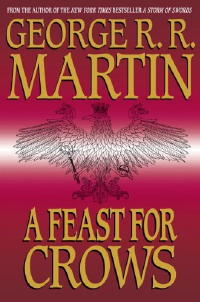
Fans have been made to wait for this for a long time, and anticipation has obviously been building. Even the stodgy Wikipedia says the book has been "highly anticipated." What that indicates is that the book is a must-read for all who have been waiting. Hell, I'm even getting curious to know what the fuss is all about myself. (But don't worry; I would never succumb to temptation and read it. Well, I did glance through this chapter, which the author made available on line. But I won't allow a small detail like that to taint this interview in any way.) In addition, there are cultish aspects to the novels of George R. R. Martin (abbreviated GRRM). There's an official game site featuring various board games, kits and tournaments, and in browsing around I discovered -- to my surprise and even shock -- that today, November 8, 2005 is the Official Day of the Feast! With this in mind, FFG is sponsoring celebrations at retailers worldwide on the Day of the Feast, November 8th. By encouraging fans of the book to play the games and fans of the games to read the book, we will enrich and reenergize both communities.I strongly encourage just such a thing! Nothing like wholesome community enrichment, I always say. (The stuff you learn when you admit your ignorance!) Heck, I could build my entire day around this book I've never read -- and so could you! And you know what else is really cool, poetically just, and eerily parallel? Just as I'm not a science fiction reviewer and haven't read the book, author GRRM is not a blogger has written a "Not A Blog" -- a blog he's not writing! Excerpt: I'm calling this "Not A Blog."And there's no way I could write a science fiction review. But I will try to be honest about this book, and if called as a witness in court, I could swear to the following under penalty of perjury: While I feel I have only scratched the surface with this review, now comes the exciting part. I get to rate it, and urge you to buy it. I think if you're a fan of GRRM, buying it will be a no-brainer. But for the others, I think the sheer power of this book makes it worth buying (it certainly makes it worthy of great respect), because what other science fiction or fantasy book could possibly have caused someone like me to review it? One last point. I note that the author is very much a turtle fan, and in childhood his pet turtles used to fuel his literary imagination: I wrote as far back as I can remember. I used to make up stories about my pet turtles and write them up in school notebooks. Later on I wrote monster stories and sold them for a nickle to other kids in the projects where I grew up.This is reflected in a caricature of the author:  In my view, any writer who likes turtles deserves voracious readers like the ones this GRRM has.  So snap to it! After all, isn't today the DAY OF THE FEAST? posted by Eric at 02:15 PM | Comments (1)
| TrackBacks (0) Monday, November 7, 2005
The games economists play?
Here's Thomas Schelling, "Nobel" Economist and game theoretician, displaying a sample of his wares: "If I go downstairs to investigate a noise at night, with a gun in my hand, and find myself face to face with a burglar who has a gun in his hand, there is a danger of an outcome that neither of us desires. Even if he prefers to just leave quietly, and I wish him to, there is danger that he may think I want to shoot, and shoot first."Yeah, and if I go downstairs without a gun, there's an even greater danger of an outcome that I definitely don't desire -- regardless of what the home invader might have desired. Plus, it's my house, and the burglar entered it armed. The only desirable outcome for me is his death, before he kills me. While I would rather not have been put in the position of having to shoot him, it was he who broke in, not I. In today's Wall Street Journal, Schelling is quoted as saying that the threat from terrorism is a "minuscule" one: In an interview in The Wall Street Journal, Thomas Schelling, game theorist and co-winner of this year's Nobel Prize in Economics, asserts that "terrorism is an almost miniscule problem." He points out that more people die from car accidents in three-and-a-half weeks in this country than died in the World Trade Center disaster. Also, when terrorism is compared with the common ways of dying (accidents, drowning, heart attacks, etc.), it is down near the bottom.Lest anyone doubt that a leading economist would spout vintage Michael Moore nonsense, I've obtained the full quote (which I'm transcribing): Prof. Schelling: It is important for us, the potential victims, to recognize that with the exception of the Twin Towers in New York, terrorism is an almost minuscule problem. [John] Mueller, at Ohio State University, estimates that the number of people who die from terrorist attacks is smaller than the number of people who die in their bathtubs. If you take the Trade Towers, we lost about 3,000 people. Three thousand people is about 3 1/2 weeks of automobile fatalities in the U.S. If you rank all the causes of death in the U.S. or around the world, different kinds of accidents, struck by lightning, heart attacks, infections acquired during hospital surgery, terrorism is way down at the bottom.I placed "Nobel" in quotes because the "Bank of Sweden Prize in Economic Sciences in Memory of Alfred Nobel" is technically not a Nobel Prize. But it might as well be the Nobel Prize. Because they're handing them out to people who make about as much sense as some of the people who get Nobel Prizes.... While I'm neither an economist nor a game theorist, I don't see what game theory has to do with how the number of people who are murdered in a given event relates to the future number of people who might be killed. Or whether the seriousness of the event can be measured by tallying numbers. Is jumping from a building to avoid being burned alive really comparable to "infections acquired during hospital surgery"? Fewer Americans were killed at Pearl Harbor than at the Ground Zero on 9/11; does that mean Pearl Harbor was more "minuscule"? Using the same logic, the number of Jews killed by Nazis before the Final Solution was implemented might have been described as "minuscule." Even on the night of the Nazi "Kristallnacht" pogram on November 9, 1938 -- an event said to mark the beginning of the Holocaust -- fewer than 200 Jews were actually killed. I realize this is unfair, but let's play 1938 retroactive game theory: "If you ranked all the causes of death in Germany or around the world, different kinds of accidents, struck by lightning, heart attacks, infections acquired during hospital surgery, Nazi pogroms would have been way down at the bottom."Yeah. And climate change was more important. Besides, weren't there more Iraqi babies killed by American bombs than there were Jewish babies murdered by Nazi doctor Josef Mengele? I'm sure I'm missing something, but I can't say I'm all that impressed with Professor Schelling, or his theory of games. posted by Eric at 08:51 PM | Comments (5)
| TrackBacks (0)
Wingnuts cover what moonbats neglect?
I'm not much of a bicycle fan, probably because the issue has been so politicized by groups like Critical Mass -- a group I've repeatedly criticized in the past because I consider it mostly composed of anti-gasoline, anti-car "moonbats." But nearly everyone is talking about "hybrids" these days ("nearly everyone" certainly includes Glenn Reynolds -- who's been called a "political hybrid"), and something I recently found made me wonder why bicycles can't also be included among the hybrids. Lots of people have been riding their bikes to work recently, but one of the limitations is the physical ability of the rider, especially on long trips, or riding uphill. For not a whole lot of money, I found an incredibly cool way to hybridize your bicycle with an add-on motor, which is profiled here: The performance of this little 2-stroke is amazing. It's rated at 1.2 hp, but unlike more powerful, less efficient designs, it delivers more power to the wheel.The actual engine they used is for sale here, and profiled here. There are plenty of pictures at Popular Mechanics, and here's a closeup:  I've ridden motorcycles, bicycles, scooters and mopeds, but the latter just aren't any good for pedaling as they're too heavy. At five pounds, this motor weighs the same as a laptop. The only thing I didn't like was the caption under that last picture: The engine cover slips right on and is held in place by a wingnut.I know it sounds nitpicky, but the term "wingnut" might be found at least as offensive to political sensitivities as pig references are to religious sensitivities. Should Popular Mechanics consider some sensitivity training? I mean, would they say that an engine cover was held in place by a "moonbat"? I doubt it. Although in fairness to Popular Mechanics (recently the subject of ridiculous moonbat attacks), this might be because according to Google, moonbats are tougher nuts than the wingnuts themselves. But someone has to hold the covers in place, dammit! (And I doubt the moonbats at Critical Mass would want anything to do with it....) posted by Eric at 12:28 PM | Comments (5)
| TrackBacks (0)
Been there? Got the T-Shirt?
In a story that wants to be an editorial, the Philadelphia Inquirer's Ken Dilanian weighs in on what's behind the riots in France: Looking as wary as U.S. soldiers in the streets of Iraq's Sunni Triangle, the armor-clad police pointed shields and rubber-projectile cannons at groups of mostly black and Arab residents, who gazed back with hard stares. The officers left after a few minutes, dodging rotten fruit thrown from high windows.U.S. soldiers in the streets of Iraq's Sunni Triangle? Isn't that a quagmire? Isn't it a little premature to be implying that the French riots are a quagmire? While I have a problem with Dilanian's analogy, because I disagree with the apparently underlying "quagmire" premise, there's more for American readers to ponder than the analogy to Iraq. There's also an analogy to America's race problem -- only the situation in France is described as, well, better: Many of those suburbs have come to resemble the worst of America's inner cities - segregated pockets of alienation - although there are important differences.Does this mean they're better off than their American, um, counterparts, because of things like "universal health care," generous long-term unemployment and gun control? If poor Americans must do without these wonders, why aren't American cities all in flames? No explanation. However, Glenn links to a fascinating piece by Brussels Journal which argues that the analogy to American blacks is hopelessy inapt: Those media that tell us that the rioting “youths” want to be a part of our society and feel left out of it, are misrepresenting the facts. As the insurgents see it, they are not a part of our society and they want us to keep out of theirs. The violence in France is in no way comparable with that of the blacks in the U.S. in the 1960s. The Paris correspondent of The New York Times who writes that this a “variant of the same problem” is either lying or does not know what he is talking about. The violence in France is of the type one finds when one group wants to assert its authority and drive the others out of its territory. American MSM who imply that there is a direct line from Rosa Parks, the black woman who refused to stand up for a white man on an American bus in 1955, to the rabble that are now throwing molotov cocktails into French buses containing passengers, are misrepresenting the facts.I'd have to agree, although I can certainly understand the need to translate this story into something Americans can easily understand (which I suspect is the problem with the misplaced analogy to the "worst of America's inner cities.") I'm fascinated by the fact that there are as many explanations for the causes of the unrest as there are reports. ABC News has a different spin from the Inquirer: Authorities say drug traffickers and Islamist militants are helping organize the unrest, via the Internet and mobile phones, among the North and sub-Saharan African immigrant communities who make up a significant part of many suburban housing estates.(Roger L. Simon shares a report confirming the role of a turf war by drug criminals.) The New York Times sees the riots as a failure of assimilation: The government has been embarrassed by its inability to quell the disturbances, which have called into question its unique integration model, which discourages recognizing ethnic, religious or cultural differences in favor of French unity. There is no affirmative action, for example, and religious symbols, like the Muslim veil, are banned in schools. Writers across the spectrum cite the failure of assimilation as a key ingredient. Arguing that "French Arabs have been carrying on a low-level intifada against synagogues, kosher butchers, Jewish schools, etc.," Mark Steyn goes so far as to ridicule the idea that the rioters are even "French": As Thursday's edition of the Guardian reported in London: ''French youths fired at police and burned over 300 cars last night as towns around Paris experienced their worst night of violence in a week of urban unrest.'' If I could editorialize for a second, I'd point out that in all fairness, neither assimilation nor multiculturalism would seem to be possible in xenophobic, intolerant France (a place where English words aren't just frowned on; they're banned!) The idea that anyone might think of France as a "melting pot" is almost absurd. Despite whatever rhetoric its leaders might use, I don't think France is comfortable with other cultures -- and whether they are to be assimilated or merely tolerated in a segregated form. Analyzing a piece by Francis Fukuyama, Belmont Club's Wretchard explores the tension between multiculturalism and assimilation: Is it possible to "reverse the counterproductive multiculturalist policies that sheltered radicalism, and crack down on extremists" and then "reformulate their definitions of national identity to be more accepting of people from non-Western backgrounds"? Or isn't that rather like taking two aspirins prior to massaging your head with a claw hammer?I don't think there's much question that multiculturalist policies shelter radicalism. They encourage it. Frankly, I don't think the forced analogies to "America's inner cities" are helpful, and while I understand the need to make the news interesting I'm a bit disappointed to see the Inquirer promoting them. But since everyone has a different take on the French riots (and since I want to try to be fair), I might as well take a look at riots with which I'm more familiar, not to search for an analogy but to see whether there's a common thread. The famous South Central rioting in Los Angeles, while ignited in black neighborhoods in reaction to the videotaped beating of Rodney King, quickly spread into many other neighborhoods in the form of opportunistic behavior by assorted criminals, thugs, and even people who wanted to run wild and trash things. There's no escaping the simple fact that if you're young and wild, riots are cool! (And being a rioter is a hell of a way to impress your friends....) I saw the same thing in Berkeley in the case of the various "People's Park" riots. Riots can be ignited by radicals, but the initial "reason" quickly morphs into a crassly opportunistic excuse, or in other cases is forgotten. It's just a riot, and people who like riots pour into the streets. I was in attendance at San Francisco's Dan White Riot -- a gay riot, which -- as I've said before -- was about as "civilized" as a riot can get. But even there, opportunists apppeared out of nowhere, mingling with the crowd and exorting them to do things like attack the San Francisco Opera House. (Something gay rioters refused to do.) But even that riot (a fluke by rioting standards), came very close to going beyond it's original attack-the-police purpose, and that's because of the dangerous and evil nature inherent in mob violence. Maybe it's because I'm twenty six years older, and maybe it's because I feel a bit guilty at having been so close to the center of the action, but I don't think mob violence should be encouraged. Ever. Whether by misleading analogies or by art reviews which shelter radicalism. The latter may be a stretch, because whether the Inquirer sheltered radicalism or not, certainly the paper didn't glorify mob violence. All they did was helped promote an artist who sells T-shirts like this:

Where there is free-flowing violence, there are megalomaniacs ready to use it.Yes. And plenty of ways to use it. posted by Eric at 08:17 AM | Comments (4)
| TrackBacks (0) Sunday, November 6, 2005
Different strokes for different folks!
According to Robert Spencer, wife beating in Australia is becoming a religious Can wife-beating be justified under any circumstances? According to some in Australia, yes — if the couple is Muslim.I guess the stoning of adulterers and "sodomites" in the name of multiculturalism shouldn't be too far behind. Fortunately, the Aztecs no longer drag sacrificial victims to the tops of pyramids to cut out their beating hearts for the gods. 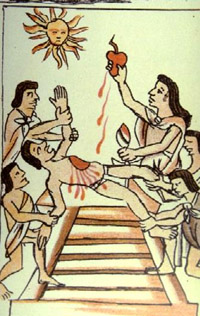
 MULTICULTURALISM. MULTICULTURALISM.Imagine! posted by Eric at 09:14 AM | Comments (3)
| TrackBacks (0) Saturday, November 5, 2005
Ice cream debate linked to retardation and bad parenting!
I don't normally print emails, but I thought I'd share an amusing one from reader "Kristin Edwards": Subject: http://www.classicalvalues.com/archives/000019.htmlI think there's a bit of a misunderstanding. The issue wasn't eating in public; it was eating (more properly, licking) ice cream in public. An activity said to be "cat-like" of which Leon Kass expressed disapproval in one of his books. I have no idea how many people would agree with the view Kass expressed, and whether it's 100, 1000, or only Kass himself really isn't the point. The point was that Leon Kass said it, and the purpose of the post was simply to point it out and express surprise (and rather restrained ridicule). As to people who might agree with Kass being "very old and sad," I have no way of evaluating their age or mental status, but Kass doesn't strike me as particularly old or sad. The question of whether I am "retarded" is irrelevant to the Kass quote -- and simply an ad hominem attack. Also irrelevant is the contention that my children (if any) would deserve sympathy from Kristin Edwards. (Because of the gratuitous nature of the sympathy, coupled with the ad hominem flavor of the email, its sincerity is doubtful.) But it's nice to see that someone felt strongly about dietary issues to write to me like this, and I do welcome all readers. Even those who think I'm retarded and pity the children I don't yet have. posted by Eric at 01:37 PM | Comments (3)
| TrackBacks (0)
Another loss for the taxpayers
A Philadelphia jury has found the two LaSalle University basketball players (in a case I've posted about twice) not guilty of rape: A jury yesterday found two former La Salle University basketball players not guilty of raping a 19-year-old woman last year, but the judge rebuked the pair for their behavior.Nor do I condone their actions. But to call drunken sex rape is to torture the meaning of the word. Not only did this woman get drunk, she went to the athlete's bedroom, refused to leave with her friends who asked her to leave, and then sat on a man's lap and told him that she'd performed oral sex "on a basketball player they both knew." She didn't report the "rape" until a considerable time later, and her story changed repeatedly. According to the Inquirer, "she refused to directly answer questions. She was also combative with the defense attorneys." The trial testimony provides ample evidence from which a jury might have concluded that, far from being a victim, she'd played a major role in setting in motion the whole chain of events: During the graphic and explicit two-week trial, members of the La Salle women's basketball team testified that in the days before the alleged assault, the woman had suggested that the group obtain alcohol. Earlier that day, witnesses said, she had examined a photograph of the men's basketball team and said she wanted to meet the players. And before she started drinking that night, she got a double-shot glass from her car.What I don't understand is why the DA spent so much time and taxpayers' money on such an obvious loser of a case. (I suspect the DA saw it as a winner regardless of result.) posted by Eric at 07:36 AM | Comments (5)
| TrackBacks (0) Friday, November 4, 2005
Global warming causes immorality!
Here's something you don't see every day: Galapagos tortoises having sex. It was amazing to see these huge things get so excited, and the male (at least, whichever one was on top) was making a strange bellowing sound which sounded like nothing I'd ever heard before. A male peacock was watching, and eventually a crowd gathered, cheering on the pair with lewd remarks.  I took the above photo today at the Philadelphia Zoo, where I entertained a visitor on a day warm enough for T-shirts. The confused tortoises must have thought Spring had arrived. (Bush's fault, no doubt.) posted by Eric at 11:37 PM | Comments (5)
| TrackBacks (1)
examinations and conclusions for sale?
A local art gallery is featuring works of propaganda art by "urban artist" Shepard Fairey. Long considered a champion of an anarchic, neo-Dadaist street art subtly calculated to ridicule conventional propaganda (whether of the commercial or political variety), Fairey has now decided to take a political turn which many would consider crass, but which is bringing him commercial success. His current show is titled "Manufacturing Dissent": The term “Manufacturing Dissent” is a derivation of “the manufacturing of consent,” a phrase coined by Walter Lippmann to describe the propaganda engineering that he helped devise in order to drum up public support for World War I. Shepard Fairey designed his politically-charged pieces to counteract the hawkish manipulations of right-wing spin doctors with biting sarcasm and thought-provoking paradoxy. He juxtaposes symbols of combat with feminine imagery to expound upon his concept of powerful pacifism, the idea that force should be used as a means of protection rather than aggression. The explicit messages are a departure from Fairey’s deliberately ambiguous style. Rather than calling on people to question their surroundings, he asks them to fortify their values. While politicians and public relations gurus aim to skew reality into a more satisfying tune, Fairey strikes a dissonant chord, unusually lovely in its honesty.For those whose "values" are in need of fortification, here's his unusually lovely poster of Angela Davis:  According to the Inquirer, he's sensitve to accusations that he's selling out to "the system": Despite Fairey's efforts to maintain street-artist credibility, detractors have questioned his social-science maverick sensibilities because of his participation in the commercialism he has seemed at odds with.The key, I think, would be to avoid the leftie communitarian impulse and remain true to his artistic principle of self-absorption. I mean, what else would compel an artist to engage in what he calls mass bombing -- "slang for spreading a piece of artwork on as many places as possible and in full view of the public"? I think that when something evolves from being free to costing over a hundred dollars for a print, that means that "the system" has reared its ugly head, and contaminated him. At least when it was free, no one had to pay for it. (Actually, people couldn't avoid seeing it -- which might mean that its cost was less than "free" in the usual sense.) Over the years, the evolution in Fairey's art from hypnotic and subtle chaos towards in-your-face leftist politics (his art now glorifies not only Angela Davis, but Mao and Chomsky) seems to have coincided with -- possibly helped bring about -- his current media successes. (Although in fairness to him, it may be that corporate success forces him into leftist rebellion, leading cyclically to more corporate success -- because after all leftist rebellion is "cool"!) He admits to a conflict between his stated philosophy and things that need addressing: ....a couple of pieces will offer much more overt views on events, including the war in Iraq.While I'm not fond of the "bombing" approach to art, I think he'd do better to stick to his original philosophy of live-and-let-live, coupled with satire. Otherwise he might succumb to the disease of taking himself seriously -- a deadly form of intellectual stultification which could cause him to start believing his political propaganda. While that might translate into commercial success in a world of socialist corporate Big Brotherism (which loves faux rebellion), his "examinations and conclusions" won't remain his own. At least not for long. While I have generally low and flexible standards, I do think there's more than one way to sell out. Some things shouldn't be for sale. (But I suppose that's something that isn't for me -- an admitted sellout -- to say....) posted by Eric at 09:15 AM | Comments (6)
| TrackBacks (0)
I Can't Find The Little Prince
Via Hobbyspace, a long and quite informative article on the Japanese Hayabusa asteroid mission. Much interesting stuff is due to start happening... After overcoming a host of obstacles, including several life-threatening solar flares on its 1-billion kilometer journey (about 620 million miles), the JAXA spacecraft finally arrived at Itokawa in September. Click here for a closeup shot of asteroid Itokowa. More stuff here, at the mission homepage. Apparently, today's Minerva landing has been cancelled, pending resolution of a technical difficulty. The probe got within less than a kilometer of the asteroid before aborting. posted by Justin at 07:43 AM | Comments (1)
| TrackBacks (0) Thursday, November 3, 2005
citizenship: n. a door prize
The new UK citizenship test is now being bandied about in the culture war across the pond: Being British is not about whether you know the lyrics to God Save the Queen or can order tea in a cool accent. No one's going to argue that citizens should have no familiarity with emergency services, but an 18 question trivia quiz does not a citizen make. The man who got the last word used it well: "History binds us together, but, of course, history can also divide," says Lawrence Goldman, editor of the Oxford Dictionary of National Biography, who says new immigrants should know the basics. "There are some key moments, key figures, key experiences that bring this nation together — the first two World Wars, for example." I have no doubt that this sort of thing grows out of historicism and relativism, two pernicious -isms which ultimately make people not only devalue their own culture and history but feel ashamed of it. There is apparently a kind of chauvinism in valuing the West's traditions of inclusiveness, openness, and rational inquiry. By encouraging immigrants to adopt these very virtues we are apparently attacking the dignity of the cultures they might lose in the process. To demand that an immigrant study and understand the society which he wishes to join is mutually beneficial. You're a fool if you fail to acknowledge that. At least here in the States we still get it. Anyone interested in playing the American version, or at least a quick, online quiz modeled somewhat on the U.S. citizenship test, here you go:
posted by Dennis at 12:08 PM | Comments (7)
| TrackBacks (0)
Emotionless appeal?
Writing about Steve Gilliard reminded me that as a blogger, he is far more successful than I am, and will probably remain that way. Being jealous of people who are successful in their endeavors is not my style. While I know that rich and successful people like Bill Gates are the target of much jealousy (even hatred), I've never been able to fully understand why people feel that way, because I just don't empathize. Normally, when someone is more successful than I am (especially at something I'm also doing), I try to examine why, in the hope of learning what I am doing wrong, and what they're doing right. But that approach doesn't help me when I contrast my blog with that of Steve Gilliard. True, his blog is far more interesting to most people, but that's because it's far more inflammatory, and people like to get stirred up about things. Aside from being inflammatory, insulting, and emotional, he's reaching two large audiences: those who agree with him (and are also highly emotional) and those who disagree with him (especially those who disagree emotionally). My problem is that I try to avoid emotion as much as I can, I try to avoid inflammatory rhetoric, and I try to avoid insulting people. While I'm a libertarian, I also tend to see problems with both "sides" on many of the common ideological disputes which tend to dominate debates. I'm afraid that approach is, simply, boring to most people. If only I could figure out a way to be inflammatory, insulting, and emotional without being inflammatory, insulting or emotional! Sigh. I'll probably never get it, as I find emotionally-charged debates between ideologues rather boring. Until I get irritated. But even then, my interest is in how illogical ideas powered by emotion become so popular, which makes me suspend even my emotion of irritation. (Looking on the bright side, I guess I should be surprised that anyone at all would find this process interesting.) posted by Eric at 10:39 AM | Comments (6)
| TrackBacks (0)
Profile of the victim as a bully?
Cathy Seipp shares her thoughts on Islamic hypersensitivity (if in fact it is that) in contrast to the other religious sensitivities: An orthodox Jew I know, for instance, told me that the handwritten Torah (not a mass-produced copy, like the Korans of those detainees) is considered so sacred that people have died trying to prevent it from being desecrated. But there are no riots when it gets desecrated anyway. Christian religious scholars point out that the Koran is not really comparable to the Bible - it's comparable to Jesus Christ, who is seen as the eternal Word of God. But Christians didn't riot when artist Andres Serrano depicted a crucifix in urine several years ago.(Via Glenn Reynolds.) While there's a lot of talk about Islamic "sensitivities" and "sensibilities" (leading to things like banning cutesy pig pictures) I'm not all that convinced that there isn't an element of bullying involved. Aren't a lot of adults forgetting that bullies often love to play victim? That they'll pick on someone, only to complain if their victim fights back? That they'll often walk around with a chip on their shoulder, just waiting for the slightest imagined offense? Perhaps it's because I lived in Berkeley, California too long, but many times, I've seen activists behaving in exactly the same way. Often they'd challenge Berkeley's well-trained and highly restrained police to the breaking point in the hope that some officer might "lose it," and then they'd have a case of "police misconduct." Sometimes the activists would be right, of course, and they were usually quite knowledgeable about exactly what the law would permit. Waving inflammatory signs while screaming at the top of your lungs can sometimes cause even well-trained officers to behave in an unconstitutional manner. I can remember one review board I sat on in my capacity as Police Review Commissioner in which an officer went so far as to snatch away a sign he thought was inflammatory ("F--- THE POLICE!" type of stuff). After spending hours, we ruled that the officer shouldn't have done that. But the demonstrator's claim of massive outrage was just a bit strained. Because I know the pattern when I see it, I've been quick to identify anti-gay activist Michael Marcavage as a highly skilled provocateur. An advocate of the death penalty for homosexuality, he's fond of making noise and waving highly provocative signs at just the right place and time, then claiming "religious persecution" when people overreact to his "message." I thought about Marcavage last night when I read about this provocative conduct at a football stadium in New Jersey: EAST RUTHERFORD, N.J. - New Jersey officials denied yesterday that racial or religious profiling had anything to do with the detention of five Muslim football fans at a New York Giants game on Sept. 19, even as several of the men insisted that they had been singled out for praying at the stadium.And that was just the Inquirer version of the story. According to other versions, former President George Bush was in the stands. And now CAIR is involved. The incident has prompted the Council on American-Islamic Relations to launch a national "Pray For Understanding" campaign, hoping to educate the public about Islam's five daily prayers.Hmmm.... How about a prelude to a lawsuit? LaGuardia recently designated a grassy area for Muslims to pray, he said, and Kennedy is on the verge of designating new space inside a building for the cabbies' religious needs.Because this incident does not pass my smell test, I wondered about the possibility that the whole thing might have been a setup by professional activists. I couldn't help but notice that the older of the two activists was an information technology specialist named Mostafa Khalifa (also spelled "Mostaffa" in some of the writeups). According to Stephen Schwartz at TCS a man with the same name made quite a name for himself at Rutgers as a Wahhabi activist: On April 21, a university employee named Mostafa Khalifa delivered a lecture to ISRU members on the nature of leadership. The apparent intent of the lecture was to assure that the ISRU election would have an "Islamic," rather than a democratic and American character. Ms. Agha described Khalifa as an exponent of "fundamentalist thought." She complained that he not only exploited his position as a university functionary to support his ideological agenda, but that, since he is an alumnus of the university and not a student, as well as older than the students, his involvement in the voting process represented an inappropriate effort to steer students away from voting according to their own preferences and opinions.According to Ms. Agha, this resulted in a sort of tyranny favoring Mr. Khalifa: The seven elected representatives would then choose the ISRU president, who would bear the title "amir" or "commander." This last detail, showing that ISRU had adopted the vocabulary of a paramilitary group rather than a student organization, is the most disturbing element in this story. Ms. Agha notes that, as announced during the elections, the "amir" of the Rutgers Muslim students would be required to be male and would enjoy "dictatorial power."Whether the "Mostafa Khalifa" shown in the stadium report videos is the same man as the one in pictured at Mostafa Khalifa's web site, (elsewhere he's known as "Br. Mostafa Khalifa, Former ISRU President; Assistant Campus Computing Facilities Manager of Rutgers University, NJ; and Ameer of the AlMaghrib Institute Qabeelat Durbah" -- and his hometown matches the reports) is open to question -- and a bit beyond my Internet sleuthing skills. But would it be "profiling" to ask? Whoever he is, the Rutgers man ("Amir"?) certainly knows how to make provocative-sounding statements: Prepare for battle. So how can we prepare for this battle? We need each other. It has become very difficult to keep the same intensity up as we had in Ramadan. We need to continue to surround ourselves with good brothers and sisters who want to hold strong to each other, to work hard together, to pick one another up when we need that support. Prepare for battle.Battle? He must mean just a spiritual battle. There's more, of course: Prepare for battle. Our brothers and sisters, our young and our old, our sick and our weak in Palestine, Kashmir, Iraq, Afghanistan, Chechnya, the Philippines, Sudan, Gujarat, Guantanamo Bay, Europe, North and South America -- they are all suffering because we have let them suffer, by not fulfilling our duties to Allah and to each other, thinking only of ourselves. I intentionally left this part to the end. We need serious people with enough patience to get through one of my e-mails willing to work toward this goal. I am looking forward to all of your responses, and to working with each of you who have taken the time to read this, think about these words and to do your part to be a part of the solution and the renaissance of our community. Prepare for battle.Prepare for battle? It sounds too much like religious war for comfort. I should probably be relieved that the New York Times' Alan Feur ends his writeup of the incident on a positive note, jokingly joining the speculation that they might have been praying for the Giants to win. I have no objection to anyone praying, whether for the Giants, for the Goliaths, or for the Davids. What I can't shake is this suspicion that Christians would not have been praying in front of a ventilation duct at a large stadium like that, and if they had, that they wouldn't have been so quick to make charges of religious persecution. Except, maybe, Michael Marcavage at a baseball event.... Hmmm.... Would it constitute "persecution" to ask these air duct prayer-leaders about their views on the death penalty for homosexuality? (My bias may be showing, but when I was a kid, bullies loved to pick on homos.) posted by Eric at 09:36 AM | Comments (3)
| TrackBacks (0)
Google wants to eat your babies
In opposing GooglePrint, Pat Schroeder and Bob Barr are guilty of the same kind of old-world idiocy that has been making the record industry look foolish for the past few years: And so we find ourselves joining together to fight a $90 billion company bent on unilaterally changing copyright law to their benefit and in turn denying publishers and authors the rights granted to them by the U.S. Constitution. Because as we all know the Constitution secures the rights of authors and publishers to disallow potential readers to judge the content of a book before buying it. It's right there between hate crimes and the diversity clause. They claim that GooglePrint will not only change copyright law (solely for Google's financial gain), but that it stifles creativity because--get this--'If publishers and authors have to spend all their time policing Google for works they have already written, it is hard to create more.' Asinine. What they mean to say is that if they're so consumed with trying to sue Google for a share of ad revenue, they'll lose time writing cheap political memoirs for the rocking chair set. That's the underlying argument throughout, that Google will generate ad revenue while, like good anarchists, working to eliminate ownership rights. They don't resolve this contradiction, how anyone might actually be able to 'completely devalue everyone else's property and massively increase the value of its own.' That's some neat trick. Google is apparently on the verge of controlling the world's economies. They close with this insult (emphasis mine): Politically, we may not agree on much. But on this, we can both agree: These lawsuits are needed to halt theft of intellectual property. To see it any other way is intellectually dishonest. What's dishonest is taking the moral highground on the pretense of protecting property when in truth you just want a piece of ad revenue generated on web searches. By the logic here anyone whose 'intellectual property' were returned by a web search should get a few pennies, but of course that's ludicrous. I was working on a paper on Ancient Greek hero cult when Amazon first allowed users to search books. I was amazed at the number of useful sources I was able to find, often buried within books I would never have thought to check. Neither there nor with GooglePrint are you able to read an entire book but both allow you to skim short samples and search for specific content to determine if a book is what you're looking for. Think about this: it's the digital equivalent of picking a book up from the shelf (say, at a bookstore or the library) and flipping through the pages. 'Sorry ... you flipped it, you bought it.' The 'Schroedery Barrn rule'? (I hear you groaning, but I couldn't help myself.) posted by Dennis at 06:51 AM | Comments (2)
| TrackBacks (0) Wednesday, November 2, 2005
Understanding racism
While I was inclined to dismiss recent outbursts by blogger Steve Gilliard (a minstrel caricature, use of the term "Sambo," etc.) as sui generis, the pelting of black Republican Michael Steele with Oreo cookies would seem to indicate that something more is going on. A coordinated approach, possibly? I suspect so, and I suspect the purpose is twofold. One is to convey a message that it's now open season on black conservatives or libertarians who think independently of the groupthink collectivism which has been imposed on them, and let them know that they, their families, and their finances are fair game for a no-holds-barred campaign of intimidation. The other is to grease the skids for similar future attacks against Condoleeza Rice on a much grander scale. According to today's Washington Times, black Democrats argue that racial attacks on conservative Republicans are justified: Black Democratic leaders in Maryland say that racially tinged attacks against Lt. Gov. Michael S. Steele in his bid for the U.S. Senate are fair because he is a conservative Republican.(The whole thing is worth reading.) What's fascinating about this is that not only can a black man be called "anti-black" merely for having conservative views (which many on the left define as including libertarianism), but that all white people who agree with him are similarly called racists. (Obviously, this means that heterosexuals who might agree with a gay conservative are "homophobic," while men who agree with conservative women are sexist.) If we follow this logic, the words "racist" and "racism" take on an entirely new dimensions. In a world where pelting a black man with Oreo cookies is not racist (because the black man himself is against black people), then opposing the pelting should also be considered an act of racism. Steve Gilliard's thinking provides a clue to understanding the mechanism of the new racism. if Andy Sullivan doesn't like what I say, that's the point of the exercise. Little Green Fucktards, Michelle "I slander American heroes" Malkin?Gilliard repeats the charge that he is hated by "conservatives" for being black: I'm black, I don't care what white conservatives have to say. They already hate me for my skin color, forget my politics. They are dedicated to making black lives harder. 97-98 percent of black people know that.Note the characteristics of the people who disagree with Steve Gilliard: 1. All are said to be "conservatives";I first became familiar with Steve Gilliard when he crossed what I consider to be a line which should never be crossed: he urged his readers to go after Glenn Reynolds' job because he didn't like Glenn's sense of humor. I'd only been blogging for a year or so, but this struck me as the most hateful thing I had seen in the blogosphere. Anyway, Steve Gillard caused me to publish a photo of myself wearing the T-shirt he called racist (which has nothing to do with race whatsoever), but in all honesty, when I did that and wrote that post I had no idea that the man was black. I just thought he was an angry, hateful blogger named Steve Gilliard. I thought he should lighten up a bit. Apparently, he hasn't. Perhaps it's because I don't read blogs as much as I should, but had Justin not told me that Steve Gilliard was black, I might never have known. Now that I know the man is black, there's no way that I can escape the usual charge of conservatism, hate-mongering, and racism. I know I am considered guilty, but I just wanted to beg for a little understanding and point out that it would have been impossible for me to hate Steve Gilliard for being black before I knew he was black! I hope my ignorance (and previous color blindness) will be taken into account at sentencing.
....why do people assume I'm white? Because many people simply cannot imagine a black man blogging, much less expressing his opinions on a range of topics. It isn't what they are trained to think. Sports, ok, but politics, nope."Sports, ok"? What assumption is being made there? Last year I just thought Gilliard was being hateful and vindictive. Should that have made me assume anything else? And what's with the "many people," anyway? What color are these "many" supposed to be? Is he making assumptions that "people" are white? Why? Sheesh. (Next he'll be making the "heteronormative" assumption that "people" are heterosexual.)
 MORE: Remember, the above is not racism according to the meaning of that term today. But criticizing it is. The bright side is that when words lose all meaning, why worry about the meaning of words? UPDATE: Black Democratic senatorial candidate Kweisi Mfume has condemned these racial attacks: Kweisi Mfume, who is running for senator, yesterday outright condemned the comments by his fellow black Democrats.Good for Kweisi Mfume! (I have to say, I'm pleasantly suprised.) UPDATE: Jeff Goldstein points out that it is now open anti-individualism that is being championed, and concludes: Perversely, then, we have progressives sanctioning the kind of racial attacks they would normally decry on the grounds that those who choose the wrong party affiliation have surrendered the protection of their race. And what makes this so troubling is that it redefines the idea of “offense” as something that is to be decided upon by identity groups—and so is yet another way in which identity politics robs the individual of autonomy. UPDATE: ANd more here via Glenn Reynolds, who notes that "'race-loyalty' has become an important campaign issue." Am I allowed to hope it's a losing one? posted by Eric at 03:41 PM | Comments (3)
| TrackBacks (0)
Encore
As a general rule, I would never chase after a story that Glenn Reynolds has already linked to. I mean, you've already read it there, right? Why indulge in pointless redundancy? But in this case, the link was rather inconspicuous, and the word "NanoBioTech" may have discouraged some readers from clicking through. That being the case, allow me some well meant copy-cattery. Ron Bailey had some observations which I found worthwhile, and would like to bring to your attention. These little snippets don't do justice to the entire article, but focus on a few points that I particularly agree with. The boldfacing, as usual, is my own alteration. Safety, however, is not what causes the greatest unease for some who contemplate nanobio. They fear that nanobio enhancements will dramatically change human nature... I hope Mr. Bailey will forgive the liberties I've taken with his article. He has put his finger on some of the sources of my ongoing irritation with the bioethical mandarinate. From where do they derive the legitimacy of their authority? How long are we supposed to think before they allow that we have the right to act? Why do they even get a say in the matter? In my more irascible moments, I think of them as parasites, plain and simple. posted by Justin at 12:45 PM | Comments (1)
| TrackBacks (0) posted by Justin at 11:37 AM
| TrackBacks (0)
Collusion and collision
I really hate it when I find an important Philadelphia news item going largely unreported in the Philadelphia Inquirer. But according to this report in a journal devoted to driving issues, "accidents have increased 10-20 percent since red light cameras began issuing tickets in Philadelphia, Pennsylvania." Why have I seen nothing about this in the Philadelphia Inquirer? As Philadelphia's only major daily, doesn't it have a sense of responsibility to report issues affecting the safety of its readers? (Especially right now, when a huge public transit strike is literally forcing commuters out of the buses and trolleys and into their cars to face what may be the worst gridlock in Philadelphia history....) I mean, I'm a subscriber to the Inquirer and a loyal daily reader. Why should I have to discover this by reading Glenn Reynolds' links? It's probably also worth asking why Glenn is doing a better job of reporting the story than the Inquirer, too, but I don't want to rub it in. I know that Knight-Ridder has fallen on bad times lately, but I don't think this explains the problem. More likely, I suspect, is a reluctance to "rock the boat" with the powers that be in the Philadelphia city government -- which desperately needs money. But should that be at the cost of public safety? The underlying circumstances strike me as outrageous. Not only has there been an increase in accidents, but the outfit which builds and supplies the cameras can also be fairly said to have built and supplied the legislation and the politicians too: The Philadelphia Daily News explained the circumstances surrounding the film provision. Dallas-based ACS is the largest U.S. camera contractor and is one of the few that have not yet converted to all-digital systems. ACS used a lot of money to influence the legislature, paying S.R. Wojdak & Associates $175,910 in lobbying fees. Stephen Wojdak just happens to be a lobbyist for the city of Philadelphia and raised money for the mayor's campaign.(Don't bother to click on the links which are supposed to go to the Philadelphia Daily News. They are now non-functional.) Back in the old days, with two competing daily locals, there'd have been no way to keep a story this major -- that the devices have increased accidents -- out of the papers. And lest anyone think the Inquirer "didn't know," consider their story which ran in August: A provision in the state law that allows the city to use the cameras at traffic intersections also puts photographs, written records, reports, facsimiles, names, addresses, and "the number of violations" off limits to the public.More recently the Inquirer reported a problem with a camera malfunction causing the generation of erroneous tickets. But the real story -- the one involving a direct danger to public safety -- is that accidents have increased, and that is not being reported in the Inquirer. It doesn't make sense -- unless the goal is to help Philadelphia keep the cameras. I sincerely hope that the Inquirer doesn't share this goal, and I'd hate to think that in their haste to preserve the cameras, they might be inadvertently assisting a government coverup of a dangerous condition. Because, if the non-reporting of the danger is coupled with the deliberate sealing of data, how are Philadelphians to ever know that the official information they're being given is wrong? To give an egregious example, the Philadelphia Parking Authority's web site FAQ would have Philadelphians believe that any increase in accidents caused by red light cameras is only temporary, and that the deadly "T-bone" collision rate does not rise at all: The installation of Red Light Cameras may temporarily cause an increase in rear end collisions. However, any small increase in these minor accidents returns to previous levels when drivers begin to slow down and comply with the speed limits and traffic signal phases. Significantly, however, the more severe accidents (like the deadly right angled “T-Bone” type) are dramatically reduced after camera installations. The vast majority of studies and reports (over 90%) support this fact.According to the Washington Post, that simply isn't true: The Post obtained a D.C. database generated from accident reports filed by police. The data covered the entire city, including the 37 intersections where cameras were installed in 1999 and 2000.As Glenn says, "traffic-ticket revenues are up, and that's more important than your safety!" It's bad enough that a financially troubled city government would consider revenue more important than safety. But when a leading newspaper ignores such a public safety issue, that's worse. posted by Eric at 07:41 AM | Comments (5)
| TrackBacks (0) Tuesday, November 1, 2005
Liquid muse
John Beck was the guest of honor at a quasi-official summit conference between Classical Values and Incite the other night, and quite a lot of liquid refreshment was consumed. (And liquidated.) While I hate to get involved in conspiracy theorizing, a seemingly innocuous (if not insignificant) topic appeared on John's blog on the same day the event was held. Usually I ignore things like this in the hope that they'll go away, but I now see that the liquid filled mouse meme has occupied a second post -- even though John's blog had up until Saturday avoided the topic entirely. Asked John rhetorically, "What in the hell is a liquid filled mouse?" This was a question to which he obviously knew the answer, as he supplied a picture. I'll supply two: 
posted by Eric at 01:54 PM | Comments (5)
| TrackBacks (0)
Big Australian Balls
Over at The Ergosphere, there's an interesting post proposing that alternative energy is civil defense. What with one thing and another, we all live in potential disaster areas and I've long thought that we don't emphasize civil defense enough in this country. Though one can argue over the details of what makes for a more robust infrastructure, I would hope that all of us agree on the need for it. Check it out. More pleasant to think about (unless you're James Kunstler) is this post regarding a reconception of marine power. ...the high cost of oil is rekindling interest in sail. Modern materials and automation have reduced the labor requirements to use it. Roller-furling jibs are one thing, but computer-controlled parafoil kites are a whole new game. Flying well above the waves, these kites can capture more power than even the highest topsail of a clipper ship. With favorable winds, even large cargo ships can see substantial fuel savings, greater speeds or both. I had a rather cursory link to this concept last Earth Day, but the Ergosphere's coverage puts mine to shame. He devotes much more time to the idea of power kites that generate useful levels of electricity regardless of wind direction. Now, some of you may remember Cousteau's old wind turbine ship, the Alcyone, and wonder why we need anything as cumbersome and Rube Goldbergesque as a kite. The answer can be found in this wonderful paper, The Case for Transport Sail Craft. One of the big advantages of kites over conventional rigs, rotating cylinders, and wind turbines is the relative freedom from heeling moment. This will allow us to attach kites to most commercial ships without significant modifications. Another advantage is dynamic sheeting, or the ability to fly patterns in the sky to maintain relative winds at the kite that are several times stronger than the wind on the deck. So much to learn and so little time. It's humbling. But what about those titular Australian balls? Relax, we're almost there. This will call for a slight change of tack, but we'll still be in peak oil survival waters. They're powerballs. Solar power, specifically. Australia's Green & Gold Energy is preparing to market what they call SunBalls to the Australian consumer. I have to say, the individual units are sort of cute, in an R2-D2 kind of way. But cute is irrelevant when what you're paying for is juice. By that standard, and assuming that the company's claims stand up to scrutiny, these power units will be freaking beautiful. An example from their FAQ... What's different about the solar cells used in the SunBall™ Solar Appliance? Great stuff, eh? If you're even slightly interested in home power, I would urge you to give their website a closer look. Don't miss their calculator feature. I know we've all had our hopes raised and dashed a few times in regard to affordable solar power, but don't let that crimp and sour you. Hope is good for the heart. posted by Justin at 11:55 AM
| TrackBacks (0)
Right Hand, Left Hand
There's almost always something worthwhile going on over at Defense Tech. A couple of articles caught my eye today. First, this evaluation of troop morale... Over three weeks in and around Baghdad this July, I spoke to dozens and dozens of soldiers about their views on the conflict. For the most part, morale among these infantrymen and engineers and bomb-disposers was high. Shockingly high, given the fact that they didn’t buy the Bush administration’s rationales for the war. Despite the name, the guys at Defense Tech are no mindless boosters of the American military establishment. They are quite often skeptical of the official armed forces line. They routinely refer to DARPA as the Pentagon's "mad scientist division". But they're honest skeptics. Now, I’d be remiss if I didn’t throw in a few caveats here. These soldiers were all stationed at Camp Victory, the poshest military base I’ve ever seen. It’s also one of the safer places would could be in a warzone. Which means better morale. Could soldiers and marines feel differently out in the sticks, where it’s MREs three times a day and mortars all night? You bet. On a lighter note, they point us toward this ridiculous looking development in non-lethal weaponry, with appropriate skepticism of course... The weapon, developed by the laboratory's Directed Energy Directorate, employs a two-wavelength laser system and is the first of its kind as a hand-held, single-operator system for troop and perimeter defense. The laser light used in the weapon temporarily impairs aggressors by illuminating or "dazzling" individuals, removing their ability to see the laser source. PHaSR, eh? Is there no shame?
posted by Justin at 10:36 AM | Comments (1)
| TrackBacks (0)
Discussion spreads social viruses, one post at a time?
Last week I remarked something in an afterthought to a post: ....attempts to discourage something can nonetheless glamorize it just as much attempts to encourage it. Many a social ill (and many a social good, for that matter) has been encouraged and spread by persecution, and by attempts to stamp it out. To the extent that there is a promiscuous sex "movement," I think it thrives as a result of the forces which claim devotion to stamping it out and to a "showdown" against it.While I'd hate to be spreading social ills by discussing them, I'm nonetheless delighted to see that my speculations about the mechanism find apparent confirmation in the MSM. On the front page of today's Philadelphia Inquirer, Marie McCullough discusses this phenomenon (politically unintended reverse psychology) in a piece titled "Critics' focus on morning-after pill may spur use": The Bush administration's opposition to emergency contraception seems to be doing wonders for awareness and use of the method.The old rule that certain things should never be discussed seems to have gone the way of the "crime against nature" which dared not speak its name. (More here.) But criminals against "nature" were convicted anyway, often by use of Latin phraseology. Humans being monkey-see/monkey-do creatures, the unraveling of such vague and ancient unspoken taboos began inexorably when people started discussing them. To illustrate by example, the following is as close as the Florida Supreme Court would come in 1921 to discussing oral sex: ....discussion of the loathsome, revolting crime would be of no edification to the people, nor interest to the members of the bar. The creatures who are guilty are entitled to a consideration of their case because they are called human beings and are entitled to the protection of the laws.My how times have changed! (Little did Justice Ellis know that he was referring to a future president of the United States.....) posted by Eric at 09:09 AM | Comments (1)
| TrackBacks (0)
Lessons in dissent
Once the "Scalito" business settles down, it will be interesting to see what the so-called "talking points" against Judge Alito turn out to be -- and how well they'll resonate with voters (and, of course, Democratic senators). Whether he has an inside line to Democratic strategy or whether's he's just prescient, Dick Polman has a pretty good knack for issue spotting. Right now he's leaning towards abortion and guns: ....Democrats, goaded by liberal interest groups, may nevertheless decide that Alito's conservative ideology warrants a filibuster. (In 1991, Alito said that wives should be required to notify their spouses before having an abortion; in 1996, he tried to curb Congress' power to ban possession of machine guns.)A machine gun toting maniac who wants women subordinated to their husbands? I can just see the cartoons. Remember, the best "talking points" are those things most easily reduced to a graphic stereotype that any idiot can understand. Most people are not going to spend their time reading Alito's dissent in U.S. v. Rybar in which he interpreted the Commerce Clause strictly, and didn't (gasp) display hostility to the Second Amendment. The details are here (Alito dissented because he did not think that "the purely intrastate possession of machine guns, by facilitating the commission of certain crimes," had "a substantial effect on interstate commerce.") But I really doubt the type of person who'd be persuaded by a cartoon of a machinegun-waving judge would read Alito's dissent. The abortion issue is of course more complicated. As Orin Kerr points out, the "talking points" focus is on Planned Parenthood v. Casey, which conveniently avoids focusing on another case -- in which Alito concurred with "striking down New Jersey's partial birth abortion statute." (Links via InstaPundit.) If anything, such a record provides better fuel for activist pro-lifers against Alito than activist pro-choicers against him. Notwithstanding the "talking points" will focus on Casey. On this, liberal pundit Polman and conservative blogger Patterico would seem to agree: Democrats will, of course, distort Judge Alito’s dissent. They will say: "Judge Alito thinks that women should have to consult with their husbands before having an abortion. Evidently he views married women as nothing more than their husbands’ property. Also, he is insensitive to the fact that battered women aren’t going to get an abortion if they have to tell their husbands about it first. If Judge Alito is confirmed, the right of married women to obtain abortions will be severely restricted.”This tortured view of Casey would have people substitute Alito's own view for that of the legislature which passed the spousal notification provision. If I didn't know any better, I'd swear that Alito's willingness to defer to the Pennsylvania legislature and sustain the provision is being seen as, well, judicial activism! Certainly, it will be spun as if the guy was deliberately advocating judicial interventionism in order to "turn back the clock" on women's rights. (Men, of course, have no rights and nothing to say about the fate of babies they've helped create. Only responsibilities! I'm only surprised they're not also compelled to pay for the abortions they're not allowed to be told were to be performed. Regardless of whether abortion should be legal, doesn't even an impregnated egg have two parents?) Lost in all of this will be Alito's actual reasoning, which is accurately reflected by his statement that "whether the legislature’s approach represents sound public policy is not a question for us to decide." I think part of the problem is that activists see everything as activism -- especially anything that might threaten gains achieved by activism. Thus, if Alito defers to the legislature about spousal notification, he's a male supremacist actively trying to overrule Roe v. Wade. And if he opines that the Commerce Clause doesn't extend to intrastate possession of a gun, he's a machinegun waving activist. Well, I long ago learned that if you don't want to be called an activist, you must never disagree with an activist. That's because if you are not part of the solution, you are part of the problem.
Hmmm.... But wouldn't that make the Democrats who voted to confirm Alito part of the problem? posted by Eric at 07:48 AM | Comments (2)
| TrackBacks (0) |
|
June 2009
WORLD-WIDE CALENDAR
Search the Site
E-mail
Classics To Go
Archives
June 2009
May 2009 April 2009 March 2009 February 2009 January 2009 December 2008 November 2008 October 2008 September 2008 August 2008 July 2008 June 2008 May 2008 April 2008 March 2008 February 2008 January 2008 December 2007 November 2007 October 2007 September 2007 August 2007 July 2007 June 2007 May 2007 April 2007 March 2007 February 2007 January 2007 December 2006 November 2006 October 2006 September 2006 August 2006 July 2006 June 2006 May 2006 April 2006 March 2006 February 2006 January 2006 December 2005 November 2005 October 2005 September 2005 August 2005 July 2005 June 2005 May 2005 April 2005 March 2005 February 2005 January 2005 December 2004 November 2004 October 2004 September 2004 August 2004 July 2004 June 2004 May 2004 April 2004 March 2004 February 2004 January 2004 December 2003 November 2003 October 2003 September 2003 August 2003 July 2003 June 2003 May 2003 May 2002 AB 1634 MBAPBSAAGOP Skepticism See more archives here Old (Blogspot) archives
Recent Entries
• Crazy unnatural thoughts . . .
• Global Warming is cold! • Eggs, Babs! Eggs! • Multi Culture War? • When fingers fly, traffic spikes • Enjoying the heat • Being against violence is way cooler than violence! (Except where violence is way cooler!) • I just hope tolerance doesn't beget intolerance . . . • Same dog, different result? • Why I Am Not A Burkean Conservative
Links
Site Credits
|
|