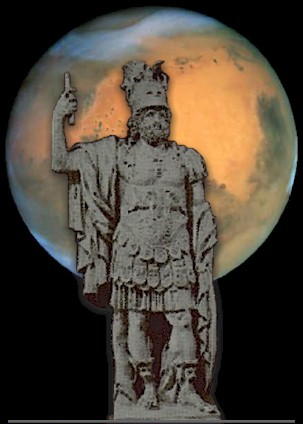



|
|
|
 Tuesday, September 30, 2003
Classical pacifism, an oxymoron
An admirer of Robert Fisk has made a favorable comparison between General Wesley Clark and the Roman Emperor Hadrian. I listened to Wesley Clark in Henniker, New Hampshire at the start of the weekend and heard between the lines the classic warning of a first-class warrior against the folly of limitless empire:I agree with Glenn Reynolds that the analogy does not hold, and not simply because the United States is not an imperial power like Rome, but because pullback strategies (whether Hadrian's strategy may be called appeasement is debatable) did not secure peace then, now will they now -- and Hadrian's pullback from certain provinces should not be seen in isolation. In Hadrian's case, even the perception of the pullbacks as appeasement might have had a role in triggering a war with disastrous consequences -- some of which are with us today. While it is true that Hadrian pulled back from the Euphrates and made deals with the Dacians, these areas had already been pacified, and he pulled back because he felt the empire had been overextended. Building the famous wall between England and Scotland also stressed Hadrian's idea of clearly defined, defensible borders. There is not one iota of evidence that Hadrian ever backed down from a war once it started. One of Rome's worst wars, in fact, started after Hadrian's pullback: the bar Kochba rebellion, discussed infra. Now, I cannot state conclusively that Hadrian's pullbacks were seen as "weak" and emboldened Shimon bar Kochba or any of the Jewish rebels. Rebellions in Judea had been going on for many decades -- long before Hadrian was born. In order to make the claim that the pullbacks emboldened the rebels, you'd have to get inside the rebel leaders' heads and analyze their thinking, which Romans did not do; although they did present Hadrian with the head of bar Kochba. But the fact is, the uprising did start after Hadrian's pullbacks. The empire had grown quite huge and unwieldy, so adjusting the borders may well have been the reasonable, prudent, and wise thing to do. Certainly it was not appeasement. But, in the eyes of angry, messianic radicals, waiting for any sign that their moment was at hand, a pullback by the Romans from other outlying provinces could very likely have been seen as precisely the evidence of weakness indicating an opportune moment to strike. So much for Hadrian and how the border pullbacks of a vastly overextended empire might have played a role in the timing of a revolt. What has this in any way to do with General Clark? I didn't make the analogy, but the only way I can makes sense out of it is if I accept the underlying premise that the United States is a vast empire which needs a Hadrian to pull back from its overextended borders. Otherwise, the analogy makes no sense. But even if I accept Mr. Ludlow's premise that we are another Roman Empire (and that presidents are the same as emperors), the argument still doesn't make sense -- precisely because pulling back failed utterly to create a magical Pax Romana for Hadrian. 90,000 Romans died in the bar Kochba war. In those days, each man had to be killed the hard way; by swords, spears, arrows. Today this would be called hand-to-hand combat. Adjusted for the relative size of the populations, 90,000 Romans becomes 500,000 Americans. (Around 50 million lived in the Roman Empire.) No matter how you look at it, that's a pretty expensive peace. And on top of that, consider the 580,000 Jewish deaths.... Contrast General Clark's view: One thing I've learned is--in my work in the Balkans and visits elsewhere around the globe: you very seldom solve political problems by killing people; you intensify them. The killing needs to stop." While it might be true that killing fails to solve political problems, war is much more than a political problem, as Hadrian discovered. Anyway, for a variety of reasons, Clark is no Hadrian. I think Mr. Lydon ought to pull back from his rather strained analogy. posted by Eric at 10:57 PM | Comments (2)
| TrackBacks (0)
Dung-eating dogs, REPENT!
Here I go, being hypersensitive again... Here's a new weapon in the arsenal of insults: a man who believes himself a modern prophet (and who gives orders to Jesus, Mohammad, Buddha, Karl Marx, and even God) now thinks I am a "DUNG-EATING DOG!" According to the prophet, Jesus "failed," but "we" will succeed if we get rid of the dung-eating dogs. I am not sure where I first found the link, so I am crediting these two places where I saw it. This confirms what science has been saying all along. Sheesh! What an unsanitary anal-ysis! And I thought they ate dogs over there where Moon comes from. posted by Eric at 12:19 PM | Comments (3)
| TrackBacks (0)
Honorable death?
I saw this story on Drudge, but then when I went back to give Drudge credit, the story had been pulled! I guess that means that now there are two stories: the Muslim honor killing, and its disappearance off the Drudge Report site. (I cannot read the mind of Matt Drudge, so I will not speculate, lest I be accused of "hypersensitivity." Might just be an accident....) Anyway, the story is a real charmer: Dad (a strict Muslim named Abdalla Yones) did not like the fact that his daughter had dated a Christian boy, so he broke down the door to the bathroom in which she had barricaded herself and stabbed her eleven times. She died. According to the story, there were twelve such deaths in Britain last year.
posted by Eric at 08:25 AM | Comments (3)
| TrackBacks (0) Monday, September 29, 2003
Monopolizing the concept of truth
At the core of the debate between fundamentalists and non-fundamentalists is a problem over the definition of truth. I am not a moral relativist by any stretch, and I do believe in such a thing as absolute truth. There are such things as facts, things which either happened or did not, and much stuff which can be proven to a scientific certainty. People such as "deconstructionists" who assert that there is no such thing as the truth sicken me. They also sicken almost all reasonable people. So why the hell are they so often presented as the only alternative to fundamentalism? Clearly, they are not. And why are fundamentalists so often presented as the only "Christians" in the country, or the world? I know it is easy to give the squeaky wheel the grease, but is this fair? Fundamentalists assert that the only absolute truth is whatever particular version of it that they assert comes from God. Each particular fundamentalist group -- whether the various Christian varieties, Muslims, Hindus, etc., claims to know this as absolute fact, and they assert that their truth is written in books which were either directly inspired by God or dictated by him. The problem is that there are too many competing branches of fundamentalist truth -- and simple logic dictates that they cannot all be right. Otherwise, truth really would be a relative thing -- to be determined by the adherents of each particular philosophy thereof. Certain fundamentalists would hate me for saying this, but the insistence by so many groups that only their group knows the truth gives ammo to the advocates of moral relativism and those in the deconstructionist camp. Yet those who do not see religious texts as absolute truths, but see the fundamentalist assertion of truth as one form of religious opinion -- why, these people are then painted as moral relativists, and on top of that, are told that they are not "real" Christians -- even though some of them might believe in God and attend church. Predictably, this leads to name-calling. I have tried to argue logically with fundamentalists, and gotten nowhere because of this stumbling block over the definition of truth. (An interesting analysis of this problem can be found here.) I don't even waste my time arguing with those true moral relativists (often known as "deconstructionists") who dispute the idea of truth, because there is no basis even for rational discussion. After all, if there is no truth, there is nothing to debate, and really, no reason to discuss anything. A bumpersticker I saw in Berkeley summed it up rather nicely: "WORDS ARE NOT TRUTH." (OK, fine; no words for him!) The biggest enemies of the fundamentalists are not radical secular atheist deconstructionists. Likewise, the biggest enemies of the latter are not the fundamentalists. These two opposites agree on the real enemy. The real enemy are ordinary "fuzzy" Christians, and ordinary, more or less secular, live-and-let-live agnostic types -- the kind of people who believe in God but don't think the Bible is literally true, or maybe believe in God but aren't completely sure of anything else. (Maybe even people who think they are atheists but aren't really sure of that!) They want these people to be afraid to speak, and they want them out of the debate. "Christian" has become a dirty word, and the fundamentalists share the deconstructionists' delight in that fact. Sure, they'll write books and cry crocodile tears, but they love the fact that ordinary people are afraid to call themselves Christians. Even agnostics have become afraid to state their honest belief in things like truth, or good versus evil. That is because they are told by fundamentalists that without God there is no truth, and by deconstructionists that there is no truth at all, or good and evil. Note the ironic agreement by deconstructionists and fundamentalists: "NO GOD, NO TRUTH." The majority disagrees, but you'd never know it.... posted by Eric at 06:01 PM | Comments (2)
| TrackBacks (0) Sunday, September 28, 2003
Another blogger censored by copyright laws!
This story is a real outrage: Homes & Gardens of November 1938 showed off Hitler's fashionable home. Homes & Gardens of 2003 would rather kill the story than apologize....It sure is! Once again, we see the copyright laws being used to stifle free speech -- this time an important discussion of the copyright holder's Nazi-glamorizing role in history. Outrageous. If the bastards can get away with this, then I say we take on the damned copyright laws. Get rid of them, rewrite them, defy them by means of civil disobedience followed by First Amendment litigation all the way to the Supreme Court. This country's founding fathers were very uneasy about interfering with the free flow of ideas. Thomas Jefferson feared the very abuse we see here: monopolists using state-granted power to control the flow of ideas. Don't just read this; read the Flea's whole piece, and then do something!
the vast majority of correspondents in prewar Iraq played ball with Saddam and downplayed the viciousness of the regime.Well! I just hope the reports they filed are copyrighted! What if Americans read them and got the wrong idea? UPDATE: Lynn at Reflections in d minor supplies a link to view JPEGs of the actual Homes & Gardens Hitler sycophancy piece, as well as links to the other intrepid bloggers who won't let Homes & Gardens get away with this perversion of the copyright laws. posted by Eric at 07:50 PM | Comments (3)
| TrackBacks (0)
Nuts, fools, and talking mules
I don't know if my blogfather is being dissed or not, but here's the situation. I just found out that Kim du Toit called Jeff a "fool" for nominating him to be Secretary of Defense. While du Toit then graciously offered to be head of the ATF (promising that "there'd be some changes" under his regime), he really doesn't appear to be grateful for the valuable contributions Jeff has made to the Second Amendment. Never has he mentioned Jeff's Weekly Media Gun Bias compilations (a public service considered an institution elsewhere), nor has he blogrolled Jeff. This seems odd, if not unfair, especially considering that Kim du Toit has proudly boasted of his status as a "nut": I’m doubtless on some ''nut'' list with the FBI or Secret Service by now anyway. Now, I am not asking Mr. du Toit to give my blogfather a link, because that is strictly his business. However, because Jeff is a leading gun nut, I do think it is fair to ask whether the fact that he is a self-described gay gun nut might be the source of the problem. Does this make people uncomfortable? I have no way of knowing, but I have experience -- twenty years of experience -- on the subject of being a gay gun nut. We get it from the right, from the left, and from the majority of homosexuals. There is nothing you can do which will put you more in the line of fire than to declare you are a gay Second Amendment supporter. It is high treason to all sacred cows of the conventional left (which wants to own homosexuals and disown the Second Amendment) and the conventional right (which wants to disown homos and own the Second Amendment). Thus, homosexual gun owners find themselves politically homeless. And all too often, anathema to both sides. If anyone can explain the logic to me, I would love to hear it. I have been waiting for twenty years. If you ask me, gun nuts should hang together, lest they hang separately.... =================================
You know, those big concrete shapes that are put up by cities to generate interest? NOTE AND UPDATE: James links to a cool blog in Esperanto with some good links to pictures of such sculpture, like these horses of different colors. Well, this all just begs the question of Berkeley's controversial Guardian Sculpture, a large, surreal archer which stands guard over Berkeley's waterfront. The City of Berkeley, with its propensity for politically correct, Stalinist art, immediately took a disliking to the piece, which had been donated by the artist and erected by a group of citizens. It was denounced as "a violent image" and "warlike." The City was therefore going to have it hauled away, but was stopped by the organized outrage of local citizens who put a measure on the ballot to save it. It stands there to this day, a lone voice of defiance against politically correct tyranny. Here's a close-up shot.
In my favorite film of all time, "Francis Covers the Big Town," psychiatrist Ernest Goodrich ("one of the top men in the psychiatric field") is reduced to a nervous breakdown after being cross-examined about his dreams by Francis -- a beast Dr. Goodrich confronted in the hope of exorcising the "hallucination" from his young patient's mind. "My dreams are my own affairs!", Dr. Goodrich shrieked. "Get me out of here! Get me out!" I'll leave you with something for your dreams: horses who sing doowop. Of course, you have to synchronize their singing by clicking on each horse with your mouse, one at a time, until you achieve a pleasant result. If a horse doesn't synch properly, click it again to stop it, then keep trying until you get the timing right. Oh well. Synch or swim! (I've had my fill of trying to lead horses to water....) posted by Eric at 10:19 AM | Comments (10)
| TrackBacks (0) Friday, September 26, 2003
More guns, less digestion!
Today must be Cool Picture Day -- because I just found a great new blog with numerous color photographs like this one showing a wall of guns. (Thanks to the Flea.) Hey, anything that gives Charles Schumer indigestion is all right by me! I have a "gut feeling" that Senator Schumer would like the Maxim Gun too! posted by Eric at 12:59 PM | Comments (2)
| TrackBacks (0)
Earthshaking tips
In case of earthquake, simply hold on and ride it out! From Solomonia (a never-ending source for techno-oriented fun and wit), I found this picture, taken in Santa Cruz, California. (Where else?) If viewing the picture makes you feel romantic, by all means go to this site, and read about the very cool god of earthquakes..... UPDATE: On the other hand, Walter in Denver highlights the (purported) view of a more modern god, that the people who got the earthquake in Santiago, Dominican Republic, had it coming. (Wouldn't you think San Francisco's sodomites would have rated more attention than Santiago?) posted by Eric at 07:01 AM
| TrackBacks (0) Thursday, September 25, 2003
Democracy; it's all Greek to me!
A blogger I have complained about before now claims to have identified "the real debate": The real debate is between Christianity and all its values verses the secular atheist elites and their lack of same. Between their sliding scale morality, which means sodomy is OK as long as your partner is over eight years old and of the same sex and the proscription of same. The battle between Thou shalt not Kill and the seculars so-called "situational ethics", meaning I killed him because he hurt my feelings is OK but I killed him because he broke into my house is not OK. The fight between the moral relativism of the Left and the moral clarity of the Christian; meaning to the secular and the atheist everything except smoking is OK almost always if one can prove (sort of) that he or she is a "victim" of white America against the clear prohibition of murder, adultery, and lying in Christian doctrine. The purpose of sex should not be ejaculation and orgasm, but children and family is a concept rejected and scorned.Yow! I don't even know where to begin with such indigestible morsels of thought. I don't want to be too hard on this blogger, but twice now I have given him the benefit of the doubt as a satirist. In all honesty, it's hard to excuse this latest outburst as satire. Mr. Veit's overall tone here strikes me as disrespectful of the American founding: unappreciative and unpatriotic. Is Mr. Veit serious? I have asked around, and a blogger I greatly respect (who has been blogging longer than I have, and who is one of the best writers in the blogosphere) thinks that Howard Veit might be "a malicious weather vane, angry with whoever, whenever for whatever reason." Considering that Mr. Veit is a fan of Michael Savage, whose entertainment style could be described the same way, the goal may be one of generating ratings. Michael Savage struck me as an agent provocateur type, and for all I know the same thing may be going on with Mr. Veit. It makes sense, considering the calculated and provocative anti-gay insults, mutual praise going back and forth between Veit and a well-known anti-Semitic organization, repeated attacks on leading Jewish organizations like ADL and B'nai Brith as well as comments like this one about Jews: Jews are in the forefront of the separation of Church and State but have no problem taking money from same; makes you think it might be separation of Christian Church and state is all they are really interested in.Well, I'll still try to be fair, but I have to admit that I find myself more than a little annoyed. Let me start by reminding Mr. Veit that the word "democracy" is Greek, and the concept we in the West know and love took root among the ancient Greeks, hundreds of years before there was such a thing as Christianity. When Jefferson, Paine, Madison, Franklin, et al. put their heads together over what sort of government was to replace the tyranny of European monarchy, they not only examined the early "Town Hall" style of local governments in the colonies, but they meticulously researched the pagan past (Greek democracy and Roman Republican political theory) and even looked at the societies of their pagan contemporaries (American Indian democracies). For the most part, Christian countries at the time of America's founding had no concept of democracy in the American sense. Kings ruled by divine right, and that was seen as the Christian way. Our founding was a clear break with the past, and a restoration of two lost Classical Values: democracy and republicanism. (I am sure Mr. Veit understands the difference between a democracy and a republic, and that he knows our founders intended to create a republic; to avoid semantical bitchiness I will use the word "democracy" in the general sense as Mr. Veit obviously did.) It would, however, be unfair to assert that there were no true European democracies between ancient times and the American Revolution. The oldest democracy which can truly be said to be Western is the Icelandic Althing, which was established in 930 AD. (I can understand why Mr. Veit would fail to cite the Althing, because when he did his research he probably noticed that the Vikings had not yet been "Christianized" -- which would render his thesis suspect....) In addition to Greece and the Rome, there have been numerous other ancient non-Christian democracies and Republics -- even in Asia! There are a number of successful democracies in Asia today which are by no means Christian. While there are not many democracies in Muslim countries, Turkey is a genuine success story, and Malaysia is working on it. (Maybe even Iraq....) Despite all of the above, Veit solemnly proclaims that "democracy has only taken hold in Christian countries."Hey! I almost forgot Israel! It is not mentioned at all. There is, of course, a well-organized movement which maintains Israel is not a democracy. Might the following statement offer a clue as to whether its author shares such sympathies? We cannot ignore the role the ADL and other Jewish orgs are playing in this, particularly in the attack on Gibson's "Passion".I had planned to write about the attacks on the "Passion," actually, because while I would defend its production as one Biblical depiction of events, the uproar over it has taken on a distinctly anti-Semitic flavor -- and I think the above remark is a pretty good example. Finally, while I don't think it's necessary, I should add a word about Veit's division of the world into the "Christians and all its values" and "secular atheist elites," the latter of whom share the following "sliding scale morality": Not only do I personally disagree with every one of the "sliding scale morality" concepts Veit alleges above (and attributes to "secular atheists"), I consider them psychotic. I resent having psychotic words and ideas cavalierly put in my mouth and the mouths of other people I respect -- even as a ruse for Veit to get hits and links. His insulting stereotypes ought to be offensive to all -- Christian and non-Christian alike. Such dishonesty ("lying in the Christian doctrine" -- or any other doctrine) squarely puts Mr. Veit on the same moral level of those "sliding scale moralists" he condemns. And that is not moral relativism! UPDATE: Here's one last gem for all you unemployed jerkoffs who have nothing better to read: You take their money and you do what they want. It's called a job. Plumbers have them, machinists have them, secretaries have them; everybody has them but the unemployed jerkoffs on the web. Who said that! Bill O'Reilly? No; that was Howard Veit, whose weathervane is now angry at Daniel Weintraub (see discussion here) and the Blogosphere: None of the people pissing and moaning on the so-called blogoshpere earn their living writing for a daily newspaper. Weintraub, like the millionaire "artists" in Hollywood, wants to say what he wants on somebody else's dime, and then get paid for it. Fuck him. That's life 101, something these pampered writers want nothing to do with.More pissing and moaning tomorrow -- if I can shumhow schlep my way back to the sho-called BLOGOSHPERE! posted by Eric at 03:32 PM | Comments (4)
| TrackBacks (0)
PEACE® BREAKTHROUGH!!!!
YES!
(Click on these beautiful, fabulous, glamorous images to find out more!)  (Breakthrough peace announcement courtesy of Being American in T.O. Thank you Debbye!) Has the Nobel Peace Prize Committee been notified? I cannot think of two more deserving Peace Prize candidates.
posted by Eric at 11:45 AM
| TrackBacks (0)
Pagan Christian?
More test results! Thanks again to the Blogosphere's great giver of tests, Ghost of a Flea, I found the identity of my Lost Souls character!
While I am woefully ignorant of Lost Souls, I am so flattered by these test results that I think I'll just revel in my ignorance. By the way, the Flea is now a blogfather! Be sure to stop by, and also check out the Flea's blogson. It was just a little over four months ago that I also found a blogfather. It makes for a wonderful bond. My congratulations! UPDATE: Christian is apparently a vampire. As a form of life extension, that's OK. I just don't especially like the historical Dracula, who makes real vampires look sweet and innocent. You can read about him by clicking on the blood:  posted by Eric at 09:46 AM
| TrackBacks (2) Wednesday, September 24, 2003
Part Two: A three-way Fall....
NOTE: This is a continuation of my "Fall" series. You can read Part One here. As I wrote last night, Constantine the Great's theological beliefs included the pagan god Mars along with the apparently monotheistic Jesus Christ. I say "apparently," because there was quite a ruckus among the early Christians over the Trinity. It was felt in some quarters that Jesus as a separate son of god was heresy to monotheism, because (obviously) once you allow any god -- even the one and only god -- to have kids, well, that's paganism. No more one god. To get around this problem, those early Roman anti-pagan guys (called "doctors") fought ferocious ideological battles to create and drum into the minds of all followers the idea that God the father and god the son were the same. Can't have a son of god as a separate entity. Whether Jesus himself knew or understood this, once again seems irrelevant. Many people have had serious problems with the Trinity concept for many years. The early Christian leaders Arius and Athanasius debated it fiercely, with Constantine eventually resolving the matter in favor of the Athanasius position: Jesus was not created by God, but existed for all time along with God. One of the problems I have with the Trinity is that it contradicts the claim of Jesus being the Jewish Messiah, because the Messiah is not God, but a man descended from King David and then anointed. If he was the Messiah, then the Trinity is wrong, and if the Trinity is right, then Jesus was not the Messiah (unless Judaism is to be rewritten retroactively for Christian purposes). Many people have died over this stuff, which gets quite complicated. A couple of lively discussions may be found here and here.
"....[T]he Athanasian paradox that one is three and three but one, is so incomprehensible to the human mind, that no candid man can say he has any idea of it, and how can he believe what presents no idea? He who thinks he does, only deceives himself He proves, also, that man, once surrendering his reason, has no remaining guard against absurdities the most monstrous, and like a ship without a rudder, is the sport of every wind. With such persons, gullibility, which they call faith, takes the helm of reason, and the mind becomes a wreck."Once again, let me repeat that I am not trying to be judgmental here, because there is always the possibility that only one approach and one understanding is the correct one. I tend not to think so, but I have to be open to the possibility that even Osama bin Laden's view of the Koran might be correct. (If so, however, I shall be proud to be placed in Hell by the Bigot God of 9-11!) During the same period that the Trinity concept was being formed (primarily during the Fourth Century), Christians made a quantum leap from being persecuted to being persecutors. For the first time in human history, Christians held real, raw, state power. It is a well-known adage that power tends to corrupt, and the early Christians, being men, would therefore have been prone to corruption like anyone else. Merely placing the label of "saint" on their leaders does not alter the reality that they had power, and they used it. Not only against pagans, but against their fellow Christians. Here's Catholic historian Hans Kung on this subject: Constantine, who was baptized only at the end of his life, pursued a tolerant policy of integration until his death, in 337. His sons, who divided the empire, were different. Particularly Constantius, the lord of the East, engaged in a fanatical policy of intolerance against the pagans: the death penalty was threatened for superstition and sacrifice; sacrifices were stopped and the temples were closed. Now Christianity increasingly permeated all political institutions, religious convictions, philosophical thought, art, and culture. At the same time other religions were often eradicated by force and many works of art were destroyed.The Jews were fated to come under pressure from all sides, and I think that one of the true tragedies of history -- a seminal event which led inexorably to modern anti-Semitism -- was the ill-fated Bar-Kochba Revolt of 132 AD. I have read numerous accounts of this very impressive revolt, and I will try to summarize its essentials. Simeon bar Kochba (the name has several spellings) was a Messianic figure, and although not considered the Messiah by many people today, at the time of the revolt many Jews believed he was. Like most ancient leaders, he had to be tough and ruthless. To join his army, you had to either uproot a cedar tree or else cut off a finger! (Definitely not an army for wimps....) The Romans were naturally skittish about rebellions in general, but especially in Judea, the locus of a very serious war just 60 years earlier. So, they kept a very close watch on arms, not allowing anyone to manufacture them except contractors under hire by the Roman military. Bar-Kochba's men very cleverly set up weapons factories which deliberately made shoddy weapons they knew would be rejected for Roman military use, and returned as "junk." This enabled them to assemble vast weapons stockpiles, which were concealed in caves. Finally, the war started when bar-Kochba's men caught the Romans by surprise, and the latter were completely defeated. Unbelievable as it sounds, the Romans lost 90,000 men. This account and many others, also confirm devastatingly high Roman casualties. Hadrian, still smarting from the death of Antinous, could not back down, so he sent his best generals with hundreds of thousands of more men. It took years to defeat the Jews, but ultimately they lost, and a total of some 500,000 Jews were killed. Jerusalem was completely leveled, rebuilt along Roman lines, renamed "Aelia Capitolina," and Jews were prohibited from entering under penalty of death (except once a year to mourn). Accounts vary as to the exact causes of this war, because Hadrian had been quite tolerant of Jews earlier in his reign; his laws against castration of boys (a common practice among the ancients) seem to have been interpreted as forbidding circumcision of Jewish boys -- something which certainly could trigger war. Meanwhile, the Christians behaved in what can only be called an opportunistic manner. Hadrian's tolerance of Christianity, coupled with a Christian belief that the Roman campaign against the Jews was divine retribution, would doubtless have contributed to anti-Jewish sentiments. Considering that bar Kochba himself ordered persecution of Christians who refused to renounce Jesus, it is easy to see how Christian anti-Semitism would take on tragic, permanent, proportions. I am sure that like any intelligent leader, Hadrian would have utilized whatever divide-and-conquer tactics were available to help defeat the Jews, and it would not have been in his interest to persecute Christians during a major campaign against Jews. Once the elements congealed, over the next two centuries, the new, officially Christianized Rome would have been naturally attracted to anti-Semitism as an official doctrine, for both practical and religious reasons. First and foremost, it erased the stain of many Roman sins. After all, Rome might have gone Christian, but it was still Rome. Not only had the Romans killed hundreds of thousands of Jews, but a good argument can be made that they, not the Jews, were the actual "Christ killers." Religious anti-Semitism was thus in their interest. (The pagans, of course, had no need to expiate such guilt, and no more religious animosity towards Christians than Jews.) Second, if Roman Christians were as intolerant as they were of heresy and paganism, it would have been seen as woefully inconsistent for them to be tolerant of Jews. I have studied this conflict for some time, and it is hard for me to see any truly wonderful good guys or any truly malevolent bad guys. Not, at least, when they are seen in the context of their times and places (but people who strictly adhere to their precedents today, though, are another matter). That is the nature of tragedy. What is amazing to consider is that thousands of years later, a single rebellion against Rome continues to have such consequences, but it does. The Diaspora. Christian anti-Semitism. Arab claims that the Jews "never lived in Palestine." More unfinished business. (Of course, the early Christians kept having problems with Antinous. More on this problem in Part Three.) posted by Eric at 05:22 PM
| TrackBacks (1) Tuesday, September 23, 2003
New, improved?
OK, I have finally been tested to determine which of the Greek Gods I am.... And the "winner" is:
(via suburban blight) I have a comment. Athena is more than the goddess of education and knowledge; she is also the goddess of war. And I mean smart war, not dumb war. For more background, everyone should read this post, as well as the article it refers to. Instapundit does a bang-up job of sizing up the old gods, especially the distinction between the Ares and the Athena approaches to war. PLEASE. My dear readers: do not make the mistake of thinking that the pagan gods are a lot of superstitious nonsense -- for they are important philosophical concepts in addition to being, er, gods. Monotheists often miss the practical, very real applications of paganism, probably because they get so caught up in (maybe beaten down by) the faith aspects of religion. The gods supply important, timeless lessons -- hence their immortality. Yet you really don't have to believe they are literally there. Faith is not required; a daydreamer's suspension of disbelief mixed with healthy cynicism is enough to keep the old gods flickering. (Even true believer monotheists might pause to ask themselves what would prevent an all-powerful deity from appearing anytime, anywhere, in whatever form he might choose....) In my view, pagans and monotheists did not define "god" in the same way, and this led to endless misunderstandings. Oh, speaking of war gods, I am glad to see some progress in the war front. This is a really good thing. It is also a good thing that Instapundit linked to it -- AND especially that Frank J. called it "The Actual Most Important Post I've Written." IMPORTANT NOTE to those who read Instapundit's paganalysis: The Greek Ares and the Roman Mars are NOT interchangeable. Mars was the Patron god of Rome as well as the Roman god of war, and far superior to Ares (for after all Mars defeated Ares when the Romans conquered Greece). Mars also had the honor of having been utilized alongside Jesus Christ by Constantine the Great -- not something you'll hear about in most Christian churches. Nor will you hear that gods (including the God of Genesis) can get smarter, and change, and improve over time.
posted by Eric at 09:41 PM
| TrackBacks (2) Monday, September 22, 2003
Not all heroes are human
There is one group of September 11 heroes who haven't gotten the recognition they deserved -- the valiant rescue dogs. If you haven't done so already, please watch this video, "A Tribute to SAR Dogs." I just watched it and was very, very, moved. Just go to this link, and click on the Tribute. posted by Eric at 08:52 PM
| TrackBacks (0)
Time to open up
Here's the mystery photo for the day. I can't tell you what it is exactly, because that would spoil the mystery, wouldn't it?

Something upbeat. For the Fall. posted by Eric at 06:25 AM | Comments (2)
| TrackBacks (0) Sunday, September 21, 2003
Before the Fall
It's the last day of summer and so I am trying to catch up on unfinished business. The question of whether or not a blog can have unfinished business seems a bit ridiculous even to pose, because blogging is an ongoing, daily effort. To the extent that right now the unfinished business of this blog might involve unfinished business of history, then I doubt it will ever be finished. Bearing in mind the possible futility of my topic, the last day of summer (just before the Fall) seems about as good a time as any to write about the last days of Rome (just before The Fall), but here I am, again contemplating the conflict between religion and sex. A conflict I did not create, but which will not go away -- and which compels me to write frustrating essays which will not be welcomed by those I want to reach. Steven Malcolm Anderson's citation of Maggie Gallagher is as good a place as any to begin: The idea that sex is a simple appetite for orgasm, is I think Barry, contradicted by pretty much all of human experience, without dragging metaphysics into it. Sex is interpersonal in ways that eating simply isn't. Sex involved not only physical pleasure, but possibilities of suffering, rejection, triumph, union, and affirmation that eating really does not. If sexual desire were only a desire for pleasure, people who never be moved as they are to do and suffer so much in restless search for its satisfaction.I do not always agree with Maggie Gallagher, but the more I contemplate the above statement, the more astounded I am. As she suggests, the modern world views the linkage of sexuality and spirituality as a female phenomenon. Not so in the ancient world! There is simply no dispute that the sexual and the spiritual were linked together in innumerable ways, by gods, ceremonies, cults, religious orgies, ad infinitum. Is it possible that early Christianity, with its stigmatization of sex, and its protracted struggle with the pagan celebration of sexual spirituality, may have placed a sort of damper on the mixing of the spiritual with the sexual? I pose this question not only because of the nature of this blog, but because the Culture War -- and our seeming national obsession with defining the sexuality of other people -- demands that I pose it. I ask further: did this contribute to a culture of stigmatizing women? Despite their generally subordinate role in Roman life, once the Vestal Virgin cult was extinguished the role of women declined further. While many women had been Christian martyrs, the early church did not allow women to serve as priestesses, and trumpeted the idea of male celibacy as the "ideal." Spirituality was seen as the opposite of sexuality. (The ultimate example of this was the self castration of Origen, said by some to find justification in Christian religious texts.) Please bear in mind that by exploring these issues, I do not mean to suggest that sexuality and spirituality are always linked, nor that only women can link them. Obviously, more men than women go through their lives seeing sex as a purely physical phenomenon. I do not mean to condemn them in the least; only to pose some questions. For that matter, why must sex (or sexuality) be seen as always one thing or the other? Why must sex be either spiritual OR physical -- any more than sexuality must be either heterosexual OR homosexual? The concept of Original Sin doubtless did much to reinforce early Christian doctrine that spirituality and sexuality are incompatible. (Whether any such notion is present in the teachings of Jesus seems largely irrelevant.) Here is my big, unresolved question (which I think may constitute the unfinished business of history): To what extent did early Christianity develop its anti-sexual tendencies as a result of reacting against the ancient Roman world? Any evidence that the competition between early Christianity and late Roman paganism contributed to a deliberate effort to sever the connection between the sexual and the spiritual (or, worse yet, by setting one against the other) begs the question of whether we suffer lingering effects of this conflict even today. Considering that the Culture War is seen by many as a direct war between religion and sexualty, this is no idle question. (Not for this blog, at least.) I do not wish to be judgmental if I can avoid it. Despite the deliberately satirical nature of this blog, I am not trying to promote a pagan revival, nor is it my goal to attack Christianity. Do I want to be a mediator? No one has asked me, Christian or pagan, so I guess that question is largely irrelevant. However, in the interests of full disclosure, I should point out that I consider myself a Christian and a pagan. And if anyone wants to tell me I can't call myself that, well, I can because I just did. The failure of Christians and pagans to peacefully coexist in ancient Rome does not obligate me or anyone else. It no more creates a permanent state of Culture War between these two religious philosophies any more than the teachings of Muhammad obligate Muslims to kill Christians and Jews. Furthermore, if the current debate over homosexuality does not invite a new look at this old history, then what does? Where is a good place to start? Let's take the last Roman pagan deity, Antinous. Antinous, the beloved favorite of the Emperor Hadrian, drowned in the Nile River in 130 AD. The emperor was so grief-stricken that not only did he lapse into a deep, lifelong, depression, but he deified Antinous, creating a cult which would rival anything the ancient world had seen, and which lasted right up until it was finally extinguished by early Christians in the Fifth Century. Moreover, Antinous came to redefine male beauty in art and in Western culture. The truth of this physical beauty could not be extinguished -- as even early Christians conceded. In the Fourth Century, Christians found themselves suddenly at the helm of power in the Roman Empire, and the cult of Antinous must have bothered the hell out of them, for they condemned Antinous in the strongest possible terms. Here's Saint Athanasius: But others, straining impiety to the utmost, have deified the motive of the invention of these things and of their own wickedness, namely, pleasure and lust, and worship them, such as their Eros, and the Aphrodite at Paphos. While some of them, as if vying with them in depravation, have ventured to erect into gods their rulers or even their sons, either out of honour for their princes, or from fear of their tyranny, such as the Cretan Zeus, of such renown among them, and the Arcadian Hermes; and among the Indians Dionysus, among the Egyptians Isis and Osiris and Horus, and in our own 9time Antinous, favourite of Hadrian, Emperor of the Romans, whom, although men know he was a mere man, and not a respectable man, but on the contrary, full of licentiousness, yet they worship for fear of him that enjoined it. For Hadrian having come to sojourn in the land of Egypt, when Antinous the minister of his pleasure died, ordered him to be worshipped; being indeed himself in love with the youth even after his death, but for all that offering a convincing exposure of himself, and a proof against all idolatry, that it was discovered among men for no other reason than by reason of the lust of them that imagined it. According as the wisdom of God testifies beforehand when it says, “The devising of idols was the beginning of fornication."In the case of Antinous, the problem was compounded not merely by homosexuality (something early Christians forbid but for which pagans did not even have a word), but by the almost eerie similarity of Antinous mythology to Christianity: There was a precedent for worshipping dead emperors, but not dead boyfriends of emperors. Some people snickered. Others were outraged. But all in all, the general populace of the empire were touched by Hadrian's devotion and loss. A city was founded in Egypt where Antinous' body had washed up. Initiatory mystery rites were begun and his cult spread throughout all of the lands of the Empire. He was identified with the beautiful young god, usually of vegetation, who dies too soon, only to be reborn and join the other deities in the celestial heavens. A whole philosophy of rebirth after death was associated with his cult. His likeness became the last great movement in ancient Pagan sculpture, in the guises of Hermes, Osiris, Adonis, Dionysus and Apollo.The cynic in me has to wonder whether Hadrian, despite his grief, might have wanted to kill two (or more) birds with one stone. By establishing a new cult and building a city (Antinoopolis) to honor Antinous, Hadrian was able not only to process his grief while building new bridges between Greek and Roman culture, and between Roman and Egyptian culture. But was he also borrowing a key Christian tenet (rebirth after death into eternal life)? Might he have been trying to slow the growth of this new cult by offering a similar alternative? Did this end up only infuriating early Christians into a counter-reaction? Are we still feeling the effects today? I don't know -- but it feels like unfinished business to me. Part Two of this essay will have to await the Fall. posted by Eric at 11:13 AM | Comments (8)
| TrackBacks (1) Saturday, September 20, 2003
This road is REALLY taking its toll!
Wow! Thanks to the brilliant (and clairvoyant) Don Watkins, I just discovered a new blogger -- Tom's Nap Room -- who knocked my socks off by thoroughly fisking something I have hated for over 30 years: the dreadful, unspeakable, medieval, PENNSYLVANIA TURNPIKE: I've about had it with the Pennsylvania Turnpike. More importantly, I hate the PA Turnpike Commission. In case you don't know, the turnpike is a toll road. You pay 5.5 cents per mile to drive on it. This throwback to the early days of interstate travel is past it's prime. The toll booths should be bulldozed, and the civil servant leaders at the commission should be sent to hold signs at PennDot.Well, they're lucky Tom's at least letting them live; I'd be more inclined to let a stern Roman judge have at 'em. Hey, the Romans built roads to last; some are still in use today. (Will the PA turnpike still be there in 2000 years?) I have driven across the country more times than I can count, and I can bear witness that the worst part of the entire drive is the Pennsylvania Turnpike. Not only that, it's the most expensive. How they get away with it, I don't know; I was told years ago that the toll money goes into general revenue instead of highway maintenance, and while that wouldn't surprise me, I don't know for sure. The damned thing is a cattle chute in the western part of the state, and as if it isn't hazardous enough dodging huge trucks which have no room to manuever, you have to watch out for the State Troopers, who run undercover operations with unmarked, sporty-looking, radar-equipped cars. Dreadful, simply dreadful! My congratulations to Tom for blogging about this national disgrace. If Ed Rendell really does want to offer the Democrats an alternative to Hillary Clinton in 2008, he'd better attend to his own backyard now. Beware, Turnpike Commission, PENNDOT and all cursed bureaucrats who inflict unspeakable tortures on innocent travelers! The blogosphere is hot on your tail! NOTE: As is often the case, Blogspot will not let me to provide the full link to Tom's Turnpike post, so you'll just have to go to his home page and scroll down. posted by Eric at 06:42 PM
| TrackBacks (0)
Traditional... Arrr! CLASSICAL Pirate Values!
Well, shiver me toga! Like a big wave, the pirate fad has come crashing through the Blogosphere, with many bloggers first donning and now doffing the Jolly Roger. Some of them, actually, sound like the real thing. Here's a good sound byte from a promising young pirate, who's already pillaged and looted his way to the top, as any good pirate should. I should know, because I just took a test confirming that I am the real thing. Can't call myself traditional, though, because the Classical traditions of this blog are not traditional in the conventional sense. Ah! But the goodie-two-shoes landlubbers have hijacked the word. I don't think they like real tradition any more than they like pirates. Here's me results -- and if ye don't like 'em I'll see yer insides!  You're the TRADITIONAL PIRATE. Stealing gold, backstabbing other pirates, being suspicious of everyone you meet, running from the law... you're the real thing. People don't like to mess with you because you always manage to get your way. Just watch out, those parrots can be a little messy sometimes.... What Kind of Pirate are You? brought to you by Quizilla Don't forget the Canadian pirates, either.... Ahoy me North Park maties!
 posted by Eric at 10:10 AM | Comments (3)
| TrackBacks (0)
Putting some teeth in the Blogosphere
My blogfather Jeff links to this fascinating story about giant rodents the size of a buffalo: A rodent the size of a buffalo? Researchers say they have found fossils for a 1,545-pound giant that thrived millions of years ago in a swampy South American forest.Well, over at TTLB I keep vacillating between being an Adorable Rodent and a Marauding Marsupial. The way I see it, either way my teeth are continuously growing. Jeff asks, "Imagine the size of the cats that went after those things. Could that be how Saber-Toothed Tigers came about? Imagine the traps you'd have to set..." Well, I'll remind everyone that when I am in my Marauding Marsupial phase I am the next thing to a Saber-Toothed Tiger! My favorite marsupial is Thylacosmilus. All missing links cheerfully devoured! posted by Eric at 09:06 AM
| TrackBacks (0) posted by Eric at 06:54 AM
| TrackBacks (0) Friday, September 19, 2003
Hate free isn't!
Colby Cosh offers words of wisdom about new restrictions on free speech in Canada (criminalizing "hate speech" against homosexuals): ....what's good for "equality" is usually very bad for liberty, and this case is no different. While Canadian politics have become consumed to obsession with the issue of homosexual marriage--the precise equivalent of a ferocious national debate on the merits of donkey baseball [1]--the Liberals have quietly extended the Criminal Code to outlaw a new class of "hate speech". "Supporters of the bill," the CBC notes, "said fears about censorship are groundless and that C-250 isn't meant to infringe on anyone's freedom of religion." Interesting bunch of "Liberals" we have in this country, don't you think? "Censorship? We just want to outlaw certain kinds of speech--you call that censorship?" This, of course, is not a new topic on this blogsite. What the hell is wrong with people, anyway? Freedom of speech works both ways. I mean, there is no one who hates anti-homosexual bigotry more than I do. It is one of the reasons I started, (and a year later, restarted) this blog. But when you silence people, when you stop them from speaking via hate speech laws, you create a completely Orwellian scenario of "thought-crimes." I cannot think of a better way to increase bigotry (and make it more malevolent) than to criminalize it. It is not often that I find myself agreeing with World Net Daily on any issue pertaining to homosexuality (and I doubt Colby Cosh loves them either), but in this case, I share their basic concern. My quarrel here with some of these moral conservatives is that they seem more interested in having homosexuals taken off the list than they do getting rid of the noxious idea of hate speech crime itself. Still, criminalizing hate speech is wrong, and I think homosexuals (being the latest group to be fashionized by group-think fascism) ought to lead the charge to get rid of this tyranny. What is it about free speech that so many gay activists don't seem to get? Do they forget that had it not been for free speech, homosexuality would still be the love that dare not speak its name? Ironically, of course, Muslims are in a double category of being both haters (of homosexuals, Christians, and Jews) and targets of hatred. But (according to WND, anyway) Muslims are probably more protected against hate speech by Christians than vice-versa. Pretty soon, white people will have no choice but to demand to be placed in a protected category. Like this poor girl. Years ago, I had a bumpersticker that read "HETEROSEXUALS HAVE RIGHTS TOO!" and I was told that my car might get vandalized if I displayed it, so like a coward I put it on my wall. Now I want it back! The world is getting more and more ridiculous by the minute.
posted by Eric at 08:03 PM
| TrackBacks (0)
More terrorism, less unhappiness!
They're all still trying to whack away at the Second Amendment based on an unending attack on John Lott's statistics, and while I agree with Glenn Reynolds that an an independent study should probably be done, my point is that statistics are often completely ridiculous. This study (link also via Instapundit) proves it: The Paradox of TerrorWhat these statistics mean, of course, is that if we win the war on terror, we will definitely become suicidally depressed. posted by Eric at 07:25 PM | Comments (1)
| TrackBacks (0)
My worst fears confirmed -- and don't you DARE laugh at me!
Another Friday, another online test! This one is designed to tell you which personality disorder you have, and I am indebted to my favorite stalker, Ray Baumgardner: Of course, now that I have posted this, I will know that all of you are planning to kill me, so I'll have to be prepared! Not so fast! I know what you're thinking! I HEARD THAT! posted by Eric at 06:48 PM | Comments (2)
| TrackBacks (0)
"Hurricane Hillary" -- You heard it here first!
... At least I think I was first. Anyway, I am delighted to see that the phrase caught on, and on today's editorial page of the Washington Times! Hurricane Hillary is a more powerful storm entirely. Bill Clinton, whose fingerprints have been all over the Clark boomlet for weeks, finally said what anyone paying attention in Arkansas has known since midsummer, that Bill is itching to get her into the presidential hustings this season, not next.As they say, "Imitation is the highest form of flattery!" Thanks Wesley! Pruden, right? (Naturally, Clark has not yet weighed in on my term....) posted by Eric at 10:09 AM | Comments (1)
| TrackBacks (0) Thursday, September 18, 2003
So particular!
I'm afraid that blogging will soon be impossible around here, as the power has been flickering already and it really is irresponsible for me to even have this computer turned on. (So, I think this will be my past post tonight.) I did blog about atomic change recently, and while it wasn't about subatomic particles, I just took another online test, and, while generally positive, the results made me feel, well, small:
(Thanks once again to the highly atomic Flea.) I think I'll go out in the storm tonight and search for some electrons! What a charge! posted by Eric at 11:22 AM
| TrackBacks (0)
Hurricane Hillary?
I don't mean to belabor the point about Hillary's top secret stealth campaign for the presidency.... However, it's hard to ignore the latest weather report. Despite Bubba's latest remarks, Hillary is still very, very quiet.... But isn't the eye of the hurricane always quiet? UPDATE: It occurred to me that some of my readers might doubt the, um, credibility of Newsmax (or maybe consider it overly paranoid in the Hillary department). Such readers might supplement the Newsmax analysis with James Taranto's recent Wall Street Journal Best of the Web column. The Clark move has all the earmarks of genius -- which I think points to a Clinton operation. posted by Eric at 09:34 AM | Comments (1)
| TrackBacks (0)
If I had an air hammer....
Let's talk about some real nuts-and-bolts issues. If there is one thing I can't stand, it's when too much torque is used in tightening bolts. I worked in a variety of places as an auto mechanic, and one of the first things I learned is NOT to use too much torque, especially when using air tools. Unfortunately, some trigger-happy mechanics (especially younger ones), like the feeling of blasting away at some helpless nut or bolt, and will apply 300 pounds (or even more, depending on how long they squeeze the trigger) of torque. Not only can this break and fatigue nuts and bolts, but it causes untold frustration when the poor car owner has to loosen them. Usually, he does not have air tools, which means that he'll reach a point where he cannot proceed with the repairs. (Or, worse, he will be unable to perform a simple but necesssary task like changing a tire!) I guess I am too stubborn, but yesterday I broke TWO socket adapters trying to remove a brake caliper. One of them was cheap Taiwanese junk and I didn't care, but the other was a perfectly good Thorsen. Here they are (offered as a belated, opportunistic sacrifice to the snow gods): 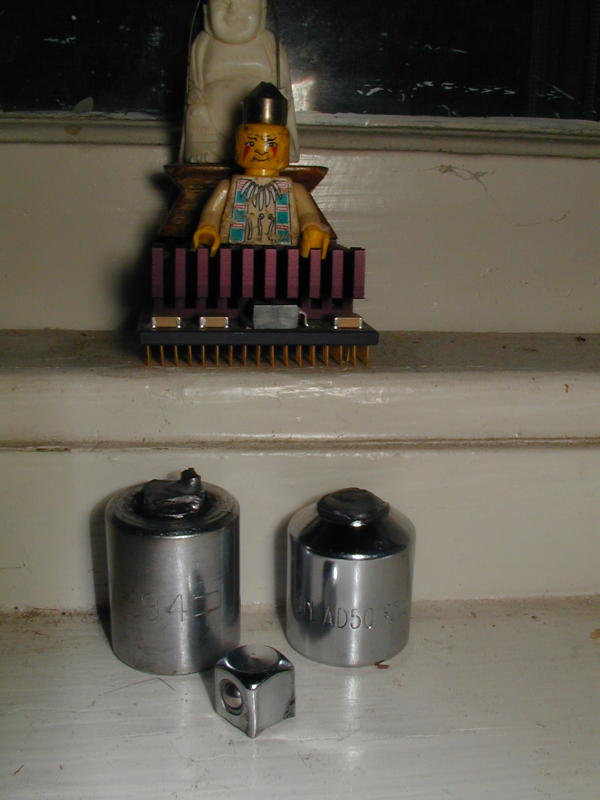 Unfortunately, I do not have an 18mm socket in 1/2 inch drive, so I had to use the 3/8 inch socket with a 1/2 inch adapter. I was able to crack one of the bolts on this bad caliper before the first adapter broke, but not the other. So now I have to buy a 1/2 inch drive socket, and I think it will work if enough force is used. If the breaker bar alone won't do it, I'll put a piece of pipe over the breaker bar -- and if that doesn't work then the breaker bar itself will break. I have broken TWO 1/2 drive Craftsman breaker bars in my time. It takes a tremendous amount of force to break a breaker bar. Wish I had an air hammer! Wish I could lecture the kid who torqued these damned bolts down. Of course, many people in my situation would simply take the car to a garage and let them use their air tools to deal with the stupid nuts and bolts. But that would only perpetuate the endless cycles of excessive force! UPDATE: Don't be too quick to condemn my appeasement of the snow gods! I will have readers know that following last year's blizzard which dumped three feet of snow in my yard, I created them in a state of near despair. Guess what? The snow eventually stopped, and Spring arrived. (I can cheerfully supply statistical proof to any doubting Thomases out there.) And considering that Hurricane Isabel -- an air hammer if ever there was one! -- is on a collision course with the East Coast, I saw nothing wrong with this gentle plea to the gods: a simple reminder that there is no need for excessive force. posted by Eric at 05:00 AM
| TrackBacks (0) Wednesday, September 17, 2003
Preventing flight (and all other means of escape)
I can't think of a better reason not to fly than this (link from Radley Balko). Jet Blue shared "confidential" records on 5 million passengers with the federal government, which in turn fed them to private contractors, which then sifted and combed through personal data, including: 1. gender (they mean sex)Hey, and that's only what I was able to download freely on the Internet. Confidentiality is a joke. So is the right to travel. If you want privacy, drive. But don't buy a new car! Seriously; these now contain EDRs (Electronic Data Recorders; the automotive equivalent of the "Black Box" flight data recorder). We're already being photographed everywhere, monitored electronically at toll plazas, and on top of that, now this: In the Matos case, a judge issued a search warrant allowing the prosecution to harvest the information.I hate lawyers (even though I guess I am one) but more than lawyers I hate the Insurance industry. They've already ruined the practice of medicine, and it just figures that they're a primary impetus behind this fascistic EDR technology. Almost makes me want to go back to practicing law -- just to retaliate. Here are a couple of more sites. And of course, unthinking parents are now being sold the idea as a way to keep track of their kids' driving. While I am not an expert on the EDR issue, a cursory glance shows that GM is the biggest offender. So, if you are going to buy a new car, I would stay away from GM until they take the damned things out or at least allow you to disable them without voiding the warranty. Speaking of driving, and lawyers, Tiger: Raggin' and Rantin' (who has a really cool, newly designed blogsite) just pointed me to a joke which combines driving, lawyers and religion all at once: A truck driver was driving down the highway when he saw an elderly priest at the side of the road. He stopped to give him a ride. Further down the road the truck driver saw a lawyer along the side of the road and turned the truck on a direct course to hit him. Then he thought, "Wait, I have a priest in the truck, I can't run down that lawyer."I don't know how to squeeze an insurance executive into that joke, so I left it as it was. Anyway, I get so frustrated with the rapid growth of totalitarian corporate socialist fascism that I sympathize with this alternative-to-the-courts approach to malpractice under socialized medicine: There are those who would say that this is why tort lawyers are necessary -- to sue the pants off hospitals and / or ambulance services like this one.That's also called "going Roman" -- and it definitely works as a deterrent. (How to deter this kind of stuff, though....) posted by Eric at 07:43 PM
| TrackBacks (1) Tuesday, September 16, 2003
How hot issues grow cold....
Working with air conditioning is enough to make a libertarian out of anyone. Once you realize that freon was abandoned for R-134a for fraudulent reasons, and all it has done is increase prices and complicate everyone's lives (because the two gases are incompatible), you might start to become very cynical about politics. And "science." But didn't freon harm the environment? Freon sounds really scary! Not so fast! Other than the scary, theatrical assertions from activists in the scientific community, there is no conclusive evidence that freon in any way caused a hole in the ozone layer. There is, however, evidence that freon would not do this. So why was freon abandoned? Du Pont's new patent? Read this: Many people may be unaware of both Du Pont and ICI's vested financial interest in the banning of CFCs. These two corporations have worked together for decades, maintaining their dominance in the world chemical market.[31] The Du Pont Corporation's monopoly patent on CFCs was about to expire and become public domain. It was therefore in Du Pont's interest to sponsor the Rio de Janeiro Earth Summit conference, and surprise, surprise; Du Pont secured the patent on the replacement HFC 134a gas.[32] The Montreal Protocol to limit CFCs was revised and on 11th February, 1992, President Bush announced a ban on CFCs by 1995.[33]The new stuff is known to be corrosive, which causes early compressor failure (maybe in my post-freon car) and there is now some serious speculation that it may have caused the thermal tile flake-off problems in the latest Columbia fiasco! (If so, don't hold your breath.) There is steady, accumulating evidence of this scientific fraud, but I don't think people care anymore. With Bush in the White House, freon is no longer a popular cause among conservatives, and big business has adjusted to the new laws (and to the new profits gleaned from retrofitting, higher prices, etc.) If scientific fraud is being covered up, you can be sure that the coverup is bipartisan. The best coverups always are. posted by Eric at 06:19 PM
| TrackBacks (0)
Chilling details
Instapundit linked to this broadside from a Bush supporter fed up with "an agenda creeping slowly towards totalitarianism." She says it "scares the juices right out of me," and cites a chilling report on Patriot II (which scares me too -- except when I get scared I get mad at the people who want to scare me.) Reading on in the blog, I found another chilling account (this one a charmer): The air-conditioning guy came today, and he discovered a host of problems. There was a slow, tiny, miniscule freon leak that needed to be repaired. Then, of course, he recharged the system with several pounds of freon. A filter was dirty (chock full of hairs fresh from the head of the Jack Russell Terrorist), thus causing some ice to form on the something-something, which in turn affected the function of the doohickey.That was exactly the problem in my car! The damned doohickey was screwed up by the something-something -- and the root cause was terrorism -- a Jack Russell Terrorist! Lest you think the term "terrorist" goes too far, I offer for your consideration an action shot of Molly the Jack Russell Terrorist. She hates the television, and leaps in the air to kill it whenever she sees an animal. 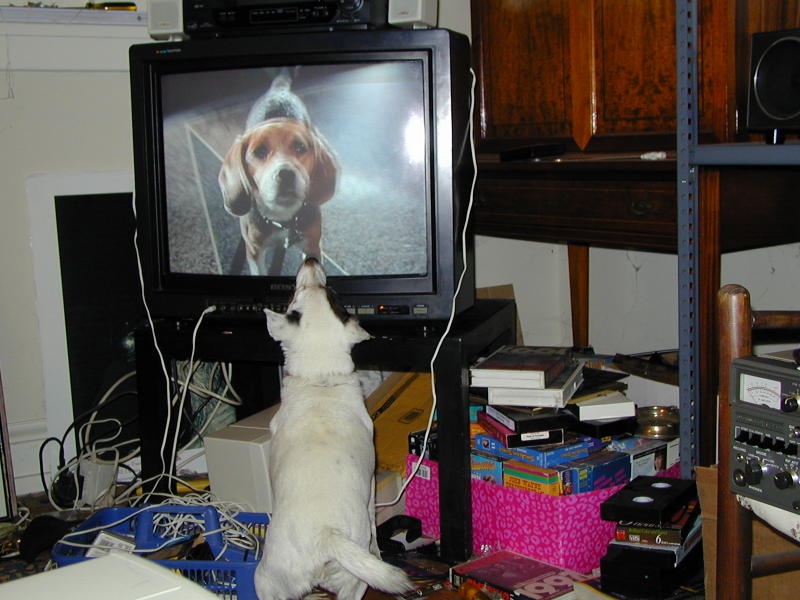 Because of the 3 second delay, it is very difficult to catch her in action with a digital camera. Why can't we all have interactive TV? posted by Eric at 05:49 PM | Comments (2)
| TrackBacks (0)
A great omen!
I have always maintained that two heads are better than one. Well, look at this! You can read the full story here. Considering the snake's long association with healing in ancient Rome, as well as the association of two heads with Janus, the god of gates and doorways, the ancient soothsayers might see this as an indication of a dramatic new breakthrough (or turning point) in medicine or healing. Anything new on the medical horizon right now? posted by Eric at 09:51 AM
| TrackBacks (0) Monday, September 15, 2003
Little do I know...
There was some Big News today. The Ninth Circuit postponed the recall election in California. The most earthshaking development, however, came from the real world: Instapundit's dramatic defection to the Other Side may spell the End of War in Our Time. By comparison, tonight's news runs from the frustrating to the infuriating: First, I found that Don Watkins can't be bought (which means I am in BIG trouble.... Waaaaahhhh!). For reasons known only to her and her dogs, Rachel Lucas has nothing to say. Here. (How do I tell her in a non-sycophantic manner that I like the dog pictures so much that I want to imitate her. Shamelessly. And. Flood! My! Blog! with daily pictures of Puff and Molly?) And, perhaps most perplexing of all, I discovered (thanks to the ever resourceful Ghost of a Flea) that I am a woman so mysterious that nothing is revealed:
So what am I to do? posted by Eric at 08:58 PM | Comments (3)
| TrackBacks (0)
No submission from Arnold!
One brave man has finally spoken out about Arnold Schwarzenegger, and has demanded that he answer questions about moral issues: "We are very concerned about the report of Arnold's promiscuity and he must come forward and tell us if it stopped when was 29 or if continued" said Rev. Sheldon. --- Reuters, August 30, 2003This is interesting, because it ties right in with my long-running argument about the "penis people" -- those whose lives are spent worrying about where another man puts his peepee! The above provides documentary evidence (as if anyone really needed any) that the obsession over whether or not certain citizens are placing their private parts into the right orifices is NOT limited to homosexuals. Arnold Schwarzenegger is a heterosexual, and a Republican! Yet still they demand to know where he puts his penis. Actually, make that "put," past tense. They demand to know about his past sexual conduct, and they not only want him to say he doesn't do things like that anymore, but they insist that he REPENT. Moreover, they want him to feel guilty, as a moral example: "We must hear from Arnold Schwarzenegger if he has repented and repudiated these past sexually promiscuous acts. As a married man and family man he must clear the air that he is not continuing in this vein from the past," Sheldon said. "Because the governor's office is one of gigantic role model proportion to many of our California citizens you must come forth and set the record clear. What will be your moral philosophy and role model if elected governor?"Role model? Putting aside the question of whether there should be role models at all, what kind of "role model" is someone who allows himself to be dictated to by the forces of shame? It is to Schwarzenegger's credit that he has so far refused to submit any answer to these ridiculously invasive questions. It all comes back to what Stephen Green praised as the American spirit of defiance. Dread is for the weak; defiance is, perhaps, the American virtue.While Stephen Green was talking about defiance in the face of Islam, he chose exactly the right word -- because Islam is its nemesis and its opposite: the word "Islam" means "submission." I think Americans in general are getting tired of being beaten down by the forces of submission. posted by Eric at 08:38 AM | Comments (2)
| TrackBacks (1) Sunday, September 14, 2003
Definitely not cool!
My car conked out yesterday in a bad way. I visited a friend, then when I returned to my car and attempted to crank it over, there was a hideous noise and smoke started pouring from under the hood. I shut it off, then opened the hood and asked my friend to tentatively turn the key. This time, I saw that the air conditioner compressor pully was stuck and not rotating. But then it slooowly started to turn and finally started spinning. I drove cautiously, and noticed that when I turned the air conditioning on the engine seemed under far more strain than usual. So I left the AC off and drove it home. Today I removed the belt (which was burnt and cracked), and sure enough, I couldn't turn the pulley unless I really bore down on it, and then it would only rotate half way around in either direction, then stop completely. The damned compressor had seized! I never thought an air conditioner problem could shut you down, but this did. Here's the blasted thing for everyone to contemplate:  The cheapest el cheapo rebuilt compressor I could find runs $289.00 -- at Autozone! That's a lot of money -- and just in time for Fall and Winter... Not only that, but I have to put the coolant back into the system after I get it all back together. I guess this beats computer carpal tunnel syndrome. (I was worried about Instapundit because of his dad's surgery, but I am glad things are OK.) Repetitive mouse movements -- especially the clicking with the index finger -- are supposed to be what create the most serious problems. Probably a good idea for me to do some wrenching for a change. I used to study Hap-Ki-Do, and my master made me do all sorts of joint twisting exercises which I use to this day to limber up. (When you feel aches and pains doing them you know you needed to.) No mouse strain yet. (Knock on particle board.) posted by Eric at 05:38 PM | Comments (1)
| TrackBacks (0) Saturday, September 13, 2003
Breakthrough in miniaturization
Justin Case (my mysterious research assistant) just told me about these tiny little horses, which live 50 years, and are about the same size as a dog. I have had dogs all my life, and I have ridden horses since I was a kid, although not as often as I would like; horses are, after all, a rural phenomenon. But these horses can be housetrained, and can be kept indoors like any other pet. Somehow, I would find it disconcerting to have a horse in my house, but I guess I could get used to it. The noise of hoofs on the floor would be weird. Plus I have (in addition to the gentlemanly Puff) a tyrannical Jack Russell Terrier who is very intolerant of other animal species. (She wants to kill them.) I think I'll hold off for awhile. Meanwhile, here is an interview with a miniature horse breeder. (Link via Procrastinations -- a good name for a blog -- which I wish I'd gotten around to using.) posted by Eric at 09:00 PM
| TrackBacks (0)
Rome wasn't built in a day...
Steven Malcolm Anderson is really onto something (and not what everybody probably thinks) when he says: I'm a girl. I must be a girl. Sex is spiritual. Told you.That was his reaction after reading this: Before the idea of homosexuality was invented (or discovered) by Viennese psychoanalyst, nobody was gay, as we now understand that term. Some men had sexual desires for other men, and some men had same-sex sex with men (although typically, as Dave Bianco points out, not as an exclusive choice). But the creation of what the Victorians called a "third sex" was a social construction, a stigmatized sexual identity, which had as much to do with anxieties about masculinity emerging as we entered the industrial revolution as anything else.Sex role tyrants dictated sex roles, then labeled those who did not conform as deviant. Said "deviants" then counter-reacted, giving rise to the gay movement. People keep reacting, and reacting, and reacting. To what? To the sexual desires of other people? To react to and to "worry constantly about whether or not certain citizens are placing their private parts into the right orifices?" I am not sparing anyone here. Homosexuals, having fallen into this trap, find themselves having to group together and then judge heterosexuals in return, labeling them as a different group. You must decide upon one of two groups, then belong to it, try like hell to conform to it, and label everyone outside it. Pretty soon, you'll start to find you really are different. A little like blacks who are "really" black and make "cultural" demands on others to conform to a similar tyranny. For what end? Why would one man care where another man puts his peepee? Beats me; I have spent decades trying to figure out what the hell is going on. And after I grew tired of reacting, I started asking basic questions, and I came to realize the ancients were right. They didn't label, because it didn't occur to them to care. Having your life ruled by tyrannical labels created by Victorian psychiatrists may be modern, but it is not freedom. That's how insanity prevails. posted by Eric at 07:20 PM | Comments (5)
| TrackBacks (0) Friday, September 12, 2003
More statistics, less truth!
I have been taken to task for my post about guns the other day: Eric Scheie argues that statistics about guns and crime "have no bearing on basic constitutional rights". I’m afraid that all the pro-gun folks who have based arguments on Lott’s statistics would seem to disagree with him.Well! If there's one thing I can't stand, it's when I'm told that people only seem to disagree with me! And as if that wasn't enough, a commenter then zeroed right in on me, lambasting the theme of my beloved blog with an accusation that not only do I think distorted thoughts, but I then insinuate them into the ancients! Comment/Excerpt: Eric Scheie apparently thinks distorting the meaning of the 2nd Amendment is a classical value.Immortal gods! They've put words in my mouth! I swear before Jupiter that I think no such thing! After such a grueling one-two, I felt obligated to reply (in the comments section), and here is what I said: I don't mind having the (apparently monolithic) "pro-gun folks" disagree with me -- although of course I admit that these statistics can be and are used for political ends. That's what you're doing, after all. My point is simply that the Second Amendment does not need the help of statistics any more than does the First Amendment -- nor are either undermined by statistics. (These debates are silly window-dressing anyway, because the truth is that you guys want to take away my guns, and I want to keep them.)I am no constitutional scholar, but I was really delighted to read this remark by a distinguished one, Glenn Reynolds: [Lambert is] wrong, however, to suggest that Lott's accuracy bears on the constitutional right to bear arms, though it may bear on the policy question of whether concealed weapons reduce the crime rate or not.Damn right. If statistics governed the constitution, next they'd claim that hate speech "is associated with" violence, or pornography "is associated with" rape and therefore, "more censorship means less crime." If this country followed its constitution, I would not be worried about such statistical nonsense (much of which runs afoul of the logical fallacy of post hoc ergo propter hoc). But if my dim memory of Con Law serves me, the Supreme Court has been known to resort to policy arguments to decide constitutional questions -- doubtless with the help of reams of statistics. What most annoys me about all gun statistics is that none can take into account the number of times guns prevent crimes which went unreported because they never occurred. If a burglar sees a National Rifle Association sticker on a home, or a mugger sees a holstered gun on a potential victim and these criminals fail to commit the crime, not only will there be no crime to report, but the "victim" will never even know a crime was prevented. Are gun stores robbed (I do not mean night-time burglaries) as often as liquor stores? Is there a reason for this? Did the presence of guns have anything to do with it? Did the criminals have common sense? There is no way to know, because one cannot know what did not happen. Thus, there is no reasonable way to know the number of times not only that guns thwarted crimes, but where no crime occurred at all. (An unreported crime is not the same thing as an uncommitted crime, of course, because of the complete unknowability of the latter.) Because of this problem, any study involving only reported crimes is by definition inherently based on a biased sample. I do not need statistics to tell me that criminals are more likely to prey on the weak, or that an unarmed citizen is weaker than an armed one. So, even if I believed in the relevancy of statistics to judging the correctness of the constitution (which I absolutely do not), I would distrust their accuracy as to guns. Notwithstanding these reservations, I am not against all use of statistics. There are innumerable good uses for them, and as Dean Esmay commented, they "have been hugely useful in solving major social problems." It strikes me that the real value of statistics is to assist honest thinking, not advance partisan politics. Practitioners of the latter use statistics as drunkards use lampposts; "for support, not for illumination." Statistics for illumination? As an aid to honest thinking? In the context of the gun debate it sounds laughable (as it is in politics) but here's how (in theory) it might work: It's a kind of scientific integrity, a principle of scientific thought that corresponds to a kind of utter honesty -- a kind of leaning over backwards. For example, if you're doing an experiment, you should report everything that you think might make it invalid -- not only what you think is right about it: other causes that could possibly explain your results; and things you thought of that you've eliminated by some other experiment, and how they worked -- to make sure the other fellow can tell they have been eliminated.Sounds great, but I don't expect to see it in this debate. In politics statistics are little more than weapons. posted by Eric at 06:35 PM | Comments (8)
| TrackBacks (0)
Atomic change?
Still thinking about Stephen Green's wonderful quote.... And this one's not bad either: We could have gone full Roman on anyone we wanted, but we didn’t. (via Instapundit) Yeah, who needs to shoot the A-bomb at asteroids in outer space when there are more dangerous rocks right here on earth to whack? (And they're small enough we wouldn't even need to use a nuke....) Lileks is right; the Romans knew how. And Stephen Green is right; the rock worshipers (who think they are the defiant ones despite their wimpy-ass "submission" crap) would be well advised to remember our defiance. As far as I'm concerned, they can take that stupid rock and stick it up their collective crack. Hope that wasn't politically incorrect. Actually, I believe in respecting the religion of others. Only if others go too far is "going Roman" an option. Until such a time comes (and I hope it never does) I would leave such silliness where it belongs: on ancient coins. UPDATE!! Hey, what's gotten into me? I almost left out Frank J.'s Nuke the Moon program! A great idea (and obviously of divine inspiration) -- especially when you consider the upstart nature of the Moon God.... Can we get along? posted by Eric at 06:02 AM | Comments (1)
| TrackBacks (0) Thursday, September 11, 2003
Quote of the day
Dread is for the weak; defiance is, perhaps, the American virtue." If I'd spent all day, I couldn't have come up with a classical quotation to equal that one. Read the post too; it's brilliant.
posted by Eric at 06:55 PM | Comments (2)
| TrackBacks (0)
Trouble ahead?
Might this story be another missing piece in the top-secret Hillary for President puzzle? Democratic presidential front-runner Howard Dean has asked General Wesley Clark to join his campaign. For something like this to be happening so early in the race, something has to be happening -- or about to happen. Dean is suddenly running to the right, and running scared. I think Dean smells blood in the water. His own blood. Fifty days or so remain for Hillary Clinton to declare. Have Dean's spies learned something from the Clinton camp? Obviously, I can't prove anything (and even if I had inside information I would refuse to disclose it). But on top of the earlier oddity I blogged about recently, (see Who's afraid of Howard Dean?) this just cannot be ignored. Stay tuned. But it looks and smells like trouble. Trouble is, it might mean trouble for the country. (UPDATED for explanatory link.) UPDATE: I don't know how I missed this piece from Mark Steyn, but I did: What does she have to gain by waiting four years? If Bush wins a second term, the Clinton aura will be very faded by 2008. And, if by some weird chance Bush loses to a Howard Dean, she's going to have to hang around till 2012. Logic dictates that, if Hillary wants to be president, it's this year or none. In her reflexive attacks on Bush over the war and the blackout and everything else, she already sounds like a candidate. The press will lapse into its familiar poodle mode (''Do you think you've been attacked so harshly because our society still has difficulty accepting a strong, intelligent woman?'' etc.). And, more to the point, when the party's busting to hand you the nomination, you only get one opportunity to refuse.Could this even cause commotion in the blogosphere? (Link via Instapundit.) posted by Eric at 11:13 AM
| TrackBacks (0)
Freedom: not free, not forgotten -- then or now
Every once in a while, those who want to control us are forced to watch helplessly while the basically decent folks in this country engage in spontaneous outbursts of simple, American, morality. I saw this firsthand on October 17, 1989 after the San Francisco Earthquake (where ordinary people who had never met went out of their way to help each other -- and this in a city widely considered to be America's Great Satan!) I saw it again in New York in the days following September 11, 2001. These days, I see it among bloggers. I might not like all of them, and I might criticize some of them, but their sincerity and desire to help this country is something I find deeply moving. I have been blogging in earnest for less than four months, and I feel renewed almost daily. One year ago I was asked the question (posed at the G. Gordon Liddy Show's website): How has your life changed since September 11? This was my answer: September 11 has, I must confess, soured me enormously. It confirmed so many of my worst fears that it has made me question many times whether I still want to call myself an American.Bloggers do not take freedom for granted either. I am glad as hell to be here right now. There is not much I would add to what I said then. But there is one thing I have noticed. This year, it seems that September 11 is being downgraded deliberately. The big networks and big newspapers are not planning a retrospective focus as they did last year. Do they want us to forget? Some people might forget, but I am glad bloggers won't. I could never cite you all, because I would spend all day doing just that. But here are a couple of things, lest anyone forget. This morning, Glenn Reynolds cites Lee Harris: Forgetfulness occurs when those who have been long inured to civilized order can no longer remember a time in which they had to wonder whether their crops would grow to maturity without being stolen or their children sold into slavery by a victorious foe....And next, here is a link I found at Little Green Footballs. It is the best slide show I have seen of September 11, period. Forty six pictures in all, and you can just click on each one to see the next. Each picture has a quotation above it, such as this gem: He who puts up with insult invites injury. ~ ProverbEven if you're really busy, it doesn't take long to view these forty six pictures, and I can't think of a better way to remember September 11. I am very proud that Little Green Footballs linked to me, and not just because it's a leading blog. There is no more staunch supporter of Israel in the blogosphere, and Israel needs the support of every one of us. I mentioned Ayn Rand in that piece I wrote last year. It is no coincidence Ayn Rand's "A Moral Defense of Israel" was seized last year by Canadian censors as "hate propaganda." I wasn't blogging then, so I couldn't link to this, but I am glad I can now. There are many in the United States would censor Ayn Rand's defense of Israel now as "hate propaganda" if they could. That is because Israel and Israelis are too much like us. And we should never forget that those who hate Israel hate us. Americans are, as the slogan goes, "hated all over the world!" because of our support for Israel. Such remarks always sting me -- because they are true. We are hated all over the world because of our loyalty to Israel. As to why these millions of people apparently hate us for supporting Israel -- why, Jews have been hated for centuries by people "all over the world" for the crime of being Jewish. If millions of people hate us just as they hate the Jews, Americans ought to be proud, not ashamed, for being the target of such hatred. As these hate-mongers often say, America is the "Great Satan," and Israel is the "Little Satan." Those Americans who want us to abandon Israel ought to ask why the self proclaimed enemies of "Great Satan" would suddenly hate us less simply because they successfully bullied us into abandoning our "little Satan." Last year I realized that just as I won’t take our freedom for granted ever again, nor will I ever take the welfare of Israel for granted again. I often wonder whether Israel has even a greater appreciation of freedom than we do, for while we suffered thousands of casualties on September 11, Israel has endured the equivalent of innumerable September 11ths, for many, many years. Yet Israel remains a free, democratic, country. Americans who want to do away with our freedom and disarming us so that we can no longer defend ourselves – simply because we were attacked on September 11 – ought to ask how it is the Israelis have suffered so much more, and for so much longer, and yet remain a bastion of freedom and an example for most of the world. Instead of bashing Israel, Americans ought to be imitating Israel. I can't help but notice that those Americans who hate Israel all seem to hate themselves. We can't let them win. The hatred of others cannot destroy us unless we join them. And we join them when we hate ourselves and our freedom. Don't hate ourselves? Does that have to be a profound concept? It shouldn't be -- any more than the idea that self defense is not "hate." 
posted by Eric at 05:12 AM | Comments (2)
| TrackBacks (0) Wednesday, September 10, 2003
More guns, less terrorism!
I agree with Glenn Reynolds that the debate over the John Lott coding error question is seemingly interminable. But I say, the hell with "econometrics," "running regressions," "coding errors," and "clustering adjustments!" I care only about two simple statistics. Since September 11, 2001: 1. the number of guns in this country has gone up; 2. the number of Americans killed in terrorist attacks has gone down. Q.E.D. =========================== Additional note: Even assuming the truth of everything Tim Lambert says, (that the 98% figure is wrong, "Mary Rosh" is an imaginary person, and errors by Lott were demonstrated in the 120 page paper), considerations of statistical data have no bearing on basic constitutional rights. If statistics showed that countries with more censorship have fewer rapes, would that justify restrictions on free speech? The Second Amendment does not live or die by statistics and counterstatistics about crime rates (much less whether or not there have been verified sightings of the mythical Mary Rosh). posted by Eric at 08:43 PM
| TrackBacks (1)
Classical family values
First, an announcement. My blogfather has helped put together a wonderful new co-op gun blog! The first thing I did was link to it with their logo over on the left. And it is great! Where else can you learn how to build an AR-15 from parts? Or something too many gun owners forget: the essentials of gun maintenance. Go there now! On a less serious note, my blogfather keeps calling himself a "link whore." I guess that means it's OK to be a link whore. Which is cool, because I have so many links that never link back to me that I am probably more on the level of a "link slut." What would the "blogmadam" say? Am I being too loose with my links? I don't know, but considering my live-and-let-live philosophy, I think I'll just keep doing what I'm doing. If I see a blog I like, I place a link to it. Sometimes I'll even link to a blog I really disagree with. Others might analogize to rape; I consider it a sort of tithe to the God of Free Speech. What is the opposite of being a link whore or link slut? A link virgin? Is there virtue in having no links? A link-free blog? I love my links, especially those who are kind enough to link back to me, and now that I have gone and described myself as a common slut I think it's time for me to defend my "honor." Not one of the following links was a one night stand (because I always come back for more) and not one has paid me anything. (I don't ask; I don't tell....) And all joking aside, as I have said before, when I see a link which grabs and holds my attention, and makes me want to return for more, I try to link to it immediately. Once I link to a blog, I'll visit it as often as I can. The blogs below have all linked to me, which means a great deal to me, and makes them the best of the best. (After all, not only did I decide I like their blogs, but apparently they see something they like in mine!) By all means check each one of these blogs -- and please link to them. My number one complaint about the blogosphere is the growing stinginess about linking. If this new media is to grow, it must grow dynamically -- and in my view, this means that there should be more and more bloggers, more and more hits, and more and more links, all the time. We are supposed to be offering a new alternative to traditional media, folks. And you don't do that by holding back, and acting stingy towards newcomers. Jeff can call it whoring, and I'll call it that too, but if you leave the moral satire aside, I honestly think generosity in linking should be every blogger's civic duty. As to ranking links, I see no way to do it fairly, and thus there is no particular order in my link list. If the list's lack of any hierarchy or structure bothers anyone, feel free to offer me your ideas, because I am still relatively new to this. (And if any of you have a link button you want me to use, please email it to me, and I will definitely use it!) The list here is taken in any order I could find them by combing through technorati and TTLB. I simply refuse to list links according to how much I might like them or agree with them or how they rank "officially." (Not only would that be next to impossible, but it would change constantly.) Please understand that I love you all for linking to me, and I will visit you as often as I can. UPDATE: Chris is back! Everything is up and running -- and I just took his latest test:
This test better be accurate, because I take my incarnations seriously! Welcome back Chris! Believe nothing even if I have said it unless it agrees with your reason and common sense.Zen Pundit always provides well written, very thoughtful, foreign policy analysis (from a libertarian perspective) and managed to snag one of best names I have seen for a blog. Link to him now! This website is not intended as a solicitation ofI am glad to see that solicitors do not solicit -- and I feel more virtuous than ever!
My inner child is sixteen years old!
Sixteen again! I knew there was something sweet about this blogger, and I am very grateful for the link! And in case you readers haven't done so already, now is the time for all good men (and women) to come to the aid of their country by making sure to read all the above blogs, link to them, and help grow the blogosphere. The blogosphere is America's most articulate answer to September 11. Mainstream media may be silent, but not we -- so go make some noise. Thank you one and all! posted by Eric at 12:26 PM | Comments (7)
| TrackBacks (2) Tuesday, September 9, 2003
Bloody Tuesday. Will Mars forgive me?
I have some very serious news. The gods themselves may be at war. For the past week, Mars has been knocking on my door. His planet has come the closest it has been to Earth for 60,000 years. And what have I been doing while Mars approached? I have been pushing "PEACE®." Coincidence? With a start, I awoke this morning and realized it was Tuesday. I SAID "TUESDAY!" Notice that because of my cultural background, I did not use the word all Latin countries use which derives from Mars. Our friends south of Northern California use the word "Martes" for Tuesday. (Which is pretty close to what it was called in England before the Romans lost to the Germanic tribes; Latin is "Martis," French "Mardi.") Most classical scholars will see where I am going with this, and I hope they'll bear with me. The point is, "Tuesday" is also named for a God of War, "Tiw," "Tiu" or "Tyr." When the Germanic tribes overran England and kicked the Romans out, it was obvious to everyone that Tiw had defeated Mars. So the day of Mars became the day of Tiw -- and we have had Tuesday (Tiwesdaeg) ever since. And today being Tuesday, I realized that I may have pissed off not just one god of war, but two! That's right; I mean, I thought I could handle Mars, being the smart-ass I am, but now I realize I also must come to terms with the god of Tuesday, Tyr! Why, oh why, did I not notice that it was on a Tuesday that Frank J. declared war? I have ignored numerous omens and portents from the gods, and now I am paying the price. Now, with a heavy heart, I must atone. I suffer from a very stubborn form of pride, though, and so I will not back down from the Classical Values Peace Plan®. However, I am not so reckless as to go on pissing off the gods. Recently my pro-Israel friend at Solomonia recognized the folly of pissing off gods even if you don't believe in them -- and to placate the pagan upstart Allah he actually offered to switch his religion, citing this unbelievable web site for Allah. Note: The above is one of the more psychotic web sites I have seen. DON'T MISS IT! Additional note: There is also a psychotic movement afoot in this country to stop people from using ANY of our names for days of the week! This shocking idea strikes at the heart of America's Pagan Traditions, and I promise you that here at Classical Values we will do everything we can to keep the sacred names for every day of the week. Readers (or war-watchers) who want an in-depth analysis of Tyr and Mars, side by side, should read this. A sample: The star Tir was thought to be at the top of the world axis, which "keeps the cosmic forces in polarized order," according to Ralph Metzner. Norse dragonships and merchanters steered by the stars at night, so the god Tyr was very likely associated with the ability to guide, and with the qualities immortalized in Shakespeare's phrase, "fixed and constant as the Northern star"—not necessarily a trait of Graeco-Roman Mars, who was more volatile.Hey, I am not trying to be judgmental here. The above is just one writer's opinion. But the connection of Tyr with the earth's axis convinced me that it is only fair to associate this war god with the Axis of Naughty. However, lest anyone imagine that Tyr is superior to Mars, which god is more famous? Which god kicked more ass in history? Which god do we think of when we think war? Here's more food for thought: the alchemy of consciousness transforms the bestial components of Mars to the realistic and protective qualities of Tyr.Please, don't expect me to take sides. To do so would be to side with one god over another -- something which would contravene every principle of the Classical Values blog! (And in light of the numerous, very powerful omens from both sides, I am -- alas! -- wholly unable to predict the winner. Seriously.) I have been called an appeaser before. But this time, appeasing the gods is just good common sense. What I have decided to do is honor them by forming two groups -- one for the Alliance and one for the Axis of Naughty -- and assigning the Roman God of War to the former (in keeping with the gaming spirit of this war, I will use his pinball game manifestation for the Alliance blogroll):
Ye heroic warriors! Ye champions of these two glorious gods! All are welcome here! Come visit anytime. Rest. Lick your wounds if you have suffered. Prepare for the next battle. Exchange information. (Yes, this website welcomes all spies…) And may the best god win! (Dare I say, "May both gods win?") Pax® posted by Eric at 01:14 PM
| TrackBacks (0)
The Culture War literally SUCKS
What is this country coming to? I mean, when the Ten Commandments are taken down by court order in one Southern city.... While in another Southern city, this disgraceful pagan statue sits in the public square in plain sight? The statue was a gift from Benito Mussolini, no less. I am even embarrassed to tell you about its vile particulars, my dear readers, and I do so only in the interests of truth. But legally, it is completely pornographic, for it is child bestiality -- an actual graphic depiction of minor children engaged in oral contact with the secondary female sex organs of an animal! I was relieved, at least, to read about threats by decent people to dynamite this disgusting display of heathen perversion. Is there no shame? posted by Eric at 04:52 AM | Comments (1)
| TrackBacks (0) Sunday, September 7, 2003
The same sex?
Considering some of my previous posts, I never thought I'd see the day when I would state a case for gay marriage. But there are a couple of ideas I have wanted to explore for some time now, and I guess this blog is as good a place as any. It is true that there is a line separating the sexes. They are different, and the biological aspects of that difference are not going to change in the foreseeable future. Legally, the difference between the sexes has more to do with the existence or nonexistence of a penis and/or testicles than anything else. Thus, if a man goes to a doctor and has himself castrated, his penis amputated, flayed, and then rearranged in such a way as to construct a faux vagina, the courts will deem him sufficiently "female" to allow his official documents to be changed. He is no longer a "man," but now a "woman." Hey, people care about these things, OK? This stuff is considered by many people to be the glue holding all society together. You've gotta be a man or a woman, get that? No in-betweens; at least, not legally. So, before we get to the question of "gay" marriage, we must address this need to define and separate the sexes. Is it a good thing? That is a moral question, and moral questions are not supposed to be relevant to legal questions, and I had more training as a lawyer than as a moralist so as you can see I am already quite confused. (This philosophical confusion, I might add, has caused me problems in my rather misspent life.) I did say "philosophical" because I have never been entirely convinced that the sex of a person (many of you define it by the word "gender"), much less his sexuality, is the legitimate concern of anyone. Statisticians, I suppose, have as much right to keep track of it as they do things like age, race, or income status, but should they really have a legal right to insist that you fit definitions? Let me tell you a true story about a legal gay marriage which degenerated into an illegal gay marriage. (I swear before God, gods, goddess, goddesses, Nature, and even Nature's God that this is true.) My college lover (whose U.S. citizenship was legally complex) considered himself an illegal alien, even though it turned out that he was not. To expedite imminent problems at the time, he decided to marry a U.S. citizen, a lesbian. The marriage would have been a legal gay marriage but for the fact that the woman could not prove her previous husband was deceased as she claimed. So, my lover abandoned his wife -- without (I hasten to add) ever having consummated the marriage. Either bigamy or a failure of consummation is grounds for annulment of marriage in California, but years went by, and my lover (who evolved into being "merely" my best friend) never pursued it. Legal note: Consummation of marriage is a legal requirement for a valid marriage only in a minority of states, but its absence may furnish grounds for annulment. (And the failure of consummation may also be grounds for rejection of a marriage considered suspect by the Immigration and Naturalization Service.) More than a decade later I looked into cleaning up the lingering issue, and after a little checking, discovered that my friend's "wife" had undergone a sex change! She was now legally a man. I excitedly called my friend to tell him that he might very well be a husband in one of America's first same-sex marriages, and his reply was a very sour, "This would only happen to me." Assuming that the marriage had otherwise been legal in all respects, can a marriage be nullified by operation of scalpel? Or does there also have to be a clear intent by the sex change patient to change the sex? Otherwise, a perfectly good marriage might be nullified by an unfortunate industrial or farm accident… What are the attributes of marriage, anyway? Man and woman, no unresolved prior marriages, consummation? How about love? Friendship? It often strikes me that the successful marriages are those between friends who love each other. Sexual attraction gets all the focus, but the real glue is the development of lasting friendship. It has been argued that heterosexual men and women are so different from each other as to be incompatible. Mutual contempt ruins many a marriage, and I'd be willing to bet that most of these marriages began with sexual attraction. When that wore off, and when the couple discovered that friendship was impossible, the marriage was doomed. This is further compounded by the confusion of sexual attraction with love. Doubtless loneliness and self-esteem issues play a role, which of course they should not. Not that it is a good thing to be lonely, or to have low self-esteem. But the mere fixing of loneliness is not love in the true sense of that word. It is merely an addictive process, because no one wants to be lonely, and (as any prisoner or captive will attest) even a horrible companion is better than no companion at all. Losing a husband or wife is often terrifying because it means loneliness. But the need not to be alone is not love, and it can never be the basis of an honest relationship. Ditto for self-esteem. If you need someone to fix you -- to make you feel good about yourself -- then you are in real trouble when that person cannot fix you, and no one can deliver good self-esteem consistently to someone who lacks it. This is another good way to guarantee a failed marriage, or failed relationship. Still, many people confuse these things -- real needs though they may be -- with love, which they definitely are not. Suppose for the sake of this argument that people conducted an experiment in marrying friends. If friendship is the glue that ultimately holds together marriage, then it would seem that such marriages might have a form of built-in protection. And if LOVE were to develop, then it might get better and better. Sex? Better yet? How would one go about finding such friends? What about gay men marrying lesbians? That would appear to be legal in every state. I am not sure whether it's a loophole in the law, but if it is, it hasn't been closed yet, and the only way to close it would be to test the sexual preferences of marriage applicants (something I don't think would fly in most states). If there was a solid basis for friendship, then could love develop? Might sex even develop in appropriate cases? If, in the conventional course of marriages, sex is supposed to precede friendship, does this put the cart before the horse? Or could it be a more logical (and possibly higher) idea for civilization? (After all, there is no reason why the idea of marrying a friend should be restricted to lesbians and gay men.) Who gets to decide whether this is a good idea? Whoa, hold on. This is not a new idea. I just found a website. (Hey, am I allowed to say "No, seriously.®"?) http://www.yvonnesplace.net/news/differentkindofqueer.htm -- a place which, among other observations, offers this gem: "Until a leather dyke and effeminate queen are delivering the nightly news, labels ought to be ubiquitous,".... "And queers should claim them, embrace them, and revel in the differences they signal." Whew. That was a relief! I mean, if people have actually started doing this (which it's clear they have) at least no one's going to blame me for my uncontrolled and politically irresponsible blogging. (And I must confess, I do love being politically irresponsible. Heh.) Once again, though, I see no reason why these things shouldn't be capable of logical discussion -- certainly at least in theory. (Between lesbian and gay friends, marriage offers the social satire angle -- which I find genuinely intriguing….) And why can't this be discussed? Aren't we in the middle of a society-wide debate on same sex marriage? Aren't we in a rather serious Culture War? One would think someone, somewhere along the line, would have thought of this rather obvious idea. Do I have to be the only blogger? Who will object? For starters, I can tell you who: religious fundamentalist and gay activists -- the strangest bedfellows of all. I don't think that they of all people have earned any particular right to complain. Whose sex is whose, anyway? UPDATE: I received the following comment via email: Just started reading your blog, and wanted to tell you that I know a dyke here in LA who married a gay male friend, and they became PASSIONATE lovers. He has since died, but she still considers him to be the love of her life!Fascinating; what would this sort of love be called? Anybody else out there? posted by Eric at 03:02 PM
| TrackBacks (0)
Stop hate! Restore fairness and balance!
It's nostalgia time, so please indulge me as I revisit some (mostly) old news. (It may be paranoia on my part, but I think it is very easy for us as Americans -- and I include myself -- to forget the value of our freedom, and the nature of those who would jump at the opportunity to take it away.) As anyone who read 1984 will remember, Big Brother ruled not so much by governmental decrees and law enforcement, but by interactive media, i.e., rule by "The Telescreen." I have long believed that when Big Media finally merges with Big Government, the real time of Big Brother will have arrived. The United States still has stubbornly resilient written document called the Constitution, however, so horrors like this will take a bit more time to implement. It is ironic that the people we entrust to be the watchdogs against totalitarian evil would become its progenitors, even enforcers, but such is the nature of power. (Lord Acton was right of course.) Great Britain is ahead of us, for there is no First Amendment hurdle to be overcome by Patriot Acts or compliant courts. The result? [T]he job of spying on British citizens has been franchised out to that "much loved" institution, the BBC. As Mr Lewis says, that is not their role. Later on in the post some Radio Nederlands commentary is quoted saying that it might be better to have "trained journalists" doing the monitoring than others. Not surprising, I suppose, that the trained journalists at Radio Nederlands rate their fellow trained journalists at the BBC as the best people to employ for this task. I must disagree: if I had to choose I'd rather be spied on by professional spies. At least they live in the real world, and in particular have the peril of Islamofascism very much in the forefront of their minds. I'd trust them way above the BBC to be able to tell the difference between clear statements warning against Islamofascism and genuine hate speech [footnote].Couple the above with this report about European criminalization of disagreement with the courts (as "hate speech"), and it doesn't take much imagination to see that freedom is little more than a memory in Europe. The Iron Curtain (and its physical manifestation, Berlin Wall) once separated freedom from Totalitarianism. In a world without borders, where freedom is constantly encroached, where does freedom find safe places? How about the blogosphere? A new word for partakers in computer-assisted free speech, this is one of the few checks and balances which, thanks to the First Amendment, appeared almost out of nowhere and now stands squarely in the way of these abuses. Recall this recent language (conveniently not available for downloading!) from The London Times: A proliferating band of independent writers known as "bloggers" (short for web loggers) is pumping out personal takes on the news, and one of the most persistent themes of their websites has been that Howell Raines, executive editor of The New York Times, would have to resign or be sacked. There is of course already a legislative movement afoot to restrict blogging in Europe. Here in the U.S., the first volley in the Cold War against bloggers has already been fired. Bill O'Reilly was the right man at the right time for this perfidious piece of work -- his carefully cultivated, grass-rootish pose as leader of opposition to Big Liberal Media providing him with the perfect cover. Dan Rather or Peter Jennings could never have gotten away with comments like these (via James Lileks): ....[T]hey work for no one. They put stuff up with no restraints. This, of course, is dangerous, but it symbolizes what the Internet is becoming.When freedom is unpatrolled, polluted, crude, gossipy, slanderous, libelous, unrestrained, vile, and dangerous, something must be done. This is a global phenomenon, and countries must work together -- with the help of media watchdogs like O'Reilly and the BBC -- to do it. "All hail America's fair and balanced Blog Czar! We who are about to blog salute you!" UPDATE: There is already a movement in Congress to regulate content of talk radio shows by forcing them to provide "fair comment." Talk radio (the first generation of interactive media) is a predecessor of blogging, and if this insidious form of censorship (disguised as "fairness") can be imposed, is blogging next? posted by Eric at 11:21 AM
| TrackBacks (0) Saturday, September 6, 2003
In search of missing links....
While it probably won't last long (because most of the links expire), I found myself today bumped up into TTLB's "Marauding Marsupial" category. Upon my first examination of the Ecosystem, when I was a Slimy Mollusc, I vowed that if I ever reached the level of Marauding Marsupial I would have to announce to the world which marsupial I wanted to be -- partly to bestow a title on myself -- but also in the more altruistic (that word again) spirit of Marsupial Empowerment. Marsupials, like many of us, suffer a bad rap. They are often unfairly stereotyped as boring slothful vegetarians, idiotic kangaroos hopping around (and running courtrooms which railroad people on phony charges), kangaroo wannabee-wallabies, drooling possums which play dead at the slightest sign of trouble, or any number of lesser-known tree climbing things -- all considered "backward" for the mere crime of having a pouch. Well not this guy!  You are looking at a realistic model of Thylacosmilus -- a fearsome marsupial which occupied an ecological niche as close to the saber toothed tiger as it was possible to be without actually being a saber toothed tiger! Thylacosmilus was a unique group of South American predators, about the size of a modern leopard. The genus is an evolutionary anomaly. It appeared suddenly in the Miocene of the isolated South American pampas as an animal entirely unique. It has no known ancestor or descendant. The shearing facets of the molars make the most effective cutting device known in carnivorous mammals. No other marsupial now known from any part of the world has developed the peculiar sabre-tooth weapon.Now that's cool! I'll bet they ate more than their share of "Large Mammals" too. Even the Playful Primates probably stopped playing and took to the trees when they saw a Thylacosmilus coming. Humans and Higher Beings simply did not exist in the good old days. This, er, thing had a long way to go. I think a marauding Thylacosmilus could probably have handled him. posted by Eric at 12:46 PM
| TrackBacks (0) Friday, September 5, 2003
Tasteless scoop?
Can someone please tell me exactly what the connection is here between a picture of President Bush dropping his poor dog (which fortunately seemed none the worse for wear) and the economy? I have leftist friends I love dearly, and I always endeavor to be polite, and engage in reasoned dialogue. But there seems to be no end to purely ad hominem tactics like the above. So the president dropped his dog! (Or maybe the dog got excited and jumped.) And some lucky photographer managed to capture the moment on film. The president and first lady are both shown grimacing, too. I guess that means they were also caught in the act of being genuinely upset. Perhaps you could somehow twist this into an argument against VIPs carrying dogs around when they are burdened with larger responsibilities. I don't even know about that; to me, knowing that someone has a dog means that he might be half human. When Pervez Musharraf was yelled at by the Saudis for owning a dog, I found myself suddenly warming up to the man greatly. And here, despite the fact that I am often very annoyed with the president (and disagree vehemently with many of his policies), I ended up feeling sorry for him. He certainly didn't drop the dog deliberately, and anyone who has owned a dog can vouch for the fact that they can squirm and make themselves very difficult to hold. The economy, though. I just can't make the connection, try as I might. For something like that to be self-apparent requires a leap of leftist faith. Perhaps if your hatred of Bush is all-encompassing enough, you can see "connections" anywhere. If the president swung and missed hitting a golf ball (or maybe hit the ball into a sandtrap or a pond), I guess that would represent whatever policy failure of the moment might be under discussion. But would it be logically persuasive of anything other than the fact that the president might need to spend more time practicing his golf game? Hmmmm...... Let's try a libertarian analysis of the same picture. President holds dog. Dog (whose entire existence is thanks largely to human tinkering) squirms -- yearning to break free. Finally, dog lands on the ground. Did the president let go, or did the dog break free? Should the president pick up the dog or is that too interventionist? Should the dog be allowed to run around a little? Or is laissez faire too dangerous? What if he bites the hand that feeds him? Or lifts his leg? It's all meaningless symbolism. Unless, of course, you just enjoy ad hominem attacks. So I'd better stop, lest I be accused of overanalysis once again. As Freud said, "Sometimes a cigar is just a cigar." No overanalysis here. You'll have to go elsewhere for presidential cigar jokes. posted by Eric at 08:18 PM | Comments (1)
| TrackBacks (0)
Last year's insults!
Boy am I outraged! I not only got insulted, but my attacker used a term which went out of style last year! The sheer nerve! L'audace! Not only that, but getting into foreign policy debates with Oxford Arabist scholars really sucks because they have all the facts and figures right there in front of them and I gotta go look it all up if I wanna say anything halfway persuasive! Sheesh! I am so upset by this trauma that I thought I would post the email and my reply for all the world to see. Question from Oxford Man: Dear Chicken-hawks in this email group,Reply from humble me: Xxxx I guess this is your way of baiting someone -- and because no one has taken the bait I feel reluctantly obliged to defend my fellow yellow raptors. Enough for tonight. I am sick of this cruel, cruel world! posted by Eric at 07:15 PM
| TrackBacks (0)
Losers Weepers!
Here's a real mess which defies easy logical analysis. Governments around the world are asserting that they own anything which is defined as an "antiquity." And worse yet, the US Court of Appeals for the Second Circuit held that, "foreign national ownership laws can make antiquities "stolen" under the US National Stolen Property Act (NSPA)"I guess that means I am now a criminal for buying ancient coins on Ebay. In other words, the passage of time creates a sort of confiscation of property which traditionally would have belonged to a landowner or a finder, and expropriates it in the name of whatever government passes the law. Doubtless, governments would reply that this is in the interests of the public good. That antiquities are the common property of all the people living in a country, and it is not fair to allow any individual to own them. What is the functional difference in logic between that and Stalin's, Mao's or the Khmer Rouge's confiscation of all private property as common property of all? Simply the age of the property? Its value? Oil, coal, and precious metals in the ground are also very old -- and they are finite in nature. Is it fair to allow a property owner to own these things? Shouldn't they be the property of everyone? Or is the cultural value of the object to be the determing factor in its expropriation? Why wouldn't any great work of art regardless of age be properly subject to government confiscation as part of a "cultural heritage?" And, in the case of antiquities, suppose we trace the property back to the people who created it. Governments today can hardly be said to stand in the shoes of various occupying powers which may have created or produced the antiquities, or once owned the land. If you dig in your yard in the United States, you might find coins from the British, French, or Spanish Empires. Assuming that these countries passed appropriate laws, why wouldn't you now be a "thief" for selling them, or for buying them from someone who dug them up? As to definitions, I do not think that there is any standard rule. For purpose of example, here is Israel's definition: An antiquity, as defined by this law, refers to (1) an artifact produced before the year 1700 CE.; (2) a human-made object of historical value made after the year 1700 CE., and declared by the Minister of Education and Culture to be an antiquity; or (3) a biological fragment dating from before the year 1300 CE.There's a lot of Spanish gold (pieces of eight, doubloons, reales, etc.) floating around in the United States which would fit the above definition -- so be careful. It's no longer finders-keepers! (Such laws would, I believe, be unconstitutional in the United States if passed here, because of the prohibition on taking private property for public use. But who am I to say that? Since when has the Constitution meant anything other than what the courts say it means?)
posted by Eric at 03:40 PM | Comments (2)
| TrackBacks (0)
"Cui Bono?"
"Conservative" Michael Savage is at it again. Don't say you weren't warned, because I tried. Repeatedly. (Yup.) This time, he is doing his level best to ruin Arnold Schwarzenegger's chances of winning the California election. Not that Savage isn't smart enough to know this, of course. With Bustamante in, his radio show will have much more to complain about, because Hispanic bashing (he calls them "animals") is one of his favorite pastimes. As to the timing, why would Savage wait until now? My theory is that the McClintock campaign is uneasy about Schwarzenegger's vow yesterday to fight the issuance of drivers licenses to illegal aliens. So, now he has enlisted California's most vehement and divisive immigrant-basher in a cheap demagogic maneuver to ensure that Schwarzenegger will be (as George Wallace used to say) "out-niggered." (Yeah, he will be, because Arnie is no bigot -- but McClintock has zero hope of winning.) Divisiveness. Bigotry. Another lost election. Who benefits? posted by Eric at 02:24 PM
| TrackBacks (0) Thursday, September 4, 2003
Viva Aztlan!
Well, hell, am I glad to see that the unfairly maligned La Voz de Aztlan has at least one defender in the blogosphere. I previously highlighted Aztlan's brilliant attack on sodomites. No word yet from Bustamante on whether he agrees. Well good old Oraculations -- a master satirist if ever there was one -- finds much to praise about La Voz de Aztlan's opinions. Not merely the sodomite issue either. (That's old.) Rather, Oraculations finds much wisdom in Aztlan's opinions about the Jews! Jews are in the forefront of the separation of Church and State but have no problem taking money from same; makes you think it might be separation of Christian Church and state is all they are really interested in. Well, since a leading blogger like Oraculations (a guy with more hits and links than most of us struggling nobodies) likes them, let's take a look at some of Aztlan's witty posts on the Jews. Do political and economic events around the world conform to what the "Protocols" set out to do? You judge for yourselves. We ask that you keep an open mind about this document... Oh, what the hell, everybody loves satire, so let's show the true colors of Aztlan and its supporters here:  I sure am glad I linked to this Oraculations guy! Otherwise, I might never have found all this cool satire!
(Might there be something I need to know?) UPDATE: Eugene Volokh defended the right of censored professor Eric Rasmussen to post anti-gay remarks at the university web site -- despite his specific, public disagreement with Rasmussen. (Link via Instapundit.) Not only do I agree with Reynolds and Volokh, I went even further by actually linking to Howard Veit in spite of my disagreement. (A link I am keeping, by the way, as an ongoing reminder that I should practice what I preach.) I believe very strongly that the best remedy against wrong speech is not censorship, but MORE speech. posted by Eric at 08:02 PM | Comments (2)
| TrackBacks (0)
Filleting my soul, one peace® at a time....
I finally found out where my soul originated, thanks to another online test:
Link to test courtesy of the ever scintillating Mind of Mog. Hmmm..... "turmoiled but pull off peace?" (Surely they mean peace®. I will give them the benefit of the doubt this time....) posted by Eric at 06:57 PM
| TrackBacks (0)
Ima instapoet!
A poet I am not. But I tried my hand using Agenda Bender's remarkable new "Chicago Pneumatic Linear Sandburg" poetry generating machine! Read and follow the rules carefully, and you too can create poems like this: halitosis grammy awards calendar 2004 Hey do you think I would make this up? I couldn't if I tried! Note: I did add some punctuation marks, which I hope does not constitute cheating.... posted by Eric at 03:13 PM
| TrackBacks (0)
Too far is sometimes not far enough!
Frank J. thinks my analysis of the Blog War went too far. But, after reading Don Watkins' final installment of the History of the Blog War, I think that if anything, my piece suffers from underanalysis. (And, please bear in mind that I held back, in the interests of peace®, as well as decorum.) Thanks to Don's fearless, electrifying clairvoyance, I now see that I was operating under a mistaken assumption about the identities of the two opposing sides. (No, seriously.) How could I have not spotted the obvious? I better shut up here, or I will spoil Don's story! Go. Read it. Now. And roll over, Thucydides! posted by Eric at 08:19 AM
| TrackBacks (0)
Playing Hookey (or Hooky; both spellings are used historically!)
No blogging yesterday, as I finally made it -- literally -- all the way to the East Coast! Here's Puff on the beach in Ocean City, New Jersey wondering what's Out There.  I guess that was why I did two long posts on Tuesday..... I cannot believe the kind words my blogfather posted about me! (Thank you Jeff.) He also has a very wise analysis of the gun control aspects of the California race. What a mess! That's all for now, but please go read Alphecca! posted by Eric at 06:13 AM
| TrackBacks (0) Tuesday, September 2, 2003
Scythians, Varangians and more....
A friend of Ukrainian ancestry sent me this song, which is unlabeled but authentic Ukrainian music. I guess that makes it the mystery tune of the day. If I am lucky, some knowledgable blogger will come to my aid once again, and tell me what it is. Listening to it, I was intrigued by the deliberate harmonic dissonances, and I attempted to research Ukrainian music, but found very little information, either on the Internet or in my home library. Ukrainrian history, however, is incredibly rich. I had heard about the ancient Sythians (the legendary Amazon warriors came from the same area too), but I hadn't known that the oldest human house yet discovered was in the Ukraine. This site discusses that, and much more. Something else I had not known about was that the Viking ancestry of the Varangians (founders of Kiev Rus) is disputed by certain Ukrainian nationalists, who understandably resent Russian domination, and do not wish to promote any theory that advances it. I think the Scandinavian origin of the Varangians is a settled matter for most historians, though. There are a number of web pages, and this one gives a pretty fair summary. However, for a contrary view, you can read this. Much as I favor the evidence for a Scandinavian origin of the Kiev Rus, I am fascinated by historical debates. A bit like blogging; people are kept honest. Forgive my ignorance, but I also learned a few things about the religious split in the Ukraine, which has persisted to this day. While Ukrainian Christians have long tilted heavily towards Eastern Orthodoxy, in 1596 Orthodox Christians and their clergy were allowed to join the Roman Catholic Church, yet retain their Orthodox rites. They are called "Uniates" or "Greek Catholics." Among other things, beards and marriage have long been (and continue to be -- except in the United States in the 19th Century) allowed for the clergy. For a fascinating discussion of the latter, including a marvelous account of Father Alexis Toth, a Greek Catholic priest whose struggle with intolerant American Catholic bishops made real trouble in the 19th Century, read this. The hounding of Father Toth caused him to defect to Orthodoxy -- and take a number of American followers with him. Under Communism the Greek Catholic Church was hunted nearly to extinction, with much of its properties confiscated and handed over to the Orthodox Church. While it may seem odd that Communists would actually favor one church over another, the Orthodox Church was considered the lesser of the evils because it was traditionally Russian (as opposed to being controlled in the West) -- and Russian nationalism had a way of raising its ugly head regularly. It never ceases to amaze me how complicated these religious disputes can get. Most of us are familiar with Northern Ireland, but reading about details like this was a real eye-opener. Then there is the fate of Ukrainian Jews. As if it wasn't bad enough that they were persecuted for centuries, then almost completely exterminated by the Nazis, the few remaining Ukrainian Jews face a new blitzkrieg -- this time by well-financed American fundamentalists fond of swooping down on vulnerable, religiously-naive Jews in former Iron Curtain countries (where Judaism was suppressed) then tricking them into thinking that "Messianic Judaism" (aka "Jews for Jesus") is indeed true Judaism. I was glad to see that the Greek Catholic Church was joined by other Christian and Jewish churches and organizations in opposing this cruel form of snake-oil fraud. (If any of you are as offended as I was by these heavy-handed tactics, here are a couple of links.) I have, of course, barely scratched the surface of Ukrainian history, steeped as it is in its own classical values. Yet independent, modern Ukraine is just celebrating its twelfth anniversary. Pretty young for such an old place! posted by Eric at 08:06 PM
| TrackBacks (0)
A burning desire for holy peace®
As the Blog War rapidly degenerates into stultifying trench warfare, the mediator in me wants to give the peace® process a little nudge. Considering that neither side has expressed the slightest interest in peace®, this means that I must take the initiative with an eye towards opening some dialogue. Because of the apparent intractability of the two sides, and their reluctance thus far to come to the bargaining table, it occurred to me that as a starting point, I could use readily available tools to determine what the two principals bring to the table, and how far apart they are. Fortunately I did not have to look far. Precise, highly scientific tests are available, and I thought the best place to begin was with a simple test which determines the battle cry of whatever name is entered. Remember, this test was created by top scientists -- forensic psychopathologists at the pinnacle of their professional careers, and is thus as close to infallible as it is possible to be. And in case any readers entertain the slightest doubts as to scientific accuracy, please remember that this is all part of the peace® process, and only a starting point for future negotiations. First, I ran the name "Instapundit" through the genie: Next, of course, was Frank J.: (Original link supplied by Tim the Michigander; new use of old technology courtesy of the peace® loving Ghost of a Flea.) OK. Are we really that far apart? Instapundit wants to blow a bullet hole the size of God in his enemy, and Frank J. wants to unleash oven cleaner in his enemy's pants. As to the God-sized bullet hole, we really do not know the size of God (indeed® many doubt God's existence), so the reference may be to some sort of spiritual hole -- OR a spiritual void. A cry for help, perhaps? The reference to gilded boxing gloves? Can it be a symbolic reference to the fact that Instapundit is the undisputed champion of the Blogosphere? The unleashing of oven cleaner in the pants of the enemy is even more interesting, because it means that Frank J. does not want to kill his enemy, but he wants to destroy (or at least slow down) his means of reproduction. There may be additional issues, and it is not my goal here to psychoanalyze anyone, so let me merely summarize what Freud and other psychoanalytic experts have said about genital mutilation: Freud and other psychoanalysts have discussed male genital mutilations as inducing a form of "castration anxiety" in the child by which the taboo against incest and parricide is pathologically strengthened (DeMeo 1986). Montagu (1946) and Bettelheim ( 1962) have discussed their connections to the male fear of vaginal blood, where menstruation is imitated (subincision), or where the male must be ritually absolved of contact with poisonous childbirth blood (infant circumcision), or hymenal blood (pubertal circumcision). Reich identified genital mutilations as but one, albeit a major one, of a series of brutal and cruel acts directed toward infants and children which possess hidden motives designed to cause a painful, permanent contraction of the child's physical and emotional self. Reich saw the real purpose of circumcision, and other assaults upon the child's sexuality, to be the reduction of the child's emotional fluidity and energy level, and their ability to experience maximal pleasurable genital excitation later in life, a major step in, as he put it, transmuting Homo sapiens into armored Homo normalis.(Perhaps some significance may also be attached to the fact that Frank J. clutches a large sword....) Religion versus sex? Is that what this war is about? Can't we all get along? Or is there a hopeless tension between religion and sex? This hasn't always been the case, nor should it be the case in the future. That is a primary reason for this blog -- to try to decrease such tensions, by advocating a return to the days when religion and sex worked cooperatively. The Classical Values Peace Plan®. Now more than ever!
posted by Eric at 03:23 PM | Comments (1)
| TrackBacks (1) |
|
June 2009
WORLD-WIDE CALENDAR
Search the Site
E-mail
Classics To Go
Archives
June 2009
May 2009 April 2009 March 2009 February 2009 January 2009 December 2008 November 2008 October 2008 September 2008 August 2008 July 2008 June 2008 May 2008 April 2008 March 2008 February 2008 January 2008 December 2007 November 2007 October 2007 September 2007 August 2007 July 2007 June 2007 May 2007 April 2007 March 2007 February 2007 January 2007 December 2006 November 2006 October 2006 September 2006 August 2006 July 2006 June 2006 May 2006 April 2006 March 2006 February 2006 January 2006 December 2005 November 2005 October 2005 September 2005 August 2005 July 2005 June 2005 May 2005 April 2005 March 2005 February 2005 January 2005 December 2004 November 2004 October 2004 September 2004 August 2004 July 2004 June 2004 May 2004 April 2004 March 2004 February 2004 January 2004 December 2003 November 2003 October 2003 September 2003 August 2003 July 2003 June 2003 May 2003 May 2002 AB 1634 MBAPBSAAGOP Skepticism See more archives here Old (Blogspot) archives
Recent Entries
• Classical pacifism, an oxymoron
• Dung-eating dogs, REPENT! • Honorable death? • Monopolizing the concept of truth • Another blogger censored by copyright laws! • Nuts, fools, and talking mules • More guns, less digestion! • Earthshaking tips • Democracy; it's all Greek to me! • PEACE® BREAKTHROUGH!!!!
Links
Site Credits
|
|