



|
|
|

September 12, 2007
Education is child's play
I found an old book in the basement which I can only partially understand because it's in Ukrainian, so call I can do is look at the pictures. It's very dogeared and it's been scribbled on in a lot of places, and because it starts out with the alphabet, I think its purpose is to teach kids how to read. A sort of "Ted and Sally -- Run! Run! Run!," type of book. I don't know how old it is, but I suspect it's from pre-Communist times, because there are pictures of churches, and none of Lenin or Stalin. And the games children played in those days! They'd never be tolerated today. To illustrate, I scanned a page:
Can anyone read it well enough to help out with a translation? Does anyone remember playing a game like that as a child? In modern terms, it's easy to say that this book "sets a bad example" by showing children harnessing and whipping each other. Certainly, no such picture would make it into a modern reader. But did it really set a bad example for children of that era? Or am I a "moral relativist" for posing such a question? posted by Eric on 09.12.07 at 11:31 AM
Comments
And I don't think it was pre-rev...this style of graphic was used in grammer books into the '70's...possibly later. OregonGuy · September 12, 2007 12:26 PM I asked a coworker who immigrated to the US from Ukraine, and she give me the following translation: Children were playing horses. Yurchik (nickname for Yura) was a driver. He made a whip and drove the horses. Ivas (nickname for Ivan) and Petrik (nickname for Peter) were horses. Yurchik tied his horses up with rope under armpits and rode. The children ran on a sand road, jumped and neighed like horses would do: She indicates that it is most likely early twentieth century, only just after the revolution. Hal Duston · September 14, 2007 05:17 PM Post a comment
You may use basic HTML for formatting.
|
|
September 2007
WORLD-WIDE CALENDAR
Search the Site
E-mail
Classics To Go
Archives
September 2007
August 2007 July 2007 June 2007 May 2007 April 2007 March 2007 February 2007 January 2007 December 2006 November 2006 October 2006 September 2006 August 2006 July 2006 June 2006 May 2006 April 2006 March 2006 February 2006 January 2006 December 2005 November 2005 October 2005 September 2005 August 2005 July 2005 June 2005 May 2005 April 2005 March 2005 February 2005 January 2005 December 2004 November 2004 October 2004 September 2004 August 2004 July 2004 June 2004 May 2004 April 2004 March 2004 February 2004 January 2004 December 2003 November 2003 October 2003 September 2003 August 2003 July 2003 June 2003 May 2003 May 2002 AB 1634 See more archives here Old (Blogspot) archives
Recent Entries
• We have succeeded in shrinking the hole that's growing
• Looking For Trouble • Nazi P0rn In Hebrew • We can agree to disagree. But what about my inner feelings?!? • Tired of taking the news seriously? • Extremism in pursuit of Cicero • Ron Brown's documents lie a moldering in the landfill.... • Libertarians On Drugs • Money goes in circles? • Education is child's play
Links
Site Credits
|
|
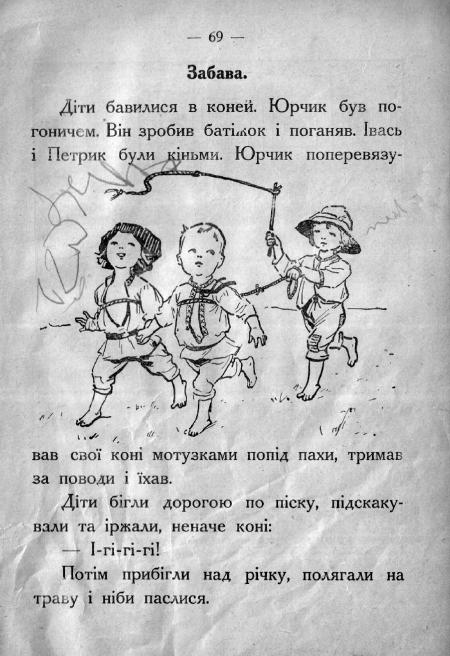
"Children in a team of small horses."
I'm not saying it is Ukrainian, it may be Russian and I'm too rusty to get it all. But there are characters one doesn't find in Russian. Sometimes, when I listen to Ukrainian, it's like listening to Russian as is listening to English being spoken in more rural southern areas of the U.S.
But the Ukrainians would never accept that.