



|
|
|

May 15, 2005
Me Two?
Hey, I think Classical Values is two years old today. (Yup, I just checked.) I was startled to realize that it's my blogiversary, and now that I've had a little time to think it over, well, I do feel very much like a two year old. I just thanked my blogfather Jeff Soyer, and I think it's high time I started acting my age. How should I celebrate? Should I celebrate? I mean, should I have a cake like the one my blogfather had last year? How might the stereotypical pagan goth look go over? Something like this, perhaps?  Hmmm.... I dunno. A big fire like that might be considered a bit precocious for a two year old. Furthermore, does the fact that birthdays are pagan mean that any celebration at all might be misinterpreted? I doubt it, and I think the above is an extreme position. The mainstream view is that whether they're pagan or not, birthdays, anniversaries and celebratory cakes are at once both classical and traditional. Historians know the Romans had them, and maybe the Greeks too: Some historians think that the custom of the birthday cake was observed in ancient Greece, and they report that the birthday cake began with the Greeks who used to make honey cakes or bread. Ancient Romans celebrated three different types of birthdays: Private celebrations among family and friends, the birthdays of cities and temples, and the birthdays of past and present emperors or members of the imperial family. The 50th year was celebrated with a honey cake made of wheat flour, grated cheese, honey, and olive oil.I do try to be as historically accurate as I can, but I wouldn't know how to track down such a cake. Another site speculates that it might have looked something like this: 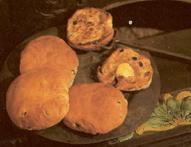 Not too dramatic, but it looks edible. I'm not sure about candles, although again, there's evidence of a classical tradition there too. Candles on birthday cakes have been around for some considerable time. Birthday celebrations were originally not celebrations at all, according to some; instead, people worried that they would be attacked by spirits on the anniversary of their birth, and so clustered with family and friends in order to keep safe. This quasi-religious aspect to a birthday "celebration" continued; we have birthday cakes because either the Greeks made round cakes to venerate Artemis, goddess of the moon, or because the Germans made a special bread (which might be called Geburtstagorten and might not) in the shape of the baby Jesus' swadding clothes. The candles were an extension of this; Gibbons stated in 1986 that the Greeks put candles on their round cakes to make them glow like the moon, hoping to gain Artemis' special favour. Alternatively, the candles were intended to carry the birthday wishes up to God (or the gods), along with the smoke.  But I haven't made my wishes yet! posted by Eric on 05.15.05 at 03:13 PM
TrackBack
TrackBack URL for this entry: http://classicalvalues.com/cgi-bin/pings.cgi/2335 Listed below are links to weblogs that reference Me Two?:
» Not So Terrible Two from The American Mind
Eric Scheie's Classical Values is a weblog I'm sad to admit I don't read enough. It's bad enough that it... [Read More] Tracked on May 16, 2005 12:41 AM
» Happy blogiversary from INCITE
Here's to two more years Eric! [Read More] Tracked on May 16, 2005 04:26 PM
Comments
And many more! Reading your blog is among my greatest delights. Aristomedes · May 16, 2005 01:01 AM Thanks for coming! Eric Scheie · May 16, 2005 11:35 PM Happy blogiversary! Steven Malcolm Anderson the Lesbian-worshipping man's-man-admiring myth-based egoist · May 23, 2005 06:11 AM |
|
December 2006
WORLD-WIDE CALENDAR
Search the Site
E-mail
Classics To Go
Archives
December 2006
November 2006 October 2006 September 2006 August 2006 July 2006 June 2006 May 2006 April 2006 March 2006 February 2006 January 2006 December 2005 November 2005 October 2005 September 2005 August 2005 July 2005 June 2005 May 2005 April 2005 March 2005 February 2005 January 2005 December 2004 November 2004 October 2004 September 2004 August 2004 July 2004 June 2004 May 2004 April 2004 March 2004 February 2004 January 2004 December 2003 November 2003 October 2003 September 2003 August 2003 July 2003 June 2003 May 2003 May 2002 See more archives here Old (Blogspot) archives
Recent Entries
• Laughing at the failure of discourse?
• Holiday Blogging • The right to be irrational? • I'm cool with the passion fashion • Climate change meltdown at the polls? • If you're wrong, then so is God? • Have a nice day, asshole! • Scarlet "R"? • Consuming power while empowering consumption • Shrinking is growth!
Links
Site Credits
|
|
Happy birthday!