



|
|
|

August 28, 2006
Half as wide?
In blogging, I've found that the best way to make a fool of myself is to write blog posts about things outside of my areas of familiarity or expertise. Hence my reluctance to get into extensive tactical or strategic analyses of the war against terrorism. That said, here I go anyway. I know next to nothing about aviation, but I've been wondering, with all the double and triple redundant controls which are supposed to govern these things, how on earth a plane could manage to find itself on the wrong runway, after spending 32 minutes in conversation with flight traffic control, just before the crash: ``The last communication was the takeoff clearance,'' said Laura Brown, a spokeswoman for the Federal Aviation Administration, which is participating in the inquiry along with the safety board and the Federal Bureau of Investigation. If the news reports are to be believed, the mistake should have been obvious to the pilot, because not only was the incorrect runway only half the length of the proper runway (which caused the crash), it's also said to be only half as wide: The width of the runways also is markedly different. The longer runway is 150 feet wide; the shorter one is 75 feet.These days, I'm disinclined to believe anything I read, so (via a thorough report from a Lexington blog), I found myself directed to a satellite map of the airport. Here's the relevant portion of the picture (the crash site is circled): 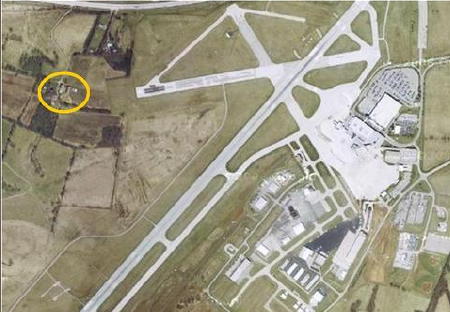 I might be missing something, but the shorter runway does not appear to be half the width of the longer runway. The two appear to be identical in width. In fact, if you go to the satellite map and zoom in, the shorter runway appears a hair wider. Reports also state that the larger runway had been repaved just a week before the crash, and I find myself wondering whether someone -- somewhere -- might be in a bit of a hurry to point the finger at the pilot, even though this is a shared responsibility. Then there's this recent report: Lexington's airport director says a repaving project a week before the fatal Comair crash altered the taxi route commercial planes take to get to the main runway, The Associated Press reports.I don't know much about aviation, but when what I can see with my naked eyes contradicts an important element of a news report, I wonder why. It strikes me that no pilot would want to be on the wrong runway, that pilots would tend to follow instructions issued by the local people on the ground, and that over a course of 32 minutes of conversation the normal assumption would be that they'd have gotten the correct information out to the pilot, and it would have been confirmed. So unless we assume reporters are simply making up facts here (possible but doubtful), who told the reporters that the shorter runway is half as wide as the wider runway if it isn't? (I hope they aren't the same people involved with local air traffic control.) UPDATE: Commenter Mark noticed that the runways are painted differently, with the shorter lane having a narrower lane painted in the middle. If runway width is defined by painted width and not actual width, that would explain the reports, although I don't know whether the paint in the center of the lane would indicate to the pilot that the lane is too short. Something about this incident makes no sense to me. I don't see how a pilot could have made such a horrendous error on his own. posted by Eric on 08.28.06 at 01:24 PM
Comments
Thanks. I see what you mean. I wonder whether the longer runways can also be painted that way, or whether something about that lane paint is supposed to indicate a shorter runway. Do pilots judge runway length by actual width, or by painted lines? If the definitions of runway width are determined by the painted area and not the pavement, then the news reports are probably right. Also the longer runway on closeup doesn't appear to me to have been recently repaved. I'm wondering how old the photos are. Eric Scheie · August 28, 2006 03:08 PM I dont quite understand how the painted lane width would even come into play in the crash. Aside from perhaps indicating to the pilot that hes on the wrong runway. Mick · August 28, 2006 04:40 PM I suspect the key is in the changed taxiways. If the pilot had flown out of that airport a few times, but not since the taxiway change, he might have heard "proceed to runway X" but not the "via taxiway Y", and since the taxiways had changed, could easily have taken the old route and ended up on the wrong runway. But then why didn't ground control see him on the wrong runway and call an abort? Jeff Medcalf · August 28, 2006 09:42 PM Some of the airports I've flown from have yellow signs at just about every runway-taxiway intersection, saying things like "A5" or "7Y". I've also seen huge letters and numbers painted onto the ends of runways. I can't say for sure that every airport has this sort of markings, but certainly they should. Does anyone know whether this airport had such markings? If so, then simply relaying to the tower every such sign a pilot passes could have prevented this sort of mistake. Raging Bee · August 29, 2006 11:01 AM According to the Bluegrass Airports' website, both runways are 150' wide. And just a note about the repaving not showing up on the google earth photos - the repaving was completed about 10 days ago, google earth's photo was taken months ago. This entire tragedy is so difficult to comprehend. Both pilots had flown in and out of Lexington 6-10 times in the last two years. They also both flew into Lexington the day before. So they landed on the 4-22 runway. They had to know which direction they were coming in from. There are only 2 runways at LEX 4-22 and 8-26. 4-22 has lights that were operating, and 8-26 had no lights. There are so many questions as to why the pilot lined the plane up on the 826, 40 degrees away from the correct direction. And why didn't the 1st officer notice the compass incongruities either? There's only one runway that both of them used flying in and out of LEX. Only one. What was distracting them to not notice they were on the wrong heading? I don't think that there was 32 minutes of conversation with the tower. I believe that it was reported that there was 32 minutes of voice recordings on the black box, not neccessarily with the tower, but chatter between the two pilots. At any rate, it's a horrible accident that appears to have happened by the tragically coicidal mistakes of 3 people. ATC, pilot and co-pilot. Marianne · August 30, 2006 03:18 PM According to today's news reports, the traffic controller had his back turned after giving takeoff clearance and was doing "admininistrative duties." http://www.philly.com/mld/inquirer/news/nation/15393128.htm The one who must be suffering the most is the copilot, who suffered massive trauma and may very well die. (Punctured lungs and a smashed pelvis.) Major body trauma can be an awful fate; I knew a man who was smashed between two cars who lingered for weeks, dying an agonizing death. Eric Scheie · August 30, 2006 04:26 PM Being a pilot (private) I was left with a few questions myself. When given clearance for a runway it is delivered as a line up and hold or cleared to takeoff. Either way you have to cross the threshold with large (and I mean large) numbers coresponding to the runway. This is in addition to a red sign at the taxiway intersection telling you the runway number. The threshold also has stripes that indicate the width of the runway. 4 stripes would be 75, 6 stripes 150, 8 stripes 200 ft. (I think) If the runway had just been repaved these marking would have been obscured and a GIANT yellow X would have marked the threshold until the appropriate information had been repainted. This is not always the case as I have flown into Casper with only the far side of the runway marked after a repave. In addition to pilot error you have the contoller that in my opinion should have monitored the aircraft's movement right up until the wheels left the ground. Just my two cents. Dana Dana · September 8, 2006 04:42 AM |
|
December 2006
WORLD-WIDE CALENDAR
Search the Site
E-mail
Classics To Go
Archives
December 2006
November 2006 October 2006 September 2006 August 2006 July 2006 June 2006 May 2006 April 2006 March 2006 February 2006 January 2006 December 2005 November 2005 October 2005 September 2005 August 2005 July 2005 June 2005 May 2005 April 2005 March 2005 February 2005 January 2005 December 2004 November 2004 October 2004 September 2004 August 2004 July 2004 June 2004 May 2004 April 2004 March 2004 February 2004 January 2004 December 2003 November 2003 October 2003 September 2003 August 2003 July 2003 June 2003 May 2003 May 2002 See more archives here Old (Blogspot) archives
Recent Entries
• Holiday Blogging
• The right to be irrational? • I'm cool with the passion fashion • Climate change meltdown at the polls? • If you're wrong, then so is God? • Have a nice day, asshole! • Scarlet "R"? • Consuming power while empowering consumption • Shrinking is growth! • My dirty thoughts
Links
Site Credits
|
|
Using Google Earth, I zoomed in on the runway. Yes, the actual surface of the runways are about the same width. But if you look at the painted takeoff lane on the runways, the shorter runway indeed has half as wide a painted takeoff lane as the long runway. The long runway's painted lane (with a large number 22 on it) takes up the entire width of the surface of the runway, whereas the short runway's painted lane (with a number 25 on it) only occupies the center portion of its surface. So a pilot sitting at the beginning of the short runway should indeed have noticed that the painted markings only provided half as wide a takeoff lane as on the long runway.