



|
|
|

August 10, 2004
Tolerance for blasphemy?
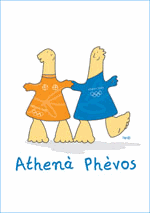
Is this anti-Pagan blasphemy? ATHENS — They are getting more bad press than the Olsen twins and worse reviews than the latest Spike Lee flick. Olympic mascots Phevos and Athena, siblings named for a pair of Greek deities, are catching an ungodly amount of abuse around Athens.This calls for an official investigation! Here's what the goofy pair looks like:
Here are some "action shots." And you can buy a pin here. Athena, it should be noted, was a war goddess, and I am not at all sure the cutesy cartoon does her justice. Here's a classical description: Athena is classically portrayed wearing full armor, carrying a lance and a shield with the head of the gorgon Medusa mounted on it. It is in this posture that she was depicted in Phidias's famous gold and ivory statue of her, now lost to history, in the Parthenon on the Athenian Acropolis. Athena is also often depicted with an owl (a symbol of wisdom) sitting on one of her shoulders.But hey! I'm not about to say the gods will be angered by any of this. Too many wars have been started that way. (Besides, as Glenn Reynolds astutely reminded the blogosphere in this classic post, Athena was smart!) I say, let the gods speak for themselves. posted by Eric on 08.10.04 at 11:15 AM
Comments
Forget Pikachu ... I think the Brothers Chaps oughta phone their lawyers about that image of Phevos in boxing gloves. Looks a bit like Strongbad to me ... Varius Contrarius · August 10, 2004 12:50 PM Profound. If I were a censor, I would ban such blasphemies against the Gods and the Goddesses. But I am not a censor and I had better not ever want to be, or else I will become the enemy I am fighting. Instead, I will only say: Hail to all the Gods and the Goddesses! May They bless you and yours eternally. Steven Malcolm Anderson (Cato the Elder) the Lesbian-worshipping gun-loving selfish aesthete · August 10, 2004 01:19 PM Athena is not Minoan, she is Lybian. Patty · August 10, 2004 02:33 PM Libyan Athena? Yikes ... let's be careful about listening to Martin Bernal, a man with an agenda if ever there was one. Athena has at least as much claim to being a native goddess as any. Let's not forget that for the Greeks Libya was hardly a real place but rather part of that mystical outer world where myth happens. There are a hundred conflicting accounts about every god and ever hero snaking through classical literature, scholia, and late collections (like the all-too-honored Library of pseudo-Apollodorus). I'd just like someone to show me the Libyan or Egyptian sources. (And footnotes in Robert Graves don't count. I can't make things up too.) The fact is that in the work that tries to make the links the evidence is non-existent, and authors tend to resort to weak linguistic games that wouldn't fool an undergraduate. In his portion of Anaximander in Context Gerard Naddaf touches upon what appears to be the late propagandistic nature of claims for the Egyptian origin of Greek religion and myth (if I recall it's in the section on the Danaus complex of myths, which appear to have had a Boeotian origin). It's worth a read. Varius Contrarius · August 10, 2004 04:49 PM They look like little archaic Rall creatures. And that's not good. J. Case · August 13, 2004 10:23 PM |
|
December 2006
WORLD-WIDE CALENDAR
Search the Site
E-mail
Classics To Go
Archives
December 2006
November 2006 October 2006 September 2006 August 2006 July 2006 June 2006 May 2006 April 2006 March 2006 February 2006 January 2006 December 2005 November 2005 October 2005 September 2005 August 2005 July 2005 June 2005 May 2005 April 2005 March 2005 February 2005 January 2005 December 2004 November 2004 October 2004 September 2004 August 2004 July 2004 June 2004 May 2004 April 2004 March 2004 February 2004 January 2004 December 2003 November 2003 October 2003 September 2003 August 2003 July 2003 June 2003 May 2003 May 2002 See more archives here Old (Blogspot) archives
Recent Entries
• Laughing at the failure of discourse?
• Holiday Blogging • The right to be irrational? • I'm cool with the passion fashion • Climate change meltdown at the polls? • If you're wrong, then so is God? • Have a nice day, asshole! • Scarlet "R"? • Consuming power while empowering consumption • Shrinking is growth!
Links
Site Credits
|
|
I'd file these mascots under "U," for "U gotta be kidding!"
Where's Pikachu when we need him?